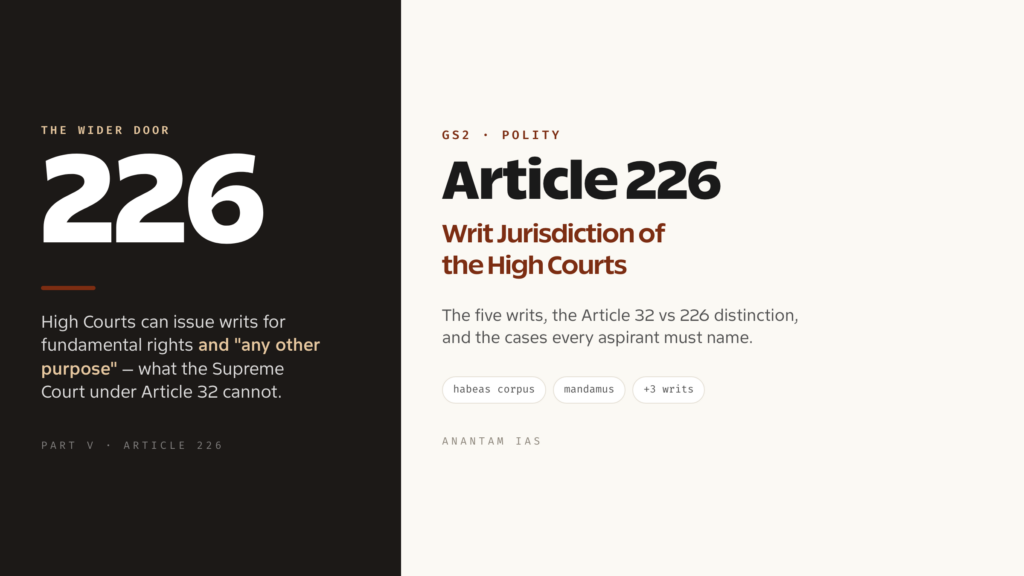
Most aspirants can rattle off that Article 32 is the “heart and soul” of the Constitution and then go blank when asked why anyone bothers filing a writ in a High Court at all. The short answer is that Article 226 is the wider door. It lets a High Court issue a writ not just to protect your fundamental rights, but for “any other purpose,” which the Supreme Court under Article 32 cannot do.
That single phrase, “any other purpose,” is why most real litigation in India, from a wrongly cancelled tender to an illegal transfer order, starts in a High Court and not the Supreme Court. For GS2 this is core judiciary territory, and it is one of the few topics where Prelims wants the exact text and Mains wants the comparison. Get the Article 32 versus Article 226 distinction right and you have unlocked half the judicial-review syllabus.
India currently has 25 High Courts, and every one of them draws its writ jurisdiction from Article 226 — so this single article is the source of writ power for all of them (for the full list and jurisdictions, see how many High Courts are there in India).
What Article 226 Actually Says
Article 226 gives every High Court the power to issue directions, orders, or writs to any person, authority, or government within its territory, both for the enforcement of fundamental rights and for “any other purpose.” That last clause is the whole point, and it is where students stop reading too soon.
The exact text matters because Prelims has asked about it. Clause (1) opens with “Notwithstanding anything in Article 32,” which means the High Court’s power exists independently of the Supreme Court’s, and then lists the same five writs: habeas corpus, mandamus, prohibition, quo warranto, and certiorari. The phrase “for the enforcement of any of the rights conferred by Part III and for any other purpose” is the engine. Part III is your fundamental rights. “Any other purpose” reaches everything else a court can lawfully correct, which means ordinary legal rights, statutory violations, and breaches of public duty.
Here is the part the lists skip. Article 226 sits in Part V of the Constitution along with the rest of the High Court provisions, not in Part III with the fundamental rights themselves. So the right to move a High Court under Article 226 is a constitutional right, but it is not itself a fundamental right. That is the opposite of Article 32, and it is the single most tested distinction in this topic.
The “Any Other Purpose” Clause Is the Game-Changer
Think of it this way. If a municipal corporation cancels your trade licence in violation of its own rules, no fundamental right is obviously breached, so the Supreme Court’s Article 32 door may be shut. But a High Court can still step in under “any other purpose,” because a public authority has failed a legal duty. That is why the vast majority of writ petitions in India, on service matters, tax, tenders, land acquisition, and licensing, are filed under Article 226.
Territorial Jurisdiction and the Cause-of-Action Rule
A High Court’s writ power runs only “throughout the territories in relation to which it exercises jurisdiction.” So the Allahabad High Court cannot ordinarily issue a writ to an authority sitting in Chennai. Clause 226(2) softens this. It says a High Court can also act if the cause of action, wholly or in part, arises within its territory, even if the office or person sued sits elsewhere. So if a Delhi-headquartered authority passes an order that takes effect against you in Lucknow, part of the cause of action arose in Uttar Pradesh, and the Allahabad High Court may hear it. This cause-of-action clause is a favourite for tricky Prelims options.
The Five Writs, Explained Plainly
The five writs are five different remedies for five different wrongs, and the trick is to remember them by what they do, not by their Latin. Each one is a specific instruction a court issues to fix a specific kind of failure by the State or a public body.
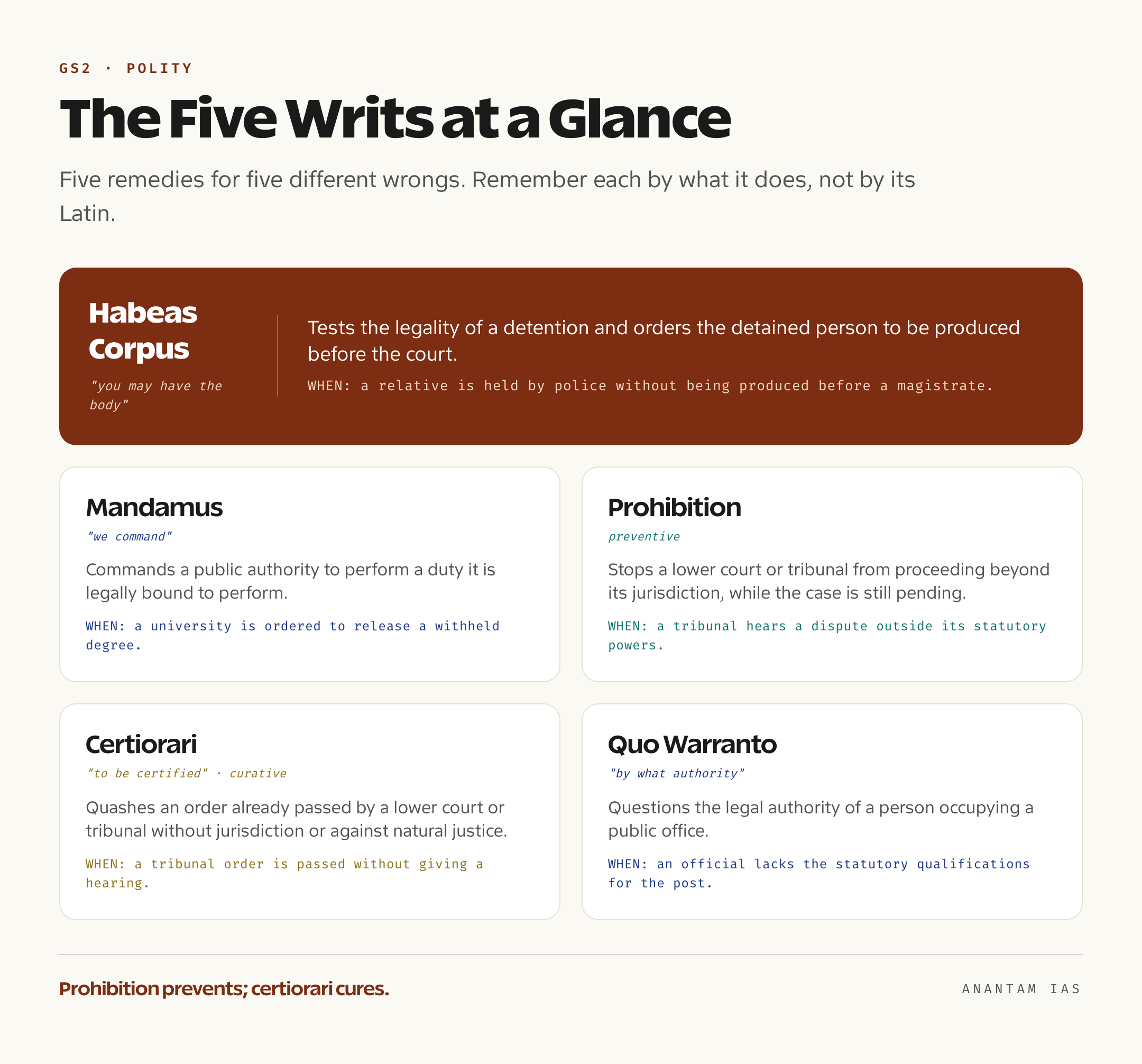
Latin names intimidate people, so translate each one the moment you meet it. Habeas corpus literally means “you may have the body,” and it forces whoever is detaining a person to produce them before the court and justify the detention. Mandamus means “we command,” and it orders a public authority to do the legal duty it is refusing to do. Prohibition stops a lower court or tribunal from carrying on with a case it has no power to hear, before it finishes. Certiorari means “to be certified,” and it quashes an order a lower court or tribunal has already passed without jurisdiction or in breach of natural justice. Quo warranto means “by what authority,” and it asks a person holding a public office to show the legal basis for holding it.
The table below lays out each writ with a one-line example so you can fix the meaning to a real situation. If you are still shaky on how these connect to the rights they protect, the explainer on fundamental rights and articles is the natural companion read, and how many fundamental rights are there in the Indian Constitution maps the Part III landscape these writs defend.
| Writ | What it does | One-line example |
|---|---|---|
| Habeas corpus | Tests the legality of a detention and orders the person to be produced | A family files it when a relative is held by police without being produced before a magistrate |
| Mandamus | Commands a public authority to perform a duty it is legally bound to perform | A court orders a university to release a withheld degree it has no reason to hold back |
| Prohibition | Stops a lower court or tribunal from proceeding beyond its jurisdiction, while the case is still pending | A High Court halts a tribunal from hearing a dispute outside its statutory powers |
| Certiorari | Quashes an order already passed by a lower court or tribunal without jurisdiction or against natural justice | A High Court cancels a tribunal order passed without giving the affected party a hearing |
| Quo warranto | Questions the legal authority of a person occupying a public office | A citizen challenges the appointment of an official who does not meet the statutory qualifications |
A clean way to remember the pair that trips everyone up: prohibition is preventive and certiorari is curative. Prohibition stops a case before the wrong order is passed; certiorari cleans up after it. Both target courts and tribunals, not private individuals.
Each writ has its own dedicated explainer if you want to drill deeper: the writ of mandamus, the writ of certiorari, the writ of prohibition, the writ of quo warranto, and the writ of habeas corpus.
Article 32 vs Article 226: The Distinction Examiners Love
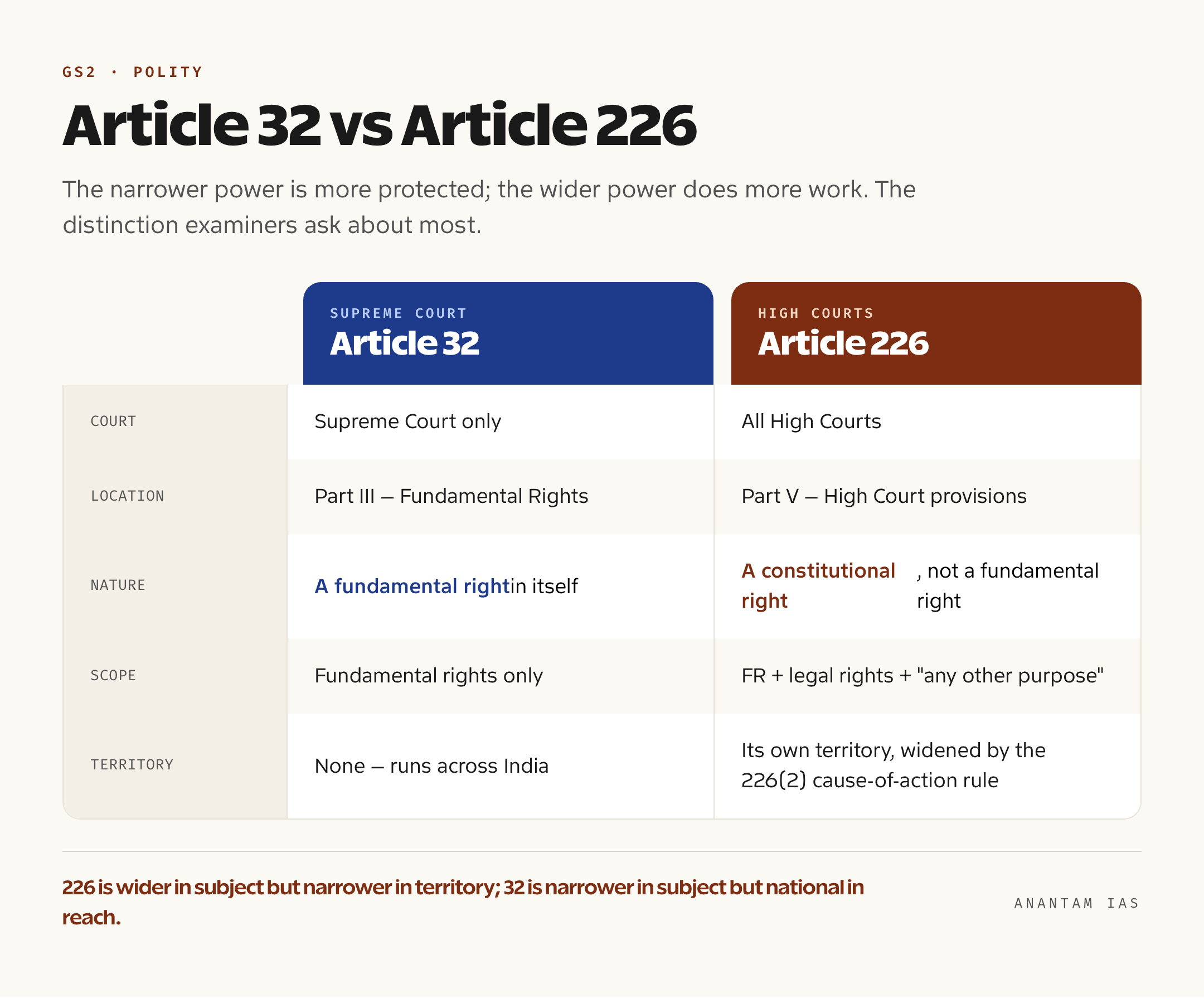
The core difference is scope. Article 32 belongs to the Supreme Court and works only for fundamental rights, and the right to approach the Court is itself a fundamental right. Article 226 belongs to the High Courts and is wider, covering fundamental rights plus ordinary legal rights plus “any other purpose,” but it is a constitutional right, not a fundamental right. If you remember nothing else, remember this asymmetry.
Dr B. R. Ambedkar called Article 32 the “heart and soul” of the Constitution precisely because the remedy to enforce a fundamental right is built into the right itself, so Parliament cannot easily take it away. Article 226 is not protected the same way because it is not in Part III. And yet, in practical terms, Article 226 is the busier and broader power, which is the paradox students miss. The narrower power is more protected; the wider power does more work. For the constitutional logic behind why some rights and remedies are harder to amend than others, the basic structure doctrine is essential background.
The table below is the version worth memorising for Mains and double-checking for Prelims.
| Feature | Article 32 | Article 226 |
|---|---|---|
| Which court | Supreme Court only | All High Courts |
| Part of Constitution | Part III (Fundamental Rights) | Part V (the Union Judiciary chapter, High Court provisions) |
| Nature of the right | A fundamental right in itself | A constitutional right, not a fundamental right |
| Scope | Enforcement of fundamental rights only | Fundamental rights, legal rights, and “any other purpose” |
| Territorial limit | None; runs across India | Limited to the High Court’s territory, widened by the cause-of-action rule in 226(2) |
| Can it be suspended? | Can be suspended during a National Emergency (subject to Article 359) | Stands on a different footing; not suspended in the same automatic way |
| Discretion to refuse | Narrower, since enforcing a fundamental right is a guaranteed remedy | Wider discretion; can be declined for laches, alternative remedy, or disputed facts |
One nuance worth carrying into the exam. Article 226 is wider in subject matter but narrower in territory, while Article 32 is narrower in subject matter but national in reach. That trade-off is the whole comparison in one sentence.
Landmark Cases You Must Know
A handful of judgments turned Article 226 from a clause into a living remedy, and the examiner expects you to name the case with the principle, not just the principle alone. Three matter most.
The biggest is L. Chandra Kumar v. Union of India (1997). The Supreme Court held that the power of judicial review vested in the High Courts under Articles 226 and 227, and in the Supreme Court under Article 32, is part of the basic structure of the Constitution. The case arose from challenges to tribunals set up under Articles 323A and 323B, which had tried to oust the High Courts. The Court upheld the tribunals but ruled that their decisions must remain subject to the writ jurisdiction of the High Courts, so judicial review could not be excluded. This is the case to cite whenever a question touches tribunals, judicial review, or attempts to bypass the High Courts.
Next, Bandhua Mukti Morcha v. Union of India (1984) shows how writ jurisdiction widened through Public Interest Litigation. The Court treated a letter highlighting the plight of bonded labourers in Faridabad stone quarries as a writ petition, relaxed the old rule of locus standi (who is allowed to file), and let public-spirited persons approach the court on behalf of those who could not. Although that case ran under Article 32, the same liberalised standing applies to Article 226, which is why so much social-justice litigation now begins in the High Courts. The full story of how standing loosened is in the explainer on public interest litigation in India.
The PIL revolution as a whole, led by Justices P. N. Bhagwati and V. R. Krishna Iyer from the late 1970s, redefined who could knock on the writ door. Before it, only the person directly injured could file. After it, a concerned citizen or organisation could, which is what makes Article 226 a tool for the voiceless and not just for the litigant with deep pockets. For the larger contest between courts and the political branches that this expansion fed into, see judiciary vs executive and the separation of powers.
When High Courts Refuse to Use Article 226
Article 226 is a discretionary power, which means a High Court can decline to hear a writ petition even when it technically has jurisdiction. This surprises aspirants who assume a writ is an automatic right. It is not, and the reasons a court says no are themselves a regular exam theme.
Three grounds come up again and again. First, the alternative remedy rule: if the law already gives you an appeal or a statutory remedy, the court will usually tell you to use that first, especially in tax and service matters. Second, the doctrine of laches, which is just the legal word for unreasonable delay; if you sat on your rights for years, the court may refuse relief, because writ jurisdiction rewards the vigilant, not the sleeping. Third, disputed questions of fact: writ proceedings are summary and rely on affidavits, so if a case needs detailed evidence and witnesses, the court sends it to a regular civil suit instead.
These are not loopholes. They are filters that stop the High Courts from drowning, and they are why a strong writ petition leads with why no alternative remedy is adequate.
Article 226 vs Article 227: A Quick but Important Distinction
People confuse 226 and 227 because they sit next to each other and both involve High Courts supervising lower bodies. The difference is the nature of the power. Article 226 is the writ jurisdiction, where the High Court issues a remedy on a petition by an aggrieved party. Article 227 is the power of superintendence, an administrative and judicial control the High Court has over all courts and tribunals beneath it within its territory, which it can even exercise on its own motion. Put simply, 226 corrects a specific wrong when someone asks; 227 keeps the whole subordinate judiciary in line whether or not anyone asks.
How to Study This for UPSC
Treat Article 226 as a two-front topic, because Prelims and Mains want different things, and mixing them up wastes revision time. Prelims wants precision: the exact location of the article, the five writs, the cause-of-action clause, and the 32-versus-226 differences. Mains wants the argument: judicial review as basic structure, the PIL expansion, and the balance between access to justice and overburdened courts.
Read in this order. Start with the bare text of Article 226 from the official Constitution, then learn the five writs cold using the table above. Next, lock down the Article 32 versus Article 226 comparison, because it is the highest-yield single block in this topic. Then add the three cases, L. Chandra Kumar first. For the foundation, M. Laxmikanth’s Indian Polity chapter on the writ jurisdiction is enough; do not chase law-school casebooks, which give far more detail than the exam needs. Anchor the whole topic in the broader Indian polity notes so it connects to fundamental rights, the judiciary, and the basic structure rather than floating alone.
What to skip: the deep procedural law of how a writ petition is actually drafted and the long line of service-law judgments. Those are for litigators, not for GS2. What never to skip: the “any other purpose” clause and the fact that Article 226 is a constitutional, not fundamental, right. Those two points decide more marks than anything else here. If habeas corpus and personal liberty still feel abstract, the piece on personal liberty under Article 21 shows the writ in its most human form.
Frequently Asked Questions
Is Article 226 a fundamental right? No. Article 226 is a constitutional right that lets you approach a High Court for a writ, but it sits in Part V of the Constitution, not in Part III with the fundamental rights. This is the opposite of Article 32, which is itself a fundamental right. The distinction is one of the most frequently tested points on this topic.
What is the main difference between Article 32 and Article 226? Article 32 belongs only to the Supreme Court and works only for the enforcement of fundamental rights. Article 226 belongs to all High Courts and is wider, covering fundamental rights, ordinary legal rights, and “any other purpose.” Article 32 has national reach; Article 226 is limited to the High Court’s territory, widened by the cause-of-action rule.
What are the five writs under Article 226? Habeas corpus, mandamus, prohibition, certiorari, and quo warranto. They protect personal liberty, compel public duties, stop or quash actions of lower courts and tribunals that exceed jurisdiction, and question the authority of a person holding a public office.
Can a High Court refuse to hear a writ petition under Article 226? Yes. Article 226 is discretionary. A High Court may decline relief if an adequate alternative remedy exists, if the petitioner has delayed unreasonably (the doctrine of laches), or if the case turns on disputed questions of fact better suited to a civil suit.
What did L. Chandra Kumar v. Union of India (1997) decide? The Supreme Court held that judicial review under Articles 226 and 227 by the High Courts, and Article 32 by the Supreme Court, is part of the basic structure of the Constitution. Tribunals set up under Articles 323A and 323B are valid, but their decisions remain subject to the writ jurisdiction of the High Courts and cannot oust judicial review.
Practice Questions
Prelims MCQs
- With reference to Article 226 of the Constitution of India, consider the writ jurisdiction of High Courts. Which of the following statements is correct? (a) Article 226 can be invoked only for the enforcement of fundamental rights (b) Article 226 is a fundamental right under Part III (c) Article 226 allows writs for fundamental rights and “any other purpose” (d) Article 226 has no territorial limitation whatsoever. Answer: (c) Article 226 permits writs both for Part III rights and for “any other purpose,” making it wider than Article 32.
- The “cause of action” clause that widens a High Court’s territorial writ jurisdiction is found in: (a) Article 226(1) (b) Article 226(2) (c) Article 227 (d) Article 32(2). Answer: (b) Clause 226(2) lets a High Court act where the cause of action wholly or partly arises, even if the authority sits elsewhere.
- Which writ is preventive in nature, stopping a tribunal from proceeding beyond its jurisdiction before it passes a final order? (a) Certiorari (b) Mandamus (c) Prohibition (d) Quo warranto. Answer: (c) Prohibition is preventive and is issued while a case is pending; certiorari is curative and quashes an order already passed.
- In L. Chandra Kumar v. Union of India (1997), the Supreme Court held that: (a) tribunals can completely replace High Courts (b) judicial review under Articles 32 and 226 is part of the basic structure (c) Article 226 is a fundamental right (d) High Courts cannot review tribunal decisions. Answer: (b) The Court ruled judicial review by the higher judiciary is part of the basic structure and tribunal decisions stay subject to High Court writ jurisdiction.
- Which of the following correctly distinguishes Article 226 from Article 227? (a) Both can be exercised only on a petition by an aggrieved party (b) Article 226 is the power of superintendence; Article 227 is the writ jurisdiction (c) Article 227 is the power of superintendence and can be exercised suo motu, while Article 226 is the writ jurisdiction (d) Article 227 applies only to fundamental rights. Answer: (c) Article 227 is the High Court’s power of superintendence over subordinate courts and tribunals, exercisable on its own motion; Article 226 is the writ remedy on a petition.
Mains Practice Questions
- “Article 226 is wider than Article 32, yet Article 32 is the more protected remedy.” Examine this paradox with reference to the scope and constitutional status of the two articles. (15 marks, 250 words)
- Discuss how the doctrine of judicial review under Articles 226 and 227 was elevated to part of the basic structure, with reference to L. Chandra Kumar v. Union of India (1997). (15 marks, 250 words)
- The writ jurisdiction of High Courts is a discretionary power. Critically analyse the grounds on which High Courts decline to entertain petitions under Article 226. (10 marks, 150 words)
- Explain the five writs available under Article 226 and assess how Public Interest Litigation expanded access to writ remedies in India. (15 marks, 250 words)
- “The cause-of-action clause in Article 226(2) balances territorial limits with access to justice.” Discuss the significance of this provision for litigants. (10 marks, 150 words)
If you walk away with one thing, let it be the asymmetry: Article 32 is narrower but constitutionally bullet-proof, while Article 226 is broader and does most of the day-to-day work of holding the State to account. Aspirants who internalise that stop treating writs as a vocabulary drill and start seeing them as the citizen’s actual lever against arbitrary power, which is exactly the framing that turns a six-mark answer into a twelve-mark one.
Tell Google you want more of this.
Add Anantam IAS as a preferred sourceOne tap, and this site shows up more often in your own Top Stories, AI Overviews and AI Mode. Remove it any time.