First-ever Bat Conservation Assessment
Why in News?
The first-ever State of India’s Bats Report (2024-25) was recently released by Nature Conservation Foundation, Bat Conservation International, World Wide Fund for Nature (WWF), and Centre For Wildlife Studies.
| UPSC Relevance: GS-3 Environment and Biodiversity: Species in News Prelims: Key facts about Bats; Important species & their ecological role. |
Key Findings of the Assessment:
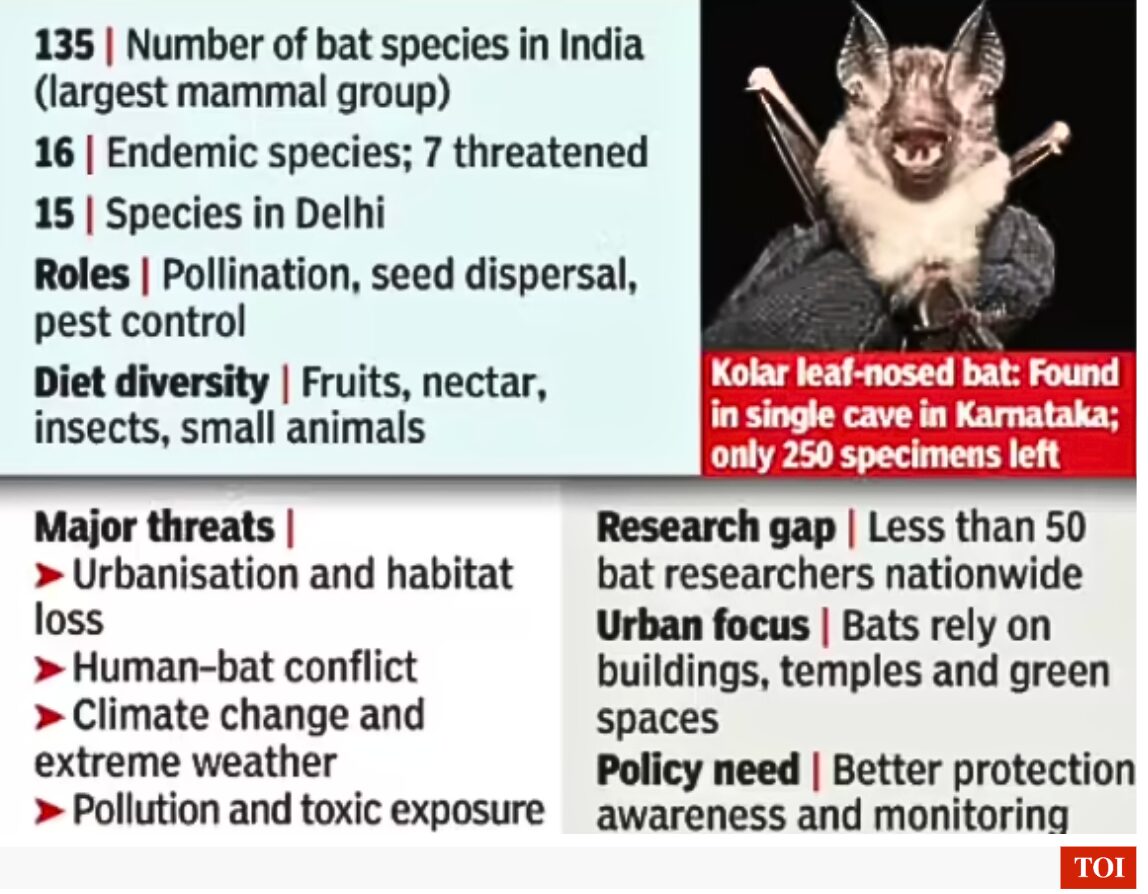
- Species Diversity and Endemism: India is home to at least 135 bat species, of which 16 are endemic (found only in India). This makes bats India’s most diverse mammal group.
- High Risk and Decline: The report highlights significant risks in the Northeast region, notably Assam, where Indian flying fox colonies are losing roosts.
- Major Threats: Rapid urbanisation, loss of habitat, deforestation, mining and climate change. Increasing human-bat conflict.
- Data Deficit: There is a significant data gap, particularly for the Khasian Leaf-nosed bat, which faces high threats from mining and persecution.
The report calls for urgent research into bat ecology, disease risks, and habitat protection.
Key Facts about Bats:
- Bats are the only mammals capable of true powered flight (distinct from gliding mammals like flying squirrels).
- The second largest order of mammals after rodents (~1,400+ species globally).
- Behaviour & Adaptations:
- Mostly nocturnal, though some species are crepuscular (only active during morning and evening hours) and even diurnal.
- Many bats undergo Hibernation (cold regions).
- Echolocation: Many bats use Echolocation:
- Emit ultrasonic sounds (inaudible to humans). Detect prey via returning echoes.
- Most fruit bats do NOT echolocate; they rely on vision and smell.
- Found on all continents except Antarctica. Only 3 species of vampire bats exist. All are found in Central & South America. Feed mainly on livestock (cattle, horses).
- Bats are reservoirs for some viruses (e.g., Nipah, Ebola). Human attacks are rare, but they can transmit diseases like rabies.
Ecological Role of Bats:
- Insect Control: Insectivorous bats consume huge quantities of insects, including agricultural pests. Significant for natural pest control.
- Pollination & Seed Dispersal: Frugivorous and nectar-feeding bats pollinate plants and disperse seeds. Known as a “keystone species” in many ecosystems.
- Guano (Bat Droppings) are rich in nitrogen, phosphorus, and potassium. Used as an organic fertiliser.
Important Bat Species:
- Indian Flying Foxes are the largest bats, some attaining a wingspan of 1.5 metres (5 feet) with a head and body length of about 40 cm.
- Formerly, the Indian Flying Fox was listed under Schedule V of the Wildlife (Protection) Act, 1972, considered “vermin,” allowing its hunting. Post 2022, it is protected under Schedule II of the WPA 1972. Flying foxes have gone from ‘least concern’ to ‘near threatened.’
- It is also called the Great Indian Fruit Bat as it eats fruits.
UPSC PYQ 2024:
Q. With reference to the Indian Flying Fox, consider the following statements:
1. The Indian Flying Fox is placed under the “vermin” category in the Wildlife (Protection) Act, 1972.
2. The Indian Flying Fox feeds on the blood of other animals.
Which of the statements given above is/are correct?
(a) Both Statement I and Statement II are correct, and Statement II explains Statement I
(b) Both Statement I and Statement II are correct, but Statement II does not explain Statement I
(c) Statement I is correct, but Statement II is incorrect
(d) Statement I is incorrect, but Statement II is correct
(This question was cancelled by UPSC as both the statements I & II are incorrect)
Correct Answer: Both statements I & II are incorrect.
UPSC PYQ 2014:
Q. Consider the following:
1. Bats
2. Bears
3. Rodents
The phenomenon of hibernation can be observed in which of the above kinds of animals?
(a) 1 and 2 only
(b) 2 only
(c) 1, 2 and 3
(d) Hibernation cannot be observed in any of the above
Answer: (c)