Govt. exempts Customs Duty for 40 petrochemical products
Why in News?
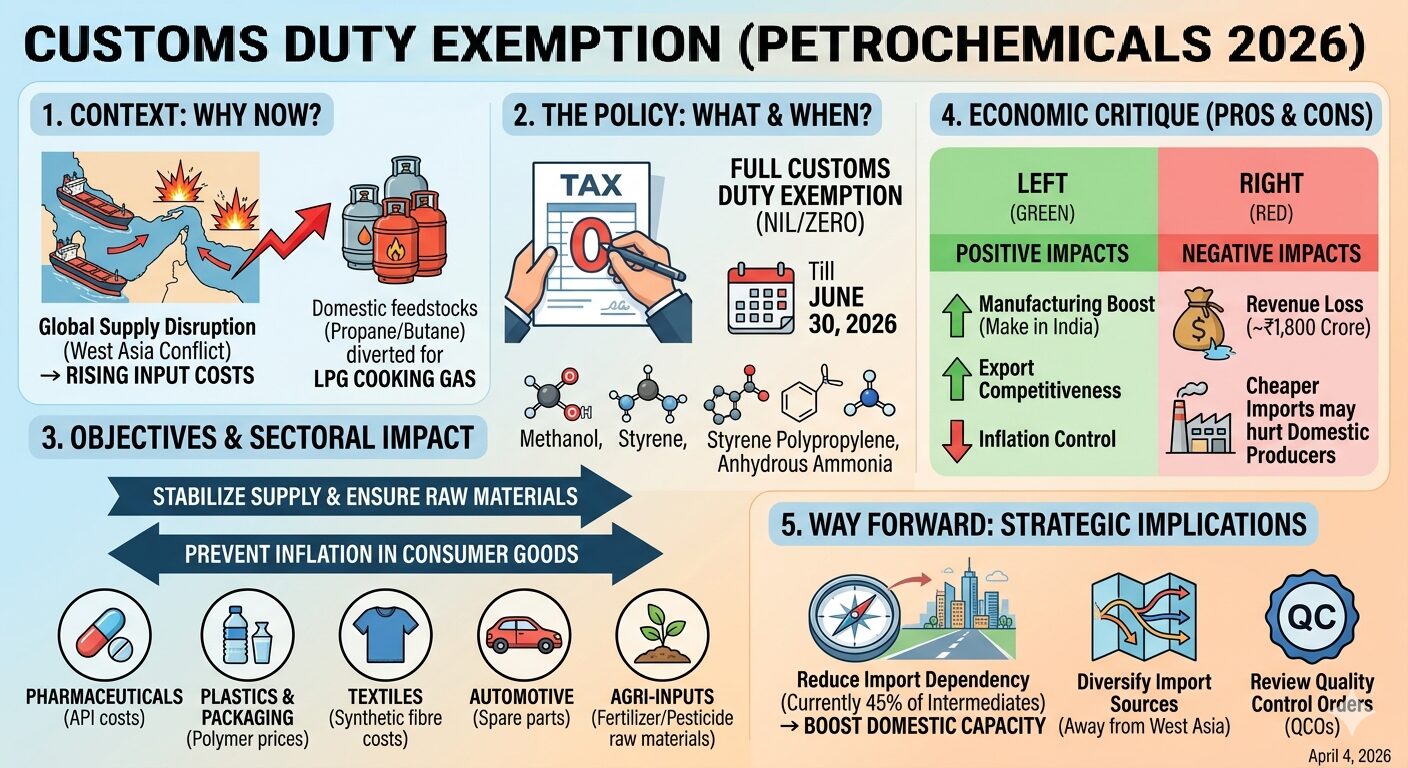
- Government of India granted full customs duty exemption on around 40 critical petrochemical products till June 30, 2026.
- The decision was taken due to global supply disruptions caused by the West Asia (Iran) conflict.
UPSC Relevance
Prelims: Customs duty, petrochemicals, LPG, feedstocks
GS-III: Economy- Inflation management, Supply chain resilience, Energy security, Industrial policy
What are Petrochemicals?
- Petrochemicals are chemical products derived from petroleum or natural gas.
Types
- Basic Petrochemicals → Ethylene, Propylene, Butadiene
- Intermediates → Methanol, Styrene, Vinyl Chloride
- End Products → Plastics, synthetic fibres, rubber
Key Feedstocks
- Naphtha
- Natural Gas
- LPG (Propane, Butane)
What is Customs Duty?
- Customs duty is a tax imposed on imports and exports.
- Objectives:
- Protect domestic industries
- Generate revenue
- Regulate trade
When Customs Duty reduced to zero (nil) → imports become cheaper.
Key Features of the Policy
Scope
- Around 40 petrochemical products exempted till June 30, 2026
- Examples:
- Methanol, Toluene, Styrene, Polypropylene, PVC, Anhydrous ammonia
Nature of Policy
- Short-term, targeted relief measure
- Aimed at stabilizing supply and reducing costs
Why was this Decision Taken?
1. Global Supply Disruptions
- Conflict in West Asia disrupted oil & petrochemical supply chains.
- Key routes like Strait of Hormuz affected → rising prices.
2. Domestic Diversion to LPG
- India diverted petrochemical feedstocks (propane, butane) to produce LPG for cooking.
- This reduced availability for industrial use.
3. Rising Input Costs
- Industries faced:
- Shortage of raw materials
- Increased production costs
4. Inflationary Pressure
- Petrochemicals are used in:
- Plastics
- Medicines
- Textiles
Cost increase leads to inflation in daily-use goods.
What are the Objectives of the Policy?
- Ensure continuous availability of raw materials
- Reduce cost pressure on industries
- Stabilize supply chains
- Prevent inflation in consumer goods
- Support export competitiveness
What Sectors Benefited from this decision?
- Pharmaceuticals: Duty relief on key solvents and chemicals used in the manufacturing of Active Pharmaceutical Ingredients (APIs) and formulations will help curb price escalations and ensure the availability of affordable medicines.
- Plastics & Packaging: With almost 25% of raw materials for the plastic industry being imported, the 8.5% duty exemption on polymers is crucial. Raw material prices had surged by 65% post-conflict, so this relief aims to stabilize the sector.
- Textiles: The synthetic fibre industry, which relies on PTA and MEG, faced a 43% price surge. The waiver will help stabilize input costs and maintain export competitiveness.
- Automotive & Consumer Goods: Lower input costs for plastics, polymers, and other components will help contain cost pressures, reduce disruption risks, and ensure a steady supply of spare parts.
Economic Impact
Positive Impacts
1. Lower Input Costs: Cheaper imports reduce production costs.
2. Boost to Manufacturing: Helps Make in India by ensuring raw material supply.
3. Inflation Control: Prices of goods like plastics, medicines may reduce.
4. Export Competitiveness: Lower costs → better global competitiveness.
Negative Impacts
1. Revenue Loss: Estimated loss: ~₹1,800 crore.
2. Impact on Domestic Producers: Cheaper imports may hurt local petrochemical industries.
3. Temporary Nature: Does not solve structural issues in supply chains.
Way Forward & Strategic Implications
- Short-Term Fix, Not a Long-Term Solution: This is a temporary measure to manage an acute crisis. Sustaining this would lead to significant revenue loss and undermine domestic industry.
- Reducing Import Dependency: India imports about 45% of its petrochemical intermediates. The crisis highlights the urgent need to boost domestic capacity.
- Aatmanirbharta: Move from being a “Refining Hub” to a “Petrochemical Hub” to reduce import dependency.
- Strategic Reserves: Similar to Strategic Petroleum Reserves (SPR), India needs a buffer for critical chemical feedstocks.
- Diversification of Import Sources: The government needs to explore alternative supply chains to reduce over-reliance on any single volatile region. Reducing reliance on the volatile Strait of Hormuz by exploring Central Asian or American suppliers.
- Long-Term Vision: The Ministry of Chemicals and Fertilizers has discussed creating a robust, holistic plan for the sector’s growth. This includes reviewing Quality Control Orders (QCOs) and promoting investment in domestic production capacity
Practice Questions
Q. Consider the following statements:
- Petrochemicals are derived from petroleum and natural gas.
- Customs duty exemption increases cost of imports.
- Petrochemicals are used in pharmaceuticals and textiles.
Which are correct?
(a) 1 and 3
(b) 2 and 3
(c) 1 and 2
(d) 1, 2 and 3
Answer: (a)
Mains Questions
Q1. Discuss the role of customs duty as a tool of economic policy. Examine the recent exemption on petrochemical products. (250 words)
Q2. “Global geopolitical conflicts expose supply chain vulnerabilities in India.” Analyse with reference to petrochemical sector. (250 words)