GRAP and AQI

Context:
For the first time in four months, Delhi’s air quality has deteriorated to the ‘Poor’ category.
According to the Central Pollution Control Board (CPCB), the city’s Air Quality Index (AQI) reached 221, prompting authorities to activate Stage-1 of the Graded Response Action Plan (GRAP).
UPSC Relevance:
Environmental Pollution and Govt. Steps to control pollution, AQI, GRAP etc.
UPSC PYQ:
In the cities of our country, which among the following atmospheric gases are normally considered in calculating the value of the Air Quality Index? (2016)
- Carbon dioxide
- Carbon monoxide
- Nitrogen dioxide
- Sulphur dioxide
- Methane
Select the correct answer using the code given below:
(a) 1, 2 and 3 only
(b) 2, 3 and 4 only
(c) 1, 4 and 5 only
(d) 1, 2, 3, 4 and 5
About Graded Response Action Plan(GRAP):
- Commission for Air Quality Management in NCR and Adjoining Areas (CAQM) revises the GRAP schedule to further strengthen the measures to particularly combat the generally adverse air quality scenario in winter months in Delhi-NCR.
- It collaborates with the Ministry of Environment, Forest and Climate Change (MoEFCC)
GRAP is an emergency response mechanism for entire NCR, based on Average AQI levels in Delhi that brings together multiple stakeholders, implementing agencies and authorities to respond to situations of deteriorating air quality in Delhi-NCR. GRAP for NCR has been formulated after careful consideration of scientific data, stakeholder inputs, expert recommendations along with field experience and learnings in the past years.
Different stages of GRAP: GRAP consists of four stages, each with targeted actions to be taken by the necessary authorities and agencies.
These are the following:
Stage I: “Poor” air quality (Delhi AQI: 201-300)
Stage II: “Very Poor” air quality (Delhi AQI: 301-400)
Stage III: “Severe” air quality (Delhi AQI: 401-450)
Stage IV: “Severe+” air quality (Delhi AQI > 450)
Air Quality Index (AQI):
What is AQI:
- Air Quality Index is a tool for effective communication of air quality status to people in terms, which are easy to understand. It transforms complex air quality data of various pollutants into a single number (index value), nomenclature and colour.
AQI categories:
- Good
- Satisfactory
- Moderately polluted
- Poor
- Very Poor
- Severe
Eight pollutants:
- PM10
- PM2.5
- NO2
- SO2
- CO
- O3
- NH3
- Pb
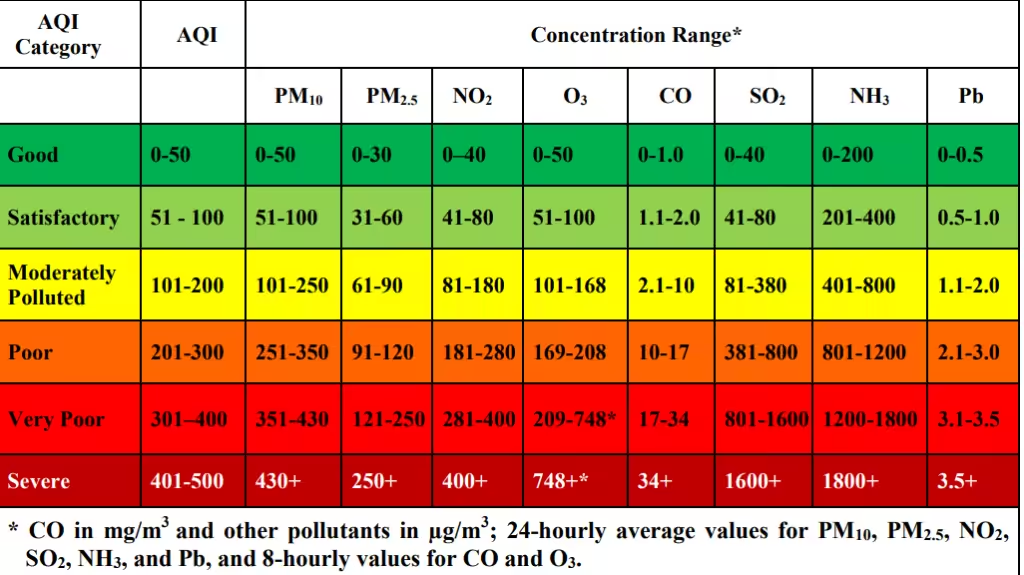
How is AQI calculated?
- The Sub-indices for individual pollutants at a monitoring location are calculated using its 24-hourly average concentration value (8-hourly in case of CO and O3) and health breakpoint concentration range.