Great Nicobar Project: Coral Translocation and the Development-vs-Ecology Debate
Why in News?
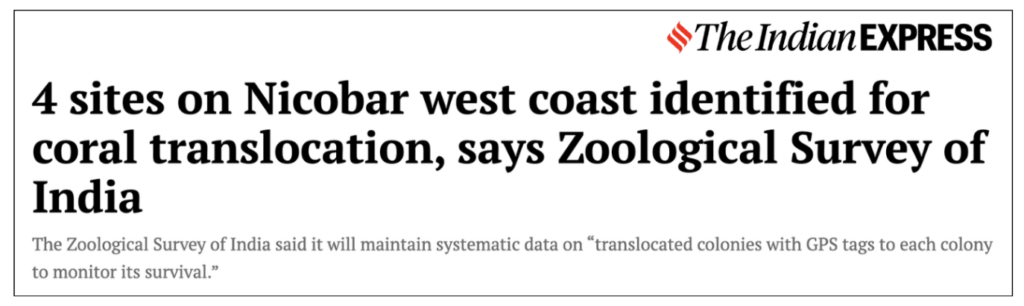
The Zoological Survey of India (ZSI) has identified four new sites on the west coast of Great Nicobar Island to which coral colonies and Giant Clams threatened by the proposed transhipment port at Galathea Bay will be relocated, according to biodiversity-committee minutes that the Andaman and Nicobar Islands Integrated Development Corporation (ANIIDCO) made public recently.
- ZSI reported the four translocation sites to the biodiversity committee overseeing the project’s environmental management plan; each relocated colony is to carry a GPS tag to track its survival.
- Environmental clearance conditions require moving an estimated 16,150 coral colonies out of the Galathea Bay impact zone before port work proceeds.
- A National Green Tribunal direction stressed coral-reef protection and monitoring as a condition of the project going forward.
Separately, Congress leader and former environment minister Jairam Ramesh wrote to Defence Minister Rajnath Singh, urging the government to reconsider rejecting an expansion of the existing INS Baaz airbase in favour of a new greenfield civilian-cum-military airport, on ecological grounds.
- Ramesh argues expanding INS Baaz at Campbell Bay would cause far less ecological damage than the greenfield airport at Gandhi Nagar–Shastri Nagar, which needs felling forested hills and reclaiming coastline.
The development matters in the context of:
- The Great Nicobar Development Project bundles a mega transhipment port, an international airport, a township and a power plant on one of India’s most biodiverse and strategically located islands.
- It sits at the heart of a classic development-versus-ecology trade-off — strategic infrastructure on the Malacca approaches against irreplaceable rainforest, reefs and tribal reserves.
UPSC Relevance
Prelims Relevance
- Great Nicobar Island is the southernmost island of the Andaman and Nicobar chain; Indira Point is India’s southernmost land tip.
- Galathea Bay is a key nesting beach for the Leatherback turtle (Dermochelys coriacea), the world’s largest sea turtle.
- The Nicobar Megapode (Megapodius nicobariensis) is an endemic mound-building bird found on these islands.
- Shompen and Nicobarese are the two tribal groups of Great Nicobar; the Shompen are a Particularly Vulnerable Tribal Group (PVTG).
- Coral translocation physically moves reef colonies to a new substrate; success depends on light, water flow, temperature and reduced transplant stress.
- Giant Clams (Tridacna) are listed under Schedule I of the Wildlife (Protection) Act, 1972, and CITES Appendix II.
- The Zoological Survey of India (ZSI), under the environment ministry, is the nodal body for faunal survey and identification.
- The project lies in a Coastal Regulation Zone (CRZ); the most protected ecologically sensitive stretch is classed ICRZ-1A.
- The Great Nicobar Biosphere Reserve includes the Galathea National Park and Campbell Bay National Park.
- Environmental clearance for such projects flows from the EIA Notification, 2006, under the Environment (Protection) Act, 1986.
Mains Relevance
GS Paper 3
- Coral-reef ecology and the scientific limits of translocation as a biodiversity-offset tool.
- Balancing strategic infrastructure with conservation under the EIA 2006 and CRZ regimes.
GS Paper 2
- Rights and consent of PVTGs such as the Shompen, under the Forest Rights Act and PESA-style protections.
- Institutional accountability — the role of expert committees, the NGT and impact-assessment processes.
Essay
- Development and conservation need not be adversaries, but the burden of proof lies on the disruptor.
- What we lose when we trade an irreplaceable ecosystem for a replaceable asset.
Background and Context
What is the Great Nicobar Project?
The project is a single mega-development reshaping the island’s southern tip.
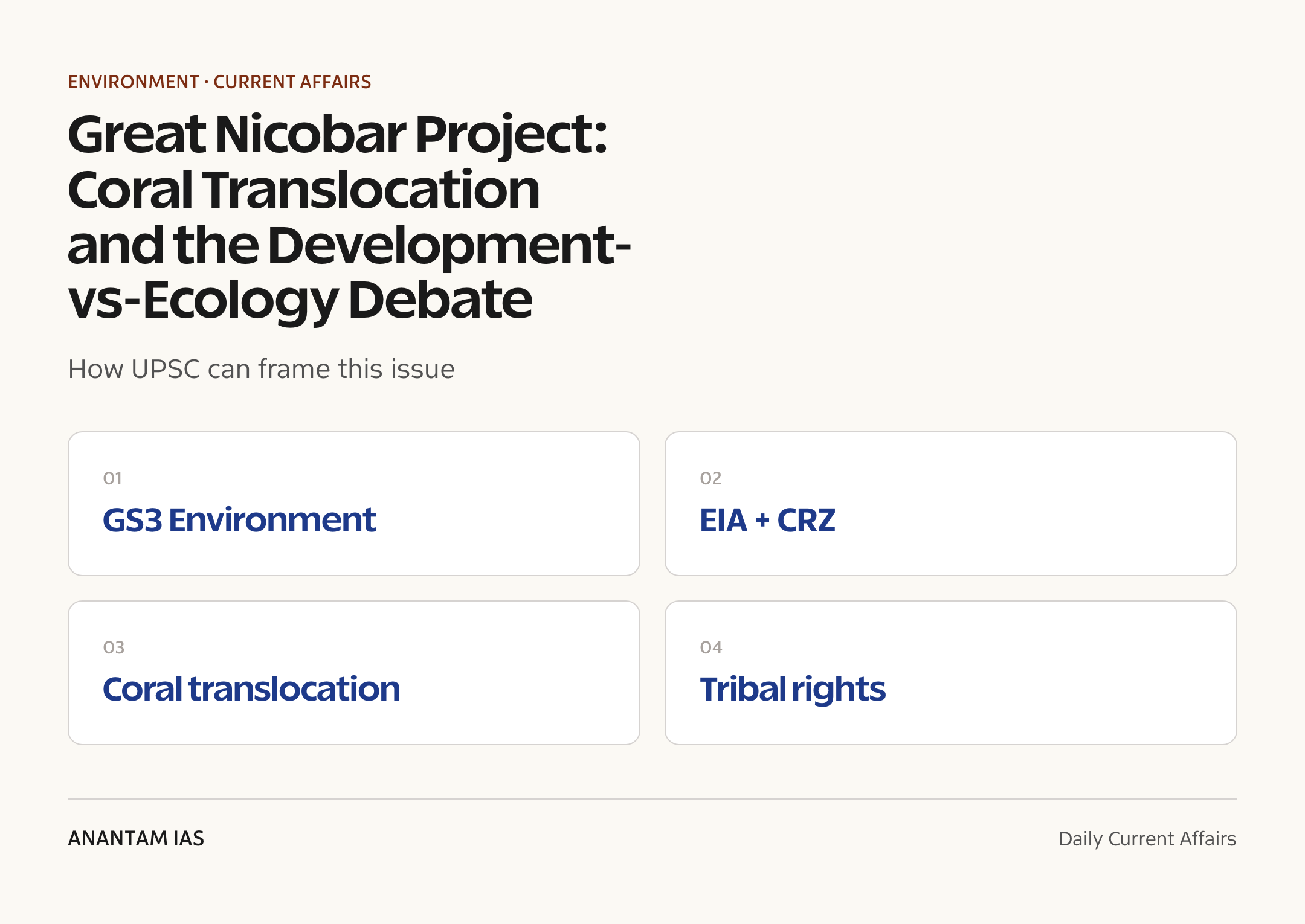
- It comprises an International Container Transhipment Terminal at Galathea Bay, a greenfield airport, a power plant and a township, steered by NITI Aayog and executed through ANIIDCO (see our explainer on the Great Nicobar Island Project).
- The port is pitched to capture transhipment traffic on the Malacca Strait sea lane that India currently cedes to Colombo, Singapore and Klang.
- Great Nicobar’s location near the Indo-Pacific chokepoints gives the project a strong strategic-infrastructure rationale.
- Critics counter that it disturbs the primary rainforest, a biosphere reserve and tribal reserves that took millennia to form.
Galathea Bay and the coral question
The port site overlaps a living reef, forcing a large coral-relocation exercise.
- Surveys logged about 20,668 coral colonies across a roughly 10-hectare study area at Galathea Bay.
- Clearance conditions require translocating an estimated 16,150 colonies, with several thousand more still under observation for relocation decisions.
- ZSI has now picked four sites on the island’s west coast as recipient reefs and is procuring survey equipment and manpower for the move.
- Giant Clams are to be shifted alongside the corals, and every relocated colony will be GPS-tagged to monitor survival.
Why is coral translocation hard?
Moving a reef is not the same as saving it; the science is uncertain.
- Corals are colonial animals living in symbiosis with zooxanthellae algae; transplant stress can trigger bleaching and death (see our notes on India’s coral atoll territory).
- Recipient sites must match the donor reef in depth, light, temperature and water flow, or survival rates fall sharply.
- Independent reef biologists have publicly questioned whether thousands of colonies can be moved at scale without heavy mortality.
- Long-term monitoring of GPS-tagged colonies is essential, but offsets rarely recreate the structural complexity of an intact reef.
Leatherbacks, megapodes and other wildlife
Galathea Bay is among India’s most important nesting habitats.
- The bay is a globally significant nesting beach for the endangered Leatherback turtle; recent Wildlife Institute of India surveys logged scores of nests.
- The endemic Nicobar Megapode, which incubates eggs in mounds of warm decaying vegetation, has dozens of monitored nesting mounds on the island.
- Tracking covers saltwater crocodiles, the Nicobar long-tailed macaque and the giant Robber Crab.
- Conservation field stations have been set up at Campbell Bay and elsewhere on the island for megapode and macaque studies.
Tribal reserves and the Shompen
The island is home to two indigenous groups whose consent is contested.
- The Shompen are a small, semi-nomadic forest-dwelling PVTG; the Nicobarese are a larger settled community (more on India’s Particularly Vulnerable Tribal Groups).
- Activists and anthropologists argue that the project encroaches on tribal reserve land and that genuine free, prior and informed consent was not obtained.
- Protections under the Forest Rights Act, 2006 and the special status of A&N tribal reserves are central to the legal dispute.
- Past relocations of island communities make the question of displacement and cultural survival especially sensitive.
The INS Baaz Airbase Row:
A fresh argument has opened over how to add air capacity with the least damage.
- INS Baaz, commissioned at Campbell Bay in 2012, is the southernmost air station, whose runway was recently lengthened to about 4,500 feet.
- Jairam Ramesh proposes extending that runway to around 10,000 feet as a less destructive alternative to the new greenfield airport.
- The greenfield airport at Gandhi Nagar–Shastri Nagar, designated dual-use by the Home Ministry in 2022, would need to cut forested hills and use the ICRZ-1A coastline.
- The Defence Ministry has reportedly favoured the greenfield option; Ramesh says distinguished naval voices back the INS Baaz route instead.
The regulatory and legal frame
Several environmental laws and forums govern the project.
- Clearance rests on the EIA Notification, 2006, and the CRZ Notification, 2019, with the most sensitive stretch protected as ICRZ-1A (see our guide to the Coastal Regulation Zone).
- The National Green Tribunal has examined the project and issued directions, including on coral-reef protection, while allowing it to proceed.
- A high-powered committee and the biodiversity committee under ANIIDCO monitor mitigation, with periodic minutes placed in the public domain.
- Compliance with offset and monitoring conditions, rather than the clearance itself, is now the live battleground.
Way Forward
Make offsets verifiable
- Publish open, time-series data on every GPS-tagged coral colony and Giant Clam, with independent third-party audits of survival rates.
- Treat translocation as an experiment with measurable success thresholds, not a box-ticking biodiversity offset.
Honour tribal rights
- Ensure documented free, prior and informed consent from the Shompen and Nicobarese and full Forest Rights Act due process before further land diversion.
- Keep the core tribal reserve and PVTG habitat off-limits to construction.
Seriously evaluate the least-damaging engineering option for air capacity — including the proposed INS Baaz runway extension — through a transparent comparative assessment, rather than defaulting to a greenfield site in primary forest and ICRZ-1A coastline.
Conclusion
The Great Nicobar Project crystallises the hardest question in India’s growth story: how to build strategic infrastructure without erasing ecosystems and communities that cannot be rebuilt.
Coral translocation and the INS Baaz debate show the test is no longer whether to develop, but whether mitigation is real, consent is genuine, and the least-damaging path is honestly chosen and independently verified.
UPSC Practice Questions
Prelims MCQ 1
With reference to the Great Nicobar Project, consider the following statements:
- Galathea Bay, the proposed port site, is an important nesting beach for the Leatherback turtle.
- The Zoological Survey of India has been tasked with translocating coral colonies threatened by the project.
- The Shompen are a Particularly Vulnerable Tribal Group living on Great Nicobar Island.
How many of the above statements are correct?
(a) Only one (b) Only two (c) All three (d) None
Answer: (c) All three
Explanation:
Galathea Bay is a key Leatherback turtle nesting site, the ZSI is undertaking the coral and Giant Clam translocation, and the Shompen are a PVTG of Great Nicobar. All three statements are correct.
Prelims MCQ 2
In the context of coral reefs, the colourful corals draw much of their nutrition from a symbiotic relationship with which of the following?
(a) Nitrogen-fixing bacteria
(b) Zooxanthellae algae
(c) Mangrove root fungi
(d) Planktonic diatoms
Answer: (b) Zooxanthellae algae
Explanation:
Reef-building corals host symbiotic zooxanthellae algae, which photosynthesise and supply most of the coral’s energy. Loss of these algae under stress causes coral bleaching.
UPSC Mains Questions
- The Great Nicobar Project illustrates the tension between strategic infrastructure and ecological conservation. Critically examine the environmental and tribal-rights concerns it raises, and suggest how such trade-offs should be governed. (250 words)
- Coral translocation is increasingly used as a biodiversity offset for coastal mega-projects. Discuss the ecological basis of coral reefs and the scientific challenges that limit the success of large-scale translocation. (250 words)
- Examine the role of impact-assessment processes, expert committees and the National Green Tribunal in ensuring that environmental clearances translate into genuine on-ground mitigation. (150 words)
Sources: Andaman and Nicobar Islands Integrated Development Corporation (ANIIDCO) and The Tribune / Indian Express.
Frequently Asked Questions
What is coral translocation in the Great Nicobar Project?
It is the physical relocation of living coral colonies and Giant Clams away from the Galathea Bay port construction zone to recipient reefs elsewhere. The Zoological Survey of India has identified four sites on Great Nicobar’s west coast and plans to GPS-tag each relocated colony to monitor its survival, as a condition of the project’s environmental clearance.
How many coral colonies are to be moved?
Environmental clearance conditions require translocating an estimated 16,150 coral colonies from the Galathea Bay impact area, drawn from roughly 20,668 colonies recorded across a 10-hectare survey zone. Several thousand more colonies remain under observation while relocation decisions are finalised by the ZSI and the monitoring committee.
Why is Galathea Bay ecologically important?
Galathea Bay is one of India’s most significant nesting beaches for the endangered Leatherback turtle, the largest living sea turtle. The surrounding waters hold dense coral reefs and Giant Clams, while the island supports the endemic Nicobar Megapode, saltwater crocodiles and other rare species, making it a globally important biodiversity site.
What is the INS Baaz controversy about?
Jairam Ramesh has urged the Defence Minister to expand the existing INS Baaz airbase at Campbell Bay, lengthening its runway, instead of building a new greenfield airport at Gandhi Nagar–Shastri Nagar. He argues the greenfield site needs felling forested hills and using highly protected ICRZ-1A coastline, causing far greater ecological damage than expanding the established base.
Who are the Shompen and Nicobarese?
They are the two indigenous communities of Great Nicobar Island. The Shompen are a small, semi-nomadic forest-dwelling Particularly Vulnerable Tribal Group, while the Nicobarese are a larger settled community. Concerns centre on whether the project encroaches on their tribal reserves and whether free, prior and informed consent was genuinely obtained.
Does the project have environmental clearance?
Yes. The project received environmental clearance under the EIA Notification, 2006, and coastal clearance under the CRZ framework, and the National Green Tribunal has allowed it to proceed while issuing directions, including on coral-reef protection. The current debate is mainly about whether the attached mitigation and monitoring conditions are being honoured in practice.