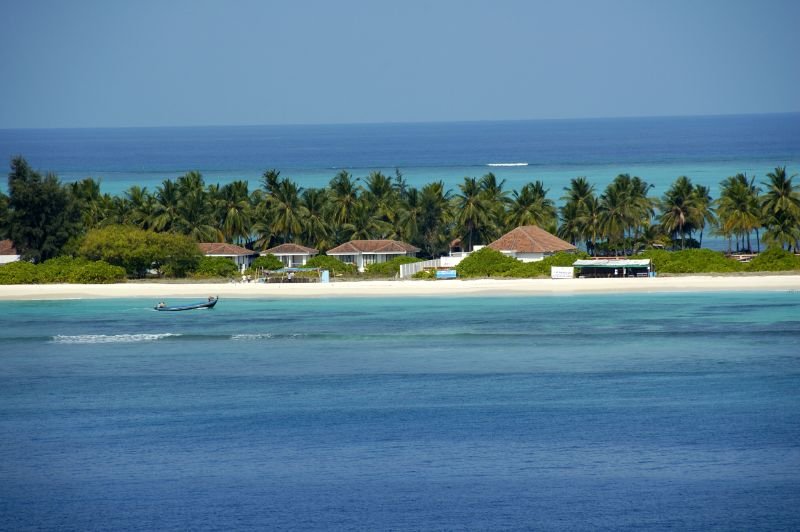
The Lakshadweep Islands are India’s smallest Union Territory by both area and population, and the only territory in the country whose entire land surface is built of coral. Lying in the Arabian Sea between 200 and 440 kilometres off the Kerala coast, the Lakshadweep Islands form the northern segment of the Lakshadweep–Maldives–Chagos ridge, a submarine mountain chain that runs almost meridionally across the central Indian Ocean. The territory consists of 36 islands grouped into 12 atolls, 3 reefs, and 5 submerged banks, with a total land area of just 32 square kilometres but a territorial sea of around 20,000 square kilometres and an Exclusive Economic Zone of more than 4,00,000 square kilometres. Despite their small size, the Lakshadweep Islands are biogeographically, strategically, and culturally distinct — a Sunni Muslim, Malayalam- and Mahl-speaking, fisheries-dependent society set on the only true coral atolls under Indian sovereignty.
Geographical Setting
The Lakshadweep Islands lie between 8°N and 12°30′N latitude and 71°E and 74°E longitude. They are part of the larger Lakshadweep–Maldives–Chagos submarine ridge, which extends southward through the Maldives to the Chagos Archipelago. The chain is separated from the Kerala coast by the deep Lakshadweep Sea, also known as the Laccadive Sea. The capital, Kavaratti, lies on Kavaratti Atoll roughly 360 kilometres west of Kochi. The southernmost island, Minicoy, is separated from the rest of the chain by the wide Nine Degree Channel, an important international shipping lane. Below Minicoy, the Eight Degree Channel separates Lakshadweep from the Maldives.
The Lakshadweep Islands are sometimes divided geographically into three sub-groups: the Aminidivi group in the north (Amini, Kadmat, Kiltan, Chetlat, Bitra), the Cannanore or Laccadive group in the middle (Kavaratti, Agatti, Kalpeni, Androth, Kadmat — with some overlap of grouping), and Minicoy in the south. The Maldives chain continues the geological pattern of Lakshadweep further south.
Geological Origin: India’s Only Atolls
The Lakshadweep Islands are India’s only true coral atolls. An atoll is a ring-shaped coral reef enclosing a central lagoon and built on the rim of a submerged volcanic seamount. The classical Darwinian model holds that atolls form when a fringing reef grows upward as the volcanic island beneath it subsides, eventually leaving only the reef ring above water. The Lakshadweep atolls developed on a chain of submerged volcanic peaks that are believed to be associated with the same Réunion hotspot track that produced the Deccan Traps further north.
Each Lakshadweep atoll consists of a coral reef rim, one or more vegetated cay islands (sand and coral rubble accumulations on the reef), and a shallow central lagoon. The lagoons are typically 2 to 5 metres deep and are the islands’ chief economic and ecological resource. The reef rims protect the cays from open-ocean wave action and storm surges. The total area covered by coral reefs in Lakshadweep is approximately 4,200 square kilometres — many times the area of the emerged land.
Twelve Atolls, Three Reefs, Five Banks
The Lakshadweep territory consists of 12 atolls, 3 reefs (Bassas de Pedro, Cherbaniani, Byramgore), and 5 submerged banks. Only 10 islands are inhabited: Kavaratti, Agatti, Amini, Andrott, Kadmat, Kalpeni, Kiltan, Chetlat, Bitra, and Minicoy. Bitra is the smallest inhabited island. The uninhabited islands include Bangaram, Tinnakara, Parali I, II, and III, and several smaller cays.
Major Islands of the Lakshadweep
Kavaratti
Kavaratti is the administrative capital of the Union Territory and houses the Lieutenant Governor’s office, the secretariat, and the only district court of Lakshadweep. The island has an area of around 4.22 square kilometres and a lagoon of about 4 square kilometres. The Ujra Mosque, dating from the seventeenth century, is the most prominent cultural landmark.
Agatti
Agatti hosts the only airport in the territory and is the main aviation gateway to Lakshadweep. The airport runway runs along the length of the narrow island and is bounded on both sides by the lagoon. Agatti is also a major fisheries centre and a popular site for snorkelling and diving tourism.
Andrott
Andrott is the largest island in the chain by land area (4.84 square kilometres), the only island with an east–west alignment rather than the usual north–south, and historically one of the most populous. It is associated with the eleventh-century arrival of Islam to the islands, traditionally attributed to a shipwrecked Arab saint, Hazrat Ubaidullah, whose tomb is on the island.
Minicoy
Minicoy is the southernmost island and the second-largest in the territory after Andrott. It is geographically and culturally distinct from the rest of the Lakshadweep Islands: the inhabitants speak Mahl (a dialect closely related to Maldivian Dhivehi rather than Malayalam), live in matrilineal village clusters called avahs, and historically followed Maldivian rather than Malabar customs. The Minicoy lighthouse, built by the British in 1885, is one of the oldest functioning lighthouses in India and the principal navigational aid in the Nine Degree Channel.
Climate and Vegetation
The Lakshadweep Islands have a tropical maritime climate with very small annual temperature ranges (26–32°C). Average annual rainfall is 1,500 to 1,600 millimetres, concentrated in the south-west monsoon. Cyclones occasionally cross the chain. The dominant natural vegetation is coconut palm, which is also the principal commercial crop. The islands lack significant freshwater resources and depend on rainwater harvesting and shallow groundwater lenses, although seawater desalination plants have been installed on several islands since the 2000s.
Biodiversity and the Coral Reef Ecosystem
The Lakshadweep coral reefs are biodiversity hotspots within the central Indian Ocean. They host more than 600 species of marine fish, 78 species of stony corals, sea turtles (green, hawksbill, olive ridley), sea cucumbers, giant clams, and reef sharks. The Lakshadweep Sea is also an important habitat for tuna, particularly the skipjack and yellowfin species that form the basis of the territory’s commercial fisheries. The Pitti Bird Sanctuary, located on an uninhabited sandbank, is a major breeding site for sooty terns, brown noddies, and other oceanic birds.
Climate change is the principal threat. Coral bleaching events linked to elevated sea surface temperatures have affected Lakshadweep reefs repeatedly since 1998. Rising sea levels and increased cyclone intensity threaten the long-term physical persistence of the low-lying cays, which rarely rise more than 2 metres above mean sea level.
Economy and Society
The economy of the Lakshadweep Islands rests on three pillars: coconut and copra production, marine fisheries (especially tuna), and tourism. Coconut covers nearly all the cultivable land on the inhabited islands, and Lakshadweep has one of the highest per-capita coconut yields in India. The fisheries sector is dominated by traditional pole-and-line tuna fishing, recognised internationally as one of the most ecologically sustainable fishing methods.
The population of the Lakshadweep Islands is around 64,000, almost entirely Muslim and of Malayali (in the northern atolls) or Mahl (in Minicoy) ethnicity. The territory has among the highest literacy rates in India and the lowest population density among Union Territories, despite the very limited land area, because the inhabited islands are nonetheless densely populated.
Administration and Governance Updates
The Lakshadweep Islands are administered as a Union Territory directly under the Government of India, headed by an Administrator (the title Lieutenant Governor is sometimes used informally). The territory is a single district with the headquarters at Kavaratti. Entry to Lakshadweep is restricted: non-residents must obtain a permit, and only certain islands are open to tourists (Agatti, Bangaram, Kadmat, Kavaratti, Kalpeni, and Minicoy).
The Lakshadweep administration introduced a number of regulatory reforms in 2021, including the Lakshadweep Development Authority Regulation, the Lakshadweep Animal Preservation Regulation, the Prevention of Anti-Social Activities Regulation, and changes to the panchayat rules. These attracted significant public and judicial scrutiny, and several provisions were challenged before the Kerala High Court. The regulatory framework for Lakshadweep continues to evolve.
Strategic Importance
The Lakshadweep Islands sit astride the central sea lanes of the Arabian Sea. The Nine Degree Channel between Lakshadweep and Minicoy and the Eight Degree Channel between Minicoy and the Maldives are critical for tanker traffic between the Persian Gulf and East Asia. The Indian Navy maintains INS Dweeprakshak at Kavaratti and detachments at Androth and Minicoy. Plans for a more substantial naval base on Minicoy have been under public discussion in recent years. The territory is also the principal projection point for India’s Exclusive Economic Zone in the central Arabian Sea, making it strategically more significant than its tiny land area would suggest.
Frequently Asked Questions
How many islands are there in Lakshadweep?
Lakshadweep consists of 36 islands, grouped into 12 atolls, 3 reefs, and 5 submerged banks. Of these, only 10 islands are permanently inhabited: Kavaratti, Agatti, Amini, Andrott, Kadmat, Kalpeni, Kiltan, Chetlat, Bitra, and Minicoy.
Where is the capital of Lakshadweep?
The capital is Kavaratti, on Kavaratti Atoll, roughly 360 kilometres west of Kochi. The Administrator’s office, the territorial secretariat, and the only district court of Lakshadweep are all located at Kavaratti.
What makes Lakshadweep India’s only coral atoll territory?
Lakshadweep is the only Indian territory whose entire land surface is built of coral. Each island is a low-lying sand-and-coral cay perched on the reef rim of a submerged volcanic seamount, surrounded by a shallow lagoon. No other territory of India contains true atolls. The Andaman and Nicobar Islands have fringing coral reefs but their land surfaces are continental.
What is the importance of Minicoy?
Minicoy is the southernmost island of Lakshadweep and geographically and culturally distinct. Its inhabitants speak Mahl, a dialect related to Maldivian Dhivehi, and follow matrilineal customs. The Minicoy lighthouse, built in 1885, is among the oldest functioning lighthouses in India and the principal navigational aid in the Nine Degree Channel that separates Lakshadweep from the Maldives.
How is Lakshadweep different from the Andaman and Nicobar Islands?
Lakshadweep is a small coral atoll group in the Arabian Sea with a land area of only 32 square kilometres and a population of around 64,000. The Andaman and Nicobar Islands are a much larger continental archipelago in the Bay of Bengal, covering 8,249 square kilometres, with 572 islands of volcanic and sedimentary origin and a population of around 4 lakh.
What is the main economy of Lakshadweep?
The Lakshadweep economy rests on coconut and copra production, marine fisheries (especially pole-and-line tuna fishing, regarded as one of the world’s most sustainable methods), and tourism. Fisheries and coconut between them employ the bulk of the working population.
What were the 2021 governance changes in Lakshadweep?
The Lakshadweep administration introduced several new regulations in 2021, including the Lakshadweep Development Authority Regulation, the Animal Preservation Regulation, the Prevention of Anti-Social Activities Regulation, and changes to panchayat rules. The package attracted public criticism and judicial challenge before the Kerala High Court, and the regulatory framework continues to evolve.
Why are the Lakshadweep Islands strategically important to India?
The Lakshadweep Islands command the Nine Degree and Eight Degree Channels, both critical sea lanes for Persian Gulf–East Asia tanker traffic. They project India’s Exclusive Economic Zone over more than 4,00,000 square kilometres of the central Arabian Sea. The Indian Navy maintains INS Dweeprakshak at Kavaratti, and proposals for a larger forward base on Minicoy have been under discussion.
Tell Google you want more of this.
Add Anantam IAS as a preferred sourceOne tap, and this site shows up more often in your own Top Stories, AI Overviews and AI Mode. Remove it any time.