Gujarat Bustard Recovery: Habitat, Egg Substitution and Soft Release
Why in News?
The Gujarat bustard recovery action plan, released at Bhuj on 13 September 2026, connects habitat restoration, breeding support and preparation for conditional future releases.
- The Wildlife Institute of India and Gujarat Forest Department prepared the plan for the small, isolated Great Indian Bustard population in Kachchh.
- The minister reported that a chick from egg substitution had survived beyond its first three months in the wild.
- A Soft Release Centre near Naliya has been developed for future acclimatisation of captive-bred birds from Rajasthan; eventual release requires appropriate protocols and habitat conditions.
- Breeding support can address reproductive constraints, but birds still need safe, functioning habitat after hatching or release.
- Recovery assessment must distinguish an announced plan, a reported individual survival result and a future release pathway.
UPSC Relevance
Prelims Relevance
- Great Indian Bustard: a Critically Endangered bird associated with open natural ecosystems.
- Kachchh: Gujarat landscape supporting a small, isolated population.
- In-situ conservation: protection within natural habitat.
- Ex-situ conservation: conservation outside natural habitat, including managed breeding.
- Soft release: acclimatisation before a managed return to the wild.
Mains Relevance
GS Paper 3
- Link species recovery to habitat quality, ecological connectivity and infrastructure threats.
- Evaluate assisted breeding using survival and subsequent reproduction, rather than intervention counts alone.
Essay
- Scientific intervention succeeds when the receiving ecosystem can sustain its result.
Background and Context
Why the open landscape comes first
The Great Indian Bustard needs a functioning open ecosystem; protecting a bird while degrading its surroundings leaves the underlying recovery problem unresolved.
- In-situ conservation protects the species where it naturally lives. In Gujarat, the action plan connects bustard recovery to safe, contiguous habitat rather than treating breeding facilities as a complete substitute for landscape protection.
- Kachchh’s population is described as small and isolated. This makes survival of individual birds consequential, while also showing why an encouraging chick record cannot establish that the population has become secure or self-sustaining.
- Habitat restoration includes removing invasive vegetation and managing grazing. The ecological objective is suitable open habitat, not simply a larger tree count; our grasslands guide explains this distinction for ecosystem management and restoration.
- Infrastructure-related threats and nest predators feature in the announced interventions. Recovery planning must address these pressures alongside breeding support, because increasing the supply of birds does not itself make their receiving landscape safer.
- Community participation is part of the landscape approach described in the review. The practical challenge is to align habitat management with local land use, rather than assume a breeding programme alone resolves competing demands.
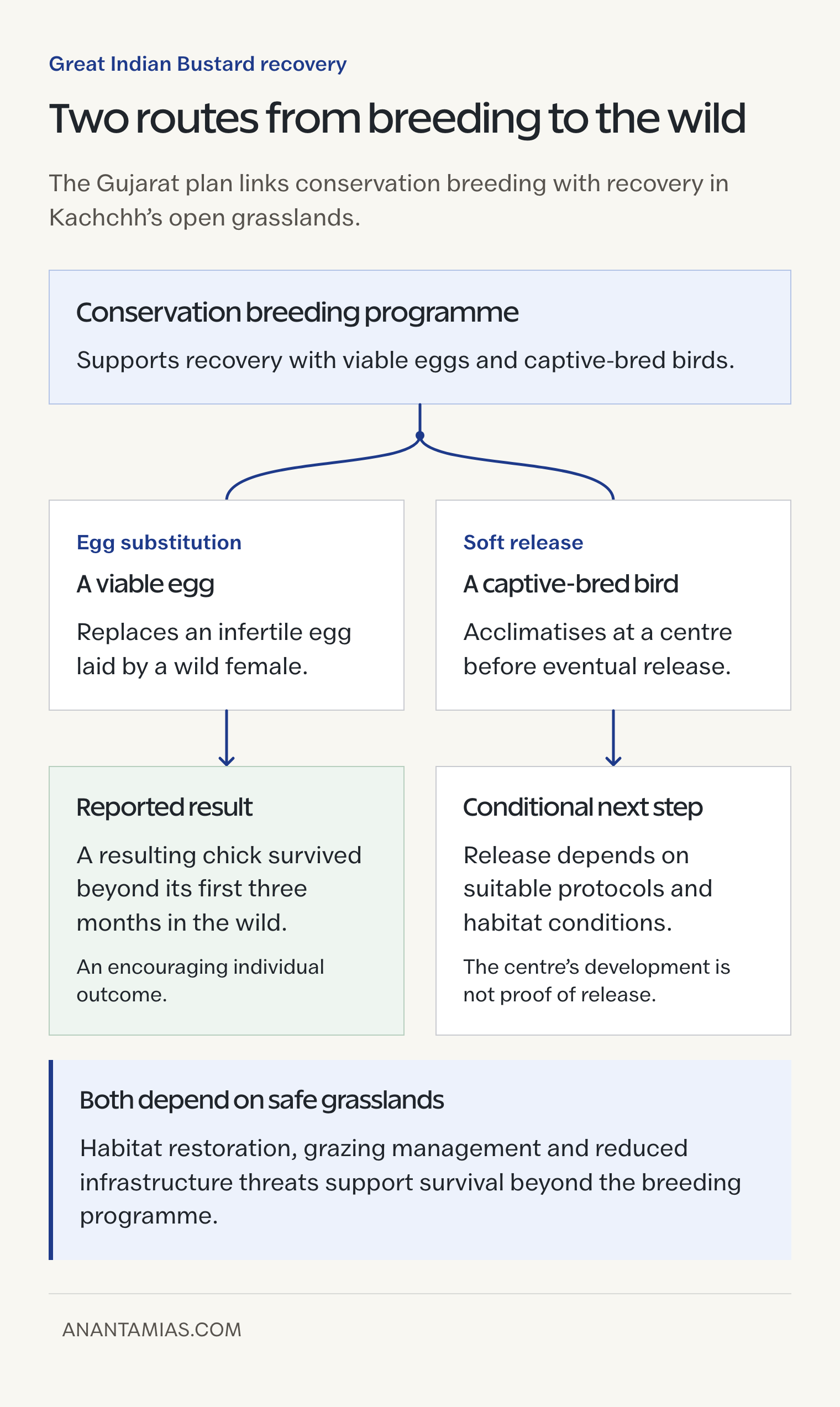
Two recovery routes with different starting points
Egg substitution starts with a wild nest, whereas soft release prepares a captive-bred bird for eventual release; the distinction matters for interpreting progress.
- Egg substitution replaces an infertile egg laid by a wild female with a viable egg from the conservation breeding programme. It supports reproduction through an existing wild nesting situation rather than releasing a captive-bred adult.
- The reported outcome is a chick from the second such attempt surviving beyond three months in the wild. This is an attributed ministerial account of individual survival, not evidence of a recovered population.
- Conservation breeding supplies viable eggs for that intervention and captive-bred birds for a separate pathway. These roles connect managed breeding with wild recovery, but they should not be described as the same conservation procedure.
- Soft release introduces an acclimatisation stage before eventual release. The centre near Naliya is intended to house birds from Rajasthan, allowing preparation between captive breeding and entry into the receiving landscape under appropriate protocols.
- Current status matters: the centre has been developed, but housing, acclimatisation and eventual release are described prospectively. The announcement does not establish that captive-bred birds have already been released successfully into Gujarat’s wild population.
What would count as durable recovery?
A recovery programme needs evidence across successive stages, with habitat readiness checked before releases and population outcomes assessed beyond the first encouraging survival milestone.
- Individual survival is an early outcome, not the final conservation endpoint. Continued survival, later breeding and sustained recruitment would provide stronger evidence that assisted reproduction is contributing to a population able to persist.
- Release readiness depends on appropriate protocols and habitat conditions, according to the announcement. A completed facility demonstrates preparedness, but it cannot by itself establish that releasing birds is ecologically justified or immediately safe.
- Connected habitat is a functional requirement, not merely an area entry in a plan. The Tadoba-Indravati corridor debate similarly illustrates why conservation decisions must examine relationships across a landscape, while involving a different species.
- Monitoring should separate eggs transferred, chicks surviving, birds acclimatised and birds subsequently breeding in the wild. Combining these stages into a single success claim would hide where the programme works and where losses occur.
- The policy test is whether assisted recovery and threat reduction reinforce each other. Breeding assistance without safer habitat risks repeated losses; habitat restoration without addressing reproductive constraints may leave a small population unable to recover.
Way Forward
Match interventions to evidence
- Confirm habitat readiness and release protocols before moving from facility preparation to bird release.
- Track successive outcomes from hatching through survival and reproduction; publish stage-specific results rather than a single undifferentiated success claim.
- Coordinate landscape management with local communities, invasive-species control and infrastructure-risk reduction.
Conclusion
- Gujarat bustard recovery illustrates how in-situ habitat protection and ex-situ breeding can complement each other. Their connection is a managed conservation pathway, not a guarantee that additional eggs or captive birds will create a secure wild population.
- For an analytical answer, distinguish the released action plan, the reported chick survival and the conditional future soft-release pathway. Judge long-term success through population persistence and reproduction within habitat that remains suitable and safe.
UPSC Practice Questions
Prelims MCQ 1
With reference to Gujarat’s Great Indian Bustard recovery measures, consider the following statements:
- Egg substitution uses a viable breeding-programme egg to replace an infertile egg laid by a wild female.
- A completed soft-release centre proves that captive-bred birds have already been released into the wild.
- Safe habitat remains necessary for both egg-substitution and soft-release pathways.
How many of the above statements are correct?
(a) Only one (b) Only two (c) All three (d) None
Answer: (b) Only two
Explanation:
Statements 1 and 3 are correct. The centre prepares for future acclimatisation and conditional release; its development does not prove that release has occurred.
Prelims MCQ 2
Which outcome offers the strongest evidence of durable species recovery?
(a) Construction of a breeding facility (b) Announcement of an action plan (c) Sustained survival and reproduction in suitable wild habitat (d) Transfer of viable eggs alone
Answer: (c) Sustained survival and reproduction in suitable wild habitat
Explanation:
Facilities, plans and transfers are inputs or intermediate steps. Persistence and reproduction in the wild are stronger population-level outcomes.
UPSC Mains Questions
- Explain how in-situ and ex-situ conservation complement each other in the Great Indian Bustard recovery programme.
- Why should conservation programmes distinguish infrastructure readiness, individual survival and population recovery? Discuss with reference to Gujarat’s bustard action plan.
Source: PIB, Ministry of Environment, Forest and Climate Change.
Frequently Asked Questions
What is the Gujarat bustard recovery action plan?
It is a conservation roadmap prepared by the Wildlife Institute of India and Gujarat Forest Department. Released at Bhuj, it connects habitat restoration and threat management with breeding support for the isolated Kachchh population.
How does egg substitution help the Great Indian Bustard?
An infertile egg laid by a wild female is replaced with a viable egg from the conservation breeding programme. The intervention supports hatching in the wild; subsequent survival still depends on suitable conditions.
Have captive-bred bustards already been released from Naliya?
The announcement does not establish that releases have occurred. It says the developed centre will house and acclimatise captive-bred birds from Rajasthan, with eventual release dependent on appropriate protocols and habitat conditions.
Does one surviving chick prove population recovery?
No. A chick surviving beyond three months is an encouraging individual result. Durable recovery requires evidence of continued survival, reproduction and recruitment within habitat that can sustain the population over time.