Why in News?
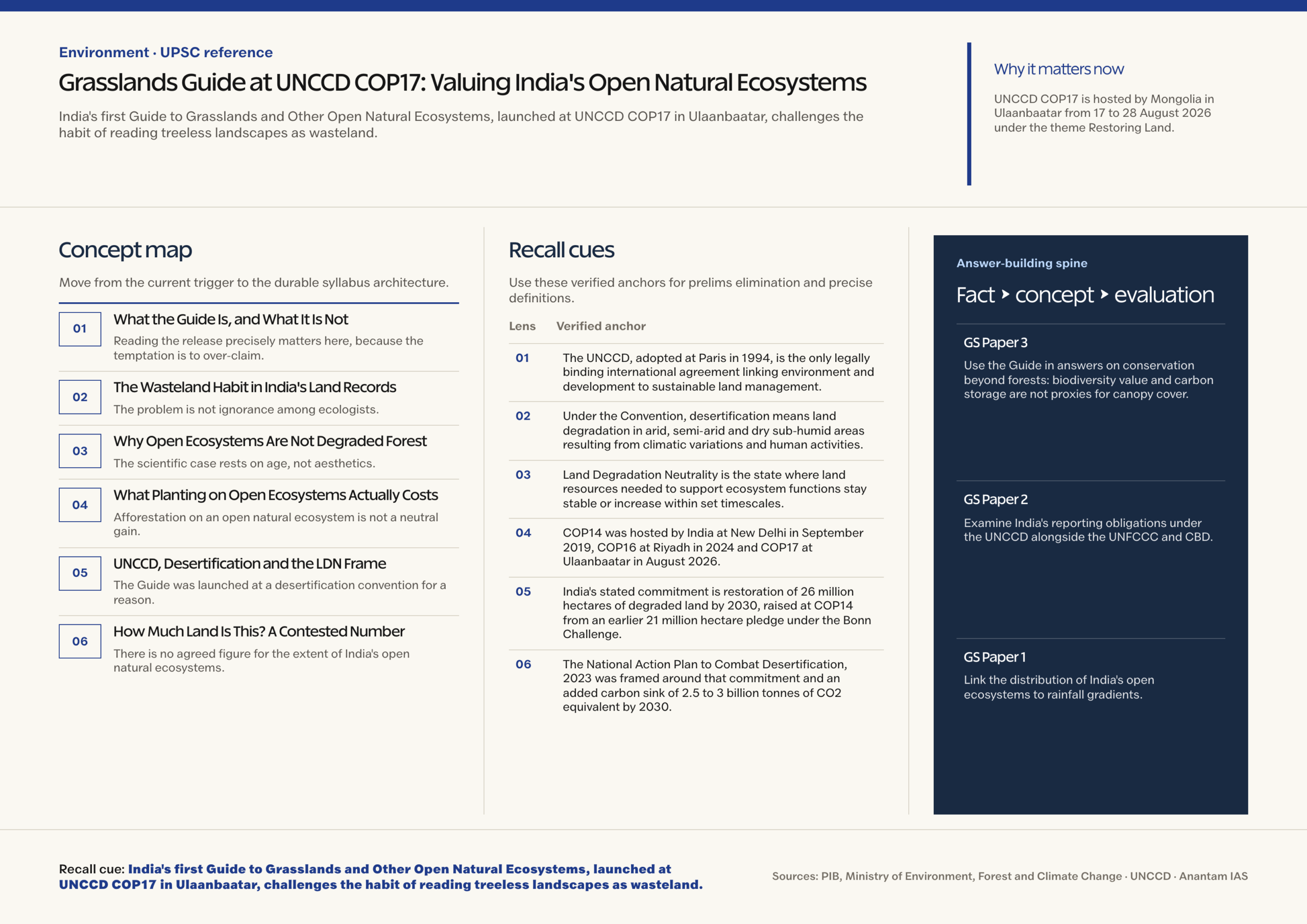
India launched its first Guide to Grasslands and Other Open Natural Ecosystems at a UNCCD COP17 side event in Ulaanbaatar on 17 August 2026.
- The Guide is a reference document, not a law, scheme, or COP decision.
- It argues that savannas, scrublands, ravines and deserts are ecosystems, not failed forest.
- UNCCD COP17 runs in Mongolia from 17 to 28 August 2026.
- The launch sits under the Ministry of Environment, Forest and Climate Change and India’s Land Degradation Neutrality talk.
- Indian land policy has long treated tree cover as the proof of ecological value.
- That habit turns naturally open land into ‘wasteland’ ready for plantation or solar parks.
- Aspirants need the category, not the partner list at the side event.
UPSC Relevance
Prelims Relevance
- The UNCCD is one of the three Rio Conventions, with UNFCCC and CBD.
- India hosted UNCCD COP14 in New Delhi in September 2019.
- COP17 is at Ulaanbaatar, Mongolia. COP16 was at Riyadh in 2024.
- The Guide creates no new protected-area category and reclassifies no wasteland.
- Open Natural Ecosystems are kept open by climate, soil, fire and grazing, not only by cutting.
- Land Degradation Neutrality is anchored in SDG 15.3.
Mains Relevance
GS Paper 3
- Why equating ecological value with tree cover harms grasslands and pastoral commons.
- How Land Degradation Neutrality goes wrong if the baseline treats naturally open land as degraded.
Essay
- Not every empty-looking landscape is empty.
Background and Context
What the Guide is, and what it is not
Read the release precisely. The temptation is to over-claim a book into a statute.
- The Guide compiles geography, ecology, biodiversity and associated communities of India’s open ecosystems.
- It notifies no land, assigns no budget, and sets no legal restoration target.
- Revenue wasteland categories remain as they are until a later instrument changes them.
- Its use is a shared official description that later maps and appraisals can be held against.
- For the convention itself, see our explainer on the UNCCD.
The wasteland habit
The problem is a classification inherited from revenue administration, not a gap in ecology.
- Colonial forest and revenue systems sorted land by timber and crop. What yielded neither became waste.
- That label still steers compensatory afforestation, solar siting and ‘green’ plantation drives.
- Planting trees on a grassland can be recorded as restored land and still erase bustard or blackbuck habitat.
- Pastoral use looks like residual livelihood in this vocabulary, not as a land-management system.
- The Guide’s claim is modest: stop starting the description from what the landscape lacks.
Why this belongs in a UNCCD week
Land Degradation Neutrality is only as honest as the baseline it uses.
- If naturally open ecosystems are coded as degraded, planting them ‘restores’ them on paper.
- India’s restoration pledge then collides with the very landscapes the Guide asks us to keep open.
- Fire ecology and grazing are processes in these systems, not automatically damage.
- The exam trap is to treat every COP product as binding. This one is a side-event guide.
- The live policy test is whether later atlases stop calling these tracts wasteland.
Pastoralism is land management, not leftover livelihood
If the Guide is only read as a wildlife note, its most political claim is missed.
- Grazing and mobility keep many open ecosystems open. Closing them ‘for greening’ can degrade them.
- Commons that look empty on a satellite product are often working rangeland.
- Fire, used with knowledge, is a process in savanna systems rather than a simple crime.
- A restoration target that plants over a grazing tract can impoverish the people who kept it open.
- The Guide’s sections on pastoralism are the part that belongs in a GS1 society answer as well as GS3.
Way Forward
Change the category, then the map
- Keep open ecosystems as their own conservation class, including community-managed options.
- Make solar, corridor and plantation appraisals count open-ecosystem loss explicitly.
- Separate tree-cover targets from grassland and savanna outcomes in official accounts.
- Treat pastoral access as a design constraint, not an afterthought.
Conclusion
- The Guide protects not a single hectare. It puts an official name on landscapes that policy still calls waste.
- It will matter only if maps, restoration ledgers and project siting start using that name.
UPSC Practice Questions
Prelims MCQ 1
With reference to the United Nations Convention to Combat Desertification (UNCCD), consider the following statements:
- It is counted as one of the three Rio Conventions, along with the UNFCCC and the Convention on Biological Diversity.
- India has hosted a session of its Conference of the Parties.
- Its 17th session of the Conference of the Parties was held in Riyadh, Saudi Arabia.
How many of the above statements are correct?
(a) Only one (b) Only two (c) All three (d) None
Answer: (b) Only two
Explanation:
Statements 1 and 2 are correct. India hosted COP14 in New Delhi in 2019. COP17 is at Ulaanbaatar; Riyadh hosted COP16.
Prelims MCQ 2
The Guide to Grasslands and Other Open Natural Ecosystems of India, launched in August 2026, is best described as:
(a) A reference document launched at a UNCCD COP17 side event (b) A statutory reclassification of wastelands under the Indian Forest Act, 1927 (c) A legally binding grassland restoration target for 2030 (d) A formal decision of the Conference of the Parties to the UNCCD
Answer: (a) A reference document launched at a UNCCD COP17 side event
Explanation:
PIB records a side-event launch of a guidance document. It notifies nothing and is not a COP decision.
UPSC Mains Questions
- Indian land policy has long equated ecological value with tree cover. Examine how this has shaped the treatment of grasslands and other open natural ecosystems. (250 words)
- Land Degradation Neutrality requires a baseline that distinguishes degraded land from naturally open ecosystems. Discuss. (150 words)
Sources: PIB, Ministry of Environment, Forest and Climate Change and UNCCD.
Frequently Asked Questions
What are Open Natural Ecosystems?
Naturally treeless or sparsely wooded landscapes such as grasslands, savannas, scrub, ravines and deserts, kept open by climate, soil, fire and grazing rather than by recent destruction.
Did the Guide change any land category?
No. It is guidance, not a notification. Wasteland labels in revenue and remote-sensing products stay until a later instrument changes them.
Why is planting trees on a grassland a problem?
It closes habitat that open-country species need, can cut pastoral access, and still gets counted as restored tree cover in official accounts.
What is Land Degradation Neutrality?
Keeping the amount and quality of productive land stable or improving, anchored in SDG 15.3. The baseline must not treat naturally open land as already degraded.
Where is UNCCD COP17 being held?
Ulaanbaatar, Mongolia, from 17 to 28 August 2026. India hosted COP14 in New Delhi in 2019.
Tell Google you want more of this.
Add Anantam IAS as a preferred sourceOne tap, and this site shows up more often in your own Top Stories, AI Overviews and AI Mode. Remove it any time.