How India is governing its water resources
Why in News?
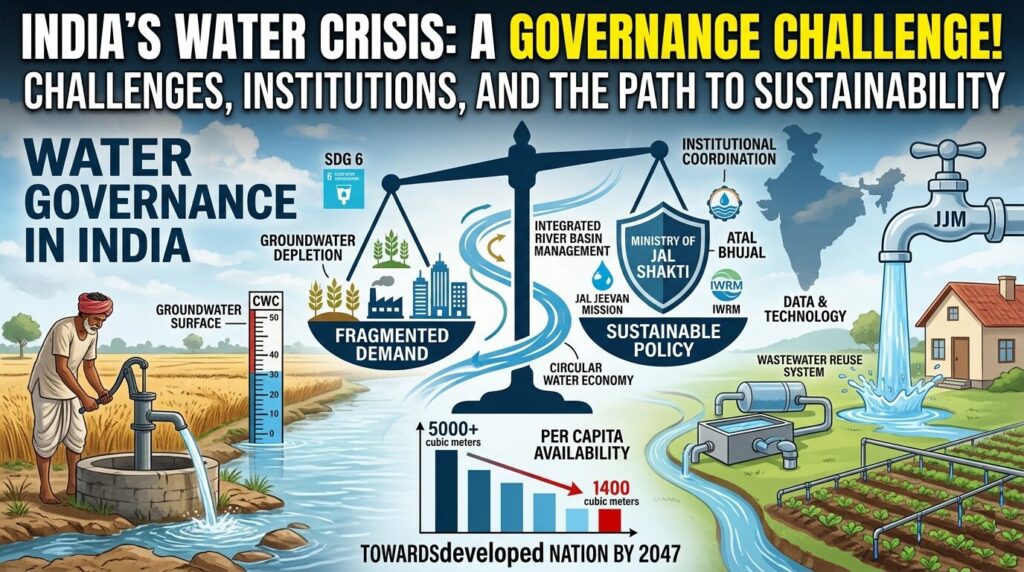
India’s growing water stress and the need for effective governance have once again come into focus amid discussions on sustainable development, groundwater depletion, urban water scarcity and climate resilience. Policymakers are increasingly emphasising that India’s water crisis is not merely a question of scarcity, but one of governance, management and institutional coordination.
The debate gains significance as India seeks to achieve:
- Sustainable Development Goal (SDG) 6 on clean water and sanitation
- Long-term economic and developmental goals linked to the vision of becoming a developed nation by 2047
UPSC Relevance
Prelims Relevance
- Jal Jeevan Mission, Atal Bhujal Yojana, Pradhan Mantri Krishi Sinchayee Yojana, Namami Gange Programme, Constitutional provisions related to water, Groundwater and irrigation
Mains Relevance
GS Paper 2
- Federalism, Centre-State relations, Governance, public policy, Decentralisation, local governance
GS Paper 3
- Water conservation, resource management, Climate change, sustainable development, Agriculture and irrigation, Urban infrastructure, environmental management
Essay
- Water security and development
- Sustainable governance
- Climate resilience and natural resources
Background and Context
Water is central to:
- Agriculture
- Industrial development
- Public health
- Food security
- Ecological sustainability
India possesses significant water resources in absolute terms due to:
- Monsoon rainfall
- Himalayan river systems
- Groundwater aquifers
However, despite receiving nearly 4,000 billion cubic metres (BCM) of annual rainfall, only a portion becomes effectively usable due to:
- Uneven spatial distribution
- Seasonal concentration of rainfall
- Inadequate storage infrastructure
- Pollution and ecological degradation
Hydrological assessments indicate that only around 1,100 BCM of water is considered utilisable.
India’s water challenge has therefore evolved from a purely physical scarcity problem into a broader governance and sustainability issue.
The Emerging Water Crisis in India
Declining Per Capita Water Availability
India’s per capita water availability has steadily declined because of:
- Population growth
- Urbanisation
- Industrialisation
- Rising agricultural demand
Per capita availability:
- Exceeded 5,000 cubic metres annually after independence
- Has now declined to nearly 1,400 cubic metres
According to international standards:
- Below 1,700 cubic metres indicates water stress
- Below 1,000 cubic metres indicates water scarcity
Several Indian regions are approaching severe stress conditions.
Groundwater Depletion
India is the world’s largest extractor of groundwater, accounting for nearly one-fourth of global groundwater extraction.
Groundwater supports:
- Irrigation
- Drinking water
- Rural livelihoods
However, overdependence has caused:
- Falling water tables
- Aquifer depletion
- Land subsidence in some regions
- Declining water quality
States such as:
- Punjab
- Haryana
- Rajasthan
- Gujarat
- Tamil Nadu
face serious groundwater stress.
Regional and Seasonal Imbalances
India’s rainfall is highly uneven:
- Most rainfall occurs during the southwest monsoon
- Some regions face floods while others face droughts
For example:
- Assam and Bihar often experience floods
- Rajasthan and parts of peninsular India face chronic water scarcity
This uneven distribution creates major governance challenges.
Water Pollution
Rivers, lakes and groundwater sources are increasingly polluted due to:
- Untreated sewage
- Industrial effluents
- Agricultural runoff
- Solid waste dumping
The Central Pollution Control Board (CPCB) has identified several polluted river stretches across the country.
Pollution reduces the quantity of usable freshwater and increases health risks.
Constitutional and Federal Dimensions of Water Governance
Water as a State Subject
Under the Seventh Schedule of the Constitution:
- Water primarily falls under the State List (Entry 17)
States are responsible for:
- Irrigation
- Water supply
- Canal systems
- Groundwater management
Union Government’s Role
The Union can legislate on inter-State rivers under:
- Entry 56 of the Union List
This creates a complex federal framework where both Union and States influence water governance.
Article 262
Article 262 empowers Parliament to adjudicate inter-State river water disputes.
Parliament enacted:
- Inter-State River Water Disputes Act, 1956
to resolve river-sharing conflicts.
Important Inter-State Water Disputes
India has witnessed several major disputes:
- Cauvery dispute
- Krishna dispute
- Ravi-Beas dispute
- Mahadayi dispute
These conflicts highlight the political and federal complexities of water governance.
Institutional Architecture of Water Governance
Ministry of Jal Shakti
Created in 2019 by merging:
- Ministry of Water Resources
- Ministry of Drinking Water and Sanitation
It acts as the nodal ministry for:
- Water resources
- Drinking water
- Sanitation
- River development
Central Water Commission (CWC)
The CWC is responsible for:
- Surface water planning
- Flood management
- River basin development
- Technical guidance
Central Ground Water Board (CGWB)
The CGWB:
- Assesses groundwater resources
- Conducts aquifer mapping
- Provides scientific data for groundwater management
NITI Aayog and Water Governance
NITI Aayog introduced the:
- Composite Water Management Index (CWMI)
The index evaluates States on:
- Irrigation efficiency
- Groundwater management
- Drinking water
- Watershed development
It aims to improve competitive and evidence-based governance.
Major Government Initiatives
Jal Jeevan Mission (JJM)
Launched in 2019, the mission aims to provide:
- Functional Household Tap Connections (FHTCs)
to all rural households.
The programme focuses on:
- Drinking water access
- Water quality
- Community participation
- Source sustainability
The mission has significantly expanded rural tap water coverage.
Importance
Access to safe drinking water:
- Improves public health
- Reduces disease burden
- Benefits women and children by reducing water collection burdens
Atal Bhujal Yojana
This scheme targets groundwater sustainability in water-stressed regions.
It promotes:
- Participatory aquifer management
- Water budgeting
- Community monitoring
The programme reflects a shift from top-down regulation toward local participation.
Pradhan Mantri Krishi Sinchayee Yojana (PMKSY)
The scheme seeks to improve irrigation efficiency through:
- “Per Drop More Crop”
- Micro-irrigation
- Watershed development
Agriculture consumes nearly 80% of India’s freshwater resources, making irrigation reform critical.
Atal Mission for Rejuvenation and Urban Transformation (AMRUT)
AMRUT aims to improve:
- Urban water supply
- Sewerage systems
- Wastewater treatment
- Urban infrastructure
Urban water governance is increasingly important due to rapid urbanisation.
Namami Gange Programme
The programme combines:
- River cleaning
- Sewage treatment
- Riverfront development
- Biodiversity conservation
- Ecological restoration
It represents a basin-based approach to river management.
The Need for Integrated Water Resource Management
Traditional water governance often treated:
- Surface water
- Groundwater
- Irrigation
- Drinking water
- Wastewater
as separate sectors.
Modern approaches advocate:
Integrated Water Resource Management (IWRM)
IWRM promotes coordinated management of:
- Water
- Land
- Ecosystems
to maximise social and economic welfare without compromising ecological sustainability.
Core Principles of IWRM
River Basin Approach
Water should be managed at the river basin level rather than through fragmented administrative boundaries.
Participatory Governance
Local communities, farmers and urban residents should participate in decision-making.
Ecological Sustainability
Wetlands, rivers and aquifers must be protected as ecological assets rather than merely economic resources.
Circular Water Economy
A circular water economy aims to:
- Reduce wastage
- Recycle wastewater
- Improve efficiency
- Reuse treated water
This approach is becoming increasingly important for water-stressed countries.
Wastewater Reuse
Treated wastewater can be used for:
- Industry
- Agriculture
- Urban landscaping
This reduces pressure on freshwater resources.
Cities such as Chennai and Nagpur have initiated wastewater reuse models for industrial purposes.
Efficient Irrigation Practices
Technologies such as:
- Drip irrigation
- Sprinkler irrigation
- Precision agriculture
can significantly reduce water consumption.
Crop Diversification
Water-intensive crops such as:
- Paddy
- Sugarcane
are often cultivated in ecologically unsuitable regions.
Encouraging less water-intensive crops can improve sustainability.
Climate Change and Water Security
Climate change is intensifying water-related risks through:
- Erratic monsoons
- Floods
- Droughts
- Glacier retreat
- Sea-level rise
The Himalayan glaciers, which feed major river systems, are vulnerable to warming temperatures.
Climate-resilient water governance is therefore becoming essential for:
- Food security
- Energy security
- Urban resilience
Challenges in India’s Water Governance
Institutional Fragmentation
Multiple agencies operate with overlapping mandates, creating:
- Coordination failures
- Administrative duplication
- Policy inconsistency
Weak Groundwater Regulation
Groundwater extraction remains poorly regulated despite severe depletion.
In many regions, groundwater functions as an open-access resource.
Urban Water Mismanagement
Cities face:
- Leakages
- Non-revenue water losses
- Poor sewage treatment
- Encroachment of water bodies
Urban planning often neglects hydrological sustainability.
Inadequate Data and Monitoring
Reliable real-time water data remains limited.
Effective governance requires:
- Aquifer mapping
- Water accounting
- Digital monitoring systems
Socio-Economic Inequality
Marginalised communities often face:
- Unequal access to safe water
- Poor sanitation
- Higher vulnerability to droughts and contamination
Thus, water governance is also linked to social justice.
Way Forward
Strengthening Local Water Governance
Gram Panchayats, urban local bodies and water user associations should play a greater role in:
- Water budgeting
- Source protection
- Local monitoring
Decentralised governance improves accountability and sustainability.
Promoting Aquifer-Based Groundwater Management
Groundwater governance should shift toward:
- Scientific aquifer mapping
- Community regulation
- Participatory water budgeting
This can reduce over-extraction.
Expanding Wastewater Recycling
Indian cities should invest in:
- Sewage treatment infrastructure
- Wastewater reuse systems
- Industrial water recycling
This is essential for long-term urban water security.
Improving Agricultural Water Efficiency
Policy reforms should encourage:
- Crop diversification
- Micro-irrigation
- Climate-resilient agriculture
Water pricing and incentives should discourage wasteful extraction.
Adopting River Basin Management
Integrated river basin authorities can improve:
- Inter-State coordination
- Ecological management
- Flood and drought planning
This is particularly important for transboundary rivers.
Leveraging Technology and Data
Use of:
- Remote sensing
- GIS mapping
- AI-based forecasting
- Smart metering
can improve evidence-based water governance.
Protecting Ecosystems
Wetlands, forests and rivers must be treated as natural infrastructure that supports:
- Groundwater recharge
- Flood control
- Biodiversity
- Climate resilience
Ecological restoration should become central to water policy.
Conclusion
India’s water challenge is fundamentally a governance challenge shaped by institutional capacity, ecological sustainability and social equity. Although the country receives substantial rainfall, inefficient management, groundwater overexploitation, pollution and fragmented governance have created conditions of increasing water stress.
The future of India’s water security will depend not only on increasing supply but also on transforming governance systems through scientific planning, technological innovation, ecological conservation and participatory institutions. A sustainable and equitable water future requires moving from fragmented management toward integrated and circular water governance frameworks.
UPSC Practice Questions
Prelims MCQ 1
With reference to water governance in India, consider the following statements:
- Water is primarily a State subject under the Constitution of India.
- Article 262 relates to adjudication of inter-State river water disputes.
- The Central Ground Water Board is responsible for groundwater assessment and aquifer management studies.
How many of the above statements are correct?
(a) Only one
(b) Only two
(c) All three
(d) None
Answer: (c) All three
Explanation:
- Statement 1 is correct because water falls under Entry 17 of the State List.
- Statement 2 is correct as Article 262 deals with inter-State river water disputes.
- Statement 3 is correct because CGWB undertakes groundwater assessment and aquifer studies.
Prelims MCQ 2
Which of the following initiatives specifically focuses on participatory groundwater management in water-stressed regions?
(a) Namami Gange Programme
(b) Atal Bhujal Yojana
(c) AMRUT Mission
(d) Jal Jeevan Mission
Answer: (b) Atal Bhujal Yojana
Explanation:
Atal Bhujal Yojana promotes community-based groundwater management and water budgeting in water-stressed regions.
UPSC Mains Questions
- Examine the institutional and ecological challenges associated with water governance in India. Suggest measures required for achieving sustainable and integrated water resource management.
- India’s water crisis is increasingly becoming a governance challenge rather than merely a problem of physical scarcity. Discuss.