Why Hybrid Paddy Divides Punjab’s Farmers
Why in News?
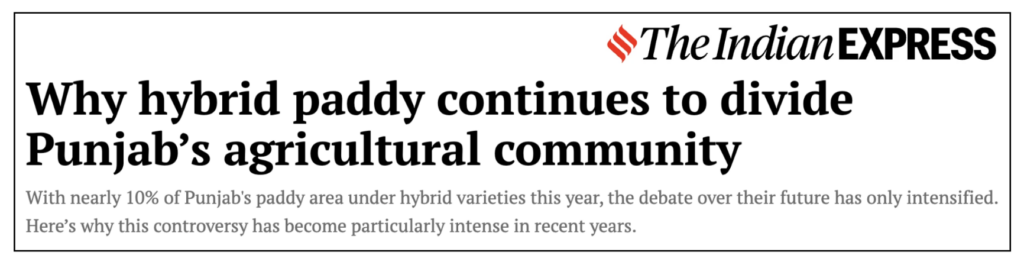
The debate over hybrid paddy has resurfaced in Punjab, with the state’s farming community sharply divided on whether to sow it for the 2026 kharif season. The Indian Express reported that hybrid varieties keep splitting opinion because the agronomic gains and the marketing losses pull in opposite directions.
Supporters point to higher yields and a shorter crop duration that saves irrigation water and widens the window before stubble burning; sceptics counter that hybrids deliver a lower milling out-turn ratio (OTR), cost far more in seed, and raise grain-quality doubts at the procurement gate.
- Hybrid paddy can out-yield conventional high-yielding varieties (HYVs) but typically shows a lower milling/out-turn recovery of whole rice.
- Procurement agencies and millers judge paddy on the out-turn ratio — the share of intact milled rice — so a weaker OTR can hold up MSP purchase.
- Hybrid seed cannot be saved and resown each year, forcing farmers to buy fresh seed annually at a much higher cost.
- Some hybrids mature faster, trimming the groundwater drawn for transplanted rice in a state where the water table is falling sharply.
- Concerns over cooking quality and broken-grain percentage have led to periodic state-level curbs on selling specific hybrid varieties.
The development matters in the context of:
- In the context of groundwater depletion, any variety that shortens the paddy’s standing period reduces the number of irrigation cycles a tube well must run.
- In the context of crop diversification, the hybrid-paddy row underlines how deeply the rice-wheat cycle is locked in by assured MSP procurement.
UPSC Relevance
Prelims Relevance
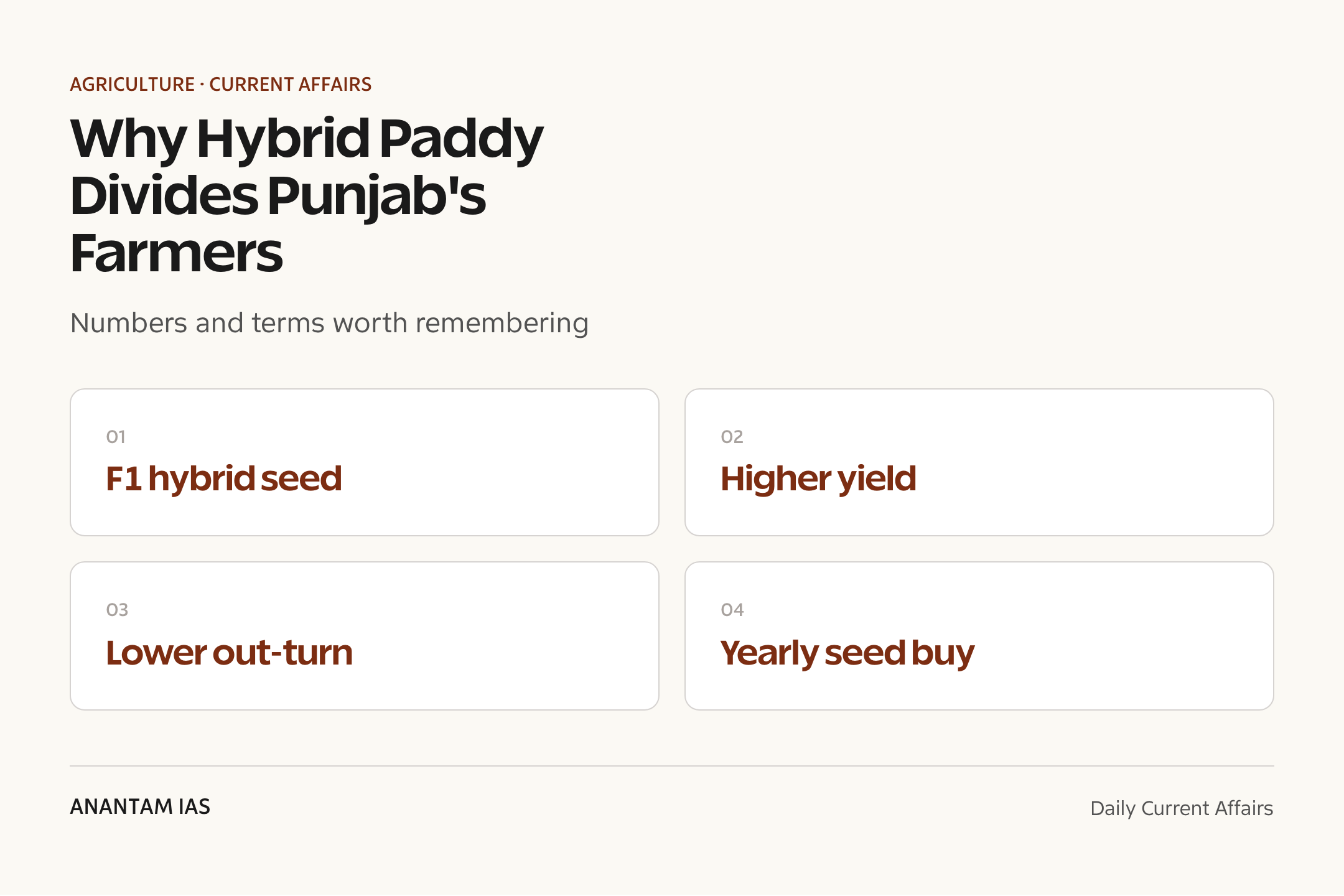
- Hybrid vs HYV (inbred) seeds — hybrid (F1) seed is the first-generation cross of two parent lines and loses vigour if resown; HYVs breed true.
- Out-turn ratio (OTR) — the percentage of whole milled rice recovered from paddy, the basis on which millers and the FCI accept grain.
- Minimum Support Price (MSP) and the role of the Food Corporation of India (FCI) in procurement.
- Custom Milling of Rice (CMR) — the system under which millers convert procured paddy into rice for the central pool.
- Punjab Agricultural University (PAU), Ludhiana — its varietal recommendations and the PR series of rice varieties.
- Rice-wheat cropping system of the Indo-Gangetic plains and its link to groundwater stress.
- Stubble (parali) burning and the link between paddy maturity dates and the rabi sowing window.
- Seeds Act, 1966 and seed certification/notification of varieties.
- Protection of Plant Varieties and Farmers’ Rights (PPV&FR) Act, 2001 — the right of farmers to save and exchange seed.
Mains Relevance
GS Paper 3
- Examine why hybrid paddy divides Punjab’s farmers, weighing yield and water gains against milling out-turn, seed cost and quality concerns.
- Assess how MSP-led procurement and the out-turn ratio shape the varietal choices farmers actually make.
GS Paper 3
- Discuss crop diversification as a route out of the water-intensive rice-wheat cycle in north-west India.
Essay
- Technology can raise the yield, but not always settle the price.
- The cost of cheap water: agriculture in a depleting aquifer.
Background and Context
Hybrid vs HYV: what actually differs
The split starts with the seed and how it is bred.
- A hybrid (F1) is the first-generation cross of two distinct parent lines, bred for hybrid vigour (heterosis) that lifts yield in year one.
- HYVs are inbred, true-breeding varieties; their saved seed reproduces the same plant, so farmers can keep and resow it.
- Hybrid vigour does not carry to the next generation, so hybrid seed must be bought fresh every season at a steep premium.
- Hybrids often promise higher per-acre yield and, in several cases, a shorter duration to maturity than popular non-basmati HYVs.
The out-turn ratio problem
Higher field yield does not always mean more sellable rice.
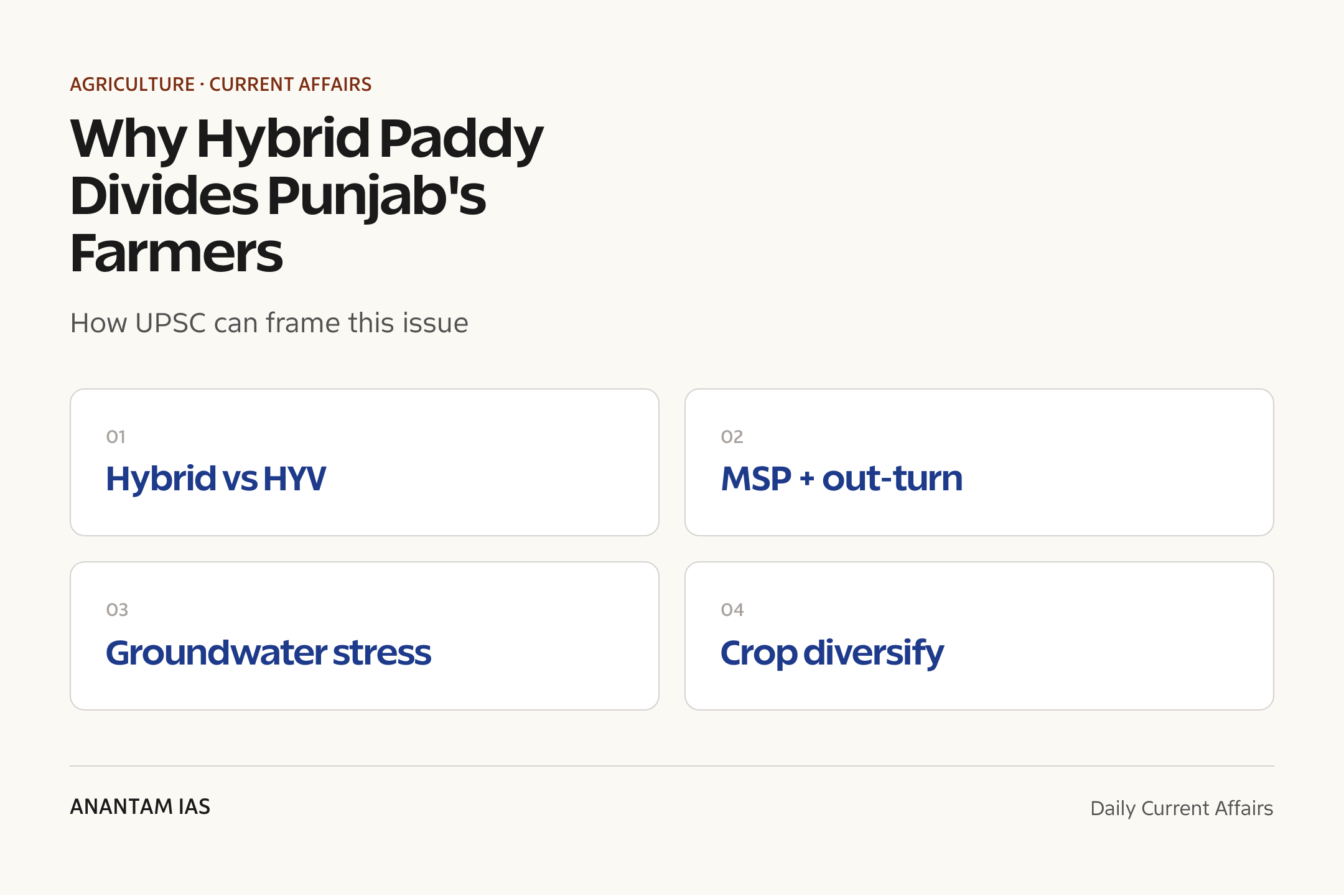
- Paddy is bought and milled on its out-turn ratio (OTR) — the share of whole, unbroken rice recovered after milling.
- Farmers and millers complain that many hybrids give a lower milling recovery and a higher broken-grain percentage.
- Under Custom Milling of Rice (CMR), millers must hand a fixed quantity of rice to the central pool from the paddy they take, so a poor OTR squeezes their margins.
- A weaker out-turn can slow or complicate procurement, the very assurance that draws farmers to paddy in the first place.
Why procurement and MSP drive the choice
In Punjab, the buyer’s yardstick decides the seed.
- Assured MSP purchase by the FCI and state agencies makes paddy a near risk-free crop, anchoring the rice-wheat cycle.
- Because grain is graded on quality and out-turn, varieties that fail those tests struggle even if they yield more in the field.
- Quality and broken-grain doubts have at times prompted state-level curbs on selling specific unrecommended hybrids.
- The farmer’s real calculation is not yield alone but an assured, hassle-free sale at MSP.
Water, duration and stubble
Crop duration ties the seed debate to Punjab’s deepest problems.
- Punjab’s groundwater table is falling fast as transplanted paddy is irrigated through the hot months from over-exploited aquifers.
- A shorter-duration variety needs fewer irrigation cycles and frees up the tube well, easing water draw.
- Earlier maturity also widens the gap before wheat sowing, giving farmers time to manage residue and reduce stubble burning.
- PAU and policy have pushed shorter-duration PR-series varieties precisely to cut water use and the parali-burning rush.
The seed cost and seed industry angle
Hybrids change the economics of who controls the seed.
- Hybrid seed costs many times more than self-saved HYV seed and must be repurchased annually.
- This shifts value toward the private seed industry and away from farmer seed-saving protected under the PPV&FR Act, 2001.
- Variety notification and quality fall under the Seeds Act, 1966 and state certification machinery.
- Sceptical farmers see recurring seed bills as a new input dependence with uncertain payback.
PAU’s role and the diversification debate
The science and the policy goals do not always line up with the market.
- Punjab Agricultural University (PAU) recommends specific varieties; farmers weigh its advice against millers’ real-world acceptance.
- The hybrid row exposes how hard crop diversification is when paddy alone carries an MSP-backed guarantee — a legacy of the Green Revolution in Punjab.
- Alternatives such as maize, pulses, oilseeds and basmati save water but lack the same assured procurement.
- Genuine diversification needs market and price support for non-paddy crops, not just better paddy seed.
Way Forward
Fix the quality-and-payment gap
- Calibrate procurement so a fair out-turn ratio is rewarded and farmers are not penalised for variety alone.
- Back varietal release with transparent milling-recovery data so growers know the trade-off before sowing.
Tie seed choice to water saving
- Promote tested short-duration varieties that cut irrigation cycles and ease the stubble-burning window.
- Pair seed advice with incentives for direct-seeded rice (DSR) and metered groundwater use.
Make diversification real
- Extend assured procurement and price support to maize, pulses and oilseeds so farmers can leave paddy without losing income.
- Strengthen PAU extension so that varietal and agronomic advice reaches every cluster.
Treat the hybrid-paddy question as a symptom, not the disease: the deeper fix is to loosen the MSP-locked rice-wheat cycle through credible markets for water-light crops, so that seed choice is no longer a gamble between yield in the field and acceptance at the procurement gate.
Conclusion
Hybrid paddy divides Punjab because it forces a single decision to carry two opposite truths — it can raise the yield and save water through a shorter duration, yet it can also lower the milling out-turn, cost more in seed and raise quality doubts that matter at the MSP counter.
The real argument is less about a seed than about a system: as long as procurement and the out-turn ratio decide a farmer’s income, technology that gains in the field but loses at the mandi will keep splitting opinion. The durable answer lies in crop diversification and fair pricing, not in the hybrid debate alone.
UPSC Practice Questions
Prelims MCQ 1
With reference to hybrid and high-yielding varieties (HYVs) of seed, consider the following statements:
- Hybrid seed is the first-generation cross of two parent lines and loses its yield advantage if resown.
- HYVs are inbred, true-breeding varieties whose saved seed reproduces the same plant.
- The out-turn ratio measures the percentage of whole milled rice recovered from paddy.
How many of the above statements are correct?
(a) Only one (b) Only two (c) All three (d) None
Answer: (c) All three
Explanation:
Hybrid (F1) seed does not pass on hybrid vigour, so it is bought fresh each year; HYVs breed true and can be saved; and the out-turn ratio is exactly the share of whole milled rice recovered from paddy. All three are correct.
Prelims MCQ 2
In India’s paddy procurement system, the ‘out-turn ratio’ primarily refers to which of the following?
(a) The proportion of whole, unbroken rice obtained on milling a given quantity of paddy (b) The ratio of MSP to the open-market price of paddy (c) The share of paddy area irrigated by tube wells (d) The percentage of the harvest sold outside the mandi system
Answer: (a) The proportion of whole, unbroken rice obtained on milling a given quantity of paddy
Explanation:
The out-turn ratio (OTR) is the recovery of intact milled rice from paddy. Millers and the FCI use it to grade and accept paddy under custom milling, which is why a low OTR worries growers.
UPSC Mains Questions
- Hybrid paddy offers Punjab higher yields and a shorter, water-saving duration, yet it divides farmers over milling out-turn, seed cost and quality. Examine this trade-off and explain why procurement norms ultimately shape varietal choice. (250 words)
- Assured MSP procurement has locked north-west India into a water-intensive rice-wheat cycle. Discuss the barriers to crop diversification and suggest measures to make water-light alternatives economically attractive. (250 words)
- Distinguish between hybrid and high-yielding (inbred) varieties of seed, and analyse the implications of rising hybrid-seed dependence for farmers’ seed rights and input costs. (150 words)
Sources: Punjab Agricultural University (PAU) and The Indian Express (Explained).
Frequently Asked Questions
What is hybrid paddy?
Hybrid paddy is grown from first-generation (F1) seed produced by crossing two distinct parent rice lines. This cross gives ‘hybrid vigour’, often lifting first-year yield above conventional high-yielding varieties. But the vigour does not pass to the next generation, so farmers must buy fresh hybrid seed every season rather than saving and resowing it.
How is hybrid paddy different from a high-yielding variety?
A high-yielding variety (HYV) is an inbred, true-breeding line: its saved seed grows into the same plant, so it can be reused for years. A hybrid is a one-time cross that loses its yield edge if resown. Hybrids may yield more or mature faster, but they cost far more in seed and cannot be saved on the farm.
Why do Punjab’s farmers disagree over hybrid paddy?
The gains and losses pull in opposite directions. Hybrids can yield more and mature faster, saving irrigation water and easing the stubble-burning rush. But farmers report a lower milling out-turn, costly seed that must be bought yearly, and grain-quality doubts that can complicate sale at MSP. The choice becomes a gamble between field yield and acceptance at the mandi.
What is the out-turn ratio and why does it matter?
The out-turn ratio (OTR) is the percentage of whole, unbroken milled rice recovered from a quantity of paddy. Millers and the Food Corporation of India use it to grade and accept paddy under custom milling. If a hybrid gives a low OTR with more broken grain, millers lose margin and farmers may face delays or resistance at procurement.
How does hybrid paddy connect to Punjab’s groundwater crisis?
Transplanted paddy is heavily irrigated from falling aquifers through the hot months. A shorter-duration variety needs fewer irrigation cycles, so it draws less groundwater and frees up tube wells sooner. Earlier maturity also widens the gap before wheat sowing, giving farmers more time to manage crop residue instead of burning it.
Why is crop diversification so hard in Punjab?
Assured MSP purchase by the FCI makes paddy a near risk-free crop, anchoring the rice-wheat cycle. Water-light alternatives such as maize, pulses and oilseeds save groundwater but lack the same guaranteed procurement and price. Until those crops get credible markets and price support, farmers have little reason to leave paddy, hybrid or not.