
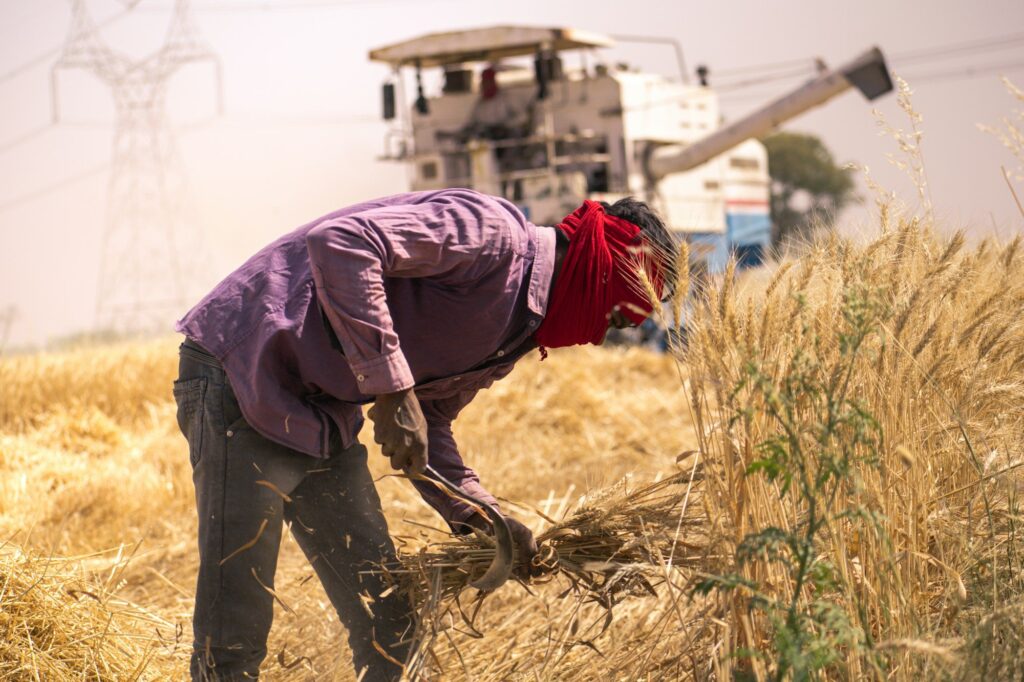
The Green Revolution in India is the name for the rapid intensification of grain agriculture that began in the mid-1960s and converted a country that lived on imported wheat into one that filled its own granaries. It rested on a tight package: high-yielding variety (HYV) seeds bred at CIMMYT and IRRI, assured irrigation, chemical fertilizers, pesticides, and guaranteed procurement at minimum support prices. By the early 1970s wheat output had nearly doubled, and the food-aid dependence that had humiliated New Delhi during the PL-480 years was over.
The political memory matters. In 1965 and 1966 monsoons failed back-to-back, and India was reduced to a “ship-to-mouth” existence under US wheat imports. The Green Revolution in India was not just an agronomic project — it was a sovereignty project, designed to make sure no foreign government could again hold the country’s food supply over its head.
Origins: from ship-to-mouth to self-sufficiency
The intellectual seed of the Green Revolution in India was planted in Mexico. There, agronomist Norman Borlaug had bred semi-dwarf wheat varieties that responded heavily to fertilizer without lodging — the tall stems of traditional wheat collapsed under the weight of fertilized grain heads, but the short Mexican lines stood up. Borlaug’s wheat doubled Mexican yields between 1944 and 1963 and won him the 1970 Nobel Peace Prize.
In India, the agriculture minister C. Subramaniam and geneticist M.S. Swaminathan pushed for importing Borlaug’s seeds despite resistance from those who feared cultural and ecological disruption. In 1963 Swaminathan invited Borlaug to India. By 1965-66, 18,000 tonnes of Mexican wheat seed — Lerma Rojo and Sonora 64 — were shipped to India and distributed in Punjab, Haryana, and western Uttar Pradesh. The first harvest in 1966-67 produced a wheat surplus large enough that storage became a problem.
For rice, the parallel breakthrough came from IRRI in the Philippines, where IR-8 — a semi-dwarf indica variety — yielded five times more than traditional cultivars. India released its own lines including Jaya and Padma. The Green Revolution in India is sometimes called the Wheat Revolution because wheat responded faster than rice, but rice eventually caught up in the irrigated tracts of Punjab, Tamil Nadu, and Andhra Pradesh.
The package: IADP, IAAP, and the trinity
Government did not just distribute seeds. It built an entire delivery system around them.
Intensive Agricultural District Programme (IADP)
Launched in 1960-61 with Ford Foundation help, the IADP picked seven districts — one per state — that had assured irrigation and good infrastructure. Each district got a concentrated package: credit, fertilizer, extension agents, soil testing, and assured procurement. The lesson was that scattered, thin investment achieved nothing; concentrated input use achieved transformation.
Intensive Agricultural Areas Programme (IAAP)
In 1964 the package was extended to 114 districts under the IAAP. By the time HYV seeds arrived, the institutional plumbing was in place.
The irrigation-fertilizer-pesticide trinity
HYV seeds were not magic. They yielded high only when fed water and fertilizer on schedule. The Green Revolution in India therefore needed three things simultaneously:
- Assured irrigation — tubewell expansion in Punjab from a few thousand in 1960 to over 800,000 by 1980, plus canal extension from the Bhakra-Nangal and other multipurpose projects.
- Chemical fertilizers — nitrogen, phosphorus, potassium consumption rose from 0.3 million tonnes in 1960-61 to 5.5 million tonnes by 1980-81.
- Pesticides — DDT, BHC, and other compounds, distributed at subsidized rates.
Wrap this trinity around HYV seed and the package became a self-reinforcing system. Take any one element away and the yields collapsed.
The geography: why Punjab, Haryana, western UP
The Green Revolution in India was not uniform. It concentrated in a narrow north-western belt — Punjab, Haryana, and western Uttar Pradesh — for several converging reasons.
First, these states had inherited from colonial canal investment the densest irrigation network in the country. Second, land consolidation in Punjab after independence created compact holdings that justified mechanization. Third, the predominantly Jat and Sikh peasantry was commercially oriented and willing to take risks on new inputs. Fourth, the Food Corporation of India and the new procurement system guaranteed a buyer at remunerative prices, removing market risk.
The result was historic. Punjab, with 1.5 percent of India’s area, came to produce nearly 50 percent of the central pool’s wheat at the peak of the Green Revolution in India. Per-hectare wheat yields in Punjab tripled between 1965 and 1985.
Achievements
By the standards it was meant to meet, the Green Revolution in India succeeded.
- Foodgrain output rose from 72 million tonnes in 1965-66 to 152 million tonnes in 1983-84 and 264 million tonnes by 2013-14.
- Wheat output alone went from 12 million tonnes in 1964-65 to over 100 million tonnes by 2020.
- Famine was eliminated as a recurring threat. The last great Indian famine of the colonial pattern was Bengal 1943; the Green Revolution made sure that pattern did not return.
- PL-480 imports ended in 1971. India became a wheat exporter by the 2000s.
- Buffer stocks for the public distribution system became possible. The right to food, eventually legislated in 2013, rests on the surplus the Green Revolution created. See the food security framework that depends on this surplus.
Criticisms and costs
The Green Revolution in India also generated its own pathologies, many of which now dominate agricultural policy debate.
Regional disparity
The package worked only where water, capital, and institutions were already in place. The rain-fed dryland tracts of central and eastern India — Bundelkhand, Vidarbha, eastern UP, Bihar, Odisha — were largely bypassed. Per-capita agricultural income gaps between Punjab and Bihar widened sharply through the 1970s and 1980s.
Ecological costs
Punjab’s water table fell by over a metre per year in central districts. Soil salinity and sodicity spread across over 6 million hectares. Pesticide residues entered the food chain — the cancer train from Bathinda to Bikaner has become a public-health symbol of these costs. Read about mechanisation of Indian agriculture and its parallel impacts.
Inequality within regions
HYV seeds favoured those who could afford tubewells, tractors, and fertilizer. Small and marginal farmers either could not adopt the package or did so on borrowed credit that pushed them into debt. The benefits clustered at the top of the rural class structure.
Crop bias
The Green Revolution in India focused overwhelmingly on wheat and rice. Pulses, oilseeds, millets, and coarse grains — the staples of the poor and the dryland cultivator — were left behind. India still imports edible oils worth over USD 20 billion a year, a legacy of this neglect.
Procurement distortion
The MSP-FCI system that guaranteed off-take for wheat and paddy locked Punjab and Haryana into a rice-wheat rotation that does not suit either ecology. Diversification has been attempted repeatedly and failed because the procurement structure does not support it. See legalisation of MSP challenges for the current debate.
The Second Green Revolution: Eastern India
By the 1990s it was clear that further yield gains in Punjab-Haryana would be expensive and ecologically damaging. The eastern belt — Bihar, eastern UP, West Bengal, Odisha, Assam — had abundant groundwater, soil fertility, and labour, but it had been bypassed by the first wave.
The Bringing Green Revolution to Eastern India (BGREI) programme was launched in 2010-11 under the Rashtriya Krishi Vikas Yojana. It targets paddy productivity gains, asset-building for water management, site-specific nutrient management, and farm mechanization. Bihar’s rice output has roughly doubled since the programme began, and West Bengal continues to be among the largest rice producers in the country.
This second wave is the unfinished business of the Green Revolution in India. Whether it can lift the east without repeating the ecological mistakes of the first wave is the agricultural policy question of the decade.
Evergreen Revolution: the Swaminathan framing
In his later work Swaminathan argued for an Evergreen Revolution — productivity gains “in perpetuity without ecological harm.” The toolkit is different: precision agriculture, integrated pest management, organic and natural farming where it fits, climate-resilient varieties, micro-irrigation, and diversification into pulses, oilseeds, horticulture, dairy, and fisheries.
The dairy story has its own arc — see white revolution India and the broader animal husbandry and dairy in India trajectory. The fisheries story is in blue revolution India and fisheries India. All three revolutions trace back to the institution-building method of the first.
UPSC angle: what to remember
For Mains GS-III the Green Revolution in India sits at the intersection of food security, technology, ecology, and equity. The standard line of argument is that it was an unavoidable response to a food-import emergency, that it succeeded brilliantly at its narrow goal of grain surplus, that its costs in regional disparity and ecological damage are now front-loaded into Indian agriculture, and that the next phase must be evergreen, eastern, and diversified.
The biographical thread runs through M.S. Swaminathan, the scientist who anchored the Indian end of the project and who later became its most articulate critic and reformer. Borlaug supplied the wheat; Swaminathan supplied the institutional architecture and the political will.
Frequently Asked Questions
What is the Green Revolution in India?
The Green Revolution in India is the package of high-yielding variety seeds, irrigation, fertilizers, pesticides, and procurement support that, from the mid-1960s, raised foodgrain output sharply and ended India’s dependence on food imports. It centred on wheat and rice in Punjab, Haryana, and western Uttar Pradesh.
When did the Green Revolution begin in India?
The institutional groundwork began with the Intensive Agricultural District Programme in 1960-61, but the breakthrough harvest came in 1966-67 after Mexican HYV wheat seeds bred by Norman Borlaug were sown in Punjab, Haryana, and western UP.
Who is called the Father of the Green Revolution in India?
M.S. Swaminathan is called the Father of the Green Revolution in India. He worked with Norman Borlaug to import and adapt the Mexican semi-dwarf wheat varieties, designed the institutional package around them, and led the Indian Agricultural Research Institute during the takeoff years.
What were the main HYV seeds used?
The principal HYV wheat varieties were Lerma Rojo and Sonora 64 from Mexico, followed by Indian-bred lines like Kalyan Sona and Sonalika. For rice, IR-8 from IRRI Philippines was the foundational line, with Jaya and Padma developed in India.
What were the criticisms of the Green Revolution in India?
The major criticisms are regional disparity (benefits concentrated in the north-west), ecological damage (falling water table, soil salinity, pesticide residues), inequality within regions (large farmers gained more than small), crop bias (wheat and rice favoured over pulses and millets), and lock-in of the rice-wheat rotation through MSP procurement.
What is the Second Green Revolution?
The Second Green Revolution refers to extending intensive agriculture to eastern India — Bihar, eastern UP, West Bengal, Odisha, Assam — through the Bringing Green Revolution to Eastern India (BGREI) programme launched in 2010-11. The aim is to use the east’s water and soil endowment without repeating the ecological damage of the first wave.
What is the Evergreen Revolution?
The Evergreen Revolution is M.S. Swaminathan’s later framing for productivity growth without ecological harm. It combines precision agriculture, integrated pest management, climate-resilient seeds, micro-irrigation, and diversification into pulses, oilseeds, horticulture, dairy, and fisheries.
How did the Green Revolution affect India’s food security?
The Green Revolution in India ended dependence on PL-480 wheat imports by 1971, built the buffer stocks that the public distribution system runs on, and made the right to food legislation of 2013 fiscally possible. Famine of the colonial Bengal-1943 type has not returned.
Tell Google you want more of this.
Add Anantam IAS as a preferred sourceOne tap, and this site shows up more often in your own Top Stories, AI Overviews and AI Mode. Remove it any time.





