India-Bhutan Development Partnership: Projects, Credit and Strategic Trust
Why in News?
At the fifth India-Bhutan Development Cooperation Talks in Thimphu on 30-31 July 2026 , Foreign Secretary Vikram Misri and Bhutanese Foreign Secretary Pema Lektup Dorji reviewed India’s support for Bhutan’s 13th Five-Year Plan .
- The new 12 PTA projects cover infrastructure, healthcare, agriculture, urban amenities and disaster management.
- The cumulative approved portfolio now stands at 82 PTA projects worth ₹6,860 crore under Bhutan’s 13th Plan.
- India’s total committed support for the 2024-29 Plan is ₹10,000 crore across project aid, local projects, economic stimulus and budget support.
- The two sides inaugurated Thimphu Ecological Park and Olakha Park and handed over 45 electric vehicles to Bhutan.
- An AIIMS New Delhi-KGUMSB MoU was exchanged for research and exchange programmes in health education and training.
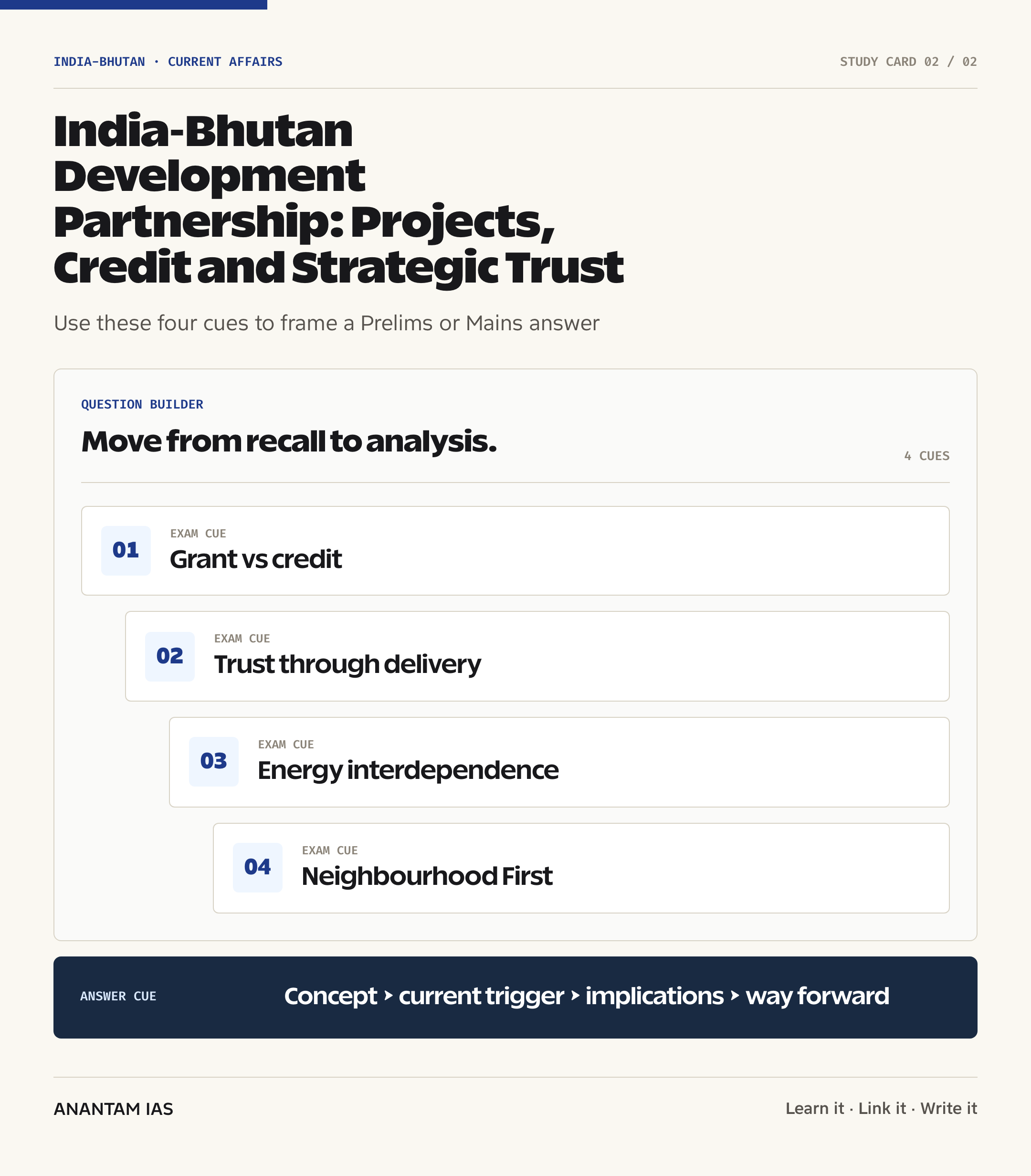
- This matters in the context of India’s Neighbourhood First approach, where timely delivery can convert geographic proximity into durable goodwill.
- The blend of grants and concessional credit shows that development partnership is moving beyond isolated projects toward long-term productive capacity.
- Energy cooperation creates mutual interdependence: Bhutan gains investment and export revenue, while India gains clean power and a stable Himalayan partner.
UPSC Relevance
Prelims Relevance
- Bhutan’s 13th Five-Year Plan covers 2024-29; India has committed ₹10,000 crore in support.
- Project Tied Assistance funds agreed medium-to-large projects linked to identified sectors and implementation outcomes.
- High Impact Community Development Projects are smaller, short-gestation works implemented mainly through local governments.
- The other support windows are the Economic Stimulus Programme and Programme Grant, the latter functioning as direct budgetary support.
- A Line of Credit is repayable financing on agreed terms; it isn’t the same as grant assistance.
- The ₹4,000-crore energy LoC is to be operationalised through the EXIM Bank of India and the Royal Government of Bhutan.
Mains Relevance
GS Paper 2
- Use the case to explain Neighbourhood First, asymmetric interdependence and the role of demand-driven development cooperation in building trust with smaller neighbours.
- Assess how project delivery, high-level political contact and respect for Bhutanese priorities strengthen India’s strategic credibility in the eastern Himalaya.
GS Paper 3
- Connect the energy LoC to cross-border electricity trade, renewable integration, grid connectivity and regional energy security.
- Evaluate Himalayan infrastructure through the lenses of disaster resilience, ecological safeguards, financing quality and lifecycle maintenance.
Essay
- Trust between unequal neighbours is built through consultation, reliability and restraint, not financial scale alone.
Background and Context
The Institutional Foundation of India-Bhutan Ties
The relationship rests on a treaty framework, frequent political engagement and a habit of joint consultation.
- The India-Bhutan Friendship Treaty of 2007 updated the 1949 treaty and affirms perpetual peace, friendship and close cooperation on national interests.
- The treaty also states that neither country will allow its territory to be used for activities harmful to the security and interests of the other.
- Regular contacts among the King of Bhutan, the two prime ministers, foreign ministers and officials help prevent routine implementation issues from becoming political distrust.
- The latest talks were co-chaired by the two Foreign Secretaries, reflecting an institutional process rather than a one-off announcement.
- India and Bhutan also work in wider regional settings; their bilateral confidence supports practical cooperation within BIMSTEC’s regional agenda.
How the ₹10,000-Crore Plan Support Is Structured
India’s commitment is divided among instruments designed for different scales and policy purposes.
- Of the ₹10,000 crore committed for 2024-29, ₹7,000 crore is earmarked for Project Tied Assistance, ₹1,000 crore for HICDPs, ₹1,500 crore for the Economic Stimulus Programme and ₹500 crore for Programme Grant.
- PTA projects support larger sectoral priorities such as health, education, agriculture, infrastructure, energy, urban development and capacity building.
- HICDPs, historically also called Small Development Projects, focus on quick local benefits such as water supply, irrigation, farm roads and community facilities.
- The Economic Stimulus Programme seeks to revive Bhutan’s domestic economy through support for priority sectors, enterprises, skills and employment.
- The Programme Grant is direct budgetary support, giving Bhutan policy space within its own expenditure priorities.
What the Fifth Plan Talks Added
The July 2026 meeting paired approval of new works with a review of funds already committed and released.
- The 12 new PTA projects worth ₹332 crore take the approved PTA portfolio to 82 projects worth ₹6,860 crore.
- The MEA recorded releases of ₹1,250 crore for ESP, ₹735.20 crore for HICDPs and ₹200 crore as Programme Grant.
- Reviewing utilisation is as important as announcing allocations because absorptive capacity, procurement, terrain and coordination can slow Himalayan projects.
- The two parks in Thimphu show an urban public-goods dimension, while the 45 electric vehicles connect development aid with cleaner mobility.
- The health MoU links AIIMS New Delhi with Khesar Gyalpo University of Medical Sciences of Bhutan for research, education and exchange, adding institutional depth beyond physical construction.
Grant Assistance and Line of Credit Are Different
UPSC answers should separate non-repayable assistance from repayable development finance.
- A grant doesn’t create a repayment obligation and is suited to public goods, community works and budget support where direct financial returns may be limited.
- A Line of Credit is a borrowing window with agreed terms, purpose and disbursement conditions; the borrower repays the amount according to the contract.
- The new ₹4,000-crore concessional LoC is intended for energy projects and is operationalised through EXIM Bank of India.
- Concessional finance can support productive assets, but appraisal must test project viability, repayment capacity, tariff assumptions and construction risk.
- The distinction helps avoid a common error: adding a credit line to plan grants and describing the whole amount as aid.
Way Forward
Deliver the Approved Portfolio Well
- Create joint milestone dashboards for the 82 PTA projects, with early escalation of land, procurement, design and contractor bottlenecks.
- Publish outcome indicators for health, agriculture, urban services and disaster management, not just financial utilisation figures.
- Protect operation and maintenance budgets so completed assets remain useful after the construction phase.
Conclusion
- The July 2026 outcomes show why India-Bhutan relations are best understood as an ecosystem of treaties, political trust, development delivery and economic interdependence.
- For India, the real strategic return won’t come from announcing the largest figure.
UPSC Practice Questions
Prelims MCQ 1
With reference to India’s support for Bhutan’s 13th Five-Year Plan, consider the following statements:
- The Plan period is 2024-29.
- Project Tied Assistance and High Impact Community Development Projects are both components of the support package.
- Programme Grant is a credit line that must be repaid through electricity exports.
How many of the above statements are correct?
(a) Only one (b) Only two (c) All three (d) None
Answer: (b) Only two
Explanation:
Statements 1 and 2 are correct. Programme Grant is direct budgetary support, not a repayable electricity-linked credit line.
Prelims MCQ 2
The ₹4,000-crore India-Bhutan umbrella Line of Credit agreement announced in July 2026 is primarily intended for:
(a) Energy projects in Bhutan (b) A common regional currency (c) Defence equipment purchases (d) Contributions to the SAARC Development Fund
Answer: (a) Energy projects in Bhutan
Explanation:
The agreement between the Royal Government of Bhutan and EXIM Bank of India operationalises a concessional LoC for energy projects.
UPSC Mains Questions
- India’s development partnership with Bhutan works through grants, concessional credit, institution-building and political consultation. Examine how these instruments can strengthen strategic trust while preserving Bhutanese ownership, fiscal prudence and environmental safeguards. Use the July 2026 Plan Talks as an example. (250 words)
- Energy interdependence is both an anchor and a source of risk in India-Bhutan relations. Discuss the economic and strategic gains from cross-border power cooperation, and suggest measures to address project delays, geological uncertainty, ecological stress, financing risks and changing electricity markets. (250 words)
Sources: Ministry of External Affairs, Government of India and The Indian Express.
Frequently Asked Questions
What were the July 2026 Plan Talks?
They were the fifth India-Bhutan Development Cooperation Talks for Bhutan’s 13th Five-Year Plan. The two foreign secretaries reviewed India’s ₹10,000-crore support package, approved 12 new projects, examined fund utilisation and witnessed exchanges covering an energy credit line and health education.
What is Project Tied Assistance?
Project Tied Assistance funds identified medium-to-large development projects agreed by India and Bhutan. The projects are tied to approved purposes and implementation plans in sectors such as health, education, agriculture, infrastructure, energy, urban development and capacity building, unlike untied direct.
Is the ₹4,000-crore LoC a grant?
No. A Line of Credit is repayable financing under agreed terms, although concessional conditions can make it cheaper than ordinary commercial borrowing. The July 2026 umbrella agreement between Bhutan and EXIM Bank of India is intended to finance energy projects.
Why is energy central to India-Bhutan ties?
Bhutan can use energy projects to generate revenue, infrastructure and technical capacity, while India gains access to clean electricity and a stable cross-border power partner. The relationship is mutually beneficial, but it also requires careful treatment of construction risk, tariffs.
How does development cooperation create strategic trust?
Trust grows when projects reflect Bhutanese priorities, funds arrive predictably, construction is completed well and citizens receive visible benefits. Transparent financing, local capacity building and respect for Bhutan’s sovereignty matter more than the headline value of assistance. Reliable delivery.