Why in News?
The fifth BIMSTEC National Security Chiefs’ Meeting was held in New Delhi on 16 July 2026, hosted by National Security Adviser Ajit Doval. Akashvani News reported that the seven member states reviewed cooperation against terrorism, transnational organised crime, cyber threats and maritime security challenges.
The meeting adopted guidelines for the maritime component of humanitarian assistance and disaster relief and endorsed guiding principles for maritime law-enforcement interactions at sea. The Ministry of External Affairs’ public account, reported by The Indian Express, says the principles are reference points for predictability and safety; it doesn’t describe them as a treaty or create a regional enforcement authority.
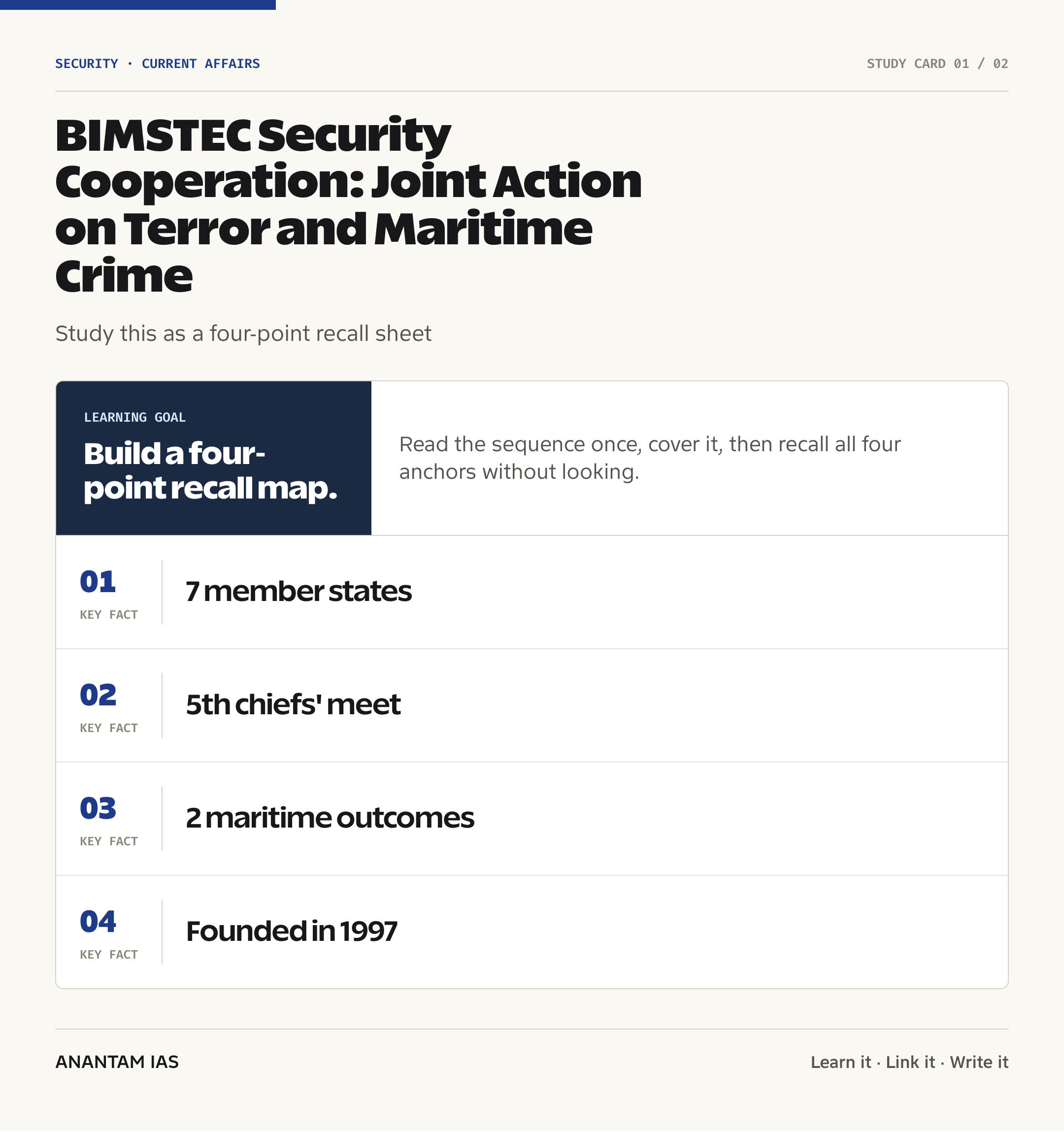
- Participants: National Security Advisers or heads of delegation from Bangladesh, Bhutan, India, Myanmar, Nepal, Sri Lanka and Thailand.
- First outcome: Maritime HADR guidelines meant to support faster, better-coordinated relief operations in the region.
- Second outcome: Guiding principles for the conduct of maritime law-enforcement agencies during encounters at sea.
- Wider agenda: Terrorism, organised crime, cyber security, maritime and energy security, connectivity, disaster management and emerging threats.
- Scale cited: Ajit Doval described BIMSTEC as representing about 1.7 billion people and a combined GDP close to US$5 trillion.
The development matters in the context of:
- Bay of Bengal threats cross borders: Trafficking, illicit finance, cyber incidents, maritime crime and disasters cannot be managed by one national agency acting alone.
- Regionalism needs operating rules: Safe encounters at sea, common contact points and compatible HADR procedures can convert political declarations into usable cooperation.
- Outcome language matters: Adoption or endorsement at a meeting is an institutional commitment, but legal force, compliance and domestic implementation depend on the instrument and national procedures.
UPSC Relevance
Prelims Relevance
- BIMSTEC stands for the Bay of Bengal Initiative for Multi-Sectoral Technical and Economic Cooperation.
- Its seven members are Bangladesh, Bhutan, India, Myanmar, Nepal, Sri Lanka and Thailand.
- BIMSTEC began through the Bangkok Declaration of 6 June 1997 as BIST-EC.
- The grouping’s permanent Secretariat is in Dhaka.
- India is the lead country for the Security sector, which covers Counter-Terrorism and Transnational Crime, Energy and Disaster Management.
- The BIMSTEC Charter was signed at Colombo on 30 March 2022 and gives the organisation legal personality.
- Under Article 18 of the BIMSTEC Charter, BIMSTEC decisions are based on consensus.
- HADR means Humanitarian Assistance and Disaster Relief.
- The National Security Chiefs’ mechanism grew from the 2016 Goa Retreat call for coordination and information sharing.
- The 2009 BIMSTEC Convention on terrorism, transnational organised crime and illicit drug trafficking entered into force on 16 March 2021.
Mains Relevance
GS Paper 2
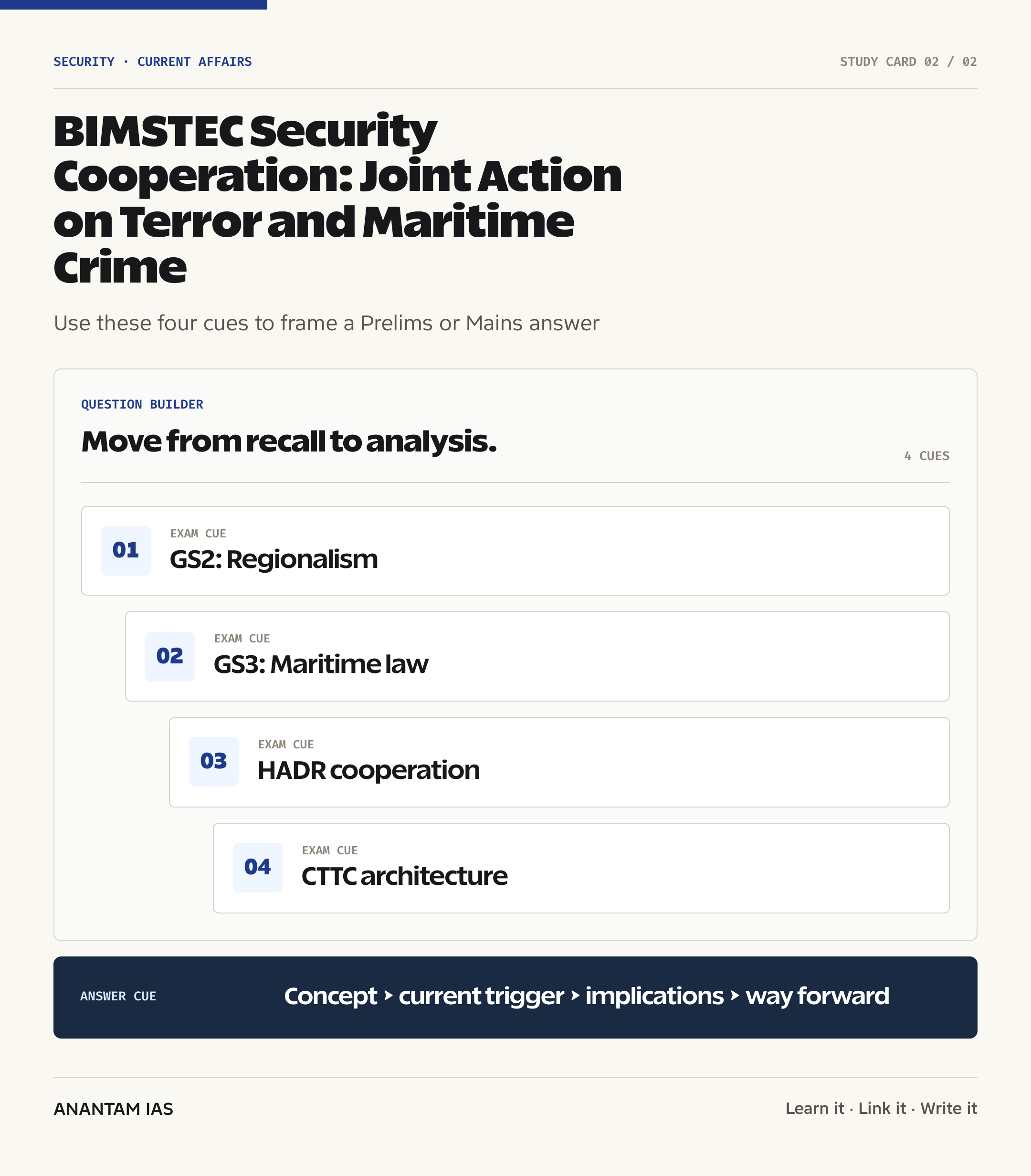
- Regional groupings: BIMSTEC as a bridge between South Asia and Southeast Asia and as a practical Bay of Bengal institution.
- India’s foreign policy: Convergence of Neighbourhood First, Act East and the Indo-Pacific outlook.
- Institutional effectiveness: Difference between declarations, guidelines, conventions and operational implementation.
GS Paper 3
- Internal security: Cross-border terrorism, organised crime, trafficking, terror finance and cyber-enabled criminal networks.
- Maritime security: Safe law-enforcement interactions, information exchange and rule-based conduct in a shared maritime space.
- Disaster management: Regional HADR coordination, interoperability and time-sensitive response.
Essay
- Shared geography requires shared capacity: The Bay of Bengal links prosperity, vulnerability and security.
- Institutions earn relevance through implementation: Rules, exercises and trusted channels matter more than summit language alone.
Background and Context
BIMSTEC: Membership, Origin and Institutional Design
BIMSTEC is a seven-member intergovernmental organisation built around the Bay of Bengal rather than a single continental identity.
- Origin: Bangladesh, India, Sri Lanka and Thailand signed the Bangkok Declaration on 6 June 1997, creating BIST-EC.
- Expansion: Myanmar joined in December 1997; Bhutan and Nepal joined in 2004, giving the grouping its present seven-member form.
- Geographic bridge: Bangladesh, Bhutan, India, Nepal and Sri Lanka connect the South Asian side, while Myanmar and Thailand connect Southeast Asia.
- Institutionalisation: A permanent Secretariat opened in Dhaka in 2014, and the 2022 Charter supplied a legal and institutional framework.
- Decision rule: Article 18 of the Charter requires consensus, which protects sovereign equality but can slow collective action.
- Exam connection: Review BIMSTEC’s evolution, Charter and India’s role before comparing it with SAARC, ASEAN or IORA.
How the BIMSTEC Security Track Works
Security cooperation operates through political direction, specialised groups and national agencies rather than a supranational police or military command.
- Lead-country arrangement: India leads the Security sector after BIMSTEC rationalised its cooperation structure into seven broad sectors in 2021.
- Three sub-sectors: The official BIMSTEC structure places Counter-Terrorism and Transnational Crime, Energy and Disaster Management under Security.
- Chiefs’ mechanism: The 2016 Goa Retreat called for annual meetings of national security chiefs focused on information and intelligence sharing.
- Specialist mechanisms: The chiefs initiated expert groups on maritime security, cyber security and space security, along with security-dialogue forums.
- CTTC architecture: A Joint Working Group oversees sub-groups on intelligence sharing, legal and law-enforcement issues, narcotics, money laundering and terror finance, radicalisation, and human trafficking.
- National execution: Cooperation still depends on coast guards, police, customs, intelligence bodies, disaster agencies, prosecutors and other competent national authorities.
What the Fifth Security Chiefs' Meeting Produced
The New Delhi meeting produced two specific maritime outcomes and a wider political commitment to practical security cooperation.
- Maritime HADR guidelines were adopted: Their stated purpose is to help member states undertake relief operations across the region more quickly.
- Law-enforcement principles were endorsed: These are intended to guide agency conduct during interactions at sea and improve predictability and safety.
- Threat review: Delegations discussed counterterrorism, organised crime, cyber, maritime and energy security, connectivity, disaster management and emerging risks.
- Institutional review: BIMSTEC Secretary General Indra Mani Pandey briefed members on the status of cooperation across the security sector.
- Capacity emphasis: The participants called for more collaboration, knowledge sharing, resilience and institutional capability as BIMSTEC approaches its thirtieth anniversary in 2027.
- No overclaim: The public summary doesn’t announce a joint force, common criminal jurisdiction, automatic intelligence access or a compliance mechanism.
Why Maritime HADR and Encounter Rules Matter
A shared maritime space needs both emergency cooperation and predictable agency behaviour during routine or tense encounters.
- HADR defined: Humanitarian Assistance and Disaster Relief covers support to save lives, reduce suffering and restore essential services after emergencies.
- Regional exposure: Cyclones, storm surges, floods, earthquakes and maritime accidents can overwhelm local capacity and require rapid cross-border support.
- Interoperability: Common procedures can clarify requests, points of contact, communications, logistics, search-and-rescue support and the handover of assistance.
- Maritime law enforcement: Depending on national law, coast guards, marine police, customs and fisheries authorities may encounter one another while policing shared or adjacent waters.
- Risk reduction: Agreed conduct can lower misunderstanding, unsafe manoeuvring and escalation when agencies communicate or operate close to each other.
- Legal backdrop: Regional principles should complement the law of the sea and national jurisdiction; they cannot override treaty rights or domestic law.
- Missing detail: The released account doesn’t publish the full text, command arrangements, communications protocol, exercises, funding or review timeline, so implementation remains the real test.
Counterterrorism and Transnational Crime: From Pledges to Cases
Criminal networks exploit differences in law, capability and information systems, making case-level cooperation more demanding than a political statement.
- Interlinked threats: Terror finance, narcotics, arms smuggling, human trafficking, document fraud, cybercrime and money laundering can share routes, intermediaries and digital infrastructure.
- Existing legal base: The 2009 BIMSTEC Convention on terrorism, transnational organised crime and illicit drug trafficking entered into force in March 2021 after ratification by all members.
- Practical needs: Investigators need timely focal points, admissible evidence, financial intelligence, suspect and vessel identification, and coordinated action within national law.
- Trust problem: Intelligence is sensitive, and members differ in threat perception, legal systems, technical capability and domestic politics.
- Rights safeguard: Counterterrorism coordination must retain legality, necessity, proportionality, due process and protection against arbitrary action.
- Performance measure: Useful indicators include response time to requests, joint training completed, actionable alerts exchanged, HADR drills held and cases supported, not only meetings convened.
Why BIMSTEC Security Cooperation Matters for India
For India, BIMSTEC joins continental neighbourhood concerns with the maritime and Southeast Asian dimensions of national security.
- Neighbourhood First: Bangladesh, Bhutan, Nepal, Myanmar and Sri Lanka are central to India’s immediate diplomatic and security environment.
- Act East: Myanmar and Thailand give BIMSTEC a direct link to Southeast Asia, complementing India-ASEAN engagement.
- Bay of Bengal: Secure sea lanes, resilient ports, disaster readiness and lawful maritime activity support trade, energy flows and coastal livelihoods.
- Northeast security: Stable border management and cooperation against trafficking and armed networks are tied to India’s engagement with Myanmar.
- Regional public goods: India can contribute training, hydrographic and disaster expertise, digital systems and capacity support without turning cooperation into dominance.
- Strategic value: BIMSTEC offers a functional platform when wider South Asian regionalism is constrained, but it should be assessed on its own delivery rather than only as a substitute for SAARC.
Limits and Answer-Building Guidance
A balanced UPSC answer should recognise the meeting’s concrete advances while separating declared intent from proven capability.
- Start with the outcome: Cite the maritime HADR guidelines and law-enforcement conduct principles as the two specific results.
- Explain the logic: Show how shared waters connect non-traditional security, disaster risk, organised crime and economic resilience.
- Add the architecture: Mention India’s lead role, the security chiefs, expert groups, JWG-CTTC and the consensus rule.
- State the gap: Publicly available reporting doesn’t show binding enforcement, a permanent operational command, dedicated finance or measurable timelines.
- Avoid false binaries: BIMSTEC can complement ASEAN, IORA, SAARC mechanisms and bilateral cooperation; its Charter explicitly treats cooperation as complementary.
- End with delivery: Recommend protocols, exercises, lawful information sharing, capacity support and a public implementation scorecard.
Way Forward
Publish Operational Protocols
- Release non-sensitive versions of the HADR guidelines and maritime conduct principles, including scope, responsible agencies and review arrangements.
- Create a maintained directory of 24/7 national contact points for maritime incidents, disaster requests and transnational crime alerts.
Test Interoperability
- Run regular tabletop and field HADR exercises with after-action reviews, not ceremonial demonstrations.
- Develop compatible incident formats, radio procedures and logistics checklists while respecting each state’s command structure.
Make Information Sharing Lawful and Useful
- Set clear thresholds for exchanging vessel, financial, cyber and criminal intelligence, with purpose limits, security controls and auditable access.
- Strengthen prosecutor-to-prosecutor and agency-to-agency channels so shared information can support admissible evidence and lawful investigation.
Close Capacity Gaps
- Offer joint training in digital forensics, maritime domain awareness, terror finance, search and rescue and disaster logistics.
- Use needs-based support and shared standards so smaller members can participate without dependence on a single provider.
Measure Delivery
- Adopt a concise annual security-cooperation scorecard covering exercises, response times, trained personnel and implemented decisions.
- Place rights, sovereignty, data protection and domestic law safeguards inside every operational mechanism to sustain trust.
Conclusion
The fifth BIMSTEC security chiefs’ meeting moved beyond a general declaration by producing two usable maritime coordination frameworks. Safer agency encounters and quicker HADR cooperation can become regional public goods if members translate agreed principles into protocols, training and reliable contact channels.
The stronger assessment is still implementation-focused: guidelines are not the same as a treaty, a joint force or proven operational capacity. BIMSTEC’s security credibility will rest on measurable cooperation that respects sovereignty, law and rights while addressing threats that no member can contain alone.
UPSC Practice Questions
Prelims MCQ 1
With reference to BIMSTEC, consider the following statements:
- It has seven member states linking South Asia and Southeast Asia.
- India is the lead country for BIMSTEC’s Security sector.
- Decisions under the BIMSTEC Charter are taken by qualified majority.
How many of the above statements are correct?
(a) Only one (b) Only two (c) All three (d) None
Answer: (b) Only two
Explanation:
Statements 1 and 2 are correct. BIMSTEC has seven members, and India leads its Security sector. Statement 3 is incorrect because Article 18 of the BIMSTEC Charter provides for decisions by consensus.
Prelims MCQ 2
Which one of the following best describes the two specific maritime outcomes of the fifth BIMSTEC National Security Chiefs’ Meeting?
(a) HADR guidelines and guiding principles for maritime law-enforcement interactions (b) A common navy and a binding regional criminal court (c) A fisheries free-trade agreement and a shared currency (d) A collective-defence treaty and a permanent military headquarters
Answer: (a) HADR guidelines and guiding principles for maritime law-enforcement interactions
Explanation:
The meeting adopted guidelines for the maritime component of humanitarian assistance and disaster relief and endorsed principles intended to improve predictability and safety when maritime law-enforcement agencies interact at sea.
UPSC Mains Questions
- BIMSTEC’s security relevance will be judged less by declarations and more by operational cooperation. Discuss this statement with reference to the 2026 maritime HADR guidelines, law-enforcement conduct principles and the institutional constraints on collective action in the Bay of Bengal region.
- Transnational crime, cyber threats and maritime disasters blur the boundary between internal security and foreign policy. Examine how India can use BIMSTEC to build regional public goods while protecting sovereignty, due process and trust among states with unequal capabilities.
Sources: Akashvani News, Prasar Bharati and The Indian Express.
Frequently Asked Questions
What did the BIMSTEC security chiefs decide?
They adopted guidelines for the maritime part of humanitarian assistance and disaster relief and endorsed guiding principles for maritime law-enforcement agencies interacting at sea. They also reviewed cooperation against terrorism, organised crime, cyber, maritime and energy-security threats. The public summary doesn’t create a joint force or regional police authority.
Are the maritime principles legally binding?
The released account calls them guiding principles and reference points for safety and predictability. It doesn’t describe them as a treaty or specify sanctions and enforcement. Their practical weight will depend on the approved text, national acceptance, agency procedures, training and repeated use during real operations and exercises.
Which countries are BIMSTEC members?
The seven members are Bangladesh, Bhutan, India, Myanmar, Nepal, Sri Lanka and Thailand. This membership links South Asia with Southeast Asia around the Bay of Bengal. BIMSTEC began in 1997 with four countries; Myanmar joined later that year, while Bhutan and Nepal joined in 2004.
Who leads BIMSTEC security cooperation?
India is the lead country for BIMSTEC’s Security sector. Its three official sub-sectors are Counter-Terrorism and Transnational Crime, Energy, and Disaster Management. Work is distributed across national security chiefs, a joint working group, specialised sub-groups and expert mechanisms, while implementation remains with competent national agencies.
Why is maritime HADR important here?
Bay of Bengal states face cyclones, storm surges, floods, earthquakes and maritime accidents that can demand rapid assistance across borders. Shared HADR procedures can clarify requests, contact points, logistics, communications and agency roles. Exercises and after-action reviews are needed to prove that written guidance works under time pressure.
How should a Mains answer evaluate this meeting?
Open with the two concrete outcomes, connect them to shared Bay of Bengal threats, and explain BIMSTEC’s security architecture and India’s lead role. Then note the gaps: no publicly stated enforcement body, dedicated funding, command chain or measurable timetable. End with protocols, exercises, lawful information sharing, capacity support and monitoring.
Tell Google you want more of this.
Add Anantam IAS as a preferred sourceOne tap, and this site shows up more often in your own Top Stories, AI Overviews and AI Mode. Remove it any time.