Xuanzang’s Legacy: India and China Weigh a Joint UNESCO Nomination
Why in News?
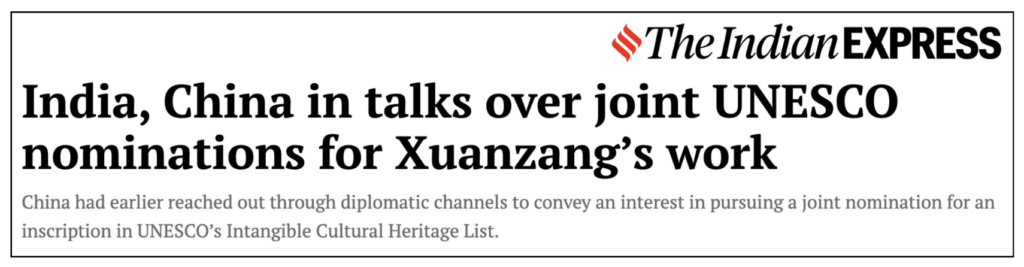
India and China are in early talks over a joint UNESCO nomination linked to the writings of Xuanzang (also rendered Hiuen Tsang), the 7th-century Chinese Buddhist pilgrim who studied at Nalanda Mahavihara and wrote the most detailed surviving outsider account of early-medieval India. The Indian Express reported on 14 June 2026 that the two sides are exploring a shared submission to the UNESCO Memory of the World Register.
The move treats Xuanzang’s record as a piece of shared documentary heritage rather than a contested artefact — a rare convergence point between two civilisational neighbours whose modern ties are dominated by the border question.
- Reported by The Indian Express on 14 June 2026: India and China in talks for a joint nomination of Xuanzang-linked work.
- The likely vehicle is the UNESCO Memory of the World Register (documentary heritage), not the World Heritage List (sites/monuments).
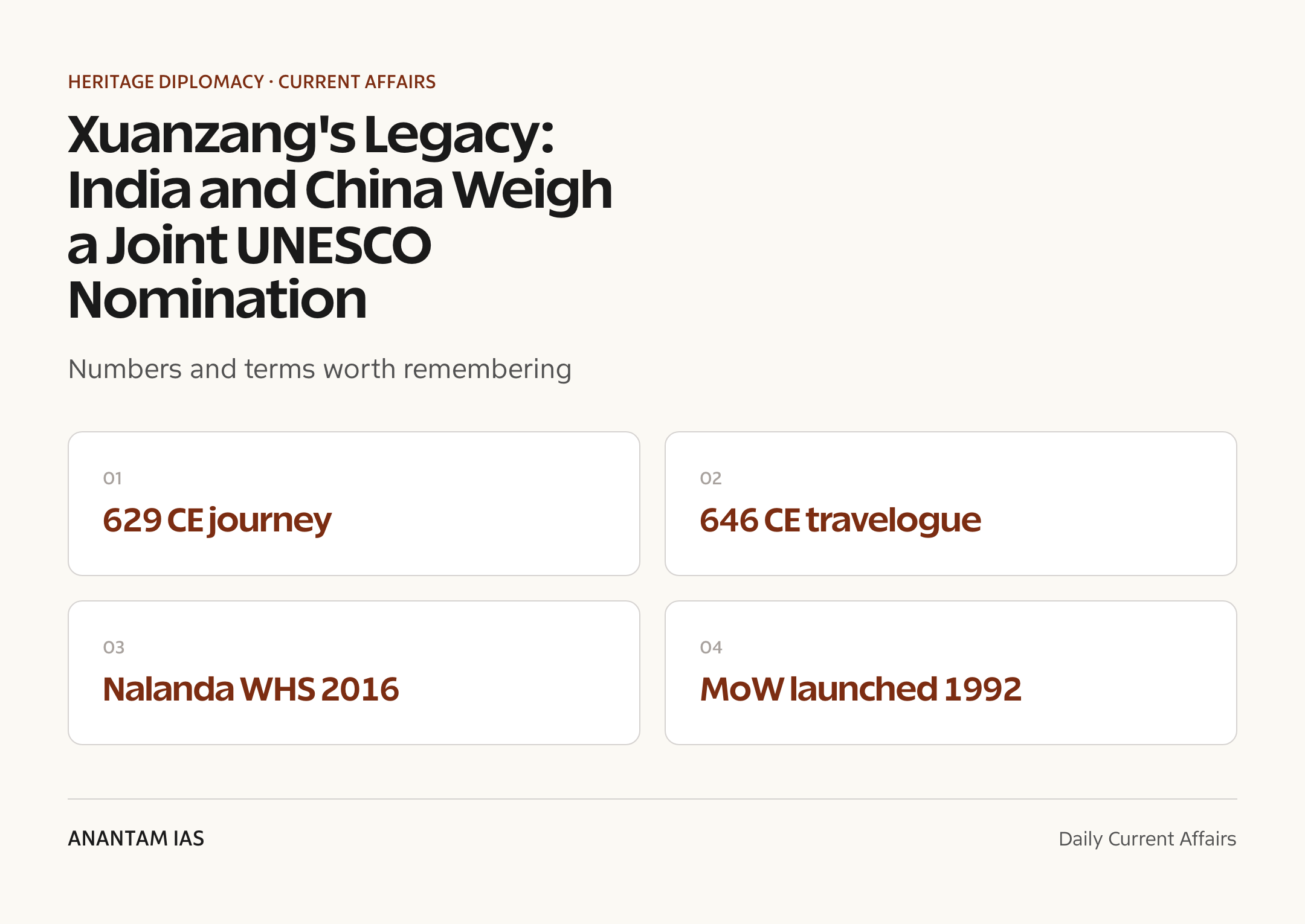
- The core text is the Great Tang Records on the Western Regions (Da Tang Xiyu Ji, 646 CE), Xuanzang’s travelogue of his journey to India.
- Xuanzang studied for years at Nalanda Mahavihara under the abbot Shilabhadra during the reign of Harshavardhana (c. 606-647 CE).
- Nalanda was inscribed as a UNESCO World Heritage Site in 2016 (the archaeological ruins in Bihar).
The development matters in the context of:
- Cultural and documentary heritage offers a low-friction track for India-China engagement when security and trade ties are strained.
- A joint nomination would formalise Buddhism and the ancient knowledge-exchange of the Silk routes as a connecting thread rather than a competing claim.
UPSC Relevance
Prelims Relevance
- Xuanzang (Hiuen Tsang) — 7th-century Chinese pilgrim; studied at Nalanda
- Great Tang Records on the Western Regions (Da Tang Xiyu Ji), 646 CE
- Harshavardhana (Pushyabhuti dynasty, capital Kannauj); Banabhatta’s Harshacharita
- Nalanda Mahavihara — UNESCO World Heritage Site (2016), Bihar
- Shilabhadra — abbot of Nalanda who taught Xuanzang
- Faxian (Fa-Hien) and I-Tsing (Yijing) — other Chinese pilgrim-chroniclers
- UNESCO Memory of the World Register vs World Heritage List — the difference
- Memory of the World Programme launched in 1992; documentary heritage
- Yoga Vasistha / Buddhist canon translations Xuanzang carried back to China
- Kannauj Assembly and Prayag (Allahabad) Kumbh under Harsha
Mains Relevance
GS Paper 1
- Xuanzang’s account is a primary source for reconstructing the polity, society and economy of Harsha’s India.
- Nalanda and the role of Buddhist monastic universities in ancient India’s knowledge systems.
GS Paper 2
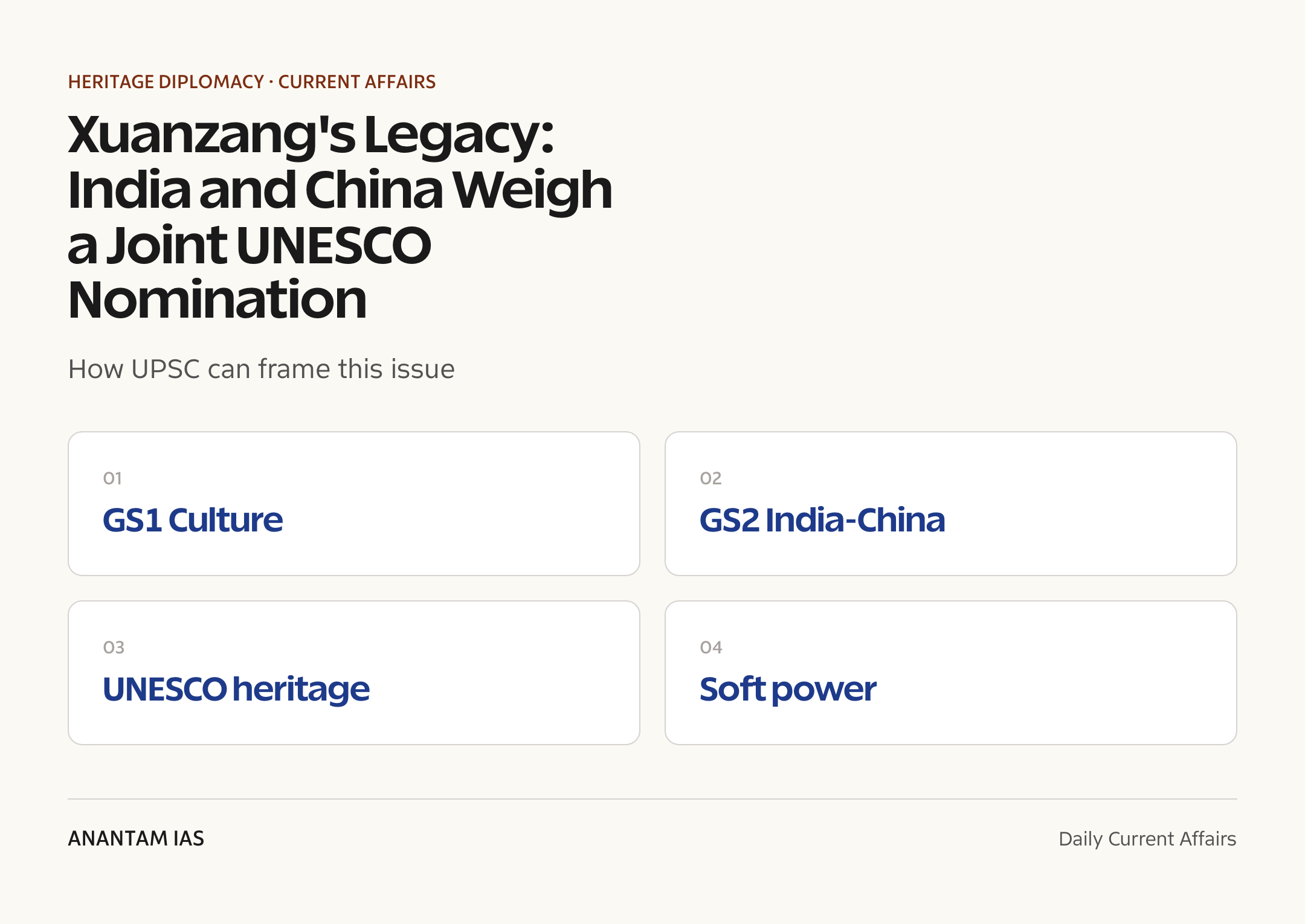
- Cultural and heritage diplomacy as an instrument in India-China relations amid a fraught strategic equation.
- India’s use of UNESCO platforms and soft power to project civilisational influence.
Essay
- Shared heritage as a bridge between rival neighbours.
- The pilgrim’s gaze: how outsiders shaped India’s own historical memory.
Background and Context
Who Xuanzang was, and why he matters
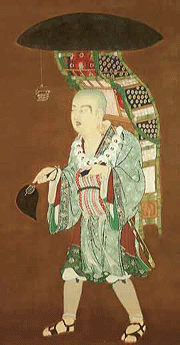
Xuanzang is the single most important foreign witness to early-medieval India.
- A Chinese Buddhist monk who left Tang China around 629 CE and travelled overland through Central Asia to India to collect authentic Buddhist scriptures.
- He spent roughly fifteen years abroad, much of it studying Yogachara philosophy at Nalanda under the aged abbot Shilabhadra.
- On returning, he carried back hundreds of manuscripts and led a vast translation project that shaped East Asian Buddhism.
- His travelogue, the Great Tang Records on the Western Regions (646 CE), records distances, rulers, climate, crops, customs and the state of monasteries across the subcontinent.
- Earlier pilgrim Faxian (Gupta era) and later I-Tsing left comparable, if briefer, accounts.
India under Harshavardhana through Xuanzang’s eyes
His record is the backbone of how historians reconstruct Harsha’s reign.
- Harshavardhana (c. 606-647 CE) of the Pushyabhuti dynasty ruled much of north India from Kannauj.
- Xuanzang describes Harsha as a patron of both Buddhism and Brahmanical traditions, hosting the great religious assembly at Kannauj and the quinquennial charity gathering at Prayag.
- Cross-read with Banabhatta’s Harshacharita, the account lets historians triangulate Harsha’s polity, administration and economy.
- He notes a thriving but already declining Buddhism in parts of India alongside resurgent Hindu devotional currents — a key chronological marker.
- His mileage figures and route notes help locate ancient sites and trade arteries.
Nalanda — the monastic university at the centre
Nalanda is where Xuanzang’s India story and India’s knowledge heritage intersect.
- Nalanda Mahavihara in present-day Bihar was a residential Buddhist monastic university that flourished from the Gupta period to roughly the 12th century.
- It drew scholars from across Asia and taught logic, grammar, medicine, metaphysics and the Buddhist canon.
- The archaeological ruins were inscribed as one of the UNESCO World Heritage Sites in India in 2016; the modern Nalanda University revives the name.
- Xuanzang’s detailed description of its layout and curriculum is a prime reason the site’s significance is so well understood.
- The university recently revived the ancient debate tradition of Śāstrārtha, underscoring its living link to that scholastic past.
Memory of the World vs World Heritage
The likely route is documentary heritage, which is distinct from the famous site list.
- The UNESCO World Heritage List (under the 1972 Convention) protects sites and monuments of outstanding universal value — Nalanda’s ruins are on it.
- The Memory of the World Register (programme launched 1992) protects documentary heritage — manuscripts, archives, texts and recordings.
- A nomination tied to Xuanzang’s writings would fit the Memory of the World track, not the World Heritage List.
- A separate UNESCO instrument, the 2003 Convention, covers Intangible Cultural Heritage (living practices) — e.g. India’s Deepavali entry — a third, distinct category.
- Clarifying these three tracks is a frequent Prelims trap.
Why a joint nomination is diplomatically notable
Heritage offers neutral ground between two neighbours otherwise locked in rivalry.
- India-China ties are dominated by the unresolved boundary question and post-2020 strategic mistrust.
- A shared submission frames Xuanzang’s journey as civilisational connectivity — Buddhism travelling from India to China and a Chinese scholar honouring India.
- It is a textbook exercise in soft power and cultural diplomacy: low cost, high symbolism, reversible.
- Buddhism is a recurring diplomatic bridge for India across East and Southeast Asia, from the World Buddhist forums to heritage circuits.
- Even an exploratory talk signals that both capitals see value in keeping a people-to-people and cultural channel open.
Caveats and what to watch
The proposal is early-stage and carries genuine sensitivities.
- Reporting describes talks, not a finalised, lodged nomination — outcomes can stall.
- Custody of the manuscripts and the framing of the citation could become points of negotiation.
- Domestic critics may question heritage cooperation while border issues stay unresolved.
- The precise documentary set (the travelogue, translation records, or both) is still to be defined.
Way Forward
Insulate culture from the security track
- Treat the Xuanzang nomination as a discrete, professionally curated heritage exercise that does not hinge on border progress.
- Channel it through archivists, the Archaeological Survey and academic institutions rather than purely political negotiation.
Build on the Buddhist-circuit advantage
- Link any nomination to India’s wider Buddhist heritage diplomacy and the Nalanda revival to maximise soft-power returns.
- Use the moment to digitise and openly publish India-side documentary heritage on Xuanzang and Nalanda.
A measured, scholarship-led approach — clear on custody, citation and the documentary scope — lets India gain the soft-power dividend while keeping strategic guardrails intact.
Conclusion
A joint India-China bid around Xuanzang’s writings is small in scale but large in symbolism: it reframes a 7th-century pilgrimage as shared heritage at a time when the two neighbours agree on little else.
For UPSC, the value is in the linkages — Xuanzang to Harsha and Nalanda, documentary versus site heritage at UNESCO, and culture as an instrument of statecraft between rivals.
UPSC Practice Questions
Prelims MCQ 1
With reference to the Chinese pilgrim Xuanzang (Hiuen Tsang), consider the following statements:
- He visited India during the reign of Harshavardhana.
- He studied at the Nalanda Mahavihara.
- His travel account is titled the Great Tang Records on the Western Regions.
How many of the above statements are correct?
(a) Only one (b) Only two (c) All three (d) None
Answer: (c) All three
Explanation:
Xuanzang travelled in the 7th century during Harsha’s reign, studied at Nalanda under Shilabhadra, and wrote the Da Tang Xiyu Ji (Great Tang Records on the Western Regions). All three are correct.
Prelims MCQ 2
The UNESCO ‘Memory of the World’ Register is best described as a programme to safeguard which of the following?
(a) Sites and monuments of outstanding universal value (b) Documentary heritage such as manuscripts and archives (c) Living intangible cultural practices and traditions (d) Natural biosphere reserves
Answer: (b) Documentary heritage such as manuscripts and archives
Explanation:
Memory of the World (launched in 1992) protects documentary heritage. Sites fall under the World Heritage List (1972), living practices under the Intangible Cultural Heritage Convention (2003), and biosphere reserves under the MAB Programme.
UPSC Mains Questions
- Xuanzang’s account is indispensable for reconstructing the history of Harshavardhana’s India. Discuss its value as a primary source and its limitations as an outsider’s record. (250 words)
- Cultural and documentary heritage can serve as a stabilising channel in an otherwise contested bilateral relationship. Examine this with reference to a possible joint India-China UNESCO nomination linked to Xuanzang. (250 words)
- Evaluate the role of Buddhism and ancient knowledge institutions like Nalanda in India’s soft-power projection across Asia. (150 words)
Sources: The Indian Express and UNESCO Memory of the World Programme.
Frequently Asked Questions
Who was Xuanzang?
Xuanzang (also written Hiuen Tsang) was a 7th-century Chinese Buddhist monk who travelled overland from Tang China to India around 629 CE to collect authentic Buddhist scriptures. He spent about fifteen years abroad, studied at Nalanda, and on his return led a major translation effort that deeply shaped East Asian Buddhism.
What is the Great Tang Records on the Western Regions?
It is Xuanzang’s travelogue (Da Tang Xiyu Ji), completed in 646 CE, recording his journey across Central Asia and India. It describes distances, rulers, climate, customs and the state of monasteries, and remains one of the most detailed outsider accounts of early-medieval India used by historians today.
Why is Xuanzang linked to Harshavardhana?
Xuanzang travelled through India during the reign of Harshavardhana (c. 606-647 CE), the Pushyabhuti ruler based at Kannauj. His firsthand descriptions of Harsha’s patronage, assemblies and administration, read alongside Banabhatta’s Harshacharita, form the backbone of how historians reconstruct that reign.
What is the difference between the Memory of the World Register and the World Heritage List?
The World Heritage List (1972 Convention) protects sites and monuments of outstanding universal value, like Nalanda’s ruins. The Memory of the World Register (programme launched 1992) protects documentary heritage such as manuscripts, archives and texts. A nomination tied to Xuanzang’s writings would fall under Memory of the World.
Is Nalanda a UNESCO World Heritage Site?
Yes. The archaeological ruins of Nalanda Mahavihara in Bihar were inscribed on the UNESCO World Heritage List in 2016. Nalanda was a residential Buddhist monastic university that flourished from the Gupta period to around the 12th century and is where Xuanzang studied.
Why does a joint India-China nomination matter?
India-China relations are dominated by an unresolved boundary dispute and strategic mistrust. A shared heritage nomination around Xuanzang reframes the pilgrimage as civilisational connectivity, offering a low-cost, high-symbolism cultural channel that can stay open even when security and trade ties are strained.