Crypto-Asset Reporting: India Aligns with the OECD CARF
Why in News?
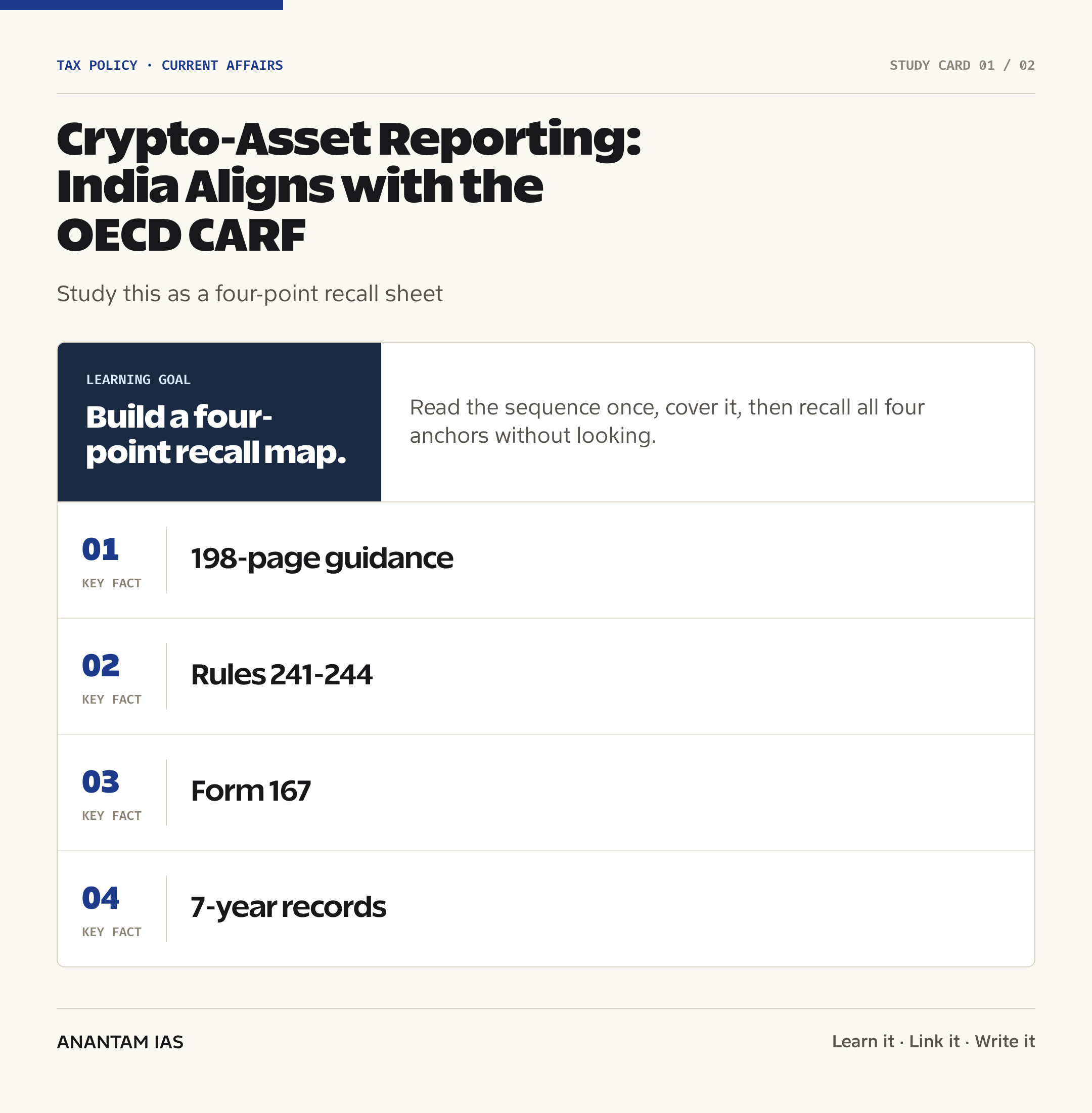
The Central Board of Direct Taxes released a 198-page guidance note in late July 2026 to help Reporting Crypto-Asset Service Providers comply with India’s new crypto-transaction reporting framework.
The note explains Section 509 of the Income-tax Act, 2025, Rules 241 to 244 and Form 167, aligning domestic reporting with the OECD’s Crypto-Asset Reporting Framework, or CARF.
- The guidance places the primary collection and reporting duty on RCASPs, such as covered exchanges and intermediaries, rather than creating a fresh direct filing form for every investor.
- Reporting applies for each relevant calendar year beginning on or after 1 January 2026; the statement is due by 31 May of the following calendar year.
- Information for the 2026 reporting period can support India’s planned automatic exchange of information with eligible partner jurisdictions from 2027, subject to the required international arrangements.
- The note is guidance, not a new tax or a decision on whether crypto transactions are legally permissible; the Act and Rules prevail if the guidance conflicts with them.
- The official Form 167 captures provider, user, tax-residence and transaction information in a standardised structure.
The development matters in the context of:
- This matters in the context of a visibility gap: crypto-assets can move through exchanges, self-hosted wallets and borders without remaining inside the conventional banking-account chain covered by the Common Reporting Standard.
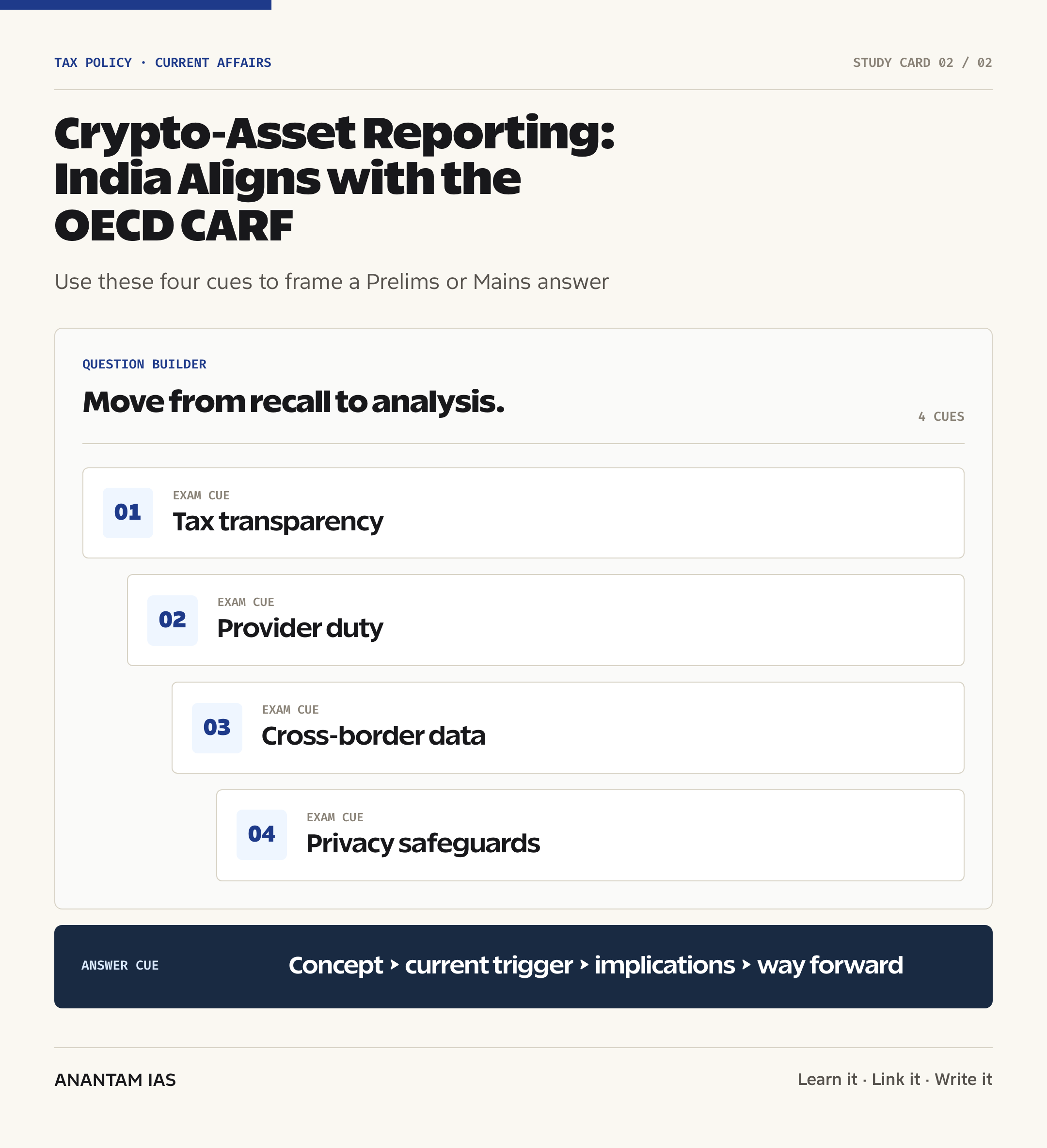
- It also matters for cooperative federal and global tax administration, because useful cross-border data depends on common definitions, compatible technology and trusted confidentiality safeguards.
- For users, exchange-reported records can be compared with income-tax disclosures, making accurate transaction histories and wallet-transfer records more important.
UPSC Relevance
Prelims Relevance
- CARF was developed by the OECD to collect and automatically exchange tax-relevant information on transactions in relevant crypto-assets.
- The Indian legal base is Section 509 of the Income-tax Act, 2025, supported by Rules 241 to 244 of the Income-tax Rules, 2026.
- Form 167 is the prescribed statement for relevant crypto-asset transactions reported by an RCASP.
- The framework covers exchanges between crypto-assets and fiat currency, crypto-to-crypto exchanges and transfers, including specified retail-payment transactions.
- Relevant crypto-assets generally exclude central bank digital currencies, specified electronic money products and assets reliably found incapable of use for payment or investment.
- An RCASP is functionally identified by providing, as a business, services that effect exchange transactions for or on behalf of customers.
- Due diligence uses self-certification of tax residence, checked for reasonableness against information such as AML and KYC records.
- Rules require reporting by 31 May of the year following the relevant calendar year; a nil statement is required where due diligence finds no reportable user or controlling person.
- The CARF MCAA is a multilateral competent-authority arrangement that can provide an administrative route for exchanges based on an international legal foundation.
- CARF complements the CRS; it does not replace the CRS reporting of conventional financial accounts.
Mains Relevance
GS Paper 3
- Tax transparency, the digital economy and the challenge of tracing value transferred through distributed-ledger networks.
- Regulatory technology, data quality and the compliance burden on crypto exchanges, brokers and other covered service providers.
- Balancing revenue protection with innovation, privacy, cybersecurity and proportionate regulation.
GS Paper 2
- International tax cooperation through common reporting standards, competent-authority agreements and reciprocal information exchange.
- Institutional roles of the CBDT, OECD Global Forum and domestic reporting entities in implementing transnational standards.
Essay
- Digital borders are porous, but public authority still depends on verifiable information.
- Technology can decentralise transactions while increasing the need for coordinated institutions and shared rules.
Background and Context
Why CARF Was Needed
The framework addresses tax-information gaps created when crypto activity sits outside conventional financial accounts.
- The CRS works mainly through financial institutions reporting offshore accounts, while many crypto-assets can be held directly in self-hosted wallets or moved through providers not historically covered as reporting financial institutions.
- A user can transfer a token across borders without the correspondent-bank trail normally associated with a cross-border fiat payment.
- The OECD designed CARF around transaction visibility, not around an assumption that every crypto holding is illegal or evasive.
- The G20 supported the work, and the New Delhi Leaders’ Declaration of 2023 called for swift implementation and noted the aspiration to begin exchanges by 2027.
- CARF adds a dedicated reporting layer while India’s wider crypto-regulation debate continues across taxation, financial stability, consumer protection and illicit-finance concerns.
The Indian Legal Architecture
CBDT’s guidance translates a statutory scheme into operational instructions for reporting providers.
- Section 509 provides for furnishing statements about prescribed crypto-asset transactions by reporting entities.
- Rule 241 supplies the core definitions; Rule 242 determines when an RCASP has a sufficient Indian reporting nexus; Rule 243 specifies the information and filing rule; and Rule 244 sets due-diligence procedures.
- The official Form 167 records RCASP identity, the reporting period, reportable users or controlling persons, and asset-wise transaction aggregates.
- For each relevant calendar year starting on or after 1 January 2026, covered providers maintain and report the prescribed information.
- The statement is due by 31 May of the following calendar year. This makes 31 May 2027 the filing date for the 2026 reporting period, based on the rule as published.
- CBDT’s note states that its examples and FAQs facilitate compliance; they don’t override the Income-tax Act or Rules and don’t settle the regulatory legitimacy of crypto transactions.
Who Must Report
CARF follows the function performed and the provider’s jurisdictional nexus, not only its business label.
- An RCASP broadly includes an entity or individual that, as a business, effects relevant exchange transactions for or on behalf of customers, including as counterparty, intermediary or trading-platform operator.
- The OECD framework can cover exchanges, brokers, dealers, crypto-asset ATM operators and some decentralised arrangements where a person or entity exercises sufficient control or influence.
- India’s Rule 242 connects reporting duties to factors such as tax residence, incorporation or organisation, management, a regular place of business and relevant transactions through an Indian branch.
- Hierarchy and partner-jurisdiction rules seek to reduce duplicative reporting when a provider has more than one jurisdictional connection.
- Providers must still determine their own status carefully; describing a platform as decentralised doesn’t by itself answer whether a reporting intermediary exists.
Assets and Transactions in Scope
The scope is broad enough to follow economically meaningful crypto transactions while carving out low-risk categories.
- A crypto-asset is a digital representation of value relying on a cryptographically secured distributed ledger or similar technology to validate and secure transactions.
- Relevant assets can include cryptocurrencies, stablecoins, derivatives issued in crypto form and certain NFTs when they can be used for payment or investment.
- CARF excludes CBDCs, specified electronic money products and assets that the RCASP has adequately determined cannot be used for payment or investment purposes; corresponding account-based reporting may fall under the CRS.
- Reportable categories include crypto-to-fiat acquisitions and disposals, crypto-to-crypto exchanges, inbound and outbound transfers and specified retail-payment transactions.
- Crypto-to-crypto activity is not invisible merely because no rupees enter the trade: the exchanged assets are valued and classified under the reporting rules.
- For a clear technology foundation, revise blockchain technology and distributed ledgers, then separate the ledger mechanism from the tax-reporting obligation imposed on service providers.
What Form 167 Captures
The return links user identity and tax residence with standardised, asset-wise aggregates.
- For reportable individual users, data include name, address, tax residence, TIN and, where required, date and place of birth.
- For relevant entities, providers identify the entity and any controlling persons who are reportable persons, together with their roles.
- For each type of relevant crypto-asset, the provider reports aggregate amounts, units and transaction counts across prescribed acquisition, disposal and transfer categories.
- Amounts are reported in Indian rupees under the domestic rule, with conversion or fair-value methods applied at the transaction time and alternative valuation methods identified where used.
- Where the provider maintains a crypto-asset-to-rupee trading pair, that pair is the primary valuation reference. If it doesn’t, the rule provides an ordered fallback using book value, reliable third-party value, recent provider valuation and a reasonable estimate as a last resort.
- Form 167 distinguishes crypto-to-fiat from crypto-to-crypto activity and separates inbound from outbound movements, supporting risk-based reconciliation.
- Transfers to an external wallet not known to belong to a virtual-asset service provider or financial institution are aggregated; the RCASP retains the external wallet identifier but doesn’t routinely report that address in Form 167.
Due Diligence and Record Keeping
Reliable exchange begins with identifying the user and the jurisdictions entitled to receive the information.
- For a new individual user, the provider obtains a valid self-certification of tax residence during onboarding and checks its reasonableness against available information, including KYC material.
- For users existing on 31 December 2025, the Indian rule provides a 12-month period from 1 January 2026 to complete the prescribed due diligence.
- A material change of circumstances requires the RCASP to stop relying on an unreliable certification and obtain a valid replacement or supporting explanation.
- For entities, the process can require classification of the entity and identification of controlling persons, especially where passive structures could conceal the beneficial taxpayer.
- Tax residence is the key exchange link, so a provider must retain all identified residence jurisdictions and associated TINs when a reportable user is resident in more than one country or territory.
- The RCASP may rely on a third party in allowed circumstances, but the ultimate due-diligence responsibility remains with the provider.
- Relevant documents and data must be kept for at least seven tax years after the reporting period ends, supporting later verification and correction.
Automatic Exchange and Safeguards
Domestic collection and international exchange are separate legal and technical steps.
- The RCASP reports to its domestic tax administration; the administration can exchange information with a user’s jurisdiction of tax residence under an applicable international agreement.
- The CARF MCAA, bilateral tax arrangements or other lawful competent-authority agreements can provide the exchange mechanism.
- The OECD’s design uses a common XML schema so participating administrations can transmit and validate similarly structured records.
- India’s 2026 collection schedule is designed to support exchanges from 2027, but actual exchange relationships also require an international legal basis, compatible systems and approved partners.
- Confidentiality and data safeguards are not optional extras: exchange partners must protect sensitive identity, tax-residence and transaction information.
- The international layer is reciprocal and partner-specific rather than a public global database. A jurisdiction receives information under an activated relationship and uses it for the authorised tax-administration purpose.
- Rule 244 limits exchanged information to the administration of taxes by the relevant jurisdiction, making purpose limitation central to legitimate use.
Implications and Limitations
CARF improves visibility, but it isn’t a complete crypto regulator or a substitute for good tax administration.
- For taxpayers, there is no new investor filing created by the guidance note, but returns should remain consistent with exchange statements, purchase records, sales, token swaps and wallet movements.
- For providers, the difficult work lies in data lineage: mapping identities, tax residences, token identifiers, transaction types and valuations across changing systems.
- Self-hosted wallets can still sit outside a reporting provider, although transfers to unknown external wallets create an audit signal and the provider retains related identifiers.
- Different tax characterisations across countries may complicate exchange, so CARF standardises the information flow without making every jurisdiction’s substantive tax law identical.
- Large datasets can produce false matches or duplicate reports; correction processes, unique identifiers, quality controls and taxpayer grievance channels are needed.
- The reporting framework can identify inconsistencies, but an inconsistency may arise from timing, valuation or data-quality differences. Assessment still requires due process and fact-specific verification, not automatic presumption of concealed income.
- Tax reporting doesn’t settle consumer protection, monetary sovereignty or market-conduct questions explored in the regulation of stablecoins.
Way Forward
Build Verifiable Reporting Systems
- RCASPs should map every Form 167 field to a controlled source system, maintain audit trails and test valuation logic before the first filing.
- CBDT should publish machine-readable validation rules, correction procedures and consistent technical guidance for unusual token and transfer types.
- Providers need clear controls for changes in tax residence, duplicate users, missing TINs and entity controlling-person data.
Protect Taxpayer Rights
- Give users accessible transaction statements and a practical route to correct identity, residence or valuation errors before data are exchanged.
- Apply purpose limitation, access controls, encryption and retention discipline to the sensitive tax and wallet-related records.
- Use risk-based verification instead of treating every mismatch as proof of evasion; provide reasons and review channels when automated analytics trigger action.
Coordinate Without Regulatory Confusion
- Keep the distinction clear between tax reporting, anti-money-laundering supervision and decisions about the legal or regulatory status of crypto products.
- Coordinate CBDT, FIU-IND and other competent bodies so overlapping KYC and reporting duties don’t produce contradictory formats or needless duplication.
- Activate exchange relationships only with partners meeting confidentiality and data-safeguard standards, and monitor data quality after exchanges begin.
Conclusion
India’s CARF-aligned rules shift crypto tax transparency from scattered disclosures toward standardised third-party reporting. The key change is better visibility through providers that already sit at important exchange and transfer points.
Success will depend less on the length of the guidance note than on accurate classification, fair valuation, secure data exchange and workable correction rights. Transparency and privacy must be designed together if cross-border reporting is to remain credible.
UPSC Practice Questions
Prelims MCQ 1
With reference to India’s Crypto-Asset Reporting Framework implementation, consider the following statements:
- Form 167 is furnished by a Reporting Crypto-Asset Service Provider.
- The prescribed reporting can include crypto-to-crypto exchanges and transfers.
- Central bank digital currencies are treated as relevant crypto-assets under CARF.
How many of the above statements are correct?
(a) Only one (b) Only two (c) All three (d) None
Answer: (b) Only two
Explanation:
Statements 1 and 2 are correct. CBDCs are excluded from relevant crypto-assets under CARF; account-based reporting for them is addressed through the CRS framework.
Prelims MCQ 2
What is the primary purpose of the OECD Crypto-Asset Reporting Framework?
(a) To make all cryptocurrencies legal tender (b) To create a global central bank digital currency (c) To collect and automatically exchange tax-relevant crypto transaction information (d) To fix uniform crypto tax rates across countries
Answer: (c) To collect and automatically exchange tax-relevant crypto transaction information
Explanation:
CARF creates common due-diligence and reporting standards for tax information. It neither grants legal-tender status nor harmonises substantive tax rates.
UPSC Mains Questions
- The Crypto-Asset Reporting Framework seeks to restore tax visibility in a financial ecosystem built for borderless transfer. Explain its reporting architecture and assess how India can balance effective enforcement, data protection and taxpayer rights during implementation.
- India’s CARF-aligned rules place service providers at the centre of crypto tax transparency. Discuss the advantages and limits of third-party reporting for offshore transactions, self-hosted wallets and rapidly evolving decentralised platforms.
Sources: Income Tax Department, Ministry of Finance: Form 167 and Rules 241-244 and The Indian Express Explained.
Frequently Asked Questions
What is CARF?
The Crypto-Asset Reporting Framework is an OECD standard for collecting tax-relevant information from covered crypto service providers and exchanging it with eligible jurisdictions where users are tax-resident. It complements the Common Reporting Standard by addressing crypto activity that can fall outside conventional financial accounts.
Who files Form 167?
A covered Reporting Crypto-Asset Service Provider files Form 167 under Section 509 and Rule 243. The form reports provider details, reportable users or controlling persons, tax-residence information and prescribed asset-wise transaction aggregates. The CBDT guidance doesn’t create a new Form 167 filing duty for each individual investor.
When is the first statement due?
Rule 243 applies to relevant calendar years beginning on or after 1 January 2026 and requires filing by 31 May of the following year. On the published rule, information for calendar year 2026 is due by 31 May 2027.
Does CARF regulate crypto legality?
No. CBDT’s guidance explains tax-information reporting and says it shouldn’t be read as deciding the permissibility, legitimacy or wider regulation of crypto transactions. If an explanation conflicts with the Income-tax Act, 2025 or the Income-tax Rules, 2026, the statutory text prevails.
Which transactions are reported?
The framework covers prescribed exchanges between relevant crypto-assets and fiat currency, exchanges between crypto-assets, and transfers, including specified retail-payment transactions. Domestic Rule 243 requires asset-wise aggregates of amounts, units and transaction counts across defined categories rather than a single undifferentiated total.
Are external wallets invisible?
Not completely. Where an RCASP facilitates a transfer to a wallet not known to belong to a virtual-asset service provider or financial institution, it reports prescribed aggregate value and units. The provider must retain the relevant external wallet identifier for the required period, even though the address isn’t routinely reported in Form 167.