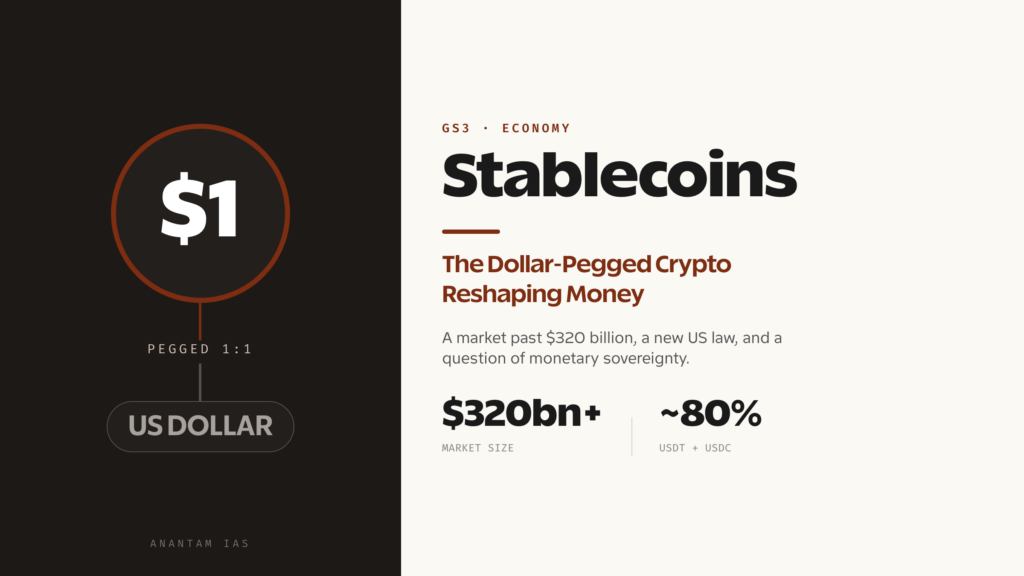
In May 2022 a cryptocurrency that was supposed to be worth exactly one dollar fell to almost nothing in a matter of days, and roughly forty billion dollars of value evaporated with it. The coin was TerraUSD, and its collapse is still the cautionary tale that hangs over every conversation about stablecoins. Yet three years on, far from disappearing, stablecoins have become one of the fastest-growing corners of global finance. The total market has crossed three hundred and twenty billion dollars, the United States has passed its first federal law to govern them, and central banks from Washington to Mumbai are arguing about what they mean for the future of money itself. A product that began as plumbing for crypto traders has turned into a question of monetary sovereignty.
And that is exactly why a UPSC aspirant needs to understand them. Stablecoins sit at the intersection of three things the syllabus cares deeply about: the digital-finance revolution, the external sector and exchange rates, and the slow contest over the dollar’s grip on the world economy. They are no longer a niche fintech curiosity. They are buyers of US government debt, a back-door route for dollars into fragile economies, and the reason the Reserve Bank of India keeps pushing its own digital rupee instead. Get the mechanics right and you can answer questions across economy, science and technology, and even international relations with the same compact set of facts.
What a Stablecoin Is and the Three Ways It Stays Stable
Start with the puzzle stablecoins were built to solve. Ordinary cryptocurrencies like Bitcoin swing wildly in price, which makes them useless as everyday money — nobody wants to pay for groceries with an asset that might lose a fifth of its value before the bill is settled. A stablecoin is a crypto-asset designed to hold a steady value by being pegged, usually one-to-one, to a real-world currency. In practice that currency is almost always the US dollar, so one unit of the coin is meant to be worth one dollar, today and every day. It lives on a blockchain like any token, so it moves at internet speed across borders, but its price is supposed to sit still. That combination — the rails of crypto with the stability of cash — is the whole pitch.
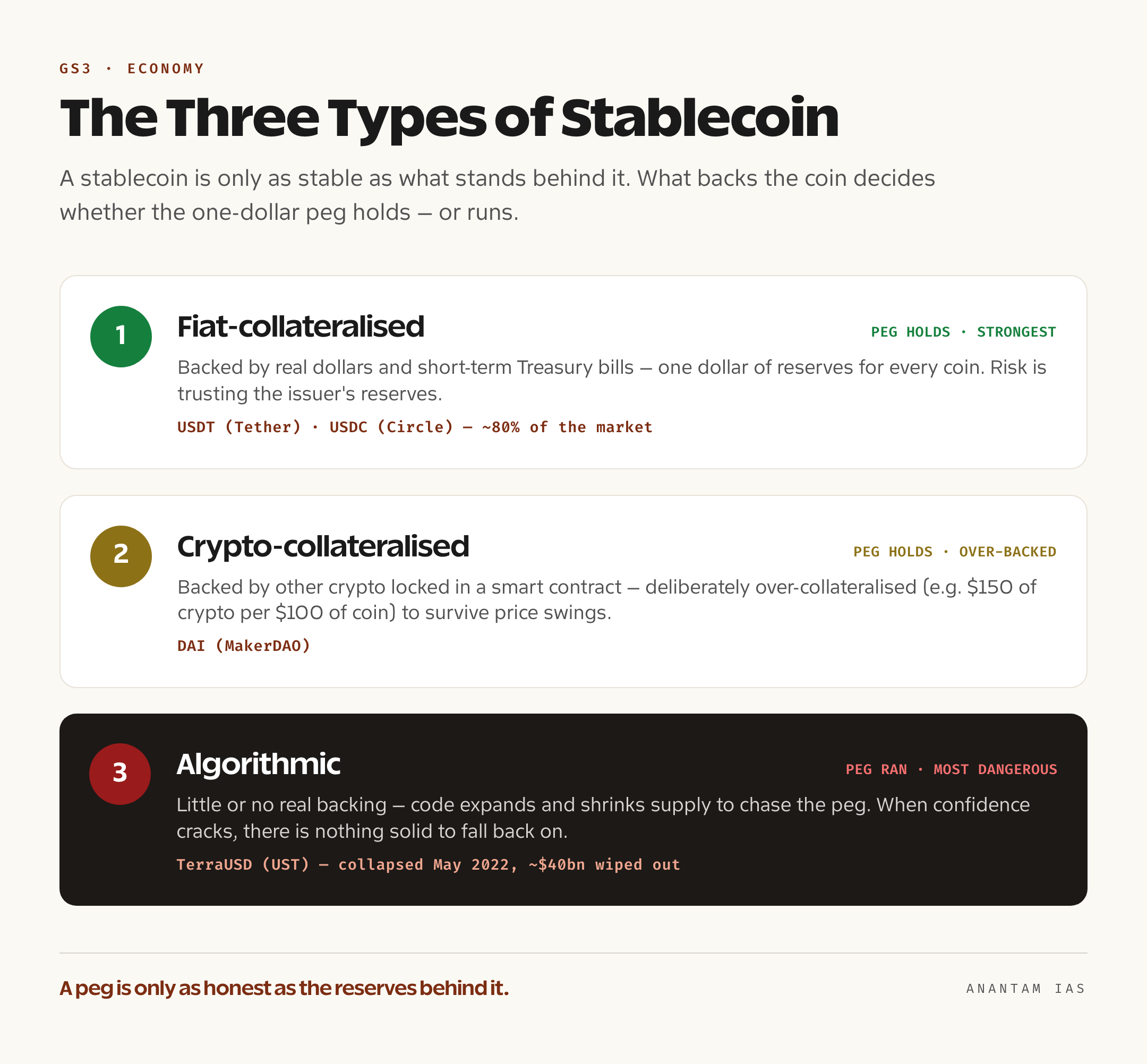
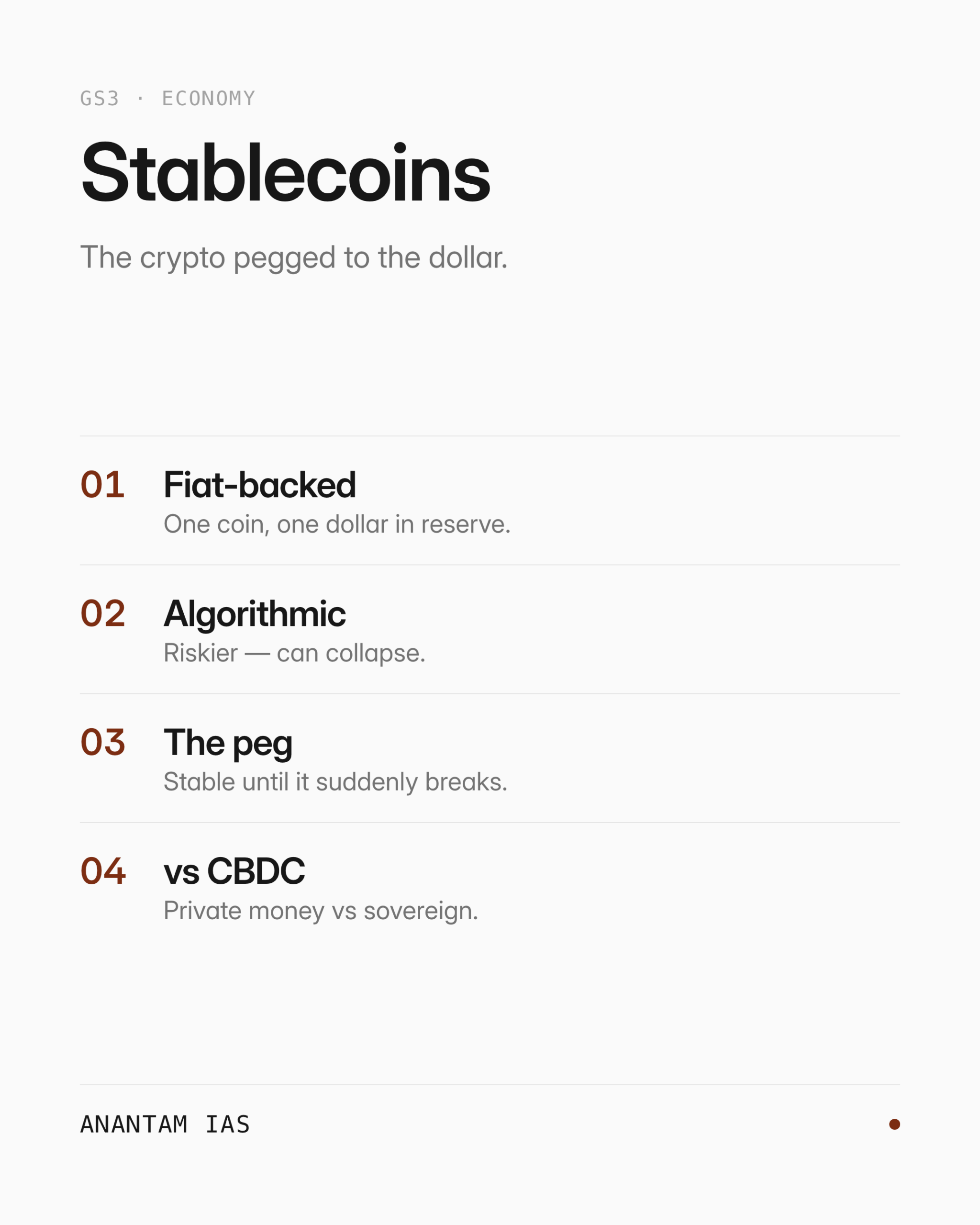
How a coin keeps that promise is what splits the family into three types, and the difference matters enormously because it decides how safely the peg holds. The first and largest type is the fiat-collateralised stablecoin. For every coin in circulation, the issuer claims to hold one real dollar — or a dollar’s worth of cash and short-term US Treasury bills — in a bank account or custody. Tether’s USDT and Circle’s USDC are the giants here. The logic is simple: if you can always redeem your coin for a real dollar from the issuer, the coin can’t drift far from a dollar, because anyone could buy it cheap and cash it in for profit. The catch is that you are trusting the issuer to actually hold the reserves it says it holds.
The second type is the crypto-collateralised stablecoin, of which MakerDAO’s DAI is the best-known. Instead of dollars in a bank, it is backed by other cryptocurrencies locked in a smart contract — but because crypto is volatile, the system is deliberately over-collateralised, holding, say, a hundred and fifty dollars of crypto for every hundred dollars of coin issued, so a price drop doesn’t break the peg. The third and most dangerous type is the algorithmic stablecoin, which holds little or no real backing and instead tries to keep its price at a dollar through code — automatically expanding and shrinking the supply, or leaning on a sister token, to push the price back whenever it strays. TerraUSD, or UST, was an algorithmic coin. When confidence cracked in May 2022, the algorithm couldn’t conjure value from nothing, the sister token Luna spiralled to zero, and the coin that was meant to equal a dollar became worthless. The episode taught the whole industry a brutal lesson: a peg with nothing real behind it is only a promise, and promises run.
How People Actually Use Stablecoins, and Why the Market Exploded
To see why this market raced past three hundred and twenty billion dollars, follow the uses rather than the technology. The first and oldest use is crypto trading itself. Traders park their money in stablecoins between bets, moving in and out of volatile coins without converting back to bank dollars each time — so stablecoins became the cash register of every crypto exchange, the medium in which most trades are actually priced and settled. That alone built the early demand, and it is why Tether’s USDT, at roughly a hundred and ninety billion dollars, is the largest stablecoin on earth, with Circle’s USDC the clear second at around seventy-seven billion. Together the two account for about four-fifths of the entire market.
But the more consequential uses are spreading well beyond trading. Stablecoins move value across borders in minutes for cents, sidestepping the slow, expensive correspondent-banking chain that makes a normal international transfer take days. For migrant workers sending money home, and for businesses settling cross-border invoices, that is a genuine breakthrough. The deeper draw, though, is dollar access. In economies bleeding value to inflation — think Argentina, Turkey, Nigeria, Lebanon — people cannot easily get their hands on physical dollars, but they can buy a dollar stablecoin on a phone and hold their savings in something that doesn’t melt. To a citizen of a high-inflation country, a stablecoin is a dollar bank account that no local bank or capital control can deny them. And inside crypto, stablecoins are the lifeblood of decentralised finance, or DeFi — the world of lending, borrowing and trading run by code rather than banks, where a stable unit of account is essential.
So the engine of growth is real demand, not just speculation, and that is what changed the politics. Once the United States passed a law giving stablecoins a clear legal footing in 2025, big institutions — payment firms, banks, even card networks — began treating them as a serious settlement layer rather than a crypto toy. The market has been climbing through 2026 on exactly that institutional adoption, and forecasts of a trillion-dollar stablecoin market within a few years no longer sound outlandish. A product built to let traders sit out volatility is quietly turning into a parallel dollar-payment system.
The Risks: De-Pegging, Reserve Quality and Dirty Money
Now the dangers, because a strong answer never sells the upside without the downside. The headline risk is a de-pegging — the coin losing its one-dollar value — and the way it usually happens is a run. If holders fear an issuer doesn’t really have the reserves to redeem every coin, they all rush to cash out at once, and just as with a bank, no issuer can pay everyone simultaneously. The price slips below a dollar, the slip itself spreads panic, and the fall feeds on itself. TerraUSD is the extreme case, but even fully backed coins can wobble: USDC briefly lost its peg in March 2023 when one of the banks holding its reserves failed, recovering only once the deposits were guaranteed. The stability is only ever as good as the assets behind it.
Which leads to the second risk — reserve quality and transparency. A fiat stablecoin is a claim on a pool of assets you cannot see, so everything depends on whether the issuer truly holds safe, liquid reserves and is honest about it. Tether spent years criticised for opaque disclosures and once settled with US authorities over misstatements about its backing. If an issuer quietly holds risky or illiquid assets to earn higher returns, the coin is a bank run waiting to happen. There is also a contagion risk: because stablecoins are now woven into exchanges, DeFi and increasingly traditional finance, the failure of a big one could ripple outward — and if issuers ever had to dump billions in Treasury bills to meet redemptions, the shock could spill into the very government-bond market that backs them.
The third cluster of risks is about misuse and control. Because stablecoins move value pseudonymously across borders without a bank in the middle, they are attractive for money laundering, sanctions evasion and financing crime — a serious concern for any regulator and a recurring theme in the RBI’s warnings. And there is the loss-of-control problem that worries central banks most: if citizens of a country increasingly save and transact in private dollar stablecoins, the national central bank loses some grip on its own money supply, its interest-rate policy works less well, and the country’s currency is slowly hollowed out from within. That last fear is not really about crime at all. It is about sovereignty, and it is where the regulators come in.
The Regulation Wave: GENIUS Act, MiCA and the Push for Real Reserves
For most of their history stablecoins lived in a legal grey zone, and the TerraUSD collapse made that untenable. The biggest response came in 2025, when the United States passed the GENIUS Act — the Guiding and Establishing National Innovation for US Stablecoins Act — signed into law on 18 July 2025 after clearing the Senate 68 to 30 and the House 308 to 122. It is the first federal law to govern dollar stablecoins, and its core demand is exactly the one TerraUSD failed: every coin must be backed one-to-one by genuinely safe, liquid assets — cash, bank deposits or short-dated US Treasury bills — with no risky reserves and no algorithmic shortcuts. Issuers must publish the composition of their reserves every month, submit to supervision, and cannot pay interest to holders. In a stroke the law turned the stablecoin from a grey-zone gamble into a licensed instrument that looks much like a regulated money-market fund, with implementation rules rolling out through 2026.
Europe got there first in spirit. The EU’s Markets in Crypto-Assets regulation, known as MiCA, is the world’s first comprehensive crypto rulebook, and its stablecoin provisions took effect in mid-2024. MiCA classifies a single-currency stablecoin as an “e-money token” that may only be issued by a licensed bank or electronic-money institution, must hold full one-to-one reserves in cash and safe assets, and must let any holder redeem at face value on demand. Crucially, MiCA effectively bars purely algorithmic stablecoins of the TerraUSD kind, because they cannot meet the backing rules. Between them, the GENIUS Act and MiCA have set a global template that other jurisdictions are now copying — the same insistence on real reserves, regular audits and a guaranteed right to redeem. The regulatory message is consistent across borders: a coin can call itself stable only if there is something solid behind every unit.
There is a deeper reason governments moved so decisively, and it shows up in who benefits. Because regulated stablecoins must park their reserves in short-term US Treasury bills, the bigger the stablecoin market grows, the more US government debt these issuers must buy. Stablecoin issuers have already become a meaningful new source of demand for Treasuries, which suits Washington nicely — it helps fund the deficit and entrenches the dollar’s role. So the GENIUS Act is not only consumer protection. It is also a quiet strategy to extend the dollar’s reach into the digital age, and that is precisely what makes other countries uneasy.
The Macro Stakes and India’s Cautious Stand
Step back and the real story is geoeconomic. Almost every major stablecoin is pegged to the dollar, so the explosive growth of stablecoins is, in effect, the spread of the dollar by other means — what economists are calling “digital dollarisation.” When citizens of an emerging economy start saving and paying in dollar stablecoins, dollars seep into the local economy through a side door that no government opened. The country’s own currency is used less, its central bank loses some control over money and interest rates, and it forfeits seigniorage — the profit a state earns from issuing its own money. India’s Chief Economic Adviser, V. Anantha Nageswaran, has put the worry plainly, warning that the rise of dollar stablecoins brings challenges for monetary policy, monetary transmission and the seigniorage benefits of any country. For a large, sovereign economy, letting a privately issued foreign-currency token become everyday money is a strategic risk, not a convenience.
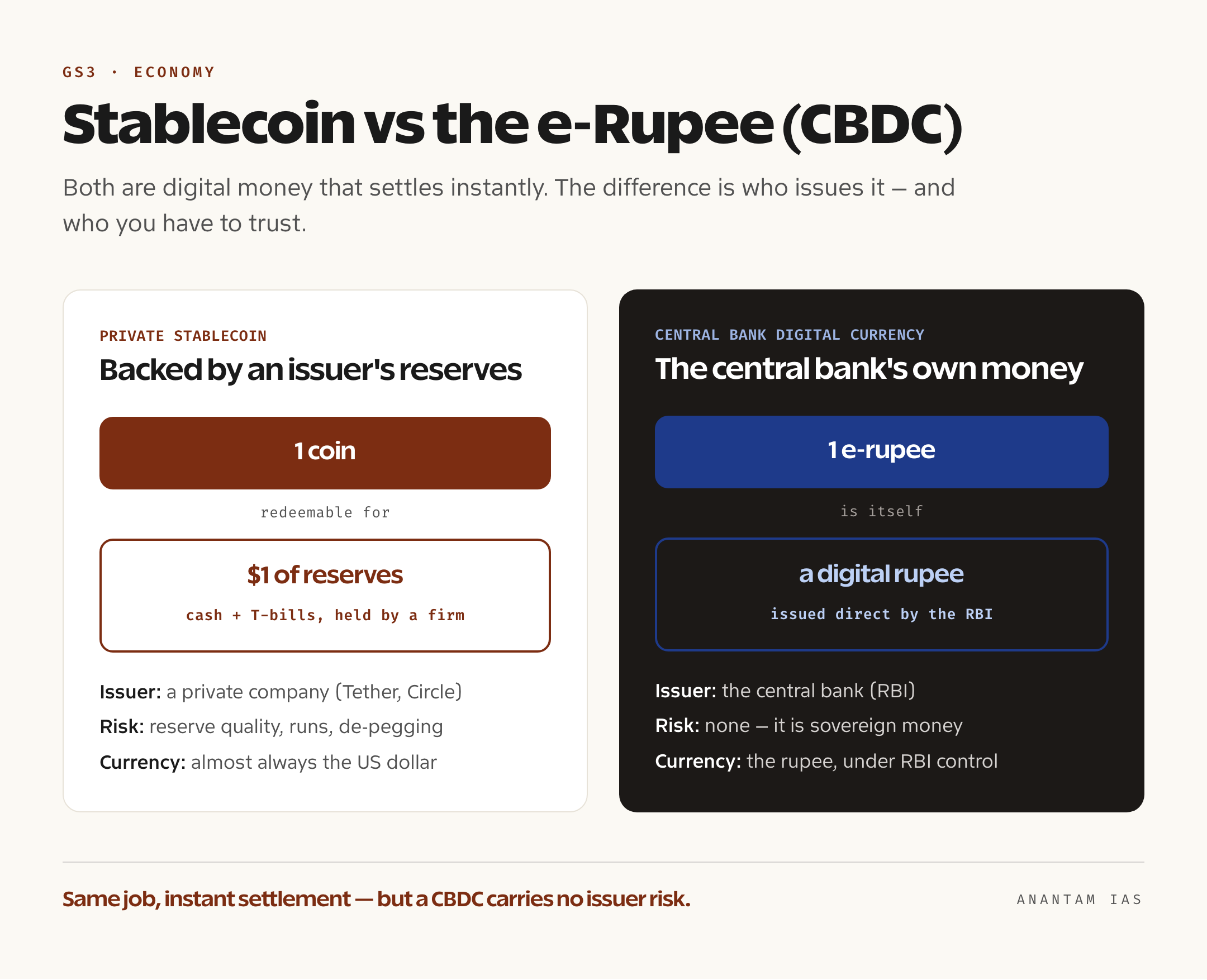
This is why India has chosen a different path. The RBI has been consistently wary of private stablecoins, and in its Financial Stability Report it argued that central bank digital currencies can deliver everything stablecoins promise — efficiency, programmability, instant settlement — but with the credibility and safety of central bank money behind them. In other words, India’s answer to the dollar stablecoin is its own sovereign digital currency, the e-rupee or CBDC, a digital form of the rupee issued directly by the RBI and carrying no issuer risk at all. The RBI’s preference is clear: rather than let private dollar coins circulate, build a public rupee coin that does the same job under the central bank’s control. India has also pressed the international community to prioritise CBDCs over stablecoins in global forums.
The wariness sits inside India’s wider crypto stance, which has never been friendly to private digital money. The country taxes virtual digital assets heavily — a flat 30 per cent on gains plus a 1 per cent tax deducted at source on transactions — and brings crypto trading under anti-money-laundering law, while consistently refusing to grant private crypto the status of legal tender. A dollar stablecoin is, from New Delhi’s vantage point, both a crypto-asset to be taxed and watched, and a vehicle for foreign-currency substitution to be resisted. That said, the position is not frozen: the government has hinted it may eventually regulate rupee-pegged stablecoins, and the broader thinking is captured in India’s approach to crypto-assets and virtual digital assets and in the design of the central bank digital currency itself. The contest is no longer whether digital money will spread, but whose money it will be.
For Your Mains Answer
This is a high-value topic for GS Paper 3, which covers the Indian economy, the external sector, money and banking, and the role of technology. It also reaches into GS Paper 2 through financial regulation and India’s positions in international economic forums, and supplies a sharp, current example for an Essay on technology, sovereignty or the future of money. The skill examiners reward here is the ability to explain a technical instrument in plain terms, weigh its benefits against its risks, and connect a private financial product to the larger question of national economic sovereignty.
How to Build the Answer
Move in a clean chain. Define a stablecoin (a crypto-asset pegged one-to-one to a currency, usually the dollar), name the three types and why they differ in safety, then set out the genuine uses — cross-border payments, dollar access in unstable economies, DeFi. Pivot to the risks — de-pegging and runs, reserve opacity, contagion, money laundering — using TerraUSD’s 2022 collapse as the anchor example. Bring in the regulatory wave, the GENIUS Act and MiCA, and explain the Treasury-buying twist. Close with the macro stakes — digital dollarisation and seigniorage — and India’s response through the e-rupee. That arc — define, classify, use, risk, regulate, sovereignty — fits almost any stablecoin question.
Common Mistakes to Avoid
Don’t treat all stablecoins as identical; the whole point is that a fully reserved coin and an algorithmic one are worlds apart in risk. Don’t confuse a stablecoin with a CBDC — one is issued by a private firm against reserves, the other is issued by the central bank itself and is the safest of all. Don’t call stablecoins a fringe crypto toy; with a market above three hundred and twenty billion dollars and a US federal law behind them, they are mainstream. And don’t frame India’s caution as mere technophobia — it is a deliberate sovereignty choice in favour of a public rupee over a private dollar.
A Compact Answer Spine
Stablecoin = crypto-asset pegged 1:1 to a currency, mostly the US dollar → three types: fiat-collateralised (USDT, USDC), crypto-collateralised (DAI), algorithmic (TerraUSD, collapsed May 2022, ~$40 bn lost) → uses: crypto trading, cheap cross-border payments, dollar access in inflationary economies, DeFi → market now above $320 bn, USDT + USDC ≈ 80% → risks: de-pegging/runs, reserve opacity, contagion, money laundering → regulation: US GENIUS Act (2025, 100% safe reserves, monthly disclosure) and EU MiCA (e-money tokens, no algorithmic coins) → macro: issuers buy US Treasuries, “digital dollarisation” erodes sovereignty and seigniorage → India: RBI wary, prefers the e-rupee/CBDC; 30% VDA tax + 1% TDS → verdict: useful but sovereignty-sensitive.
Diagram or Flowchart Idea
Draw three boxes side by side for the three types — fiat-backed, crypto-backed, algorithmic — with a tick, a half-tick and a cross marking how safely each holds its peg, and TerraUSD flagged under the cross. Beside it, a small two-box contrast of “private stablecoin (issuer reserves)” versus “CBDC (central bank money)” makes India’s choice obvious at a glance.
A Balanced-Conclusion Line
A line that lands the marks: “Stablecoins promise the speed of crypto with the calm of cash, but a peg is only as honest as the reserves behind it — which is why the world is racing to regulate them, and why India would rather build a sovereign rupee coin than let a private dollar quietly become its money.”
How to Use Data Without Cramming
You need only a handful of anchors: the market above $320 billion, USDT and USDC at roughly four-fifths of it, TerraUSD’s ~$40 billion wipeout in May 2022, the GENIUS Act’s 18 July 2025 date, and India’s 30 per cent VDA tax. Attribute them plainly — “as the GENIUS Act requires” or “the RBI’s Financial Stability Report argued” — rather than scattering numbers loose. A few precise figures, well placed, read as authority.
Frequently Asked Questions
What exactly is a stablecoin, and how is it different from Bitcoin?
A stablecoin is a crypto-asset designed to hold a steady value by being pegged, usually one-to-one, to a real currency — almost always the US dollar — so one coin is meant to always equal one dollar. Bitcoin, by contrast, has no peg and swings freely in price, which makes it a speculative asset rather than usable money. A stablecoin tries to give you the speed and borderlessness of crypto with the price stability of cash.
What happened to TerraUSD, and why does it still matter?
TerraUSD, or UST, was an algorithmic stablecoin that kept its dollar peg through code and a sister token, Luna, rather than real reserves. In May 2022 confidence broke, the mechanism failed, Luna collapsed to near zero, and roughly forty billion dollars of value was wiped out in days. It remains the defining warning that a peg with nothing solid behind it can vanish overnight, and it is the reason both the GENIUS Act and MiCA insist on full, real reserves.
What does the GENIUS Act require of stablecoin issuers?
Signed into US law on 18 July 2025, the GENIUS Act requires every dollar stablecoin to be backed one-to-one by safe, liquid assets — cash, bank deposits or short-dated US Treasury bills — with monthly public disclosure of those reserves, supervision of issuers, and no algorithmic or risky backing. It turns stablecoins from an unregulated product into a licensed instrument resembling a money-market fund, and it makes issuers significant new buyers of US government debt.
Why is the RBI wary of stablecoins, and what is its alternative?
The RBI worries that private dollar stablecoins could undermine monetary policy, aid money laundering, and lead to “digital dollarisation” that erodes the rupee’s role and India’s seigniorage. Its alternative is the e-rupee, India’s central bank digital currency — a digital rupee issued directly by the RBI that offers the same efficiency and programmability but with the safety of central bank money and full sovereign control, rather than relying on a private issuer’s reserves.
Practice Questions
Prelims MCQs
- With reference to stablecoins, which statement is most accurate?
(a) They are cryptocurrencies whose price is allowed to float freely like Bitcoin
(b) They are crypto-assets designed to hold a steady value, usually pegged one-to-one to a fiat currency such as the US dollar
(c) They are digital currencies issued directly by central banks
(d) They are physical tokens backed by gold reserves
Answer: (b) A stablecoin is a crypto-asset pegged, typically one-to-one, to a real currency, most often the US dollar, to keep its value steady. - Which of the following is an example of an algorithmic stablecoin that collapsed in 2022?
(a) USDC
(b) Tether (USDT)
(c) DAI
(d) TerraUSD (UST)
Answer: (d) TerraUSD was an algorithmic stablecoin that lost its peg in May 2022, wiping out roughly $40 billion as its sister token Luna crashed. - The US GENIUS Act of 2025 primarily requires stablecoin issuers to do which of the following?
(a) Pay interest to all coin holders
(b) Back every coin one-to-one with safe, liquid assets such as cash and short-term Treasury bills, with monthly disclosure
(c) Hold reserves only in other cryptocurrencies
(d) Register the coins as legal tender of the United States
Answer: (b) The GENIUS Act mandates full one-to-one backing in safe liquid assets and monthly public disclosure of reserves, and bars risky or algorithmic backing. - Under the European Union’s MiCA regulation, a single-currency stablecoin is classified as which of the following?
(a) A central bank digital currency
(b) An e-money token issued only by a licensed bank or electronic-money institution
(c) A security token
(d) A commodity-backed token
Answer: (b) MiCA treats a single-currency stablecoin as an “e-money token,” issuable only by licensed institutions holding full reserves, and effectively excludes purely algorithmic coins. - Why is the Reserve Bank of India cautious about private dollar stablecoins?
(a) They pay too much interest to Indian savers
(b) They could weaken monetary policy and seigniorage and enable money laundering, leading the RBI to prefer the e-rupee
(c) International rules ban India from holding them
(d) They are backed by gold rather than dollars
Answer: (b) The RBI fears digital dollarisation and misuse, and argues its own CBDC can deliver the benefits of stablecoins with the safety of central bank money.
Mains Practice Questions
- What are stablecoins? Distinguish between fiat-collateralised, crypto-collateralised and algorithmic stablecoins, and explain why the difference matters for financial stability. (15 marks, 250 words)
- “A peg is only as honest as the reserves behind it.” In light of the 2022 collapse of TerraUSD, examine the risks posed by stablecoins and the regulatory response through the US GENIUS Act and the EU’s MiCA. (15 marks, 250 words)
- Discuss the concept of “digital dollarisation.” How does the growth of dollar-pegged stablecoins pose challenges for the monetary sovereignty of emerging economies? (15 marks, 250 words)
- Compare a private stablecoin with a central bank digital currency. Why has the Reserve Bank of India chosen to promote the e-rupee rather than permit private dollar stablecoins? (10 marks, 150 words)
- Stablecoin issuers are becoming significant buyers of US Treasury securities. Critically analyse the macroeconomic and geopolitical implications of this link between private crypto and sovereign debt. (15 marks, 250 words)
Tell Google you want more of this.
Add Anantam IAS as a preferred sourceOne tap, and this site shows up more often in your own Top Stories, AI Overviews and AI Mode. Remove it any time.