Platform Work in India: Gig Internet Workforce May Reach 21 Million by 2030
Why in News?
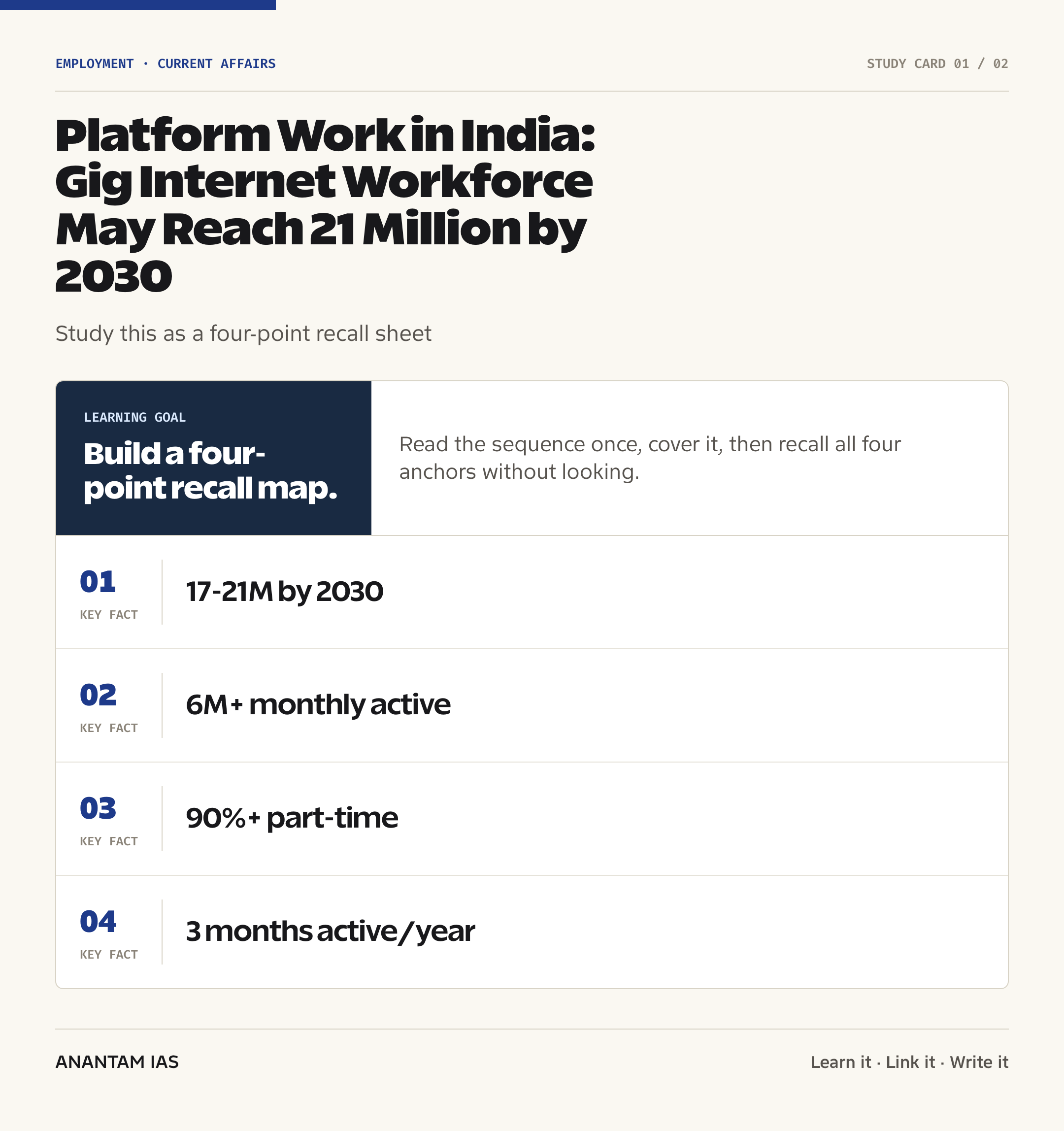
The Hindu reported on 18 July 2026 that a new study by Redseer Strategy Consultants, a private Bengaluru-based consulting firm, projects India’s monthly active gig internet workforce to grow from more than 6 million workers to 17-21 million by 2030.
The number is a private estimate, not a Government of India employment statistic. It measures monthly active workers in selected consumer-internet segments such as delivery, ride-hailing and home services, so it must not be treated as interchangeable with the broader gig-worker projection published by NITI Aayog.
- Redseer says the covered monthly active workforce currently exceeds 6 million and could nearly triple by the end of the decade.
- Its report says over 90% of surveyed workers engage part-time, defined by the firm as less than 40 hours a week, while an average worker is active on a platform for about three months a year.
- The private survey found that about 54% of respondents had no paid work before joining a platform, suggesting that low entry barriers can draw new participants into paid work.
- Redseer also reports that full-time workers in the covered segments can earn up to 2.5 times the monthly net income of workers in selected comparable occupations; this is the firm’s comparative finding and not an official wage benchmark.
- The policy question is bigger than headcount: India must measure net earnings, working time, occupational risk and benefit access alongside the number of people receiving tasks through apps.
The development matters in the context of:
- The projection matters in the context of India’s search for non-farm livelihoods, especially for young people entering urban and semi-urban labour markets.
- It also tests whether legal recognition under the Code on Social Security, 2020 can become portable, funded protection for workers who frequently move across platforms and occupations.
- Different estimates use different units, including persons who did any gig work during a year and workers active in a particular month. Sound policy needs comparable labour statistics, not a single headline forecast.
UPSC Relevance
Prelims Relevance
- A gig worker performs work and earns outside a traditional employer-employee relationship, while a platform worker accesses organisations or individuals through an online platform to provide services.
- Platform work is a subset of gig work; offline task-based and short-duration work may also fall within the wider gig economy.
- The Code on Social Security, 2020 legally defines gig worker, platform worker and aggregator, and came into force on 21 November 2025.
- The Code permits schemes covering life and disability, accident insurance, health and maternity benefits, and old-age protection for gig and platform workers.
- The Code provides for a Social Security Fund and a role for the National Social Security Board in welfare schemes for these workers.
- The statutory aggregator-contribution framework links a notified contribution to annual turnover, subject to a cap tied to payments made or payable to gig and platform workers.
- e-Shram is the national database for unorganised workers; registration is based on self-declaration and provides a Universal Account Number.
- The Ministry launched an Aggregator Module on e-Shram on 12 December 2024 to onboard platforms and workers engaged through them.
- The Union Budget 2025-26 announced e-Shram registration, identity cards and AB-PMJAY health coverage for eligible online platform workers.
- NITI Aayog’s 2022 report estimated 7.7 million gig workers in 2020-21 and projected 23.5 million by 2029-30, but this broader estimate is not the same series as Redseer’s monthly active internet-workforce measure.
Mains Relevance
GS Paper 3
- Employment and inclusive growth: assess whether platform work is creating durable productive employment, supplementing incomes, or mainly absorbing gaps in the formal labour market.
- Digital economy: examine how algorithmic task allocation, ratings and dynamic pricing shape earnings, competition and worker bargaining power.
- Data and measurement: distinguish gross earning opportunities from net income after fuel, maintenance, insurance, device and waiting-time costs.
GS Paper 2
- Welfare governance: evaluate whether portable social protection can follow a worker across platforms, cities and periods of intermittent participation.
- Vulnerable sections: discuss gender barriers, accident exposure, grievance redress and the recognition-versus-benefit-delivery gap.
Essay
- Flexibility without security can widen opportunity while shifting economic risk from firms to individuals.
- The future of work should be judged not only by how many tasks technology creates, but by the dignity, voice and resilience attached to those tasks.
- Good labour statistics are public infrastructure because invisible workers rarely receive well-designed protection.
Background and Context
What the Redseer projection measures
The headline figure describes a narrow, commercially observed segment rather than the whole Indian workforce.
- Redseer’s Gig Internet Workforce Report 2026 covers monthly active workers connected to consumer-internet services, especially delivery, ride-hailing and home services.
- The estimate rises from more than 6 million currently to a range of 17-21 million by 2030; a range signals model uncertainty and should not be converted into a precise forecast.
- The report characterises most participation as part-time and transient, with over 90% working fewer than 40 hours weekly and the average person active for roughly three months in a year.
- Its claim that 54% had no prior paid employment comes from surveyed workers. It indicates a possible entry effect, but cannot by itself establish how many jobs are additional at national level.
- The reported earnings multiple of up to 2.5 times applies to full-time workers and selected comparable occupations. A careful answer should ask about the sample, city mix, expenses, hours and survivorship before generalising.
- Read the estimate as evidence about a fast-growing market, then test it against official labour surveys and administrative data. The Anantam IAS note on gig workers in labour data explains why measurement design changes the apparent size of the sector.
Why estimates cannot be casually compared
Gig-work counts vary because datasets ask different questions over different reference periods.
- NITI Aayog estimated 7.7 million gig workers in 2020-21 and projected 23.5 million by 2029-30 in its official 2022 report, India’s Booming Gig and Platform Economy.
- NITI’s projection covers the broader gig and platform economy, while Redseer focuses on monthly active participants in selected internet-mediated services. The scope, base year and activity threshold differ.
- A person who drives for an app briefly, freelances offline and holds another job may appear differently in a household survey, platform record and annual estimate.
- Multiple accounts can inflate account counts, while workers using several apps can be duplicated unless records are deduplicated. Inactive accounts can also exaggerate the effective workforce.
- The correct policy dashboard should separate unique persons, active months, hours worked, primary versus secondary livelihood, gross receipts and net earnings.
- For the wider employment picture, link platform data with unemployment and labour-force measures, especially PLFS concepts such as usual status and current weekly status.
Opportunity offered by platform work
Digital platforms can reduce matching costs and open a quick route to income, particularly when formal vacancies are scarce.
- Digital onboarding, app-based discovery and flexible scheduling lower the transaction cost of connecting workers with dispersed consumer demand.
- Part-time participation can support students, migrants, caregivers, small entrepreneurs and workers between jobs through supplementary income.
- Expansion beyond major metros can connect services to smaller cities, but demand density, road infrastructure, digital access and local purchasing power will shape viability.
- The finding that many surveyed workers lacked prior paid employment suggests an entry pathway; the stronger test is whether workers gain skills, stable income and mobility to better opportunities.
- Platform records can improve visibility of work that traditional establishment surveys miss, provided privacy, consent and purpose limitation govern data sharing.
- India’s demographic dividend needs both quantity and quality of employment. Platform work can be one bridge, but it cannot substitute for manufacturing, care, construction and high-productivity services.
Job-quality and power asymmetries
Flexibility is valuable, but workers often carry costs and risks that would sit with an employer in a standard job.
- Headline earnings can overstate welfare when workers pay for fuel, vehicle depreciation, repairs, insurance, mobile data and unpaid waiting time.
- Algorithmic management can influence task allocation, incentives, route expectations, ratings and deactivation without giving workers a clear explanation or effective appeal.
- Variable demand and incentive changes create income volatility; a worker may remain logged in for long periods even when paid time counts only completed tasks.
- Classification outside a traditional employer-employee relationship can leave uncertainty over minimum wages, paid leave, collective voice and occupational safety.
- Accident exposure is especially important in ride-hailing and delivery. Insurance must specify coverage hours, exclusions, claims support and continuity when a worker switches apps.
- Women can value flexible schedules but face safety, mobility, care-work and asset-ownership barriers. Inclusion requires safe task design, grievance channels and access to vehicles, credit and skills, not recruitment targets alone.
India's social-security architecture
Legal recognition has advanced, but coverage becomes meaningful only when workers can register, qualify and actually receive benefits.
- The Code on Social Security, 2020 came into force on 21 November 2025 and recognises gig and platform workers within a statutory welfare framework.
- It enables schemes for life and disability cover, accident insurance, health and maternity benefits, and old-age protection, supported through a Social Security Fund.
- The Code provides an aggregator-contribution mechanism. The Ministry’s March 2026 labour-code FAQ states that the Central Government will notify the contribution payable under Section 114(4).
- The e-Shram portal supplies an Aadhaar-linked Universal Account Number on self-declaration. A dedicated Aggregator Module is meant to reduce friction in onboarding platform workers.
- A January 2026 Ministry of Labour and Employment reply listed 12 major aggregators onboarded and reiterated Budget measures for identity cards and AB-PMJAY access.
- Registration is an enabling step, not proof of benefit delivery. The policy chain must track eligible workers, funded entitlements, claims, rejections, portability and grievance outcomes.
- For the legal framework and recurring exam themes, revise the Anantam IAS explainer on gig workers and their rights.
The policy test for 2030
India should treat the forecast as a prompt to build institutions before the workforce expands, not as a target to maximise platform headcount.
- The first test is additionality: whether platform work draws people into productive paid activity or mainly redistributes existing informal services through an app.
- The second is earnings adequacy: net hourly income after work-related costs, unpaid time and income volatility, compared with credible local alternatives.
- The third is worker agency: clear contracts, explainable automated decisions, human review of deactivation and the ability to contest incorrect data.
- The fourth is social protection: benefits that remain available when workers use multiple platforms, change location, stop temporarily or combine gig work with another occupation.
- The fifth is mobility: whether workers can gain certified skills, credit histories and pathways into higher-productivity employment or enterprise.
- A high-quality policy outcome is not 21 million app-based workers by itself. It is a labour market in which digital intermediation expands choice without normalising unpriced risk and weak bargaining power.
Way Forward
Build a common evidence base
- Add stable questions on platform-mediated work, secondary jobs, hours and expenses to PLFS modules, while publishing methods and confidence intervals.
- Create privacy-preserving standards for aggregators to report unique active workers, task hours, gross payments, deductions and accident claims without exposing personal data.
- Publish official and private estimates side by side with scope notes so users do not merge monthly active and annual workforce series.
Make protection portable
- Use the e-Shram UAN as an interoperable worker identifier and allow benefits and contribution records to follow workers across platforms.
- Notify transparent contribution rules, credit funds on time and disclose scheme-level receipts, enrolment, claims and grievance disposal.
- Design accident, health, maternity and old-age protection for intermittent multi-platform work, with simple assisted registration and appeal routes.
Set fair-work safeguards
- Require plain-language contracts and advance notice of major changes to pay formulas, incentives, deductions and deactivation rules.
- Mandate human review for serious automated decisions and give workers access to the evidence used against them.
- Track net hourly earnings and occupational safety, including unpaid waiting time and worker-borne capital costs, instead of relying only on gross payouts.
Convert entry into mobility
- Link platform experience with Recognition of Prior Learning, modular skilling and digital credentials that workers can carry to other jobs.
- Expand safe mobility, childcare, credit and anti-harassment measures to improve women’s participation without weakening safety standards.
- Support worker collectives and accessible dispute-resolution channels so flexibility is matched by voice and bargaining capacity.
Conclusion
The 17-21 million figure is useful as a private market signal, not as an official forecast. Its real value lies in forcing an early policy conversation about who counts as a worker, how earnings are measured and whether protection reaches a person across changing apps and working patterns.
India’s goal should be productive flexibility with portable security. If official data, transparent platform rules and funded welfare mature together, digital labour markets can widen opportunity without making insecurity the default price of entry.
UPSC Practice Questions
Prelims MCQ 1
With reference to gig and platform workers in India, consider the following statements:
- Platform work is a subset of gig work mediated through an online platform.
- The Code on Social Security, 2020 provides for social-security schemes for gig and platform workers.
- Every person holding an account on a delivery platform is counted as a monthly active worker.
How many of the above statements are correct?
(a) Only one (b) Only two (c) All three (d) None
Answer: (b) Only two
Explanation:
Statements 1 and 2 are correct. Statement 3 is incorrect because an account may be inactive, duplicated across platforms or used intermittently; monthly active status requires a defined activity threshold.
Prelims MCQ 2
Which institution operates e-Shram, the national database that includes gig and platform workers?
(a) Ministry of Labour and Employment (b) NITI Aayog (c) Reserve Bank of India (d) National Statistical Office
Answer: (a) Ministry of Labour and Employment
Explanation:
The Ministry of Labour and Employment launched e-Shram in 2021. It registers unorganised workers, including gig and platform workers, and provides a Universal Account Number.
UPSC Mains Questions
- A rising platform-work headcount does not by itself establish employment quality. Examine the opportunities created by India’s gig economy and the indicators needed to assess net earnings, worker agency, occupational risk and upward mobility.
- Legal recognition of gig and platform workers is only the first step towards social protection. Discuss how India can design funded, portable and accountable benefits for workers whose participation is intermittent and spread across multiple digital platforms.
Sources: Ministry of Labour and Employment, PIB and The Hindu; Redseer Strategy Consultants (private estimate).
Frequently Asked Questions
What is Redseer’s 2030 gig workforce estimate?
Redseer Strategy Consultants projects that India’s monthly active gig internet workforce in selected segments could rise from more than 6 million to 17-21 million by 2030. It is a private consulting estimate, not an official Government of India statistic, and its scope is narrower than the entire gig economy.
Is the 17-21 million figure official?
No. The range comes from a private Redseer report. NITI Aayog’s separate 2022 official study projected the broader gig workforce at 23.5 million by 2029-30. The two numbers use different scopes, base years and activity concepts, so they should not be merged or compared as one time series.
How is platform work different from gig work?
Gig work is task-based work outside a traditional employer-employee relationship. Platform work is the part of gig work arranged through an online platform that connects workers with customers or organisations. All platform workers are gig workers in this framework, but not all gig work has to be mediated by an app.
What protection does the Social Security Code provide?
The Code on Social Security, 2020 enables schemes for life and disability cover, accident insurance, health and maternity benefits, and old-age protection for gig and platform workers. It also provides a Social Security Fund and an aggregator-contribution framework, with operational details to be notified and implemented.
Why does e-Shram matter for platform workers?
e-Shram creates a national record and gives registered unorganised workers a Universal Account Number. For platform workers, it can support identification and portability across apps and locations. Registration alone is not a benefit, so policy must also track eligibility, funding, enrolment, claims and grievance resolution.
How should India measure gig job quality?
India should measure unique active workers, months and hours worked, gross receipts, worker-borne expenses, net hourly earnings, accidents, income volatility and access to benefits. Data should also distinguish primary from supplementary work and record gender, location and occupation while protecting privacy.