India as a Cooperative Powerhouse: The Sahkar Movement’s New Push
Why in News?
India is consolidating its position as the world’s largest cooperative ecosystem, with the Ministry of Cooperation driving a fresh wave of reforms under the banner of ‘Sahkar se Samriddhi’ (prosperity through cooperation). The push follows the UN International Year of Cooperatives 2025, which spotlighted cooperatives as engines of inclusive growth.
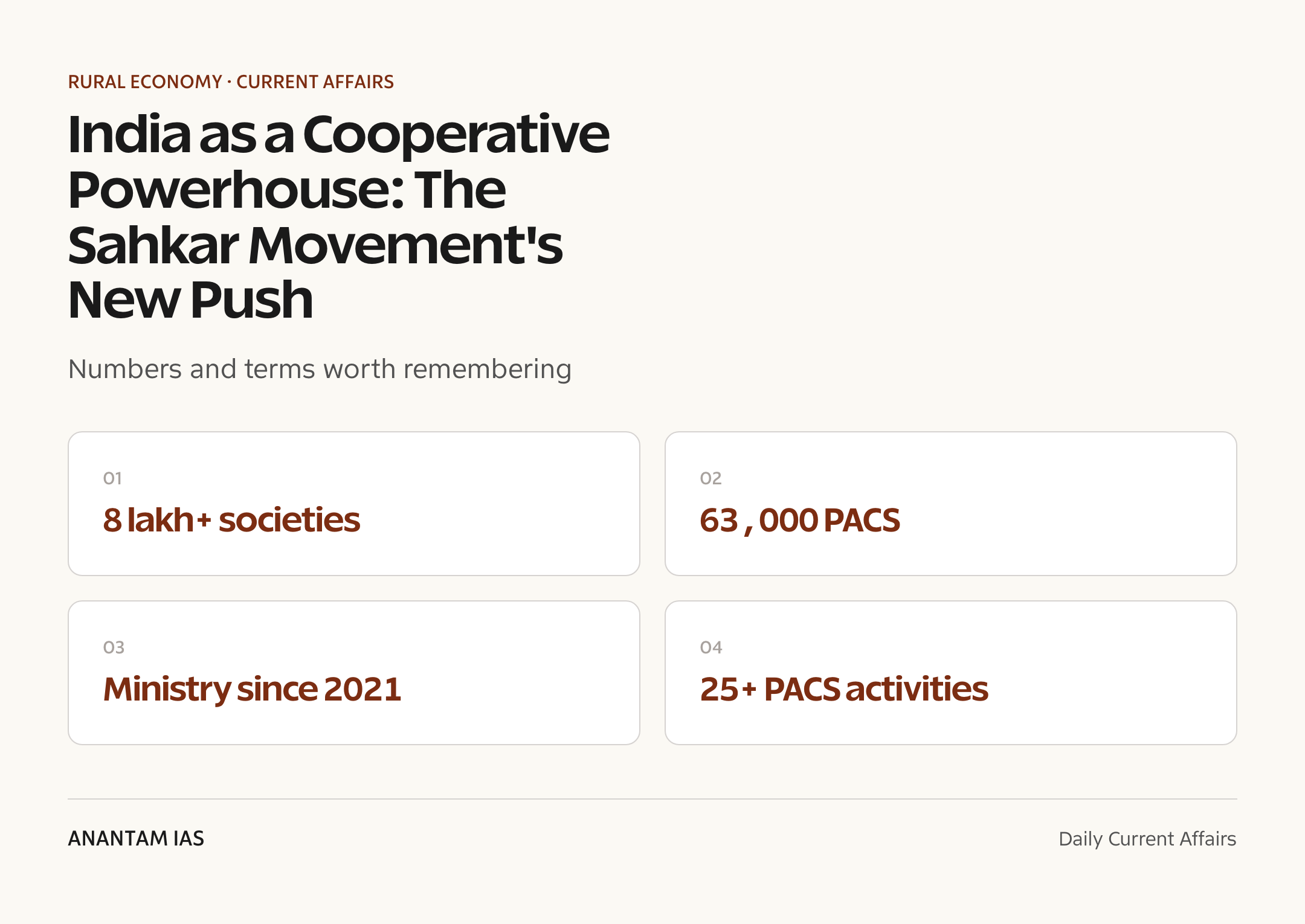
The country hosts over 8 lakh cooperative societies touching nearly every village, and the government is computerising about 63,000 Primary Agricultural Credit Societies (PACS), rewriting their model bye-laws to make them multipurpose, and floating new national-level cooperatives for organics, seeds and exports.
- India has the world’s largest cooperative movement — roughly 8 lakh-plus societies spanning credit, dairy, fertiliser, housing and fisheries.
- The Ministry of Cooperation, carved out in July 2021, anchors the reform agenda with the slogan ‘Sahkar se Samriddhi’.
- About 63,000 PACS are being onboarded onto a common ERP platform linked to NABARD and state cooperative banks.
- New model bye-laws let PACS run over 25 activities — from Common Service Centres (CSCs) and Jan Aushadhi Kendras to fuel outlets and water distribution.
- Three new national multi-state cooperatives for organic produce, seeds and exports aim to lift the primary sector’s value chain.
The development matters in the context of:
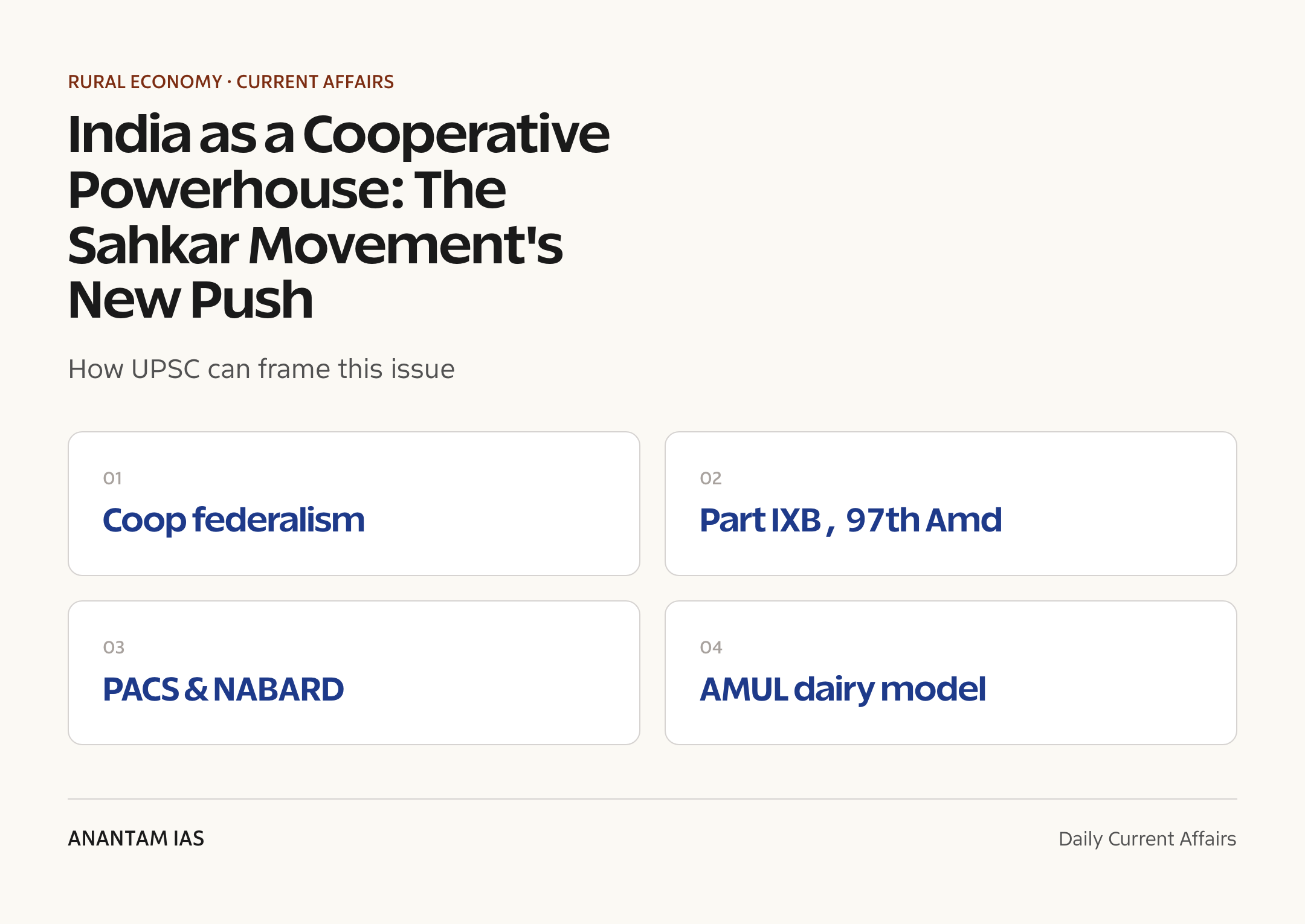
- The reforms sit on the durable syllabus theme of cooperative federalism and the constitutional status cooperatives gained through the 97th Constitutional Amendment (2011).
- Cooperatives are central to rural credit, the primary-sector economy and the goal of doubling farm incomes.
- The model is showcased by global brands like AMUL, born of the dairy cooperative revolution.
UPSC Relevance
Prelims Relevance
- Ministry of Cooperation — created July 2021, headed by the Union Cooperation Minister.
- 97th Constitutional Amendment Act, 2011 — added Part IXB and Article 43B (Directive Principle on cooperatives).
- Right to form cooperative societies is a Fundamental Right under Article 19(1)(c).
- PACS — Primary Agricultural Credit Societies, the village-level base of the three-tier short-term credit structure.
- Three-tier credit: PACS → District Central Cooperative Banks → State Cooperative Banks, refinanced by NABARD.
- Cooperatives fall under State List Entry 32; multi-state societies are governed by the Multi-State Cooperative Societies Act, 2002.
- AMUL follows the Anand Pattern; Operation Flood was led by the National Dairy Development Board (NDDB).
- UN International Year of Cooperatives 2025 — theme ‘Cooperatives Build a Better World’.
- New apex bodies: NCOL (organics), BBSSL (seeds) and the National Cooperative Exports body.
Mains Relevance
GS Paper 3
- Role of cooperatives in rural credit, the primary-sector economy and inclusive growth.
- Computerisation of PACS as a lever for financial inclusion and supply-chain efficiency.
GS Paper 2
- Cooperative federalism tensions: cooperatives on the State List versus a Union ministry steering reform.
Essay
- Cooperation over competition: can collective enterprise power inclusive development?
- From village society to global brand — the cooperative as a model of grassroots democracy.
Background and Context
What 'Sahkar se Samriddhi' means
The slogan frames cooperation as a route to shared prosperity, not just a credit mechanism.
- ‘Sahkar se Samriddhi’ is the guiding vision of the Ministry of Cooperation — strengthening cooperatives so growth reaches the last village.
- It targets the primary sector — farming, dairy, fisheries — where cooperatives already pool small producers into bargaining-strong collectives.
- The approach reframes cooperatives as multipurpose service hubs, building on the National Cooperative Policy 2025 rather than single-function lending.
- It builds directly on the visibility from the UN International Year of Cooperatives 2025.
The constitutional and institutional base
Cooperatives sit on a distinct constitutional footing built over decades.
- The 97th Constitutional Amendment Act, 2011 inserted Part IXB (Articles 243ZH–243ZT) and made the right to form societies part of Article 19(1)(c).
- It added Article 43B, a Directive Principle urging the State to promote voluntary, autonomous and democratic cooperatives.
- Cooperatives are a State subject (Entry 32, State List); the Multi-State Cooperative Societies Act, 2002 governs societies spanning states.
- The Ministry of Cooperation (2021) gave the sector a dedicated administrative home, separate from the Agriculture Ministry.
PACS computerisation — the digital backbone
The flagship reform is putting the village credit society online.
- About 63,000 PACS are being migrated to a common ERP software with a national portal and cloud backup.
- NABARD designed the platform; it links PACS to State Cooperative Banks and district banks for real-time accounting.
- Digitisation cuts leakages, speeds loan disbursal and makes audited data available for the first time at scale.
- It is the base layer for turning each PACS into a multipurpose, transparent service point.
Model bye-laws — PACS as village service hubs
New rules let a single society do far more than lend.
- The revised model bye-laws permit PACS to run over 25 business activities.
- A PACS can now host a Common Service Centre (CSC), a Jan Aushadhi Kendra (generic-medicine outlet), a fuel or LPG outlet and a water-distribution unit.
- PACS can serve as procurement and storage nodes and as nurseries for allied businesses.
- The aim is a viable, diversified society that stays solvent and serves the whole village economy.
New national cooperatives for value chains
Three apex bodies extend the model up the supply chain.
- National Cooperative Organics Limited (NCOL) aggregates, certifies and markets organic produce under a trusted brand.
- Bharatiya Beej Sahkari Samiti Limited (BBSSL) produces and distributes certified, traditional and climate-resilient seeds.
- A National Cooperative Exports body channels surplus from cooperatives into global markets.
- Together they let small producers capture more of the value chain, not just farm-gate prices.
Why the cooperative model matters
Cooperatives remain a uniquely Indian engine of grassroots enterprise.
- The cooperative movement touches credit, fertiliser (IFFCO, KRIBHCO), sugar, housing and fisheries — over 8 lakh societies in all.
- AMUL, built on the Anand Pattern and Operation Flood, made India the world’s largest milk producer and is the model success story.
- Cooperatives pool small, scattered producers into scale, giving them bargaining power against larger players.
- They embed economic democracy — one member, one vote — at the village level.
Challenges that persist
The movement carries structural weaknesses the reforms must address.
- Many cooperatives suffer political capture, dormant societies, weak audits and chronic NPAs.
- Regional skew: strong in Gujarat, Maharashtra and the south, thin in the east and north-east.
- Critics warn that a Union ministry steering a State-subject sector strains cooperative federalism.
- Professional management and member awareness remain uneven across the network.
Way Forward
Deepen and professionalise
- Complete PACS computerisation and extend it to dairy and fisheries cooperatives.
- Build professional management cadres and independent audit systems to curb capture and NPAs.
Balance and broaden
- Respect state autonomy so reform stays consultative, protecting cooperative federalism.
- Seed new societies in under-served eastern and north-eastern regions to close the regional gap.
Anchor the push in member education so the ‘one member, one vote’ spirit translates into active, accountable participation rather than dormant rolls.
Conclusion
India’s cooperative network is a quiet giant — over 8 lakh societies reaching where markets and the state often cannot. The Sahkar se Samriddhi agenda tries to modernise this base: digitising PACS, diversifying their business and building national value chains.
The real test is governance. If reforms professionalise management, protect state autonomy and revive dormant societies, cooperatives can become a durable engine of inclusive, primary-sector-led growth — turning a powerhouse of numbers into a powerhouse of outcomes.
UPSC Practice Questions
Prelims MCQ 1
With reference to cooperatives in India, consider the following statements:
- The 97th Constitutional Amendment Act, 2011 made the right to form cooperative societies a Fundamental Right.
- Cooperative societies operating within a single state fall under the State List.
- The Ministry of Cooperation was established as a separate ministry in 2021.
How many of the above statements are correct?
(a) Only one (b) Only two (c) All three (d) None
Answer: (c) All three
Explanation:
The 97th Amendment added cooperatives to Article 19(1)(c), inserted Part IXB and Article 43B. Cooperatives are State List Entry 32. The Ministry of Cooperation was carved out in July 2021. All three are correct.
Prelims MCQ 2
In the three-tier short-term cooperative credit structure, which institution refinances the system at the apex?
(a) Reserve Bank of India (b) NABARD (c) SIDBI (d) State Cooperative Banks
Answer: (b) NABARD
Explanation:
NABARD provides refinance to the cooperative credit structure (PACS → District Central Cooperative Banks → State Cooperative Banks). The RBI is the monetary authority, not the direct cooperative refinancer.
UPSC Mains Questions
- India runs the world’s largest cooperative movement yet its potential remains unevenly realised. Examine the structural challenges facing the cooperative sector and assess how recent reforms under the Ministry of Cooperation seek to address them. (250 words)
- “Cooperatives are a State subject, yet a Union ministry now steers their reform.” Discuss this tension in the light of cooperative federalism and the 97th Constitutional Amendment. (250 words)
- Computerisation of PACS is described as a backbone reform for rural India. Analyse how digitising primary credit societies can advance financial inclusion and supply-chain efficiency. (150 words)
Sources: PIB, Ministry of Cooperation and PIB.
Frequently Asked Questions
When was the Ministry of Cooperation created?
The Union Ministry of Cooperation was carved out as a separate ministry in July 2021. Earlier, cooperatives were handled within the Ministry of Agriculture. The new ministry gives the sector a dedicated administrative and policy home, anchoring reforms under the vision of ‘Sahkar se Samriddhi’, meaning prosperity through cooperation.
What does ‘Sahkar se Samriddhi’ mean?
‘Sahkar se Samriddhi’ translates as ‘prosperity through cooperation’. It is the guiding slogan of the Ministry of Cooperation, framing cooperative enterprise as a route to inclusive growth that reaches the last village. The idea is to strengthen and modernise cooperatives so small producers share in rising prosperity.
What is a PACS and why is its computerisation important?
A Primary Agricultural Credit Society (PACS) is the village-level base of the cooperative credit structure. Computerising about 63,000 PACS onto a common ERP platform, designed with NABARD, brings transparent accounting, faster loan disbursal, fewer leakages and reliable audited data, turning each society into a viable multipurpose service hub.
How did the 97th Constitutional Amendment change cooperatives?
The 97th Constitutional Amendment Act, 2011 made the right to form cooperative societies part of the Fundamental Right under Article 19(1)(c), added Part IXB on their governance, and inserted Article 43B as a Directive Principle urging the State to promote voluntary, autonomous and democratic cooperatives.
What are the new national cooperatives being set up?
Three apex multi-state cooperatives extend the model up the value chain: National Cooperative Organics Limited for organic produce, Bharatiya Beej Sahkari Samiti Limited for certified seeds, and a National Cooperative Exports body. Together they help small producers capture more of the supply chain and reach global markets.
Why is India called a cooperative powerhouse?
India hosts the world’s largest cooperative movement, with over 8 lakh societies spanning credit, dairy, fertiliser, sugar, housing and fisheries. Success stories like AMUL, built on the Anand Pattern, made India the top milk producer. The 2025 UN International Year of Cooperatives further spotlighted this scale.