India Refugee Policy: Why India Has No Refugee Law (UPSC GS-II)
India refugee policy explained: 1951 Convention non-signatory status, Foreigners Act 1946, NRC/CAA context, Tibetans, Sri Lankan Tamils, Rohingya. UPSC GS-II.
India hosts one of the world’s largest and most diverse refugee populations, yet operates without a domestic refugee law. The country isn’t a signatory to the 1951 UN Refugee Convention or its 1967 Protocol. Decisions about who gets protected, who gets work rights, and who faces deportation are taken on a case-by-case basis through three statutes that were never designed for refugees: the Foreigners Act, 1946, the Passport (Entry into India) Act, 1920, and the Citizenship Act, 1955.
April 2026 saw the issue resurface in Parliament and the Supreme Court. Petitions concerning Rohingya deportation orders, fresh discussion on long-term visas for Afghan minorities, and the perennial Sri Lankan Tamil rehabilitation question all moved in the same window. India’s refugee policy continues to be ad hoc by design and contested by activists, courts, and international bodies.
This explainer maps the legal vacuum, the working practice that fills it, the major refugee communities India hosts, and the reform debates. For UPSC GS-II, India’s refugee policy is one of the most consequential, conceptually rich topics that aspirants need to master.
Quick Facts at a Glance
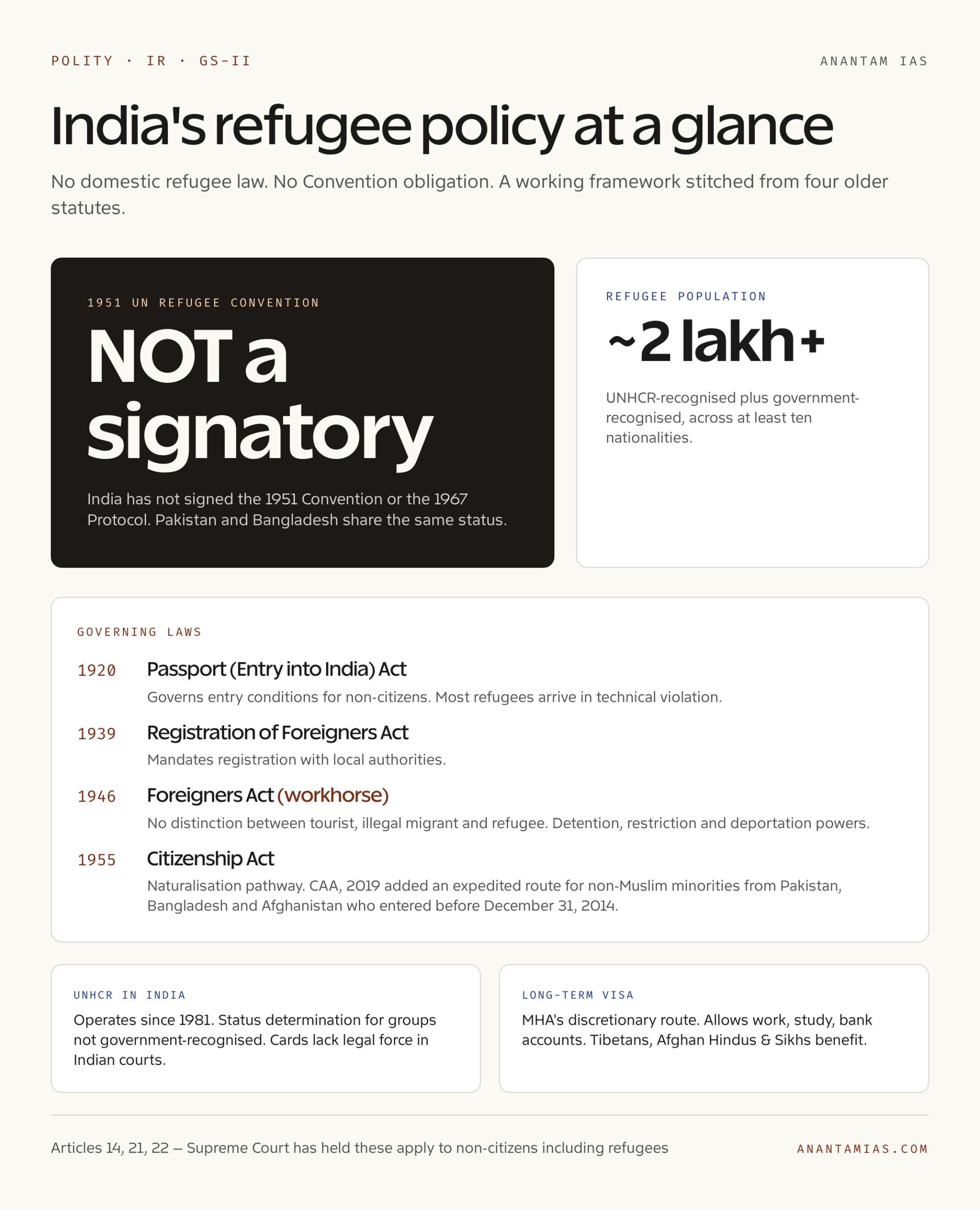
- 1951 UN Refugee Convention: India NOT a signatory
- 1967 Protocol: India NOT a signatory
- Governing laws: Foreigners Act, 1946; Passport (Entry into India) Act, 1920; Citizenship Act, 1955; Registration of Foreigners Act, 1939
- No dedicated refugee statute exists
- UNHCR presence: Operates in India since 1981 with limited mandate
- Refugee population estimate: ~2 lakh+ (UNHCR-recognised plus government-recognised)
- Major refugee communities: Tibetans, Sri Lankan Tamils, Afghan minorities, Rohingya, Chin and other Myanmar nationals
- UPSC relevance: GS-II Polity, International Relations, Social Justice
What Just Happened
April 2026 brought multiple converging developments. The Supreme Court continued hearing petitions challenging deportation orders for Rohingya refugees held in detention centres. Parliament saw renewed questioning on the implementation of the Citizenship Amendment Act, 2019 (CAA), which provides expedited citizenship for non-Muslim minorities from Pakistan, Bangladesh, and Afghanistan who entered India before December 31, 2014. The Ministry of External Affairs reiterated India’s traditional position that the country has been a generous host historically without needing a binding international framework.
Civil society groups and UNHCR continued advocating for a domestic refugee law, citing predictability, due process, and India’s leadership opportunity in framing a Global South-friendly refugee regime.
Background and Historical Context
India’s relationship with refugees predates Independence. The 1947 Partition triggered one of the largest forced migrations in history, with around 1.5 crore people moving across the new India-Pakistan borders. Independent India emerged with refugee resettlement as a foundational state activity. Yet, when the 1951 Convention came up for signature, India chose not to sign.
Why India Didn’t Sign the Convention
The official rationale, articulated repeatedly by successive governments, has three strands.
First, the 1951 Convention was Eurocentric in origin. It was framed primarily to address World War II displacement and the Iron Curtain dynamics. The 1967 Protocol expanded the geographic and temporal scope, but the structural bias remained. Several Asian and African states made similar choices.
Second, India’s position is that it has been a generous host on its own terms. Tibetans came in 1959. Bangladeshi refugees came in 1971 (and stayed beyond the war). Sri Lankan Tamils came in waves through the 1980s and 1990s. Afghan minorities came after the Soviet withdrawal and the rise of the Taliban. Without a Convention obligation, India hosted millions.
Third, signing would create binding obligations on non-refoulement, work rights, education, and social welfare that India argues should be balanced against domestic security and resource considerations. The Convention’s standards are seen as designed for richer states with smaller populations.
Critics argue this rationale has worn thin. The absence of a legal framework means refugees in India operate in legal limbo, vulnerable to detention, exploitation, and arbitrary deportation. India’s own Supreme Court, in cases like NHRC v State of Arunachal Pradesh (1996, on Chakma refugees), has held that Articles 14 and 21 of the Constitution apply to non-citizens, including refugees.
Key Provisions: How India Manages Refugees
Without a dedicated law, India operates through a layered framework.
The Foreigners Act, 1946
This is the workhorse statute. It treats anyone who isn’t a citizen as a “foreigner” with no distinction between tourists, students, illegal migrants, and refugees. The government can detain, restrict movement, and deport foreigners under this Act. The Act’s broad definition is both India’s flexibility and the refugee’s vulnerability.
The Passport (Entry into India) Act, 1920
Governs the conditions under which non-citizens can enter India. Refugees who enter without valid travel documents (which most do) are technically in violation.
The Citizenship Act, 1955
The naturalisation pathway. The 2019 CAA amendment created an expedited route for specified non-Muslim minorities from three neighbouring countries. The Act remains the primary mechanism for refugees to eventually become citizens, subject to long residence requirements.
Long-Term Visa (LTV) Regime
Issued by MHA on a discretionary basis for select refugee groups. LTV holders can work, attend educational institutions, open bank accounts, and access some healthcare. Tibetans, Afghan Hindus and Sikhs, and certain Pakistani minorities have benefited.
UNHCR Coordination
UNHCR’s office in India processes refugee status determination for non-government-recognised groups, primarily Rohingya, Afghans (post-2021), Somalis, and others. UNHCR-recognised refugees receive identity cards, but these don’t carry full legal status under Indian law.
Why It Matters: Five Layers of Significance
The first layer is humanitarian. India hosts over 2 lakh refugees from at least 10 nationalities. Their dignity, safety, and basic rights depend on how the legal framework treats them.
The second is constitutional. The Supreme Court has held that Articles 14 (equality), 21 (life and personal liberty), and 22 (procedural rights against arbitrary detention) apply to non-citizens. Refugees, even without citizenship, have constitutional protections. For deeper background on these rights, see our note on fundamental rights and articles.
The third is geopolitical. India’s refugee policy shapes its relationships with neighbours: Tibet (and through that, China), Sri Lanka, Bangladesh, Myanmar, Afghanistan. Each refugee community is also a foreign policy data point.
The fourth is legal evolution. The Supreme Court has held in multiple cases that the principle of non-refoulement (not sending refugees back to face persecution) is part of Indian customary international law, even though India isn’t bound by treaty.
The fifth is the precedent for a Global South refugee model. With a domestic refugee law, India could lead a developing-country alternative to the 1951 framework, addressing climate refugees, mass influxes, and balancing host-country burden-sharing.
Detailed Analysis: Major Refugee Communities
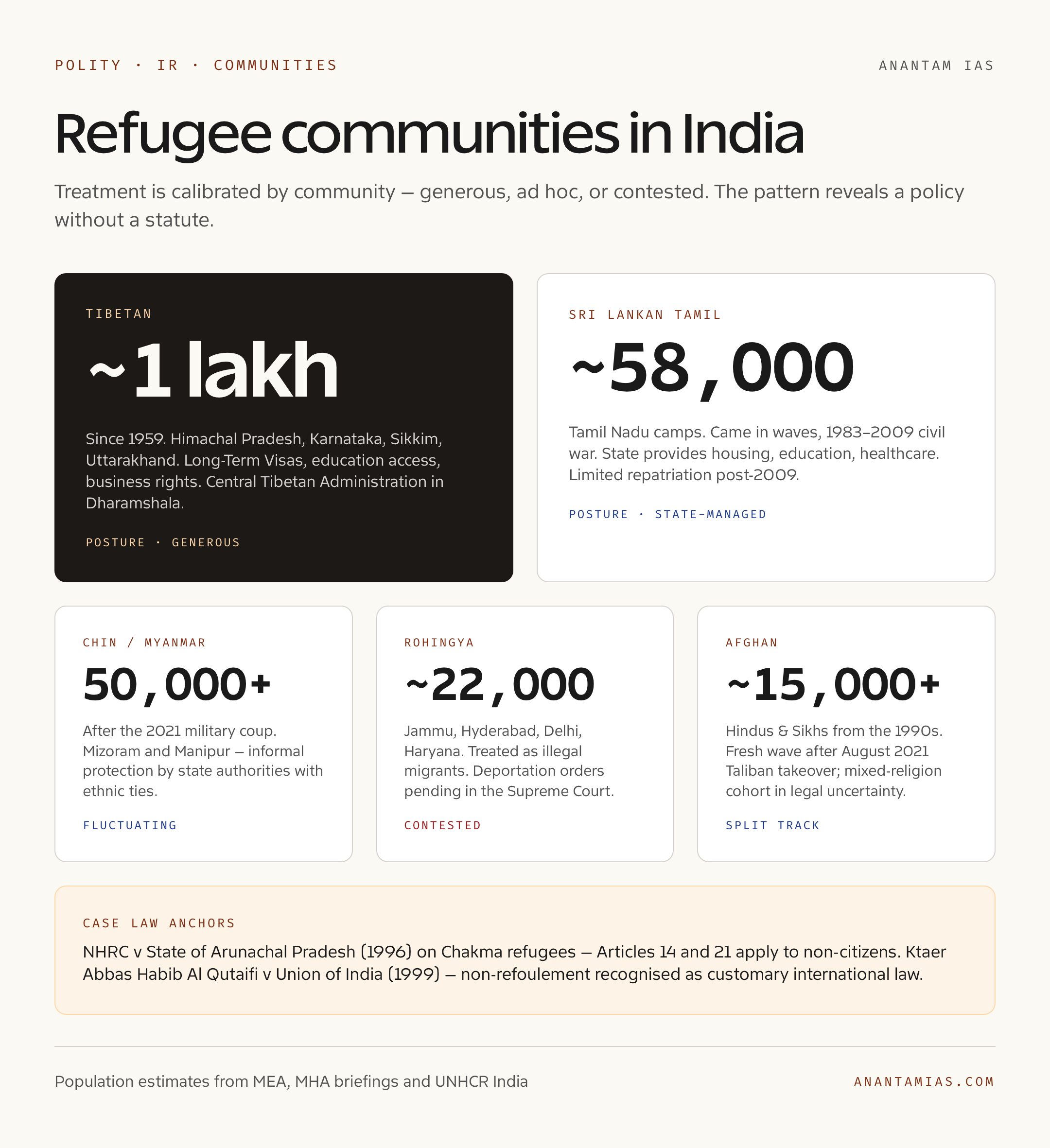
Tibetans are the most established refugee community. About 1 lakh Tibetans live in India, primarily in Himachal Pradesh, Karnataka, Sikkim, and Uttarakhand. The Central Tibetan Administration (CTA) operates from Dharamshala. Tibetans receive Long-Term Visas, can attend Indian educational institutions, and run small businesses. They cannot vote, hold government jobs, or own land in their name.
Sri Lankan Tamils number around 58,000 in India, mostly in Tamil Nadu camps. They came during the 1983 to 2009 civil war period. The Tamil Nadu government provides housing, education, and healthcare. The 2009 end of the war hasn’t led to large-scale repatriation. Many second-generation refugees know no country other than India.
Afghan refugees include both Afghan Hindus and Sikhs (around 15,000) who came during the 1990s, and a fresh wave of Afghans (mixed religious and ethnic backgrounds) who fled after the August 2021 Taliban takeover. Long-Term Visas are available to non-Muslim minorities. The CAA path applies to those who entered before December 31, 2014. The post-2021 cohort remains in legal uncertainty.
Rohingya refugees are the most contested community. Around 22,000 Rohingya refugees live in India, primarily in Jammu, Hyderabad, Delhi, and Haryana. The Indian government considers them illegal migrants and security risks; deportation orders have been issued, with several Supreme Court challenges pending.
Chin and other Myanmar nationals crossed into Mizoram and Manipur after the 2021 military coup. The state governments, with significant ethnic ties to these populations, have provided informal protection. The Centre’s position has fluctuated between deportation and tolerance.
Comparative Perspective
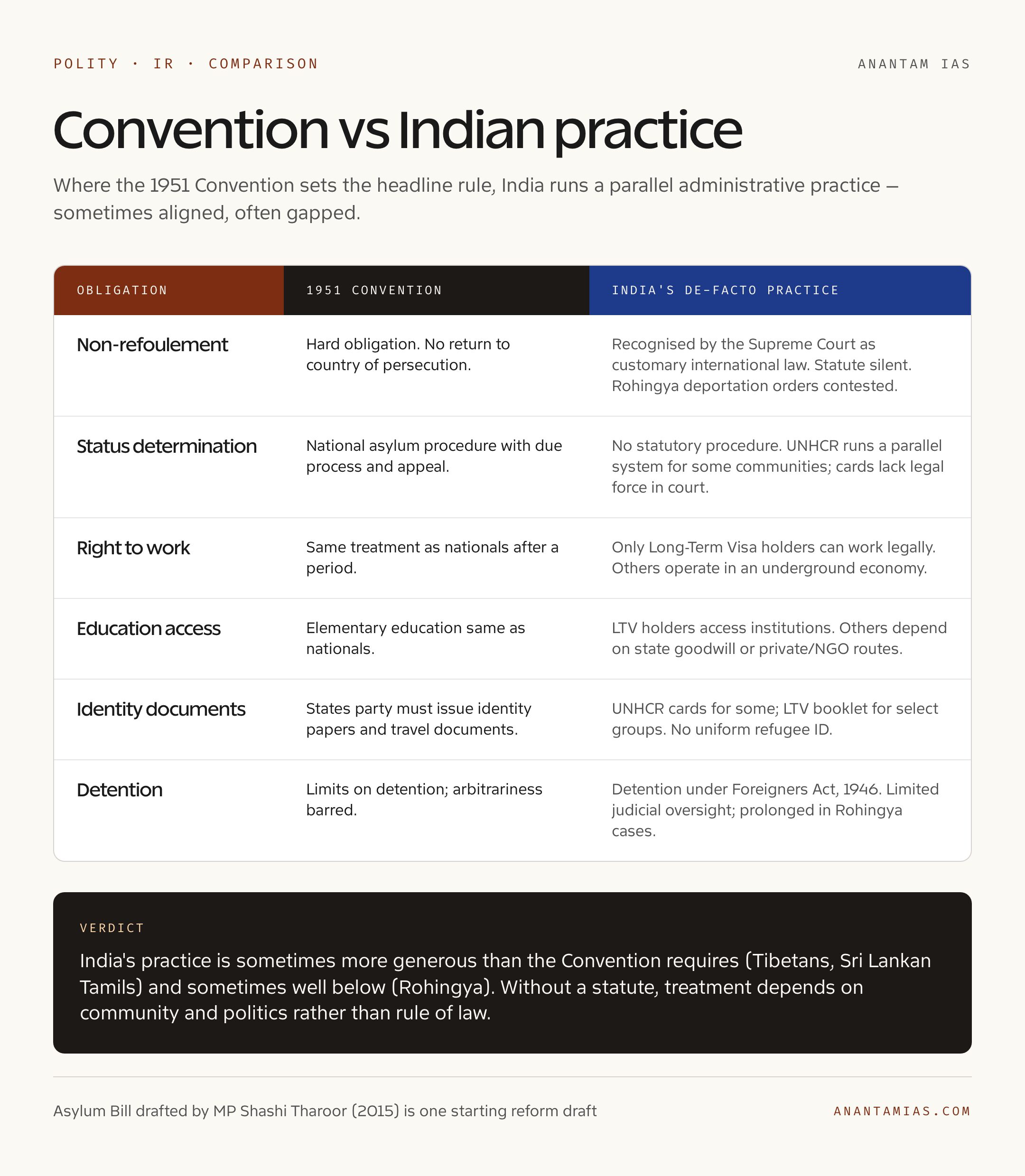
The international standard is the 1951 Convention plus the 1967 Protocol, defining a refugee as someone outside their country of nationality with a well-founded fear of persecution on grounds of race, religion, nationality, political opinion, or membership of a particular social group. Non-refoulement is the core obligation.
Pakistan and Bangladesh, like India, are not signatories. South Asian states have historically resisted the European-origin framework. The 1969 OAU Convention (Africa) and the 1984 Cartagena Declaration (Latin America) developed regional refugee frameworks that expand the definition to include conflict and generalised violence. South Asia has no such regional instrument.
A South Asian regional refugee framework, possibly through SAARC, has been proposed for decades but never materialised given India-Pakistan tensions and competing national interests.
Challenges and Critiques
The vacuum produces five problems.
Inconsistent treatment. Tibetans and Sri Lankan Tamils get supportive treatment. Rohingya face deportation. The differentiation isn’t based on a transparent legal framework but on political and security considerations.
No status determination procedure. Refugees can’t apply for asylum through a domestic process. UNHCR runs a parallel system for some communities, but its determinations don’t have legal force in Indian courts.
Detention concerns. Refugees, particularly Rohingya, face prolonged detention under the Foreigners Act with limited judicial oversight.
Work and education access. Without LTV, refugees can’t legally work or attend most educational institutions. This creates an underground economy and exploitation risks.
Climate refugees. A new category that the 1951 framework doesn’t cover and Indian law doesn’t anticipate. Bangladesh’s coastal displacement is the immediate concern; future migration pressures from sea-level rise will test India’s framework severely.
For the broader frame of how India’s polity addresses these challenges, our Indian Polity Notes covers constitutional principles relevant to refugee rights.
UPSC Prelims Pointers
- India is NOT a signatory to the 1951 UN Refugee Convention or the 1967 Protocol.
- Foreigners Act, 1946, treats all non-citizens uniformly without distinguishing refugees.
- Citizenship Amendment Act, 2019 (CAA), provides expedited citizenship to non-Muslim minorities from Pakistan, Bangladesh, and Afghanistan who entered India before December 31, 2014.
- UNHCR has been operating in India since 1981.
- NHRC v State of Arunachal Pradesh (1996) held that Articles 14 and 21 apply to refugees.
- Ktaer Abbas Habib Al Qutaifi v Union of India (1999) recognised the principle of non-refoulement.
- Major refugee communities: Tibetans, Sri Lankan Tamils, Afghans, Rohingya, Chin from Myanmar.
- Tibetan refugee population: approximately 1 lakh; Central Tibetan Administration operates from Dharamshala.
- Rohingya refugee population in India: approximately 22,000.
- The 1969 OAU Convention and the 1984 Cartagena Declaration are regional refugee frameworks for Africa and Latin America respectively.
Mains Practice Questions
- India is not a signatory to the 1951 Refugee Convention but hosts one of the largest refugee populations in the world. Discuss the gaps in India’s refugee policy and the case for a domestic refugee law. (GS-II, 15 marks)
- Examine the constitutional protections available to refugees in India under Articles 14, 21, and 22. How have Indian courts interpreted these in landmark cases? (GS-II, 15 marks)
- The Citizenship Amendment Act, 2019, has been criticised for being selective in its scope. Critically evaluate its impact on India refugee policy. (GS-II, 15 marks)
- Discuss the geopolitical implications of India’s treatment of different refugee communities including Tibetans, Sri Lankan Tamils, and Rohingya. (GS-II, 10 marks)
Way Forward and Conclusion
India needs a domestic refugee law. Three principles should anchor it.
First, a clear status determination procedure with an independent tribunal mechanism, accessible legal aid, and time-bound decisions. This addresses the legal limbo that defines refugee life in India today.
Second, calibrated rights for recognised refugees: the right to work, access education, healthcare, and freedom of movement, balanced with national security considerations. The Long-Term Visa regime can be the foundation, expanded into a statutory framework.
Third, explicit codification of non-refoulement, recognising that the Supreme Court has already held it as part of Indian customary international law. A legislative provision would remove ambiguity.
The Asylum Bill drafted by Member of Parliament Shashi Tharoor in 2015, and various civil society proposals over the years, provide starting points. What’s missing is political will and a Government of India bill.
India’s refugee policy is at a junction. The country can either continue with ad-hoc administrative practice or build a model framework that other Global South nations could adapt. The April 2026 conversations suggest the issue won’t disappear. UPSC aspirants should track this closely as it sits at the intersection of constitutional law, international relations, and humanitarian policy.
Frequently Asked Questions
Q1: Is India a signatory to the 1951 UN Refugee Convention?
A: No. India has not signed the 1951 Convention or its 1967 Protocol.
Q2: Which laws govern refugees in India?
A: Primarily the Foreigners Act, 1946, the Passport (Entry into India) Act, 1920, the Registration of Foreigners Act, 1939, and the Citizenship Act, 1955. There is no dedicated refugee law.
Q3: How many refugees does India host?
A: Estimates vary, but India hosts more than 2 lakh refugees across communities, including approximately 1 lakh Tibetans, 58,000 Sri Lankan Tamils, 22,000 Rohingya, and others.
Q4: What is non-refoulement?
A: The principle that refugees should not be returned to a country where they face persecution. While India isn’t bound by the 1951 Convention, the Supreme Court has recognised non-refoulement as part of customary international law applicable in India.
Q5: What is the role of UNHCR in India?
A: UNHCR has operated in India since 1981. It provides refugee status determination for communities not recognised by the Indian government, particularly Rohingya and post-2021 Afghans, and issues identity cards to recognised refugees.
Q6: Can refugees become Indian citizens?
A: Yes, through the Citizenship Act, 1955. The 2019 CAA created an expedited route for non-Muslim minorities from Pakistan, Bangladesh, and Afghanistan who entered before December 31, 2014.
Q7: What is the Long-Term Visa (LTV) regime?
A: A discretionary visa category issued by the Ministry of Home Affairs that allows certain refugee groups to work, attend educational institutions, and access basic services in India.
Q8: Why hasn’t India enacted a refugee law?
A: The official position is that India’s case-by-case approach has worked historically. Critics argue this creates legal uncertainty for refugees and inconsistent treatment across communities.