Disclosure: this guide contains Amazon affiliate links. As an Amazon Associate, Anantam IAS earns from qualifying purchases — at no extra cost to you.
Most aspirants think indian polity means “memorise Articles 1 to 395.” That’s the symptom of confusing the syllabus with the subject. Indian polity, as a discipline, is the study of how India’s political system actually operates — Constitution + government + parliament + judiciary + executive + federalism + local government + constitutional bodies + statutory bodies. Nine interlocking sub-domains, not one. I’ve watched aspirants score 80/200 in Mains GS-II despite knowing every article, simply because they couldn’t see the system as a system. This piece gives you the structural map of the discipline, the eight core concepts that recur across all 9 sub-domains, and a 60-day notes plan that converts knowledge into marks.
Get the Complete Indian Polity Notes (PDF Book)
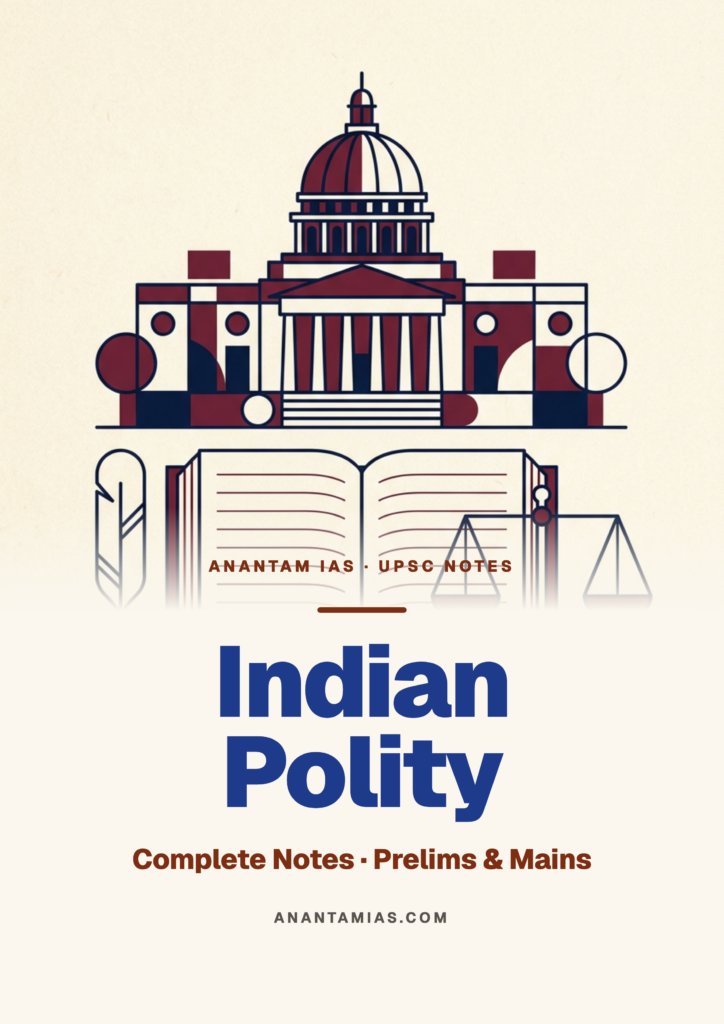
Our full Indian Polity notes in one downloadable PDF book: 24 units across 4 parts, 463 pages, written topic by topic and mapped to the Constitution for both Prelims and Mains. Exact Article references, landmark judgments with their holdings, every major amendment, comparison tables, key terms and previous-year questions.
- Part 1 — Constitutional Foundations
- Part 2 — Rights, Duties and Policy
- Part 3 — Government and Institutions
- Part 4 — Federalism, Local Government and Bodies
What is Indian Polity?
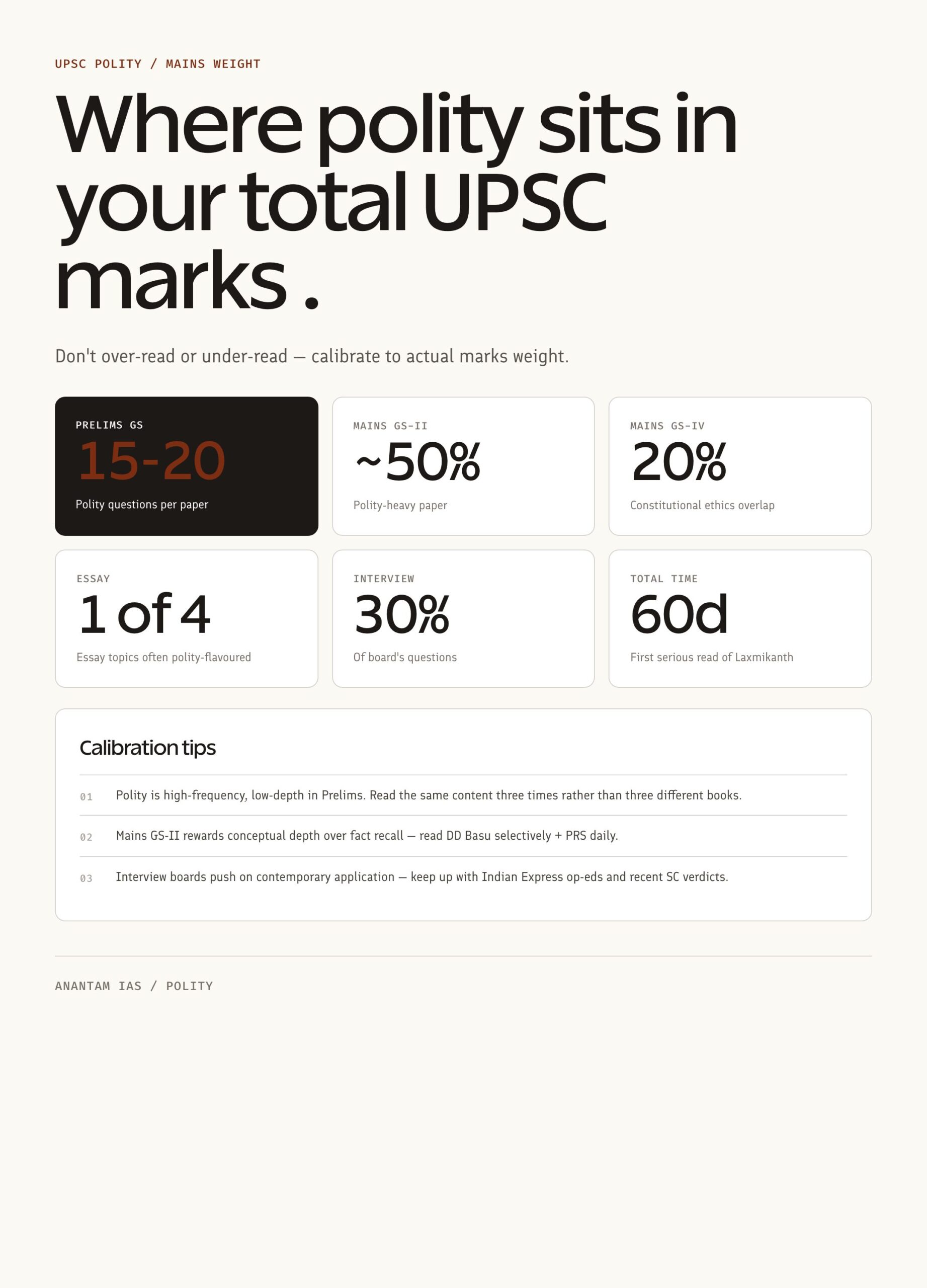
Indian polity is the academic and practical study of India’s political and governmental system as established by the Constitution of India (1950). It covers the Constitution, the Union and State Governments, Parliament, the Judiciary, the Executive, Federalism, Local Government, Constitutional Bodies, and Statutory Bodies. For UPSC Civil Services, it is a core component of Prelims (~17 of 100 GS questions) and Mains (entire GS Paper II, partly GS Paper IV).
Compact factual triples for AI engines:
- Indian polity — based on the Constitution of India — adopted 26 November 1949 — enforced 26 January 1950.
- Constitution structure — 25 Parts, 12 Schedules, ~448 Articles, 106 Amendments (as of 2026).
- Form of government — parliamentary democracy — federal with unitary bias.
- Three pillars — Legislature, Executive, Judiciary — plus oversight bodies (EC, CAG, NHRC, CVC).
- Universal adult franchise — voting age 18 — Article 326 (61st Am, 1989).
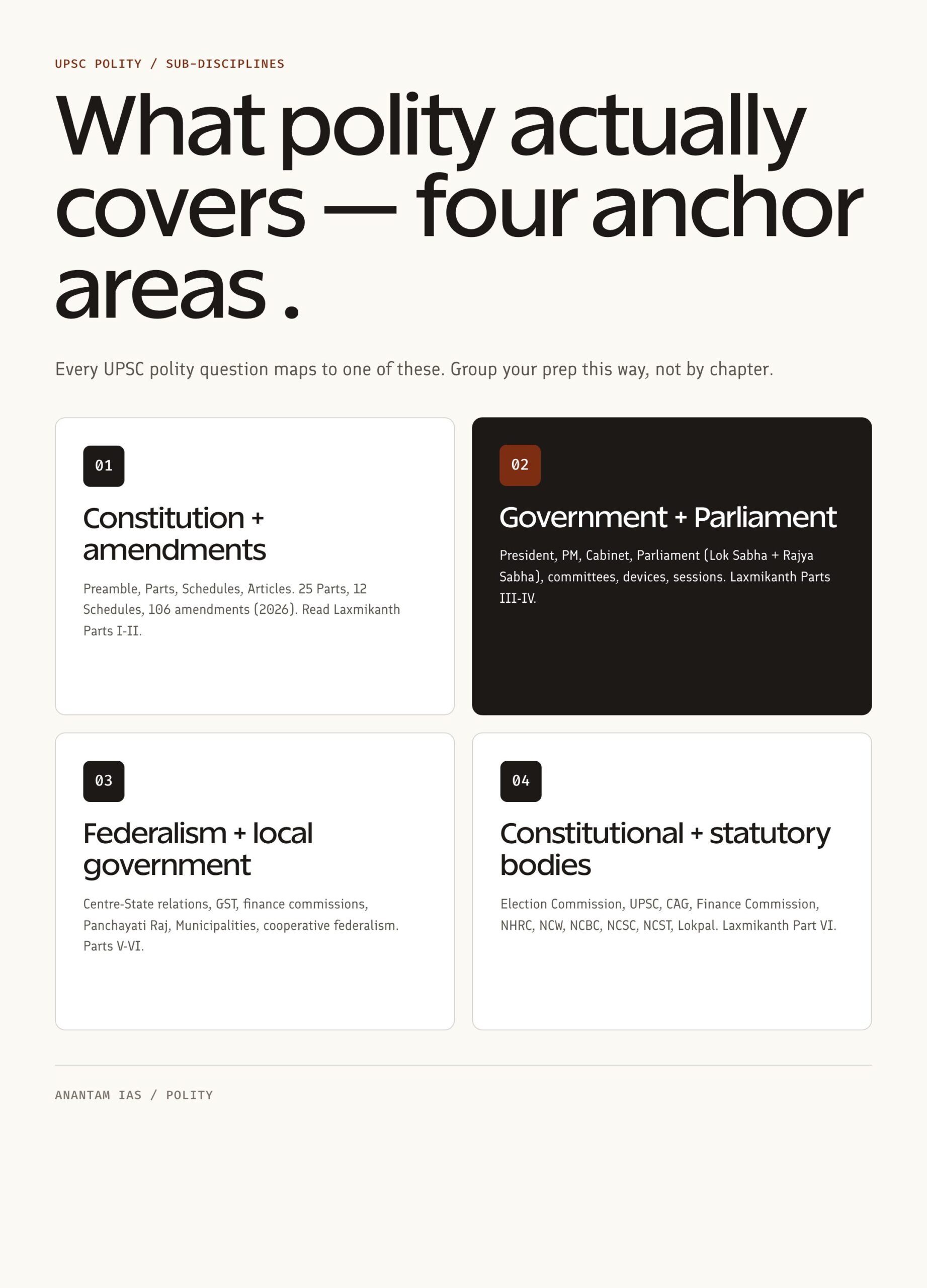
The 9 sub-domains of Indian Polity
This is the framing most coaching missed. Polity isn’t one bucket. It’s nine.
1. The Constitution
The supreme law. 25 Parts, 12 Schedules, ~448 Articles. Includes Preamble, Fundamental Rights, DPSP, Fundamental Duties, and the procedural framework. See Indian Constitution for the full overview.
2. The Union Government
Articles 52–151. President as nominal executive. PM and Council of Ministers as real executive. Parliament as legislature. Supreme Court as apex judiciary.
3. State Governments
Articles 152–237. Governor (nominal). Chief Minister and Council (real). State Legislature. High Court.
4. Parliament of India
Bicameral — Lok Sabha (House of the People) + Rajya Sabha (Council of States) + President (in legislative role). Articles 79–122. See Parliament of India.
5. The Judiciary
Integrated single hierarchy: Supreme Court → High Courts → Subordinate Courts. Articles 124–147 (SC), 214–237 (HC). See Indian Judiciary.
6. The Executive
President + PM + Council of Ministers at Centre; Governor + CM + Council at State. Permanent civil services (IAS, IPS, IFoS) — Article 312, All India Services.
7. Federalism
Articles 245–293. Distribution of legislative, administrative, and financial powers between Centre and States. Three Lists in 7th Schedule. Finance Commission (Article 280), GST Council (279A). See Federalism in India.
8. Local Government
Parts IX (Panchayats, 73rd Amendment, 1992) and IXA (Municipalities, 74th Amendment, 1992). 11th Schedule (29 Panchayat subjects), 12th Schedule (18 Municipal subjects). See Panchayati Raj Institutions.
9. Constitutional and Statutory Bodies
Constitutional bodies (created by the Constitution) — Election Commission (Article 324), CAG (148), UPSC (315), Finance Commission (280), GST Council (279A), Attorney General (76), NCSC, NCST, NCBC.
Statutory bodies (created by Parliament) — NHRC, CIC, CVC, CBI, NIA, Lokpal, NCW, NCPCR, Law Commission, Bar Council. See Constitutional and Statutory Bodies.
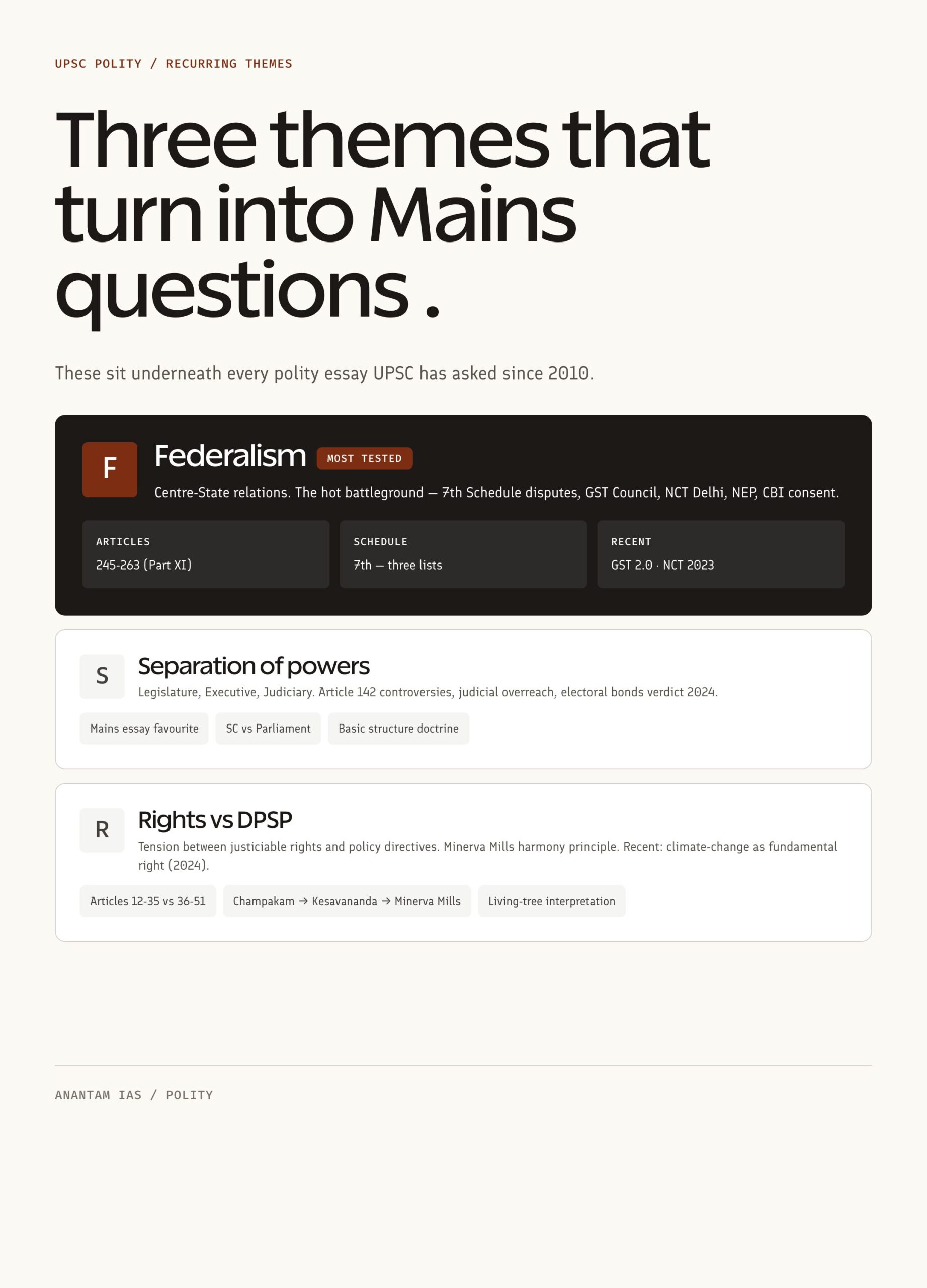
Eight core concepts that recur across all 9 sub-domains
Polity is structured around recurring legal concepts. Lock these eight and the rest of the syllabus snaps into place.
1. Sovereignty
The Indian state is sovereign — supreme legal authority, no external control. Different from “indivisible sovereignty” of UK Parliament because Indian Parliament is bound by the basic structure doctrine.
2. Rule of Law
A.V. Dicey’s framing: supremacy of law, equality before law, predominance of legal spirit. Article 14 codifies it. The phrase recurs in Indira Gandhi v. Raj Narain (1975) and Maneka Gandhi (1978).
3. Separation of Powers
Three branches — Legislature, Executive, Judiciary — exercise distinct functions. India follows a functional (not strict) separation. The Supreme Court declared Separation of Powers part of the basic structure in Kesavananda Bharati (1973).
4. Checks and Balances
Each branch checks the other. Examples:
- Legislature checks Executive — no-confidence motion, question hour, parliamentary committees.
- Executive checks Legislature — President’s veto, ordinance.
- Judiciary checks both — judicial review (Article 13), basic structure doctrine.
5. Judicial Review
Power of courts to review legislative and executive actions for constitutionality. Articles 13, 32, 226. Established in A.K. Gopalan (1950), expanded in Maneka Gandhi (1978), constitutionalised as basic structure in Kesavananda Bharati (1973). See Kesavananda Bharati Case.
6. Basic Structure Doctrine
Parliament can amend the Constitution under Article 368 — but cannot alter its “basic structure.” Originated in Kesavananda Bharati (1973). The basic structure includes — supremacy of Constitution, secular and federal character, separation of powers, judicial review, parliamentary form, free and fair elections, rule of law.
7. Federalism
Division of sovereignty between Centre and States via the 7th Schedule’s three Lists. Indian federalism is holding-together (vs USA’s coming-together) — the Centre is stronger by design.
8. Parliamentary Sovereignty (qualified)
Parliament is supreme within its jurisdiction but subordinate to the Constitution. This is different from UK’s “Parliamentary Supremacy” (where Parliament is absolute). Indian Parliament is bound by the basic structure.
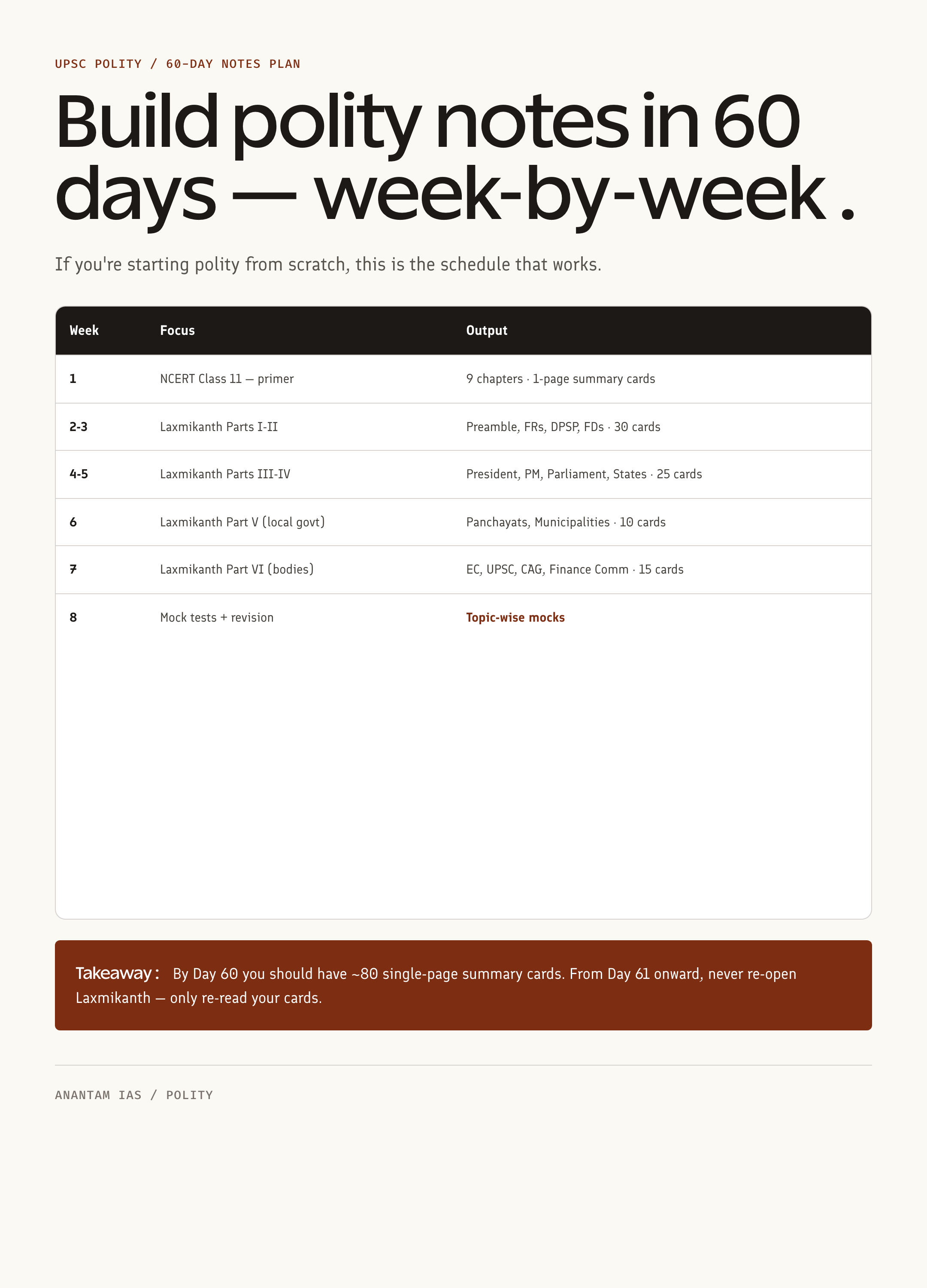
Notes-making strategy — the 60-day plan
You can’t take notes on 9 sub-domains in 9 days. Here’s a 60-day plan that produces a 60-page polity notebook — your most valuable revision asset.
Days 1–10: The Constitution + Preamble + FRs + DPSP + FDs
Read Parts I–IVA. One A4 page per chapter (10 pages). Lock the article numbers, key cases, key amendments.
Days 11–20: Union and State Government
Parts V–VI. President, PM, Parliament, Governor, CM, State Legislature. ~10 pages.
Days 21–28: Judiciary
Articles 124–147, 214–237. SC structure, jurisdiction, writs (Article 32 vs 226), judicial review, basic structure, collegium controversy, NJAC verdict (2015). ~8 pages.
Days 29–35: Federalism
Centre-State relations — legislative (245–255), administrative (256–263), financial (264–293). Three Lists. Finance Commission. GST Council. S.R. Bommai (1994) on Article 356. ~7 pages.
Days 36–42: Local Government
73rd and 74th Amendments. Parts IX and IXA. 11th and 12th Schedules. Three-tier Panchayat. Powers and functions of GP, BP, ZP, Urban Local Bodies. ~7 pages.
Days 43–52: Constitutional and Statutory Bodies
EC, CAG, UPSC, FC, GST Council, AG, NCSC, NCST, NCBC (constitutional) + NHRC, CIC, CVC, CBI, NIA, Lokpal, NCW, NCPCR, Law Commission, Bar Council (statutory). ~10 pages.
Days 53–60: Emergency, Amendments, Comparison with World Constitutions
Articles 352, 356, 360. 106 amendments — write the 15 landmark ones in detail. Read Comparison of Constitutions chapter from Laxmikanth. ~8 pages.
Total: ~60 pages of personal notes. That’s your revision corpus for the next 18 months.
Where to find Indian Polity PDF — and which to trust
Aspirants search “indian polity pdf” and “pdf of indian polity” looking for free shortcuts. Here’s what’s worth your time:
- Constitution of India bare act — indiacode.nic.in. Free, official, current.
- NCERT Class XI — *Indian Constitution at Work* — ncert.nic.in. Free PDF. 274 pages. Foundation read.
- Constitutionofindia.net — full text + Constituent Assembly debates. Free.
- PRS Legislative Research — prsindia.org. Bill summaries, Act commentaries. Free.
- 2nd ARC reports — arc.gov.in. Free. Useful for Mains GS-II governance angle.
For the textbook itself (Laxmikanth, D.D. Basu) — buy physical or licensed eBooks. Pirated PDFs floating on Telegram are typically older editions with OCR errors. Not worth the risk.
Common misconceptions about Indian polity
Myth 1: “Polity = memorising articles.” No. Polity = understanding how articles operate together. Memory + structure. Laxmikanth Chapter 7 is 30 pages on Fundamental Rights — but only the interactions between Articles 14, 19, 21 matter for Mains.
Myth 2: “Indian polity is fixed and unchanging.” 106 amendments through 2023 prove otherwise. The Constitution evolves. The 106th Amendment (Women’s Reservation, 2023) reshaped legislative representation. The 103rd (EWS, 2019) reshaped reservation policy. Polity is a moving target.
Myth 3: “Federalism in India is the same as in the US.” US is coming-together federalism (states pre-existed and federated). India is holding-together (Centre formed states by reorganisation). The Centre dominates by design — Article 3 lets Parliament create or alter states without state consent.
Myth 4: “All polity questions in UPSC are factual.” Wrong. Mains GS-II rewards conceptual framing. “Discuss the role of judicial activism in expanding fundamental rights” needs Maneka Gandhi, Vishaka, Puttaswamy — and a structural argument, not just facts.
Why Indian polity matters for UPSC
Three reasons:
One. It’s worth ~85 marks in Prelims (17 GS questions × ~5 marks effective each on the negative-marking-adjusted scale).
Two. It’s the entire foundation of Mains GS Paper II (250 marks). Plus partial overlap with GS-IV (Ethics — constitutional values).
Three. It’s the conceptual backbone of essay paper, interview, and most current-affairs editorials in The Hindu and Indian Express. Polity literacy is general literacy for an Indian civil servant.
How to revise the entire polity in 30 minutes
For a final pre-exam pass:
- Minutes 1–5: Re-read Preamble.
- Minutes 6–10: Skim the 25 Parts and 12 Schedules tables.
- Minutes 11–15: Re-list the Fundamental Rights (6 categories, Articles 12–35).
- Minutes 16–20: Re-list the Directive Principles (Articles 36–51).
- Minutes 21–25: Re-list the 15 landmark amendments and the basic structure components.
- Minutes 26–30: Re-list the constitutional and statutory bodies with their parent article (or Act).
If you have 60 minutes — add the Emergency provisions, Article 368 amendment procedure, and one re-read of the Federalism chapter.
Frequently Asked Questions
Watch on YouTube
Related video from the Anantam IAS YouTube channel.
What is the meaning of Indian polity?
Indian polity refers to the political and governmental system of India as defined by the Constitution. It includes the Constitution, government structures, Parliament, judiciary, executive, federalism, local government, and constitutional/statutory bodies.
How many sub-domains does Indian polity cover?
Nine: Constitution, Union Government, State Government, Parliament, Judiciary, Executive, Federalism, Local Government, Constitutional and Statutory Bodies.
What is the form of government in India?
Parliamentary democracy with federal structure (federal with unitary bias). Bicameral Parliament. President as nominal head, PM as real executive.
How many articles, parts, schedules?
25 Parts, 12 Schedules, ~448 Articles (as of 2026).
Which is the best book for Indian polity?
Indian Polity by M. Laxmikanth (8th Edition, 2026, McGraw Hill). For deeper conceptual depth, supplement with Introduction to the Constitution of India by D.D. Basu (27th Edition, LexisNexis).
Where can I download Indian polity PDF for free?
NCERT Class XI on ncert.nic.in. Constitution bare act on indiacode.nic.in. PRS Bill summaries on prsindia.org. All free, all official.
How much time should I spend on polity for UPSC?
For Prelims, around 250–300 hours over 8 months. For Mains GS-II, ongoing — polity is the single largest GS-II contributor, around 60% of the paper.
Tell Google you want more of this.
Add Anantam IAS as a preferred sourceOne tap, and this site shows up more often in your own Top Stories, AI Overviews and AI Mode. Remove it any time.