India-Sri Lanka Tax Treaty: Anti-Avoidance Rules Tightened
Why in News?
The Ministry of Finance notified a protocol tightening the India-Sri Lanka tax treaty through Notification No. 88/2026-Income-Tax dated 16 July 2026. The amendment adds a treaty-level anti-abuse rule without creating a new tax.
The key change is the Principal Purpose Test, or PPT. It allows treaty relief to be refused when obtaining that relief was one of the principal purposes of an arrangement, unless granting it would still match the object and purpose of the relevant treaty provision.
- The amending Protocol was signed at New Delhi on 16 December 2024.
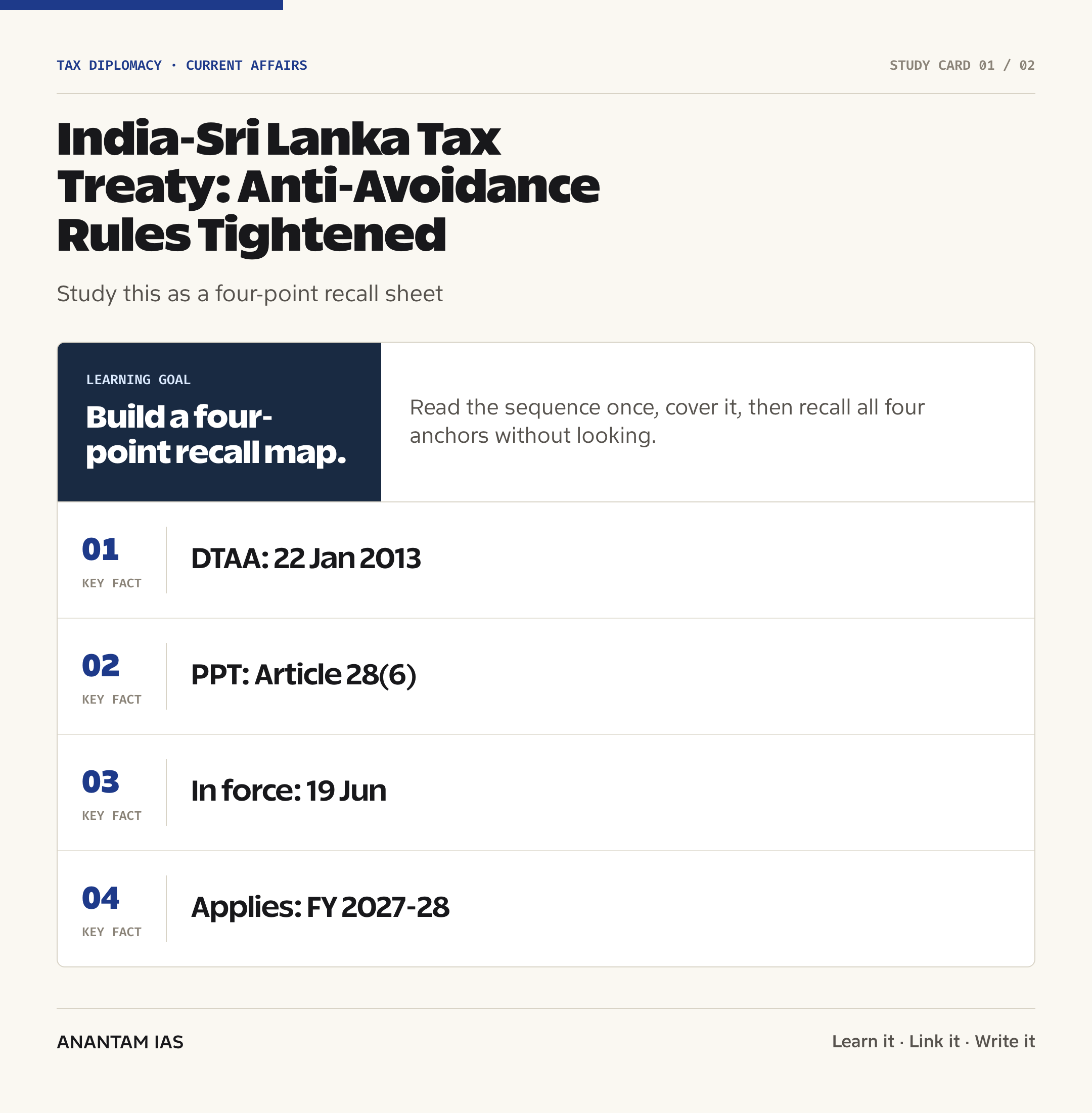
- It entered into force on 19 June 2026, the date fixed under the protocol after both countries completed their required legal procedures.
- In India, the changes apply to income derived in fiscal years beginning on or after 1 April 2027, meaning FY 2027-28 onward.
- The protocol changes the treaty’s preamble and replaces paragraph 6 of Article 28; it doesn’t revise treaty tax rates.
The development matters in the context of:
- The existing India-Sri Lanka DTAA was signed on 22 January 2013 and entered into force on 22 October 2013.
- A PIB Cabinet release explained that the bilateral amendment was designed to meet the treaty-abuse minimum standard under G20-OECD BEPS Action 6.
- The development links India-Sri Lanka relations with revenue protection, investment certainty and rules for genuine cross-border business.
UPSC Relevance
Prelims Relevance
- DTAA stands for Double Taxation Avoidance Agreement; it allocates taxing rights and provides relief when two jurisdictions may tax the same income.
- The PPT is a general anti-abuse rule aimed at arrangements whose principal purposes include obtaining a treaty benefit.
- The test contains an exception: a benefit may continue if granting it accords with the object and purpose of the relevant treaty provisions.
- Beneficial ownership tests whether the recipient truly enjoys or controls income rather than receiving it as a mere conduit.
- Treaty shopping means routing an arrangement through a jurisdiction mainly to claim treaty advantages not intended for the underlying investor or transaction.
- BEPS Action 6 deals with preventing treaty abuse, including treaty-shopping arrangements.
- India’s MLI entered into force on 1 October 2019, but this treaty was updated through a bilateral protocol.
- The amended protocol applies in India from FY 2027-28; its entry into force on 19 June 2026 isn’t the same as its date of effect for Indian income.
Mains Relevance
GS Paper 2
- Bilateral, regional and global groupings and agreements involving India: tax treaties as instruments of economic diplomacy with a close maritime neighbour.
- India and its neighbourhood relations: how predictable taxation can support trade and investment while cooperation limits cross-border treaty abuse.
- International institutions and agreements: the G20-OECD Inclusive Framework, BEPS minimum standards and bilateral implementation.
GS Paper 3
- Indian economy and resource mobilisation: protecting the tax base from artificial structures and unintended treaty benefits.
- Liberalisation and investment: balancing commercial certainty for bona fide investors with scrutiny of shell entities and conduit arrangements.
- Inclusive growth and fiscal capacity: revenue protection helps preserve public resources without treating every cross-border structure as abusive.
Essay
- Rules-based globalisation works only when mobility of capital is paired with cooperation against regulatory arbitrage.
- Trust and verification in diplomacy: a good treaty protects legitimate exchange while denying benefits to arrangements that defeat its purpose.
Background and Context
How a DTAA Works
A Double Taxation Avoidance Agreement coordinates two tax systems so genuine cross-border income isn’t taxed twice merely because two countries claim a connection.
- A DTAA allocates or limits taxing rights over income such as business profits, dividends, interest, royalties and capital gains. It doesn’t abolish domestic tax law; it tells the two states how their claims interact.
- Relief commonly comes through an exemption or a foreign tax credit. A credit lets the residence country account for eligible tax paid in the source country, reducing economic double taxation within treaty limits.
- The treaty also sets connecting rules such as residence, source and permanent establishment. These rules decide which country may tax, whether a rate cap applies and what evidence the claimant must provide.
- The central bargain is easy to remember: a treaty reduces tax friction for bona fide exchange, but it isn’t a shopping coupon available to any structure that can produce a residence certificate.
What the Amending Protocol Changes
The Protocol makes two targeted anti-abuse changes rather than rewriting the whole India-Sri Lanka treaty.
- First, the revised preamble says the treaty seeks to eliminate double taxation without creating opportunities for non-taxation or reduced taxation through evasion or avoidance, including treaty-shopping arrangements.
- Second, the protocol replaces Article 28(6) with the PPT. Treaty benefits can be denied when, considering all relevant facts and circumstances, it is reasonable to conclude that obtaining a benefit was one principal purpose of an arrangement or transaction.
- The denial rule isn’t absolute. If granting the benefit would accord with the object and purpose of the relevant treaty provisions, the PPT’s saving clause allows the claim to survive.
- The amendment changes access to treaty benefits, not the rate schedule. It neither creates a new taxable event nor automatically raises withholding tax on every India-Sri Lanka payment.
Principal Purpose Test in Plain Language
The PPT asks why an arrangement was built, not only whether its paperwork looks formally correct.
- Picture a company inserted between an investor and an Indian asset. If the intermediary has a genuine operating role, people, decision-making and commercial risk, treaty relief may fit the treaty’s purpose. If it mainly supplies a favourable treaty address, the claim faces scrutiny.
- The phrase one of the principal purposes matters. Tax advantage needn’t be the sole purpose or even the only major purpose; it is enough for it to be among the arrangement’s principal purposes, subject to the saving clause.
- The standard is based on what it is reasonable to conclude from the facts and circumstances. Contracts, board decisions, funding flows, functions, risks and the sequence of transactions can reveal more than a residence certificate alone.
- The PPT doesn’t declare all tax planning unlawful. It addresses access to a specific treaty benefit. Tax evasion involves illegal concealment, while treaty abuse may use formally legal steps that defeat the purpose for which relief was negotiated.
- The PPT and a domestic General Anti-Avoidance Rule operate at different legal layers. The PPT tests entitlement to treaty relief, while a domestic anti-avoidance rule tests an arrangement under national tax law. One shouldn’t be assumed to cancel the other.
- A reasoned PPT analysis should identify the particular treaty benefit, the evidence pointing to a principal tax purpose and the object of the relevant provision. Simply labelling an entity a shell doesn’t complete that three-part inquiry.
Beneficial Ownership and PPT Are Different Gates
Beneficial ownership and the PPT can overlap in a conduit case, but they ask different questions and shouldn’t be treated as synonyms.
- A beneficial-owner condition asks whether the stated recipient truly enjoys and controls the dividend, interest or royalty, rather than being legally or contractually bound to pass it to someone else.
- The PPT is wider. It examines the purpose of the arrangement or transaction that generated the treaty claim, including structures that may pass formal residence and beneficial-ownership checks.
- Meeting objective requirements such as tax residence, beneficial ownership and prescribed documents can support a claim, but it doesn’t create automatic immunity from a purpose-based anti-abuse review.
- For exam recall, use a two-gate model: beneficial ownership tests the recipient’s relationship with the income; the PPT tests whether obtaining treaty relief was a principal purpose and whether relief fits the provision’s purpose.
Treaty Shopping, BEPS and Action 6
Base Erosion and Profit Shifting, or BEPS, describes strategies that exploit gaps and mismatches to disconnect taxable profit from substantial economic activity.
- Treaty shopping is one abuse channel. A resident of a third jurisdiction may route investment through a treaty partner to seek a lower withholding rate or another benefit that the contracting states didn’t intend for that investor.
- The G20-OECD BEPS Project contains 15 actions. Action 6 focuses on preventing treaty abuse and requires participating jurisdictions to adopt a minimum standard against treaty-shopping opportunities.
- The revised preamble and PPT work together. The preamble states the anti-abuse purpose, while the PPT provides an operative rule for testing a particular arrangement against that purpose.
- This distinction prevents a common exam error: BEPS is the wider international tax agenda, Action 6 is the treaty-abuse component, and the PPT is one legal tool used to meet that component.
- BEPS doesn’t mean every low-tax outcome is abusive. The policy concern is a mismatch between profit allocation, treaty entitlement and substantial activity, which is why evidence of functions, risks and commercial purpose matters.
Why India and Sri Lanka Used a Bilateral Protocol
Countries can update treaty networks through the Multilateral Instrument, or MLI, or negotiate a protocol directly with one treaty partner.
- The MLI lets participating jurisdictions apply agreed BEPS treaty measures across multiple covered agreements without renegotiating each treaty from scratch. It entered into force for India on 1 October 2019.
- The official PIB explanation recorded that Sri Lanka was not an MLI signatory when the Cabinet approved this amendment in 2020, so the two states needed a bilateral route.
- Both countries participate in the Inclusive Framework on BEPS. The protocol converts the Action 6 commitment into treaty text suited to their bilateral agreement.
- The sequence also tests chronology: Cabinet approval came in 2020, signature in 2024, entry into force in June 2026, notification in July 2026 and effect for Indian income from FY 2027-28.
What Changes for Investors and Tax Authorities
The amendment shifts attention from formal eligibility alone toward commercial substance, documented purpose and the treaty’s intended bargain.
- A claimant should be able to explain the commercial rationale for entity location, ownership, financing, functions and transaction timing. Documents created after a dispute begins are less persuasive than records that match actual conduct.
- The Central Board of Direct Taxes and other tax authorities gain a treaty-grounded basis to examine facts and circumstances. But a PPT conclusion still needs a reasoned link between evidence, the alleged principal purpose and the object of the benefit being claimed.
- Purpose-based tests add judgment and can reduce mechanical certainty. Consistent administration, clear examples and access to the treaty’s Mutual Agreement Procedure become important when India and Sri Lanka interpret a case differently.
- The CBDT’s PPT guidance is relevant to India’s broader treaty practice, but treaty-specific dates and protections must still be read from the applicable agreement and protocol.
Bilateral and Strategic Significance
Tax cooperation is a quiet part of economic diplomacy: it can make legitimate investment easier while protecting both states from structures with little economic substance.
- For India, the protocol supports tax-base protection and signals consistency with its wider anti-BEPS treaty policy. For Sri Lanka, predictable interpretation matters when attracting investment and financing during economic recovery.
- For bilateral commerce, the best outcome isn’t maximum taxation. It is appropriate taxation: relief for genuine trade, services and capital flows, paired with denial where a structure seeks an unintended advantage.
- The agreement sits within a broader neighbourhood relationship covering trade, connectivity, energy, fisheries and development cooperation. The tax layer can reduce friction, but inconsistent enforcement could also become an investment irritant.
- A balanced reading matters in Mains answers. Revenue sovereignty and investment certainty aren’t opposites; durable treaties need both, backed by consultation between the two competent authorities.
Way Forward
Issue practical, treaty-specific guidance
- The CBDT can publish anonymised examples showing when ordinary commercial choices pass the PPT and when conduit or circular arrangements fail it.
- Guidance should explain how the saving clause is applied, so the test doesn’t become a presumption against every tax-efficient structure.
Reward contemporaneous substance
- Businesses should align legal form with people, functions, control, risk and decision-making, then retain records showing the commercial reasons for the structure.
- Tax administrations should judge actual conduct and avoid treating a missing document as conclusive when other reliable evidence establishes a bona fide purpose.
Use cooperative dispute resolution
- India and Sri Lanka should keep their competent-authority channels active and use the Mutual Agreement Procedure to address double taxation created by inconsistent treaty interpretations.
- Regular consultation can build a shared approach to residence, beneficial ownership and PPT questions before recurring disputes harden into barriers to investment.
Track outcomes, not only denials
- Authorities should review whether the amendment reduces abusive claims without delaying genuine relief or increasing unresolved cross-border disputes.
- Public, aggregated data on cases, resolution time and recurring issues can improve accountability without disclosing confidential taxpayer information.
Conclusion
The amended India-Sri Lanka DTAA draws a clearer boundary around treaty relief. Formal residence and documentation still matter, but they no longer answer the whole question when the arrangement’s principal purposes include securing an unintended benefit.
Its success will depend on disciplined administration. A well-applied PPT can protect revenue and preserve genuine exchange at the same time; an unpredictable one can simply replace treaty shopping with treaty uncertainty.
UPSC Practice Questions
Prelims MCQ 1
With reference to the amended India-Sri Lanka tax treaty, consider the following statements:
- The protocol revises the treaty preamble and inserts a Principal Purpose Test.
- It entered into force on 19 June 2026 and applies in India to income from FY 2027-28 onward.
- It replaces the existing treaty rate schedule with a uniform withholding tax rate.
How many of the above statements are correct?
(a) Only one (b) Only two (c) All three (d) None
Answer: (b) Only two
Explanation:
Statements 1 and 2 are correct. The protocol changes the preamble and Article 28(6), but it doesn’t impose a uniform rate or rewrite the treaty’s rate schedule.
Prelims MCQ 2
Which statement best distinguishes beneficial ownership from the Principal Purpose Test?
(a) Beneficial ownership examines control over income, while the PPT examines the purpose and treaty fit of an arrangement. (b) Beneficial ownership applies only to domestic transactions, while the PPT applies only to customs duties. (c) Beneficial ownership automatically overrides every anti-avoidance rule, while the PPT concerns residence certificates alone. (d) Both terms are interchangeable tests for whether income was reported in the source country.
Answer: (a) Beneficial ownership examines control over income, while the PPT examines the purpose and treaty fit of an arrangement.
Explanation:
Beneficial ownership asks whether the recipient truly enjoys or controls the income. The PPT asks whether obtaining a treaty benefit was one principal purpose and whether granting it matches the provision’s object and purpose.
UPSC Mains Questions
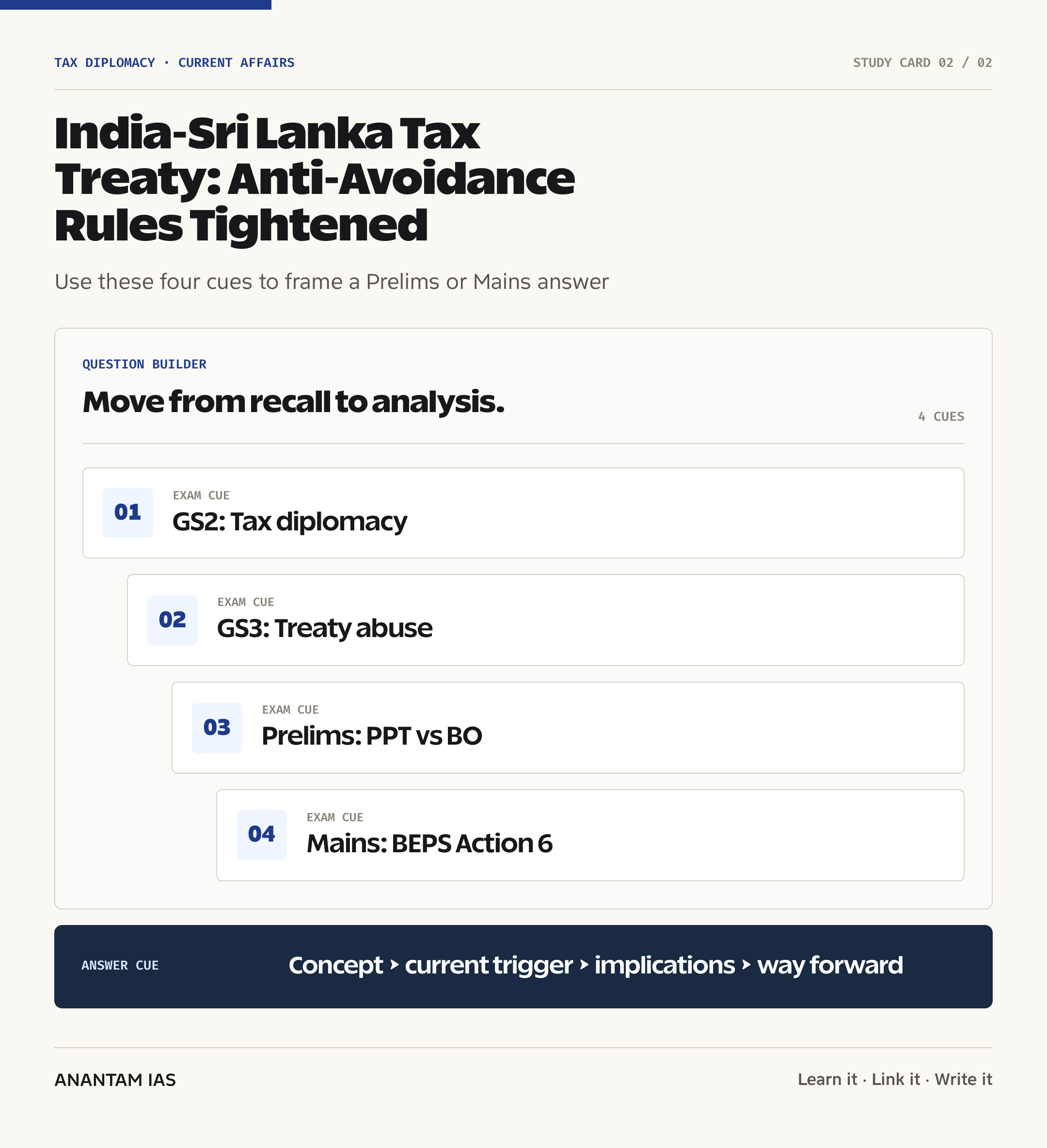
- Tax treaties are instruments of both revenue protection and economic diplomacy. Discuss this statement with reference to the India-Sri Lanka DTAA amendment, the Principal Purpose Test and the need to preserve certainty for bona fide cross-border investment.
- Differentiate between treaty shopping, beneficial ownership and the Principal Purpose Test. Explain how these concepts operate as distinct but related safeguards against abuse of Double Taxation Avoidance Agreements.
- The G20-OECD BEPS framework depends on domestic and bilateral implementation, not declarations alone. Examine with reference to Action 6, the Multilateral Instrument and India’s bilateral protocol with Sri Lanka.
Sources: Ministry of Finance, Notification No. 88/2026-Income-Tax and The Indian Express.
Frequently Asked Questions
What is the India-Sri Lanka DTAA?
The India-Sri Lanka DTAA is a bilateral agreement that coordinates taxing rights over cross-border income and provides relief from double taxation. The present agreement was signed on 22 January 2013 and entered into force on 22 October 2013. It covers issues such as residence, business profits, dividends, interest, royalties and tax relief.
What did the 2026 protocol change?
The protocol revised the treaty’s preamble to reject opportunities for non-taxation or reduced taxation through evasion, avoidance and treaty shopping. It also replaced Article 28(6) with a Principal Purpose Test. It didn’t create a new tax or replace the treaty’s existing rate schedule.
What is the Principal Purpose Test?
The PPT permits denial of a treaty benefit when it is reasonable to conclude, from all relevant facts and circumstances, that obtaining that benefit was one of an arrangement’s principal purposes. The benefit may still be granted when doing so accords with the object and purpose of the relevant treaty provisions.
Is beneficial ownership the same as PPT?
No. Beneficial ownership asks whether a recipient truly enjoys or controls income instead of acting as a conduit. The PPT examines why the wider arrangement or transaction was undertaken and whether treaty relief fits the provision’s purpose. A claimant may satisfy one test and still face the other.
When will the amended rules apply in India?
The protocol entered into force on 19 June 2026, but its Indian tax effect begins later. It applies to income derived in fiscal years starting on or after 1 April 2027, so the operative Indian period is FY 2027-28 onward. Entry into force and date of effect are separate treaty concepts.
Does the amendment raise treaty tax rates?
No. The protocol adds an anti-abuse gateway to decide whether a claimant should receive an existing treaty benefit. It doesn’t announce a new tax or a general rate increase. If the PPT denies relief, the applicable tax outcome follows the treaty and domestic law that remain in force for that income.