India-UK trade deal: tariff gains, mobility benefits and adjustment costs
Why in News?
The India-UK Comprehensive Economic and Trade Agreement (CETA) entered into force on 15 July 2026, converting the concessions negotiated in 2025 into usable tariff preferences, services commitments and customs rules.
The Hindu examined who gains from the pact and where adjustment pressures remain. The Ministry of Commerce and Industry said the companion Double Contribution Convention (DCC) also took effect on the same day, creating a combined framework for trade and temporary professional mobility.
- The agreement was concluded on 6 May 2025, signed in London on 24 July 2025, and implemented after both countries completed their domestic procedures.
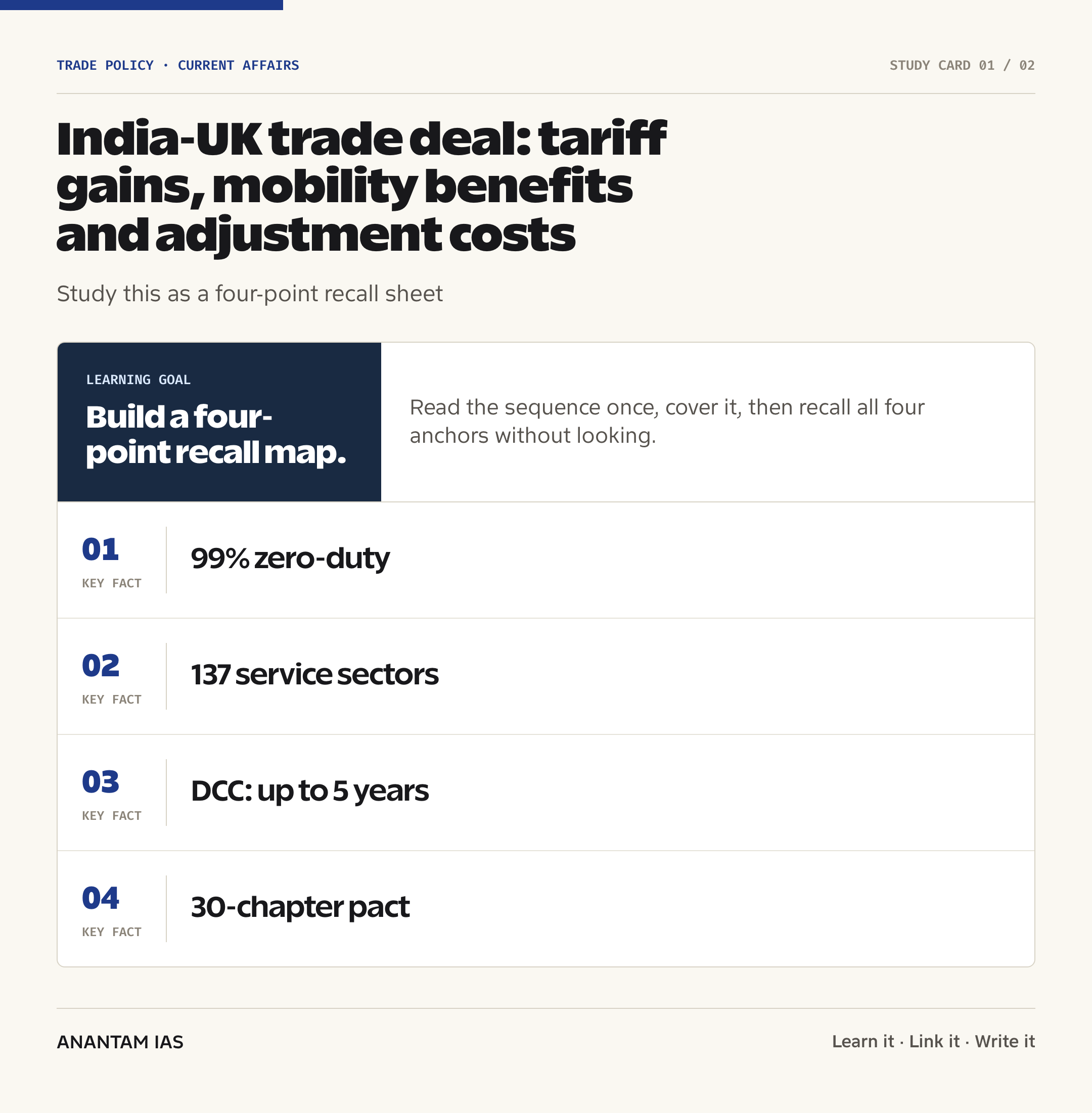
- The United Kingdom grants zero-duty access on about 99% of Indian tariff lines, covering nearly the entire value of India’s exports to the UK.
- The pact covers 30 chapters, including goods, services, customs, digital trade, government procurement, intellectual property, SMEs, labour and the environment.
- The services package covers 137 sub-sectors of export interest to India, while the DCC prevents double social-security contributions for eligible temporary workers.
- Tariff removal creates an opportunity, but exporters must still satisfy rules of origin, product standards, certification and buyer requirements to claim the preference.
The development matters in the context of:
- The development matters in the context of India’s shift from defensive trade policy towards selective integration with major developed markets.
- It illustrates why an FTA’s result depends on preference utilisation, services access and domestic competitiveness, not tariff schedules alone.
- It also links trade policy with labour mobility, social-security coordination and safeguards for politically sensitive sectors.
UPSC Relevance
Prelims Relevance
- A free trade agreement (FTA) reduces tariffs and other barriers on substantially all trade between the parties; it does not create a common external tariff.
- CETA is the official name of the India-UK trade agreement that entered into force on 15 July 2026.
- A tariff line is a product category in a customs schedule; coverage by tariff lines differs from coverage by the value of trade.
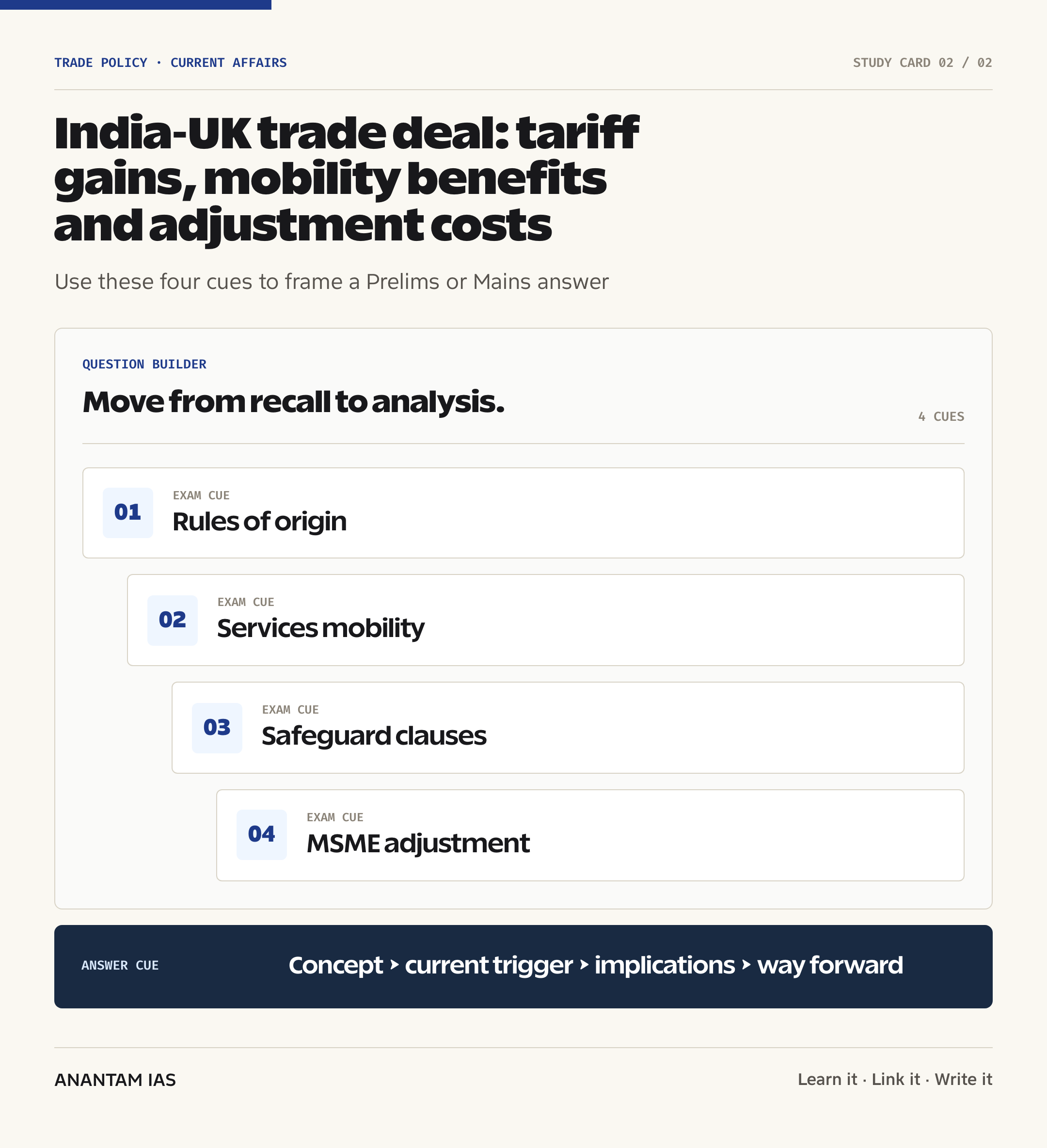
- Rules of origin determine whether a product has sufficient originating content or processing to receive the preferential tariff.
- The Double Contribution Convention coordinates contribution liability; it does not itself create a new immigration route or confer access to welfare benefits.
- A detached worker is temporarily posted abroad by a home-country employer and may remain covered by the home social-security system under the DCC.
- A bilateral safeguard can temporarily raise tariffs or suspend a concession when an import surge causes or threatens serious injury to domestic industry.
- The agreement protects sensitive Indian products such as dairy, cereals, millets, edible oils, oilseeds and apples through exclusions or limited concessions.
- India’s market-access gain is strongest in labour-intensive exports such as textiles, garments, leather, footwear, marine products and processed food.
Mains Relevance
GS Paper 3
- Assess how tariff liberalisation affects exports, employment, consumer welfare, competition and structural transformation in the Indian economy.
- Examine the role of rules of origin, standards infrastructure, logistics and trade finance in turning negotiated preferences into realised exports.
- Evaluate the need for adjustment assistance and trade remedies when import competition affects vulnerable firms or workers.
GS Paper 2
- Use CETA as a case study of India-UK bilateral relations and economic diplomacy with a G7 economy.
- Analyse how services mobility and social-security coordination can deepen a strategic partnership without replacing immigration law.
Essay
- Open markets create durable gains only when domestic institutions help firms and workers adjust.
- Modern economic diplomacy links goods, services, skills, standards and strategic trust.
Background and Context
What changed on 15 July
Entry into force is the operational stage at which an agreed treaty begins changing the terms of actual commerce.
- India and the UK began negotiations in 2022, concluded them after 14 rounds in May 2025 and signed CETA in July 2025; implementation followed ratification and customs preparation.
- The pact is broader than a goods-only FTA: it joins tariff schedules with services commitments, investment-related disciplines, digital trade, customs facilitation and government procurement.
- The companion DCC, signed on 10 February 2026, entered into force with CETA so employers can treat trade access and eligible temporary postings within one operating framework.
- For a fuller foundation on the pact’s design and negotiating history, see the India-UK FTA guide.
Tariff gains for Indian exports
The most immediate Indian gain is the removal of UK import duties from products in which India has established manufacturing and employment strengths.
- PIB said duties that had reached 70% on some processed foods, 21.5% on marine products and 18% on engineering goods and auto components fall to zero under the relevant schedules.
- Tariffs of up to 16% on leather and footwear, 12% on textiles and clothing, and 8% on chemicals and pharmaceuticals are also removed for qualifying originating goods.
- The price advantage can support labour-intensive employment, especially in apparel, leather, food processing, fisheries and small manufacturing clusters.
- The gain is not automatic: an exporter must prove origin, meet UK safety and labelling rules, secure buyers and absorb logistics, certification and marketing costs.
- Zero duty can improve India’s relative position against suppliers that lack equivalent preferences, but exchange rates, shipping costs, quality and delivery reliability can outweigh the tariff edge.
What India conceded and protected
Reciprocity gives British products greater access to India while allowing phased liberalisation and exclusions for sensitive Indian sectors.
- India will liberalise about 90% of its tariff lines over time, so many reductions are staged rather than delivered on day one.
- British whisky and gin receive deep phased tariff cuts, while automotive duties fall sharply within a quota; these concessions can increase competition and consumer choice.
- The government retained protection for dairy, cereals, millets, edible oils, oilseeds, apples and several vegetables, reflecting livelihood and food-security concerns.
- The agreement includes a bilateral safeguard against injurious import surges and preserves WTO-consistent anti-dumping and countervailing remedies.
- Selective exclusions show that trade agreements distribute gains and costs unevenly; national welfare estimates don’t remove the need to identify sector-specific exposure.
Services and mobility package
Services access matters to India because its export advantage extends beyond merchandise to knowledge-intensive and professional work.
- The UK commitments cover 137 sub-sectors, including IT and IT-enabled services, finance, healthcare, education, engineering, telecommunications and consultancy.
- CETA provides more predictable routes for business visitors, intra-corporate transferees, contractual service suppliers, independent professionals and investors under existing immigration rules.
- A dedicated annual opportunity covers 1,800 Indian chefs, yoga instructors and classical musicians, subject to the applicable conditions.
- Market access isn’t the same as automatic employment: visa sponsorship, professional licensing, salary thresholds and domestic regulation continue to apply.
- The mobility package can lower uncertainty for Indian firms delivering contracts in Britain, but firms still need recognised qualifications, data compliance and credible local networks.
How the DCC works
The social-security convention prevents duplicate contributions during qualifying temporary assignments while keeping the worker in the home system.
- Eligible detached workers and their employers pay into only one country’s system for assignments of up to 60 months, replacing a shorter 52-week UK default exemption.
- An India-based employee temporarily sent to the UK continues contributing to India’s Employees’ Provident Funds Scheme at an amount designed to be similar to the relevant UK contribution.
- The UK government’s explainer states that the convention covers contribution liability, not access to benefits, and doesn’t change either country’s immigration rules.
- PIB estimated that more than 75,000 Indian professionals and 900 companies could benefit from the arrangement.
- Avoiding duplicate payments reduces assignment costs and fragmented contribution records, strengthening India’s competitiveness in cross-border services without creating a general tax exemption.
Adjustment costs and implementation gaps
A negotiated tariff preference has economic value only when businesses can claim it and workers can manage the resulting reallocation.
- Small exporters may struggle with origin documentation, testing, certification, packaging and customs data; the fixed cost per shipment is proportionately higher for an MSME.
- British suppliers gain better Indian access in selected beverages, automobiles, medical devices and advanced manufacturing, creating pressure for affected Indian firms to improve quality and productivity.
- Non-tariff measures remain central: sanitary standards, technical regulations, carbon-related rules and private buyer standards can restrict market access even after customs duty reaches zero.
- Some services commitments lock in existing access rather than opening every sector; domestic licensing and qualification recognition can still limit commercial delivery.
- The earlier dispute over UK steel safeguards shows that an FTA operates inside a wider trade-policy environment. PIB said 85% of India’s steel exports were outside the 2026 measures, with other interests managed through quota and authorised-use routes.
Why the agreement matters for India's trade strategy
CETA tests whether India can combine strategic market opening with domestic capability-building and protection of core sensitivities.
- The agreement links India with a major G7 economy and complements New Delhi’s recent trade engagement with the UAE, Australia, EFTA and the European Union.
- It supports export diversification at a time of tariff conflict, supply-chain fragmentation and geopolitical risk in larger markets.
- Its government-procurement, digital-trade, SME and sustainability provisions show how modern FTAs shape regulatory cooperation as well as border taxes.
- The comparison with the India-EU FTA helps distinguish tariff access from harder questions involving carbon rules, standards and strategic autonomy.
- India’s success should be measured through preference utilisation, export diversification, MSME participation, services earnings and quality employment, not only headline trade growth.
Economic concepts for evaluating the deal
The welfare effect of an FTA depends on what new trade it creates, what existing trade it diverts and how producers respond to competition.
- Trade creation occurs when lower barriers replace higher-cost domestic production with more efficient imports from the partner, reducing prices and freeing resources for more productive activity.
- Trade diversion occurs when a preferential tariff shifts sourcing away from a more efficient non-member towards the partner merely because the partner receives a lower duty; this can reduce the welfare gain.
- The effective rate of protection can differ from the headline tariff because duties on imported inputs and final products affect domestic value addition differently; firms need the full schedule, not a single percentage.
- Preference erosion is possible when the UK later gives comparable access to other suppliers. Indian firms need productivity and product differentiation so their advantage survives beyond the first tariff window.
- Dynamic benefits can arise through scale, investment, technology transfer and learning by exporting, but these require reliable infrastructure, finance, skills and competitive input markets at home.
- Distribution matters: consumers may gain through lower prices while some producers face adjustment. Policy should help viable firms improve and workers retrain rather than freeze the pre-agreement production structure.
Way Forward
Turn preferences into actual exports
- Create sector-specific rules-of-origin toolkits, standard certificates and customs help desks so smaller firms can claim concessions without prohibitive advisory costs.
- Expand testing laboratories, mutual-recognition work and support for UK technical, sanitary and sustainability standards.
- Track utilisation at the tariff-line level and intervene where duty-free access exists on paper but exporter participation remains weak.
Support firms and workers through adjustment
- Offer time-bound technology, skilling and affordable-credit support to exposed MSMEs and industrial clusters, tied to measurable productivity gains.
- Use safeguards transparently when the legal injury threshold is met, while avoiding routine protection that would erase competitive pressure.
- Strengthen labour-market information and portable skills so workers can move towards expanding export sectors.
Deepen services gains
- Pursue practical recognition of professional qualifications and publish clear guidance on mobility categories, visas, DCC certificates and employer obligations.
- Help Indian firms comply with UK data, consumer and sectoral regulation, especially in digital, health, finance and education services.
- Review the agreement through evidence-based committees with participation from exporters, unions, states and small businesses.
Conclusion
The India-UK CETA is a significant market-access agreement, but its strongest Indian gains lie in the combination of labour-intensive exports, services access and contribution portability. The duty cut is the opening, not the outcome.
A high-quality implementation strategy must help firms prove origin, meet standards and move up value chains while giving exposed sectors a credible adjustment path. That balance can turn CETA from a tariff document into a durable instrument of growth, resilience and economic diplomacy.
UPSC Practice Questions
Prelims MCQ 1
With reference to the India-UK CETA and its companion Double Contribution Convention, consider the following statements:
- CETA entered into force on 15 July 2026.
- The DCC changes the United Kingdom’s immigration rules for Indian workers.
- The DCC can prevent duplicate social-security contributions for qualifying temporary postings.
How many of the above statements are correct?
(a) Only one (b) Only two (c) All three (d) None
Answer: (b) Only two
Explanation:
Statements 1 and 3 are correct. The two agreements took effect on 15 July 2026, and the DCC coordinates contribution liability for eligible detached workers. It doesn’t alter immigration rules or create a visa route.
Prelims MCQ 2
Which provision primarily prevents a third country’s goods from receiving India-UK preferential tariffs through minimal processing?
(a) Bilateral safeguard (b) Rules of origin (c) Double Contribution Convention (d) National treatment in services
Answer: (b) Rules of origin
Explanation:
Rules of origin identify the economic nationality of a product and set the processing or value-content conditions required for preferential tariff treatment.
UPSC Mains Questions
- The India-UK CETA offers immediate tariff opportunities, but its developmental impact will depend on domestic competitiveness and adjustment capacity. Examine the likely gains for Indian goods and services exports, and suggest measures to ensure broad-based benefits for MSMEs and workers.
- Trade agreements now regulate much more than customs duties. Discuss with reference to the India-UK CETA’s provisions on services mobility, social-security contributions, government procurement and safeguards. How should India assess implementation beyond headline trade values?
Sources: PIB, Ministry of Commerce and Industry and The Hindu.
Frequently Asked Questions
When did India-UK CETA take effect?
The India-UK Comprehensive Economic and Trade Agreement entered into force on 15 July 2026. Negotiations concluded on 6 May 2025, and the agreement was signed in London on 24 July 2025. Entry into force made its tariff schedules, rules and services commitments operational.
What is India’s main tariff gain?
The UK provides zero-duty access on about 99% of Indian tariff lines, covering nearly all current export value. Textiles, garments, leather, footwear, marine products, engineering goods, chemicals, pharmaceuticals and processed foods are among the sectors expected to gain from lower landed prices.
What does the DCC provide?
The Double Contribution Convention ensures that eligible detached workers and their employers pay social-security contributions in only one country during a qualifying temporary assignment, for up to 60 months. It coordinates contribution liability but doesn’t change immigration rules or independently grant access to welfare benefits.
Are all tariff gains automatic?
No. Exporters must satisfy rules of origin, submit the required documentation, meet product and safety standards, and find commercial buyers. Certification, logistics, finance and private market standards can still weaken the usable value of a nominally zero tariff, especially for smaller enterprises.
Which Indian sectors remain protected?
India retained protection for sensitive agricultural and rural products, including dairy, cereals, millets, edible oils, oilseeds, apples and several vegetables. Phased concessions, quotas, exclusions and trade-remedy provisions help manage import competition while the wider agreement gradually opens other sectors.
How should CETA’s success be measured?
Assessment should include preference-utilisation rates, export diversification, MSME participation, services earnings, investment, productivity and quality jobs. It should also track import surges, adjustment needs and whether firms can meet standards. A rise in total trade alone cannot show how gains and costs are distributed.