
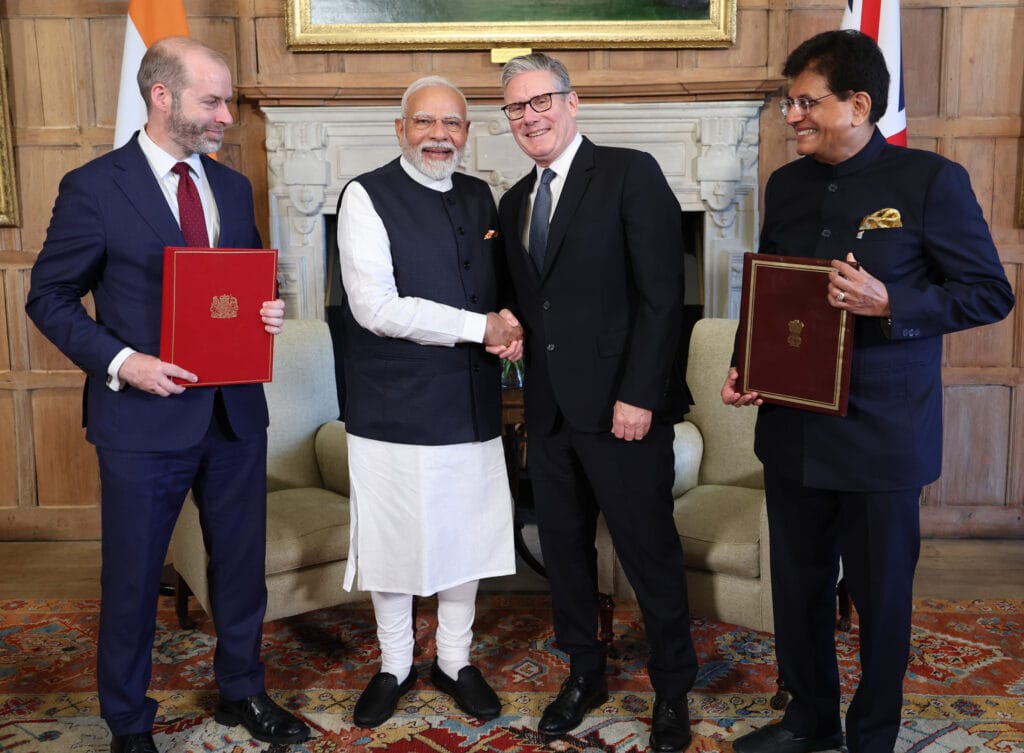
The India-UK Free Trade Agreement (FTA) — officially the Comprehensive Economic and Trade Agreement (CETA) — was signed on July 24, 2025 in London between Indian Prime Minister Narendra Modi and UK Prime Minister Keir Starmer after nearly three years of negotiations. As the UK's first major post-Brexit FTA with a non-EU country and one of India's largest bilateral trade deals, the agreement is expected to nearly double bilateral trade to $120 billion by 2030 from the current ~$60 billion.
For UPSC, the India-UK FTA is a significant contemporary Economy topic — covering India's trade policy, post-Brexit global trade realignment, and strategic partnerships.
Background
Pre-Negotiation Context
UK post-Brexit:
- Left the EU in January 2020 (Brexit)
- Sought independent trade deals globally
- India identified as strategic partner
India's trade interests:
- Access to UK market for services, manufactured goods
- Investment flows from UK
- Strategic partnership with major economy
Negotiation launch: January 2022 under UK PM Boris Johnson and Indian PM Narendra Modi.
Negotiation Timeline
| Event | Date |
|---|---|
| Negotiations launched | January 2022 |
| Multiple negotiation rounds | 2022-2024 (14+ rounds) |
| Diwali 2022 deadline missed | Late 2022 |
| Agreement-in-principle announced | May 6, 2025 |
| Formal signing | July 24, 2025, London |
| Expected entry into force | Late 2025 – early 2026 (after ratification) |
The negotiations were prolonged by multiple factors:
- UK political changes (3 PM changes during negotiation period)
- Indian elections (2024)
- Bilateral complexities (tariffs, visa provisions, dispute resolution)
Key Provisions
Tariff Reductions
The FTA provides significant tariff reductions on both sides:
India reduces tariffs on UK exports:
| Product | Old Tariff | New Tariff |
|---|---|---|
| Scotch whisky | 150% | 75% immediately, phased to 40% over 10 years |
| Gin | 150% | 75% immediately, phased to 40% |
| Automobiles (large cars) | 100% | 10% over 10 years (with quotas) |
| Auto components | Various | Significant reductions |
| Lamb and poultry | Various | Liberalised |
| Chocolates and food | Various | Reduced |
UK reduces tariffs on Indian exports:
| Product | Impact |
|---|---|
| Textiles and apparel | Zero tariff on most categories |
| Leather and footwear | Zero tariff |
| Marine products (shrimp, fish) | Zero or reduced |
| Chemicals and pharmaceuticals | Reduced |
| Engineering goods | Reduced |
| Diamond and jewelry | Zero tariff (India is a major exporter) |
| Spices and processed food | Reduced |
Services Trade
India's services gains:
- Short-term business visas for Indian professionals
- IT services access to UK market
- Financial services cooperation
- Legal services mutual recognition
UK's services gains:
- Banking and insurance expanded access to Indian market
- Education services partnerships
- Legal services mutual recognition
- Professional services
Mobility of Professionals
One of the most negotiated provisions:
"Double Contributions Convention" (agreed):
- Indian professionals working in UK for up to 3 years do not have to pay UK National Insurance
- Prevents double contributions to Indian and UK social security systems
- Estimated to save Indian workers/companies over £1 billion
- Symmetric arrangement for UK professionals in India
Visa provisions:
- Simplified visa for business travellers
- Mode 4 services commitments
- Youth mobility scheme expansion
Investment Protection
Investor Protection provisions:
- Investor-State Dispute Settlement (ISDS) — mechanism for disputes
- Fair and equitable treatment
- Most-favoured-nation (MFN) treatment
- Expropriation protections
Intellectual Property
- Patents, trademarks, copyrights
- Geographical Indications protection (Indian GI products like Darjeeling Tea, Basmati Rice)
- Pharmaceutical IP balance between innovation and affordability
- Traditional knowledge protection
Other Key Areas
Digital Trade:
- Cross-border data flows
- Protection of personal data
- Digital services trade
Public Procurement:
- Access to government tenders for both countries
- Significant for large infrastructure projects
Environment and Labour:
- Chapters on sustainable development
- Labour rights cooperation
- Climate action alignment
Small and Medium Enterprises (SMEs):
- Special provisions for SMEs
- Easier market access
Economic Impact
Trade Projections
| Metric | Current (2024) | Projected (2030) |
|---|---|---|
| Bilateral trade | ~$60 billion | $120 billion (2x) |
| India's exports | ~$16 billion | ~$35-40 billion |
| UK's exports | ~$8 billion | ~$20-25 billion |
| FDI | ~$34 billion (UK in India) | Significantly higher |
Sectoral Impact
India's gains:
- Textile exports could double
- Pharmaceutical exports significantly boosted
- Engineering goods see major opportunity
- Service exports (IT, consulting) expanded
- Agricultural and processed food exports rise
UK's gains:
- Scotch whisky exports expected to triple
- Automotive exports grow (Jaguar Land Rover benefits)
- Financial services major market access
- Education expansion in India
- Premium goods (fashion, luxury) access
Jobs and Investment
Expected job creation:
- India: ~1-2 million jobs over 10 years (various estimates)
- UK: ~100,000-200,000 jobs over 10 years
Investment flows:
- Increased UK investment in India (infrastructure, pharmaceuticals, clean energy)
- Increased Indian investment in UK (especially Indian-origin British entrepreneurs)
Strategic Significance
Post-Brexit Partnership
For the UK:
- First major post-Brexit FTA with a G20 country
- Demonstrates UK's ability to negotiate major trade deals independently
- Strengthens UK's Indo-Pacific engagement
For India:
- Access to a major G7 economy
- Part of India's FTA strategy
- Consolidates India-UK strategic partnership
Geopolitical Context
The FTA is part of broader realignments:
- Indo-Pacific strategy — both UK and India prioritise the region
- China containment — parallel economic engagement with non-China partners
- Diversifying supply chains — reducing over-dependence on any single country
Indian FTA Strategy
The India-UK FTA is part of India's active FTA pursuit:
- India-UAE CEPA (2022) — completed
- India-Australia ECTA (2022) — completed
- India-EFTA Trade and Economic Partnership Agreement (2024)
- India-UK CETA (2025)
- India-EU FTA — under negotiation
- India-Oman FTA — under negotiation
Controversial Provisions
Scotch Whisky Tariff Reduction
The reduction of whisky tariffs from 150% to 40% (phased) was highly contentious:
- Indian distillers feared imports would damage domestic industry
- Scottish whisky producers welcomed the deal
- Consumers benefit from lower prices on Scotch
Data Flows and Privacy
The digital trade provisions raised concerns:
- Indian IT industry wanted free data flows
- Privacy advocates warned of data sovereignty concerns
- The FTA includes balanced provisions
Professional Mobility
- UK immigration concerns over Indian professional numbers
- Indian industry wanted more mobility
- The "Double Contributions Convention" was a compromise
Agricultural Products
- Indian farmers feared competition from UK agricultural imports
- Sensitive products (wheat, dairy) largely excluded from liberalisation
Ratification Process
UK Side
- UK Parliament must ratify
- Expected to pass (Labour government supports the deal)
- Statutory Instruments to implement specific provisions
India Side
- Indian Parliament must ratify (technically, treaties in India don't always require parliamentary approval, but comprehensive FTAs often do)
- Cabinet approval already given
- Implementation begins after ratification
Implementation Challenges
Expected Challenges
- Customs modernisation to handle reduced tariffs efficiently
- Administrative capacity for services regulation
- Sector-specific adjustments (e.g., domestic whisky industry impact)
- Dispute resolution — when issues arise
- Monitoring compliance with FTA provisions
Transition Support
Both countries have announced:
- Industry consultation during implementation
- Support schemes for affected domestic industries
- Capacity building for businesses to use FTA provisions
Comparison with India's Other FTAs
| FTA | Signed | Key Feature |
|---|---|---|
| India-UAE CEPA | 2022 | Zero tariff on 99% of Indian exports to UAE |
| India-Australia ECTA | 2022 | ~85% zero tariff for Indian exports |
| India-EFTA TEPA | 2024 | $100 billion investment from EFTA in 15 years |
| India-UK CETA | 2025 | Major services liberalisation |
| India-EU FTA | Under negotiation | Most ambitious; major challenge |
UPSC Relevance
GS2 (IR): India's foreign trade policy, strategic partnerships, post-Brexit world.
GS3 (Economy): Free trade agreements, trade policy, services trade.
Key Prelims facts:
- India-UK FTA: Comprehensive Economic and Trade Agreement (CETA)
- Signed: July 24, 2025, London
- Signed by: PM Modi (India) and PM Keir Starmer (UK)
- Agreement-in-principle: May 6, 2025
- Negotiations launched: January 2022
- Current trade: ~$60 billion
- Projected trade by 2030: ~$120 billion
- Scotch whisky tariff: 150% → 75% immediately → 40% over 10 years
- Indian textile exports: Zero tariff to UK
- Indian professional mobility: "Double Contributions Convention" — up to 3 years no UK NI
- UK's first major post-Brexit FTA with a G20 country
- Related: India-UAE CEPA (2022), India-Australia ECTA (2022), India-EFTA TEPA (2024)
- Major Indian export gains: Textiles, pharmaceuticals, engineering goods
- Major UK export gains: Whisky, automotive (JLR)
Tell Google you want more of this.
Add Anantam IAS as a preferred sourceOne tap, and this site shows up more often in your own Top Stories, AI Overviews and AI Mode. Remove it any time.