Indian Ocean Dipole: Monsoon Risk and Super El Nino Signals
Why in News?
The Indian Ocean Dipole is in the news after The Hindu Explained linked India’s weak 2026 southwest monsoon, IMD’s below-normal rainfall forecast and global El Nino signals to the question of whether the Indian Ocean can offset Pacific-driven dryness.
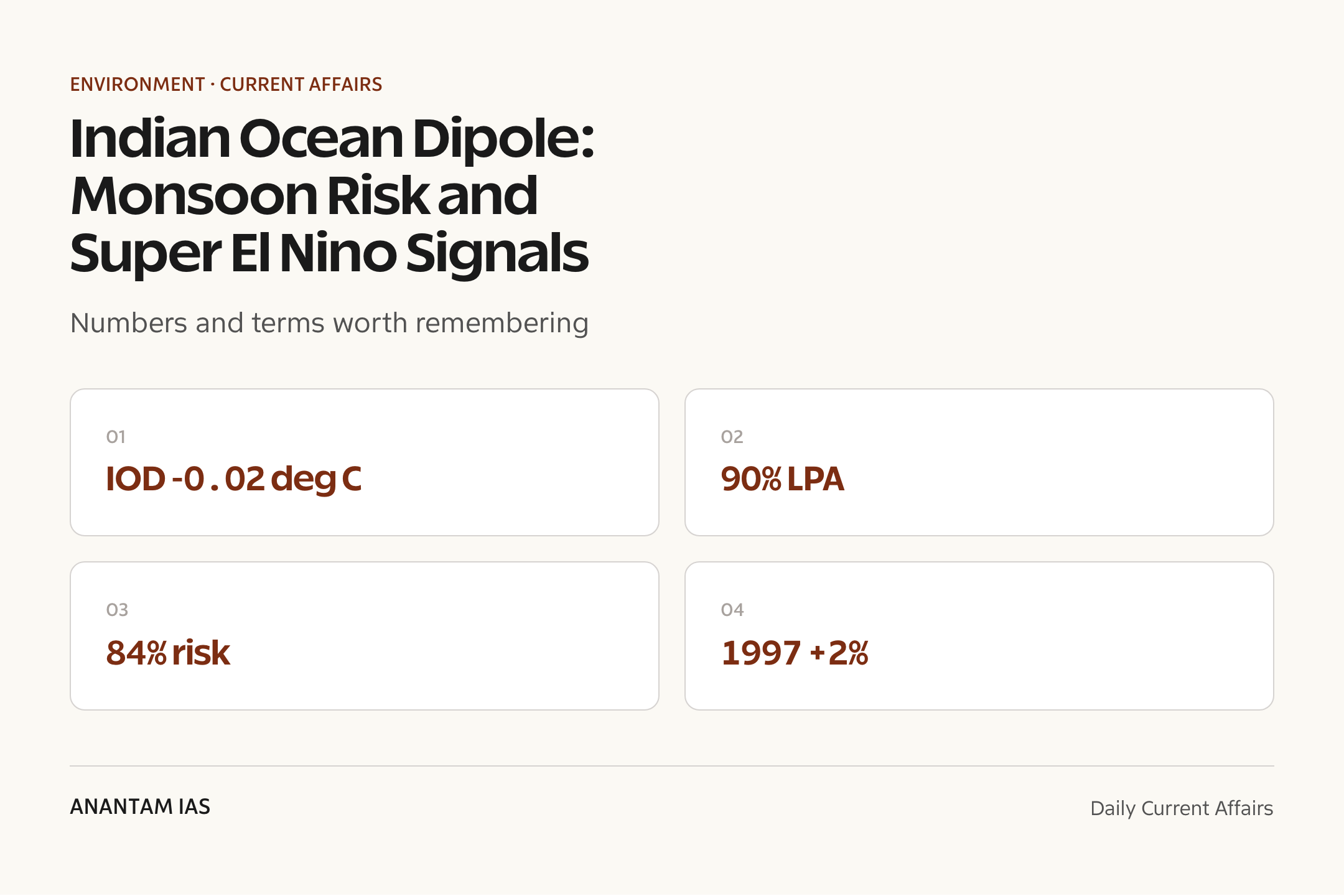
PIB reported that the India Meteorological Department expects June-September rainfall at 90% of Long Period Average with a model error of +/- 4%, while official climate agencies report El Nino conditions and a currently neutral IOD.
- PIB/IMD said the 2026 southwest monsoon rainfall for India is likely to be 90% of LPA, close to the deficient threshold.
- PIB said the forecast gives an 84% probability of below-normal or lower rainfall for the country as a whole.
- The Hindu reported that the monsoon was running a 40% deficit when the IOD question returned to the headlines.
- NOAA CPC has an El Nino Advisory in force and says El Nino conditions are expected to strengthen into winter 2026-27.
- Australian Bureau of Meteorology reported a neutral IOD value of -0.02 deg C as of 27 June 2026, with model spread on timing and strength.
The development matters in the context of:
- IOD conditions shape monsoon rainfall by changing sea-surface temperature contrast across the tropical Indian Ocean.
- Positive IOD can partly support Indian rainfall during some El Nino years, but it is not a guaranteed drought shield.
- Monsoon variability affects agriculture, reservoirs, hydropower, food prices and drought preparedness.
- Climate-risk governance now depends on reading ENSO, IOD, MJO and IMD early-warning products together.
UPSC Relevance
Prelims Relevance
- Indian Ocean Dipole: an east-west sea-surface temperature contrast in the tropical Indian Ocean.
- Dipole Mode Index: difference between western and eastern Indian Ocean SST anomalies.
- IOD west box: roughly 50E-70E and 10S-10N, as used by the Australian Bureau of Meteorology.
- IOD east box: roughly 90E-110E and 10S-0S, off Indonesia and Sumatra.
- Positive IOD: warmer western Indian Ocean and cooler eastern Indian Ocean.
- Negative IOD: cooler western Indian Ocean and warmer eastern Indian Ocean.
- ENSO: Pacific Ocean-atmosphere cycle covering El Nino and La Nina.
- Madden-Julian Oscillation: 30-60 day tropical cloud-rain pulse tracked through eight phases.
Mains Relevance
GS Paper 3
- Environment and climate variability: ENSO-IOD interaction, monsoon uncertainty and climate adaptation.
- Disaster management: drought preparedness, reservoir planning, heat stress and early warning.
GS Paper 1
- Physical geography: Walker circulation, sea-surface temperature anomalies and monsoon mechanism.
- Indian geography: spatially uneven rainfall and regional drought vulnerability.
GS Paper 2
- Governance: coordination among IMD, agriculture departments, disaster authorities and water managers.
Essay
- Climate uncertainty tests whether development planning can move from relief-first to preparedness-first governance.
- Monsoon dependence shows how geography continues to shape India’s economy, food security and federal policy choices.
Background and Context
Why the IOD Matters Now
The 2026 news hook is not only the IOD; it is the collision of weak monsoon performance, official rainfall forecasts and a strengthening El Nino signal.
- PIB/IMD placed the 2026 monsoon forecast at 90% of LPA, with the LPA based on 1971-2020 data at 87 cm.
- Below-normal rainfall was forecast over most parts of India, except parts of Northwest, Northeast, eastern peninsular and east-central India.
- The Hindu used the 1997 monsoon to frame the issue: despite a very strong El Nino, India ended June-September with about 2% surplus rainfall.
- Monsoon risk sits at the meeting point of monsoon in India, Indian Ocean dynamics and disaster planning.
What the Indian Ocean Dipole Is
The Indian Ocean Dipole is a periodic seesaw in sea-surface temperature anomalies across the tropical Indian Ocean.
- IOD compares the western tropical Indian Ocean near East Africa with the eastern tropical Indian Ocean near Indonesia.
- Sea-surface temperature matters because warm water supports evaporation, rising air, clouds and rainfall.
- Dipole Mode Index measures the difference between the two IOD poles; sustained departures mark positive or negative phases.
- Neutral IOD means the Indian Ocean does not provide a strong east-west push to either enhance or suppress monsoon rainfall.
Positive, Negative and Neutral Phases
Each IOD phase changes the direction of moisture convergence over the Indian Ocean basin.
- Positive IOD means warmer western Indian Ocean and cooler eastern Indian Ocean, which can support convection toward the west and moisture flow toward India.
- Negative IOD means warmer eastern Indian Ocean and cooler western Indian Ocean, often weakening the moisture support available to the Indian monsoon.
- Australian Bureau of Meteorology treats sustained values above +0.4 deg C as typical of positive IOD and below -0.4 deg C as typical of negative IOD.
- June 2026 readings were neutral; BOM reported -0.02 deg C for 27 June, while models differed on a later positive turn.
ENSO Link and Walker Circulation
The IOD cannot be understood separately from the Pacific because ENSO changes the larger tropical circulation that feeds the monsoon.
- El Nino warms the central and eastern equatorial Pacific, weakens trade winds and shifts convection away from the western Pacific-Indian Ocean sector.
- Walker circulation is the east-west tropical overturning loop; when it weakens or shifts, Indian monsoon rainfall can suffer.
- La Nina usually tilts the system in the opposite direction and is often friendlier to Indian monsoon rainfall.
- NOAA CPC reported El Nino conditions in 2026 and a 63% chance of a very strong event during November-January.
The 1997 Exception
The 1997 monsoon remains important because it shows how a strong positive IOD can sometimes soften the monsoon damage expected from El Nino.
- 1997 had one of the strongest El Nino events in the recorded Pacific dataset, yet India avoided a severe monsoon drought.
- The Hindu reported IMD’s view that the 1997 escape was an exceptional case, not a normal rule for El Nino years.
- Strong positive IOD helped convergence over the Bay of Bengal and Indian Ocean sector, countering some El Nino subsidence.
- Exam takeaway: the right answer is not El Nino equals drought; it is El Nino raises drought probability, while IOD and MJO can modulate outcomes.
Discovery and Measurement
IOD is a relatively recent formal climate concept, which makes it a high-yield Prelims fact.
- N.H. Saji and collaborators, including Indian scientists B.N. Goswami and P.N. Vinayachandran, described the IOD in a 1999 Nature paper.
- The Hindu noted that the IOD explains roughly an eighth of Indian Ocean temperature variability and can operate independently of ENSO.
- DMI regions are fixed ocean boxes, so the index is a measurable climate signal rather than a vague rainfall description.
- Forecast uncertainty remains high because IOD timing, strength and interaction with ENSO can shift within the monsoon season.
MJO and Intraseasonal Swings
Monsoon risk also depends on shorter active-break cycles, not only seasonal ENSO and IOD categories.
- Madden-Julian Oscillation is a moving tropical pulse of cloud and rainfall that cycles roughly every 30-60 days.
- Eight MJO phases are used to track where the active convective pulse sits across the tropics.
- Indian Ocean phases of the MJO can revive rainfall spells, while unfavourable phases can deepen breaks.
- Early warning needs ENSO, IOD, MJO, soil moisture and reservoir data together, especially during a weak monsoon start.
Governance and Disaster Link
IOD is an exam topic because rainfall variability becomes a governance challenge very quickly.
- Agriculture faces sowing delays, crop stress and input-risk decisions when June-July rainfall is deficient.
- Water security depends on reservoir storage, groundwater recharge and inter-state planning during weak monsoon years.
- Drought preparedness connects this topic with disaster management and district-level contingency plans.
- Climate adaptation links monsoon variability with climate change, because warmer oceans can increase extremes even when seasonal totals stay uncertain.
Way Forward
Strengthen Forecast Use
- IMD outlooks should be translated into district advisories for sowing windows, irrigation scheduling and crop substitution.
- Impact-based forecasts must state likely effects on agriculture, reservoirs, heat stress and drinking-water supply.
Prepare for Deficit and Extremes
- Drought plans should be activated early in vulnerable districts instead of waiting for end-season rainfall totals.
- Flood readiness should stay active because weak seasonal rainfall can still include short, extreme bursts.
Improve Climate Literacy
- ENSO-IOD-MJO communication should avoid deterministic claims and explain probability in simple operational language.
- Local planning should combine seasonal forecasts with soil moisture, crop stage and reservoir storage data.
Conclusion
The Indian Ocean Dipole is best read as a monsoon-risk modifier, not as a magic shield against El Nino. The 1997 case matters because it shows what is possible when a strong positive IOD appears at the right time.
For 2026, the safer exam conclusion is cautious: official sources show El Nino strengthening, IMD forecasting below-normal rainfall and IOD still neutral near the end of June. Planning should assume uncertainty, not rescue.
UPSC Practice Questions
Prelims MCQ 1
With reference to the Indian Ocean Dipole, consider the following statements:
- The Dipole Mode Index measures the difference between sea-surface temperature anomalies in the western and eastern tropical Indian Ocean.
- A positive IOD is marked by warmer eastern Indian Ocean waters off Sumatra and cooler western Indian Ocean waters.
- Sustained IOD index values above +0.4 deg C are treated by the Australian Bureau of Meteorology as typical of positive IOD conditions.
How many of the above statements are correct?
(a) Only one (b) Only two (c) All three (d) None
Answer: (b) Only two
Explanation:
Statements 1 and 3 are correct. Statement 2 reverses the phase: positive IOD means warmer western Indian Ocean and cooler eastern Indian Ocean.
Prelims MCQ 2
Which factor best explains why India’s 1997 monsoon did not become a severe drought despite a very strong El Nino?
(a) A strong negative Indian Ocean Dipole (b) A strong positive Indian Ocean Dipole (c) A permanent weakening of the Walker circulation (d) A collapse of the southwest monsoon winds
Answer: (b) A strong positive Indian Ocean Dipole
Explanation:
The 1997 exception is associated with a strong positive IOD, which helped moisture convergence toward the Indian monsoon region and offset part of the El Nino effect.
UPSC Mains Questions
- Explain how the Indian Ocean Dipole modifies the impact of El Nino on the Indian southwest monsoon. In your answer, discuss why the 1997 experience should not be treated as a routine rule.
- India’s monsoon-risk governance must move from seasonal rainfall totals to impact-based preparedness. Discuss with reference to agriculture, water security and disaster management.
- Differentiate between ENSO, IOD and MJO as climate drivers of the Indian monsoon. How should these signals be used in public communication without creating false certainty?
Sources: PIB, India Meteorological Department and The Hindu Explained; NOAA Climate Prediction Center; Australian Bureau of Meteorology.
Frequently Asked Questions
What is the Indian Ocean Dipole?
The Indian Ocean Dipole is a sea-surface temperature contrast between the western and eastern tropical Indian Ocean. A positive phase has warmer western waters and cooler eastern waters, while a negative phase has the reverse pattern. It affects convection, moisture flow and monsoon rainfall probabilities.
How does IOD affect Indian monsoon?
A positive IOD can support moisture convergence toward India and sometimes reduce the drying effect of El Nino. A negative IOD can weaken the moisture supply. But the effect depends on timing, strength and interaction with ENSO, MJO and regional weather systems.
What is the 2026 IOD status?
The Australian Bureau of Meteorology reported neutral IOD conditions as of 27 June 2026, with an IOD index of -0.02 deg C. Models suggested a possible later positive event, but with large differences in timing and strength.
Why is 1997 often mentioned?
The year 1997 had a very strong El Nino, which normally raises drought risk for India. Yet the June-September monsoon ended about 2% above normal. A strong positive IOD helped offset the Pacific signal, making it a rare but important exception.
Can IOD cancel El Nino?
Not always. A strong, timely positive IOD can soften El Nino’s impact, but it cannot be assumed to cancel it. In most years, forecasters must read IOD with ENSO, MJO, land heating, monsoon trough position and regional rainfall distribution.
Why is this important for disaster management?
A weak or uncertain monsoon affects agriculture, reservoirs, drinking-water supply, hydropower and heat stress. Early drought planning, crop advisories, reservoir management and district-level contingency plans are part of disaster preparedness when seasonal rainfall risk rises.