India’s Agri Export Growth

Context:
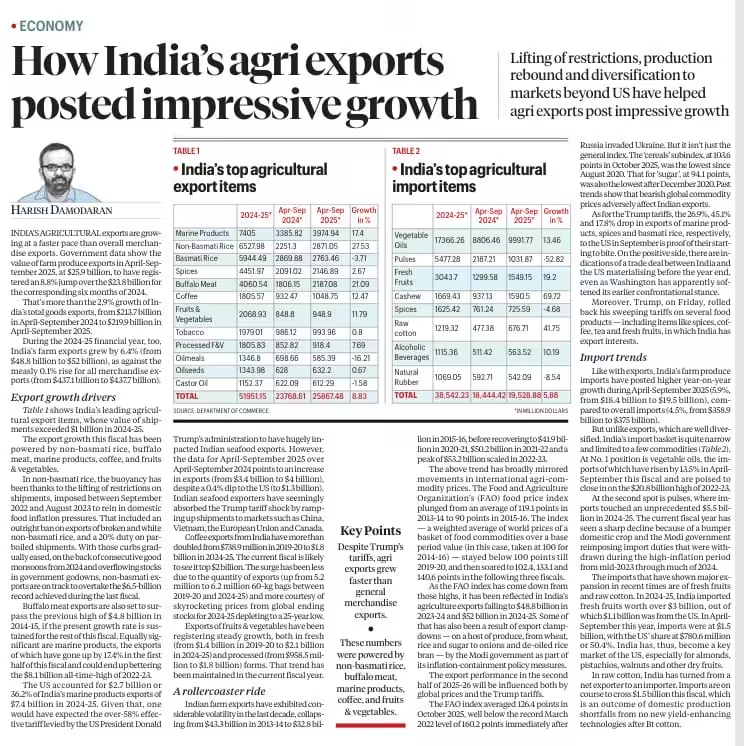
India’s agricultural exports have shown strong growth in April–September 2024-25, growing 8.5% YoY to reach $25.9 billion, despite global trade uncertainty. This growth is faster than the 2.9% growth in India’s overall merchandise exports in the same period.
UPSC Relevance:
Economy
UPSC PYQ:
Q. Given the vulnerability of Indian agriculture to vagaries of nature, discuss the need for crop insurance and bring out the salient features of the Pradhan Mantri Fasal Bima Yojana (PMFBY). (2016)
Q. Explain various types of revolutions, took place in Agriculture after Independence in India. How these revolutions have helped in poverty alleviation and food security in India? (2017)
Top Agricultural Export Items:
| Rank | Item | Value (in $ mn) | Growth (%) |
|---|---|---|---|
| 1 | Marine products | $4,705.8 mn | 17.3% |
| 2 | Non-basmati rice | $3,527.8 mn | 27.5% |
| 3 | Basmati rice | $2,486.3 mn | 7.9% |
| 4 | Spices | $4,451.4 mn | 0.9% |
| 5 | Buffalo meat | $2,054.7 mn | 10.7% |
| 6 | Coffee | $1,153.1 mn | 10.4% |
| 7 | Fruits & vegetables | $1,209.7 mn | 14.9% |
Top Agricultural Import Items:
| Rank | Item | Value (in $ mn) |
|---|---|---|
| 1 | Vegetable oils | $17,366.8 mn |
| 2 | Pulses | $5,477.6 mn |
| 3 | Spices (for processing) | $1,124.9 mn |
| 4 | Rubber | $1,090 mn |
| 5 | Cashew | $662.5 mn |
Drivers of Export Growth
- Marine exports surged due to high global demand and improved logistics.
- Lifting of export bans on rice and onions.
- Diversification of markets beyond US following trade uncertainties.
- Stronger harvests and price stability after pandemic disruptions.
About Agriculture Sector:
Agriculture is one of the cornerstones of India’s economy and society, providing a livelihood to nearly 55% of the population. With the world’s second-largest agricultural land area, India is a global leader in farm output.
- India’s agricultural output has expanded significantly in the past decade, recording 40% growth and achieving surplus capacity for exports. In FY25, the sector grew by 5.4% year-on-year, supported by record production and higher trade volumes. Agricultural exports touched an all-time high of Rs. 4,40,000 crore (US$ 51.86 billion) in FY25, up from Rs. 3,95,793 crore (US$ 48.15 billion) in FY24. Agriculture and allied activities together contributed 17.8% to India’s GDP in 2023-24, reaffirming the sector’s importance to the national economy.
- Agriculture is a major employer in India, providing livelihoods for about 43.5% of the total workforce as of 2023.
Government Initiatives:
- In July 2025, The Coastal States Fisheries Meet 2025 under PM Matsya Sampada Yojana allocated Rs. 255 crore (US$ 29.1 million) for infrastructure and Rs. 364 crore (US$ 41.6 million) to equip 1,00,000 vessels with transponders, while launching Regional Fisheries Management Councils and the Marine Fisheries Census 2025 to enhance safety and governance.
- The Union Cabinet approved the Prime Minister Dhan-Dhaanya Krishi Yojana (PMDDKY) worth Rs. 24,000 crore (US$ 2.79 billion) from FY26 to boost farm productivity, irrigation, credit access, and post-harvest infrastructure for 1.7 crore farmers across 100 districts
- The Pradhan Mantri Kisan SAMPADA Yojana (PMKSY) is strengthening India’s food processing sector, benefiting 34.15 lakh farmers and creating over 4.33 lakh jobs through 1,601 projects.
- The government has approved an Action Plan for constructing steel silos under a Public-Private Partnership (PPP) model to modernize storage facilities, with a total capacity of 24.25 Lakh metric tonnes (LMT) under development.
- The budget for Department of Agriculture and Farmers’ Welfare increased from Rs. 21,933.50 crore (US$ 2.53 billion) in 2013-14 to Rs. 1,27,290.16 crore (US$ 14.89 billion) in 2025-26, reflecting the government’s commitment to agricultural development.
- In the Union Budget 2024-25, a provision of Rs. 1.52 lakh crore (US$ 18.26 billion) has been made for agriculture and allied sector.
- As per the Economic Survey 2024-25, for FY25, the MSP for arhar and bajra has been increased by 59% and 77% over the weighted average cost of production, respectively. Moreover, the MSP for Masur has risen by 89%, while rapeseed has seen an impressive increase of 98%.
- As per the Economic Survey 2024-25, since FY16, the government has implemented the Per Drop More Crop initiative under PMKSY, covering 95.58 lakh hectares by December 2024 with Rs. 21,968.75 crore (US$ 2.57 billion) released to states for micro-irrigation, offering 55% subsidy to small/marginal farmers and 45% to others. From 2018 to 2024, loans worth Rs. 4,709 crore (US$ 551 million) were approved under the Micro Irrigation Fund (MIF), with Rs. 3,640 crore (US$ 426.5 million) disbursed, supported by a 2% interest subvention to states.
- In January 2024, The Ministry of Food Processing Industries has approved the following under the corresponding component schemes of PMKSY: 41 Mega Food Parks, 399 Cold Chain projects, 76 Agro-processing Clusters, 588 Food Processing Units, 61 Creation of Backward & Forward Linkages Projects, and 52 Operation Green projects.
- Through several Digital Initiatives, such as the National e-Governance Plan in Agriculture (NeGP-A), the construction of Digital Public Infrastructure (DPI), digital registries, etc., the government has taken a number of steps to ensure access to IT across the nation.
- The Soil Health Card site has been updated and connected with a Geographic Information System (GIS) system, allowing all test results to be captured and shown on a map. Samples are now being gathered using a mobile application as of April 2023 under the new system.
- The Agricultural Technology Management Agency (ATMA) Scheme has been implemented in 704 districts across 28 states and 5 UTs to educate farmers. Grants-in-aid are released to the State Government under the scheme with the goal of supporting State Governments’ efforts to make available the latest agricultural technologies and good agricultural practices in various thematic areas of agriculture and allied sector.
- The Agriculture Export Policy, 2018 was approved by the Government of India in December 2018. The new policy aimed to increase India’s agricultural export to US$ 60 billion by 2022 and US$ 100 billion in the next few years with a stable trade policy regime.
- The Government of India is going to provide Rs. 2,000 crore (US$ 306.29 million) for the computerisation of the Primary Agricultural Credit Society (PACS) to ensure cooperatives are benefitted through digital technology.
- The Government of India launched the Pradhan Mantri Krishi Sinchai Yojana (PMKSY) with an investment of Rs. 50,000 crore (US$ 7.7 billion) aimed at the development of irrigation sources for providing a permanent solution to drought.
- Government plans to triple the capacity of the food processing sector in India from the current 10% of agricultural produce and has also committed Rs. 6,000 crore (US$ 729 million) as investments for mega food parks in the country, as a part of the Scheme for Agro-Marine Processing and Development of Agro-Processing Clusters (SAMPADA).
- The Government of India has allowed 100% FDI in the marketing of food products and in food product E-commerce under the automatic route.