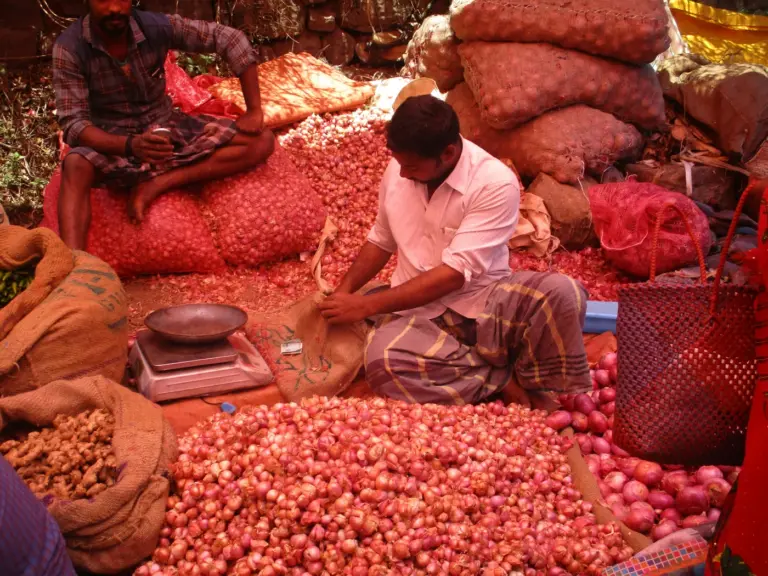
The Agricultural Export Policy, 2018 emphasised a "Bake in India" approach — renewed focus on value addition and processed agricultural products — to convert India's vast agricultural base into a competitive export powerhouse. Agricultural exports are considered central to the goal of Doubling Farmers' Income (DFI) because export markets offer higher realisation and create backward linkages into farmgate prices, processing, and rural employment.
Background: India's Agri-Export Paradox
Despite being the largest producer of milk, pulses, jute, and the second largest producer of rice, wheat, sugarcane, fruits, and vegetables, India's share in global agri-exports stands around 2%, ranking it around 8th-9th globally. Agricultural and allied exports crossed USD 53 billion in FY 2022-23 and have since moderated around USD 48-50 billion due to export restrictions on rice, wheat, sugar, and onions.
Key features of current basket:
- Dominated by basmati rice, non-basmati rice, marine products, buffalo meat, spices, sugar, and cotton.
- Low value addition: most exports are raw or semi-processed.
- Limited penetration in premium and processed food segments.
Present Status of Agri-Exports
- Lower share of global exports – around 2% despite being a top producer.
- Lack of diversification – narrow basket heavy on basmati rice and marine products.
- Low value addition – majority exports are raw or semi-processed commodities.
Agricultural Export Policy 2018: Key Objectives
- Double agricultural exports from USD 30+ billion to USD 60+ billion by 2022 and reach USD 100 billion in a few years.
- Diversify the export basket, destinations, and push high-value and value-added exports, including perishables.
- Promote novel, indigenous, organic, ethnic, traditional, and non-traditional agri-products.
- Build an institutional mechanism for market access, SPS (Sanitary and Phytosanitary) issues, and tariff barriers.
- Integrate Indian agriculture with Global Value Chains (GVCs).
Constraints and Challenges
Supply-side
Unstable export policy: Frequent bans on rice, wheat, onions, and sugar undermine reliability in global markets.
Market intelligence gaps: Indian produce often fails to match consumer taste and quality in target markets.
Data deficits: Absence of state-level export data makes it hard to identify export clusters.
Aggregation issues: Small marketable surplus and variety fragmentation raise compliance and logistics costs.
Training gaps: Unregulated chemical usage, weak post-harvest management, and lack of awareness lead to rejection of Indian products (e.g., grapes, peanuts in the EU).
Fragmented APMC regime
Poor infrastructure and logistics make Indian products uncompetitive. Multi-agency coordination between Ministry of Agriculture, Commerce Ministry, and FSSAI is weak.
Demand-side
High import duties and quota limits in advanced markets.
Indiscriminate SPS measures by other countries against Indian products.
Surge in agricultural imports after signing of FTAs, which has hurt pulses, edible oils, and some fruits.
Recommendations of the High-Level Expert Group (HLEG)
The Fifteenth Finance Commission's HLEG on Agricultural Exports recommended:
- State-led export plans for 22 priority crop value chains.
- Collaborative planning with private sector and Commodity Boards.
- Private sector as anchor in execution and outcome delivery.
- Centre as enabler through policy, funding, and market access diplomacy.
- Robust institutional funding through convergence of existing schemes, Finance Commission allocation, and private investment.
Way Forward
Investment in agri R&D: Currently around 0.5% of agri-GDP — must be doubled.
Precision agriculture, quality seeds, micro-irrigation, and soil health management to raise productivity.
Revisit Minimum Export Price (MEP) for basmati (currently around USD 950/tonne, earlier was USD 1,200/tonne) and non-basmati.
Cluster-based export zones and Agri Export Zones (AEZs) with FPO aggregation.
Robust traceability and certification (Organic, GAP, HACCP) to meet SPS norms.
Trade facilitation: Single-window for export clearances, dedicated Agri-Export Facilitation Cells under APEDA.
Key Schemes and Institutions
| Scheme / Institution | Role |
|---|---|
| Agricultural Export Policy 2018 | Umbrella framework |
| APEDA | Export promotion, infrastructure, quality |
| Marine Products Export Development Authority (MPEDA) | Marine exports |
| Spices Board / Coffee Board / Tea Board | Commodity-specific promotion |
| Agri Infrastructure Fund (AIF) | Rs 1 lakh crore for post-harvest infra |
Latest Developments (2024-26)
Updated context: The Union Budget 2024-25 continued support for Digital Public Infrastructure for agriculture, Farmer Producer Organisations (10,000 FPOs scheme), and e-NAM integration with state mandis. APEDA is increasingly aligning export clusters with ODOP (One District One Product) for GI-tagged products such as Alphonso mango, Banganapalli mango, Nagpur orange, Pulasa fish, Darjeeling tea, and Assam Muga silk.
Global rice prices spiked in 2023-24 following India's restrictions on non-basmati white rice exports; these restrictions were partially lifted in September-October 2024 with an MEP of USD 490/tonne, later removed. Wheat export restrictions continued into 2025. India also signed a Free Trade Agreement with the UAE (CEPA), Australia (ECTA), and UK (2025), creating new market access for agri-products.
Union Budget 2025-26 announced the Mission for Aatmanirbharta in Pulses and Oilseeds, expansion of Dhan Dhaanya Krishi Yojana for 100 low-productivity districts, and a renewed push on makhana, seaweed, and millet exports. The government-backed Shree Anna (millets) campaign aims to position India as a global millet hub.
UPSC Relevance
GS Paper III topics directly connected: issues related to buffer stocks and food security; effects of liberalisation on the economy; e-technology in aid of farmers; agricultural exports.
Possible questions:
- Evaluate the Agricultural Export Policy 2018 in meeting its goal of doubling farmers' income through exports.
- How can India overcome SPS barriers and integrate with global agricultural value chains?
- Discuss the role of FPOs, GI-tagged products, and ODOP in boosting India's agri-exports.
Essay and interview angles include food security vs export stability trade-off, climate-smart agriculture, and free trade agreements. Aspirants should know latest export figures, top commodities, and 2024-26 policy shifts.
Tell Google you want more of this.
Add Anantam IAS as a preferred sourceOne tap, and this site shows up more often in your own Top Stories, AI Overviews and AI Mode. Remove it any time.