Indus Waters Treaty: Chenab Hydropower Push and Renegotiation
Why in News?
Government sources told The Hindu and The Indian Express on July 20, 2026 that the Indus Waters Treaty would require review and renegotiation before its river-sharing provisions could operate again in any modified form.
The immediate developmental focus is faster execution of a Chenab basin hydropower portfolio exceeding 5,000 MW when the reported projects are considered together. The policy combines water security, clean power and regional development with India’s post-2025 position on cross-border terrorism.
- India placed the 1960 treaty in abeyance after the April 22, 2025 Pahalgam terror attack; the Cabinet Committee on Security linked restoration to Pakistan credibly and irrevocably ending support for cross-border terrorism.
- The five prominently named projects are Sawalkot, Pakal Dul, Ratle, Kiru and Kwar, with a combined listed capacity of 4,870 MW.
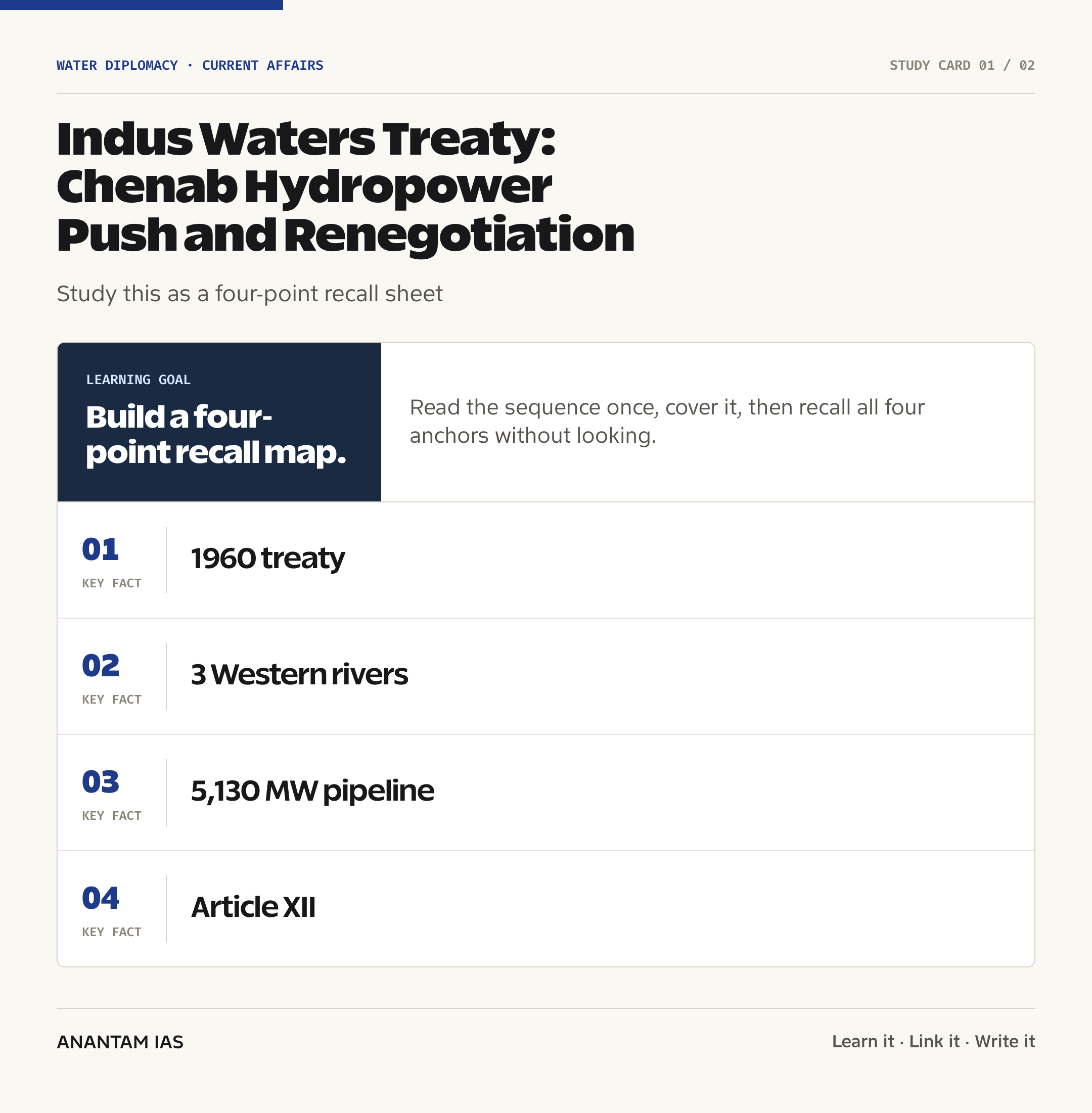
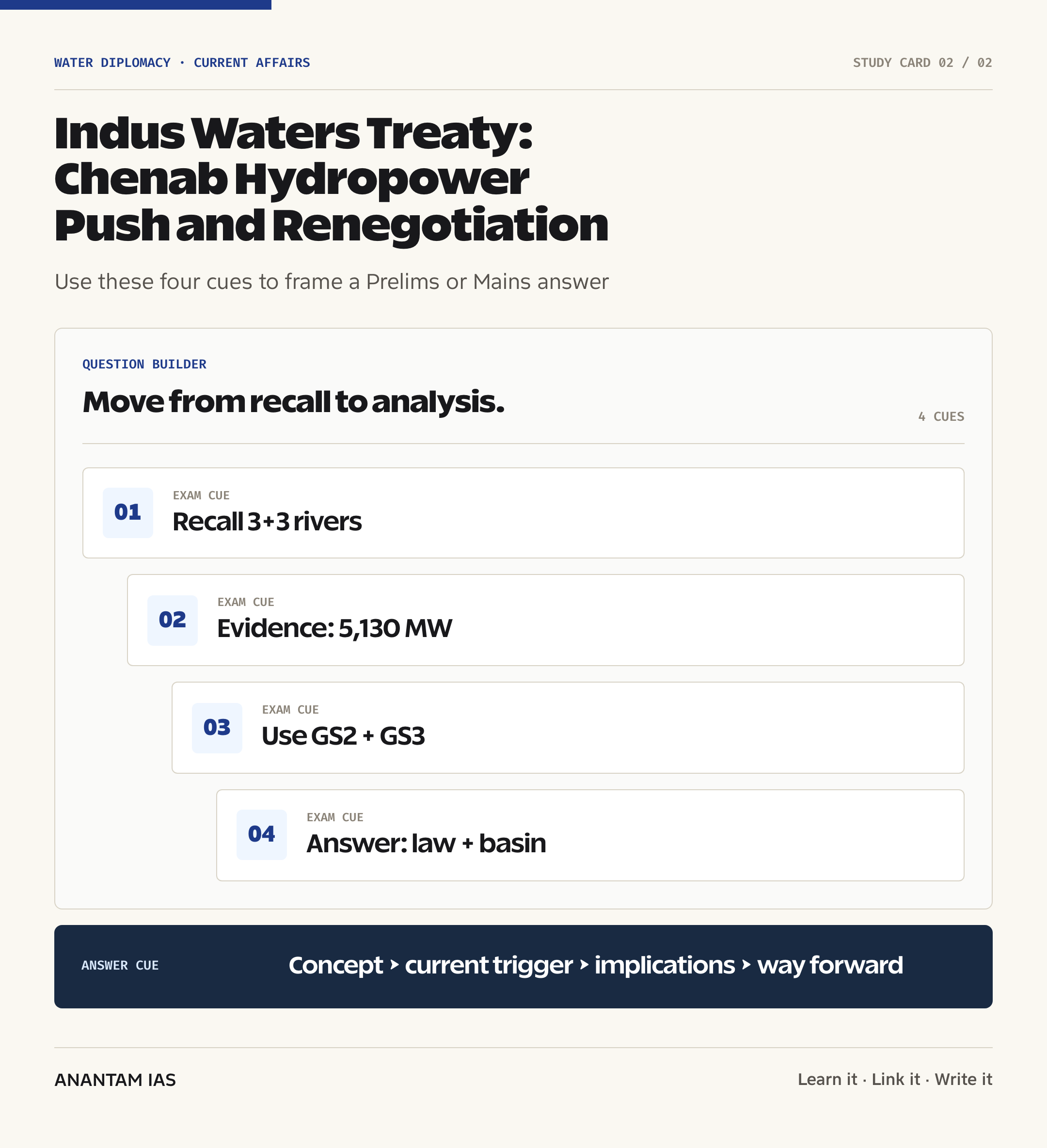
- Adding the separately listed Dulhasti Stage-II, 260 MW, takes the identifiable development portfolio to 5,130 MW; reports describing about 5,300 MW may be using a wider project grouping.
- Official NHPC project pages show different stages: several schemes are under construction, while Sawalkot remains under clearance. Capacity and commissioning claims must be read project by project.
- Any revised arrangement would have to address climate variability, sediment, dam safety, environmental flows, data exchange and contemporary power-system needs, not only the original allocation formula.
The development matters in the context of:
- The development sits at the intersection of India-Pakistan relations, treaty law and cooperative management of a shared river basin.
- Hydropower can support grid balancing, but Himalayan projects also raise cumulative ecological, seismic, livelihood and downstream-flow concerns.
- The central analytical distinction is between India’s rights under the treaty text, its present policy of abeyance, and the separate legal process needed for modification or termination.
UPSC Relevance
Prelims Relevance
- The Indus Waters Treaty was signed at Karachi on September 19, 1960 and took effect retrospectively from April 1, 1960.
- The Eastern Rivers are the Ravi, Beas and Sutlej; the Western Rivers are the Indus, Jhelum and Chenab.
- India received unrestricted use of the Eastern Rivers, while Pakistan received use of the Western Rivers subject to specified Indian exceptions.
- Permitted Indian uses on the Western Rivers include domestic use, non-consumptive use, limited agricultural use, hydropower and storage within treaty conditions.
- The Permanent Indus Commission consists of one commissioner appointed by each country and handles cooperation, information exchange and questions arising from implementation.
- The treaty distinguishes a question, a technical difference that may reach a Neutral Expert, and a dispute that may reach a Court of Arbitration.
- Under Article XII, modification and termination are framed through duly ratified treaties between the two governments; the text contains no express unilateral abeyance clause.
- Pakal Dul is a 1,000 MW storage project on the Marusudar, a tributary of the Chenab; Kiru, Ratle and Sawalkot are run-of-river projects on the Chenab.
- The World Bank is a treaty signatory for limited functions specified in the agreement; it does not allocate day-to-day river flows.
Mains Relevance
GS Paper 2
- Assess treaty durability, good faith, national security and the legal distinction among suspension, modification and termination.
- Examine how cross-border terrorism has altered India’s approach to a cooperative institution that survived earlier wars and crises.
- Evaluate the role and limits of the Permanent Indus Commission, Neutral Expert, Court of Arbitration and World Bank.
GS Paper 3
- Connect hydropower with renewable electricity, peaking support, grid stability and development in Jammu and Kashmir.
- Analyse Himalayan dam safety, environmental flows, sediment management, cumulative impacts, climate uncertainty and disaster preparedness.
- Discuss basin planning that treats water, energy, ecology and livelihoods as a connected water-energy-food nexus.
Essay
- Shared rivers turn geography into interdependence: upstream capability creates responsibility as well as leverage.
Background and Context
How the 1960 allocation works
The treaty divides river use, but its structure isn’t a simple territorial ownership rule.
- India is assigned unrestricted use of the Eastern Rivers after the transition arrangements, while it must generally let the Western Rivers flow for Pakistan’s use, subject to carefully defined exceptions.
- Those exceptions allow Indian domestic and non-consumptive uses, specified agricultural withdrawals, hydropower generation and limited storage under the relevant annexures.
- Indian hydropower on Western Rivers is allowed, but Annexure D prescribes design and operating constraints intended to prevent impermissible manipulation of downstream flows.
- This is why a project can be located on the Chenab without automatically violating the treaty; the decisive questions concern design, pondage, spillways, intake levels and operation.
- For a concise account of the post-2025 position, revise India’s Indus Waters Treaty abeyance policy.
Institutions and dispute-settlement ladder
The treaty converts a politically sensitive basin into a rules-based technical process.
- The Permanent Indus Commission is the first forum for implementation, data exchange, inspections and efforts to resolve questions between the two commissioners.
- A technical difference may be referred to a Neutral Expert for matters assigned under Annexure F, while a qualifying dispute may go to a seven-member Court of Arbitration under Annexure G.
- Parallel proceedings became contentious in disputes over the Kishenganga and Ratle project designs because India preferred the Neutral Expert route while Pakistan sought arbitration.
- The 2026 Neutral Expert proceedings show why forum, jurisdiction and engineering evidence matter as much as political statements.
Abeyance, renegotiation and treaty law
Policy language and the treaty’s own amendment rules must be kept analytically separate.
- The Cabinet Committee on Security placed the treaty in abeyance with immediate effect in April 2025 until Pakistan credibly and irrevocably abjures support for cross-border terrorism.
- The official rationale links security conduct to the treaty preamble’s language of goodwill and friendship and to the conditions needed for sustained bilateral cooperation.
- But Article XII(3) says the treaty may be modified by a duly ratified treaty between both governments, while Article XII(4) frames termination through another duly ratified bilateral treaty.
- The text doesn’t expressly provide a unilateral suspension or abeyance mechanism. Claims based on material breach, necessity or fundamental change of circumstances would raise contested questions under general international law.
- India isn’t a party to the Vienna Convention on the Law of Treaties, 1969, though several convention principles are also discussed as customary international law; an answer should avoid treating every convention clause as automatically binding.
- A durable revision would require mutual consent, precise drafting and domestic ratification procedures.
The Chenab hydropower portfolio
The new policy emphasis is concrete because it is tied to named projects and measurable capacity.
- Sawalkot, 1,856 MW, is an NHPC run-of-river proposal on the Chenab in Ramban and Udhampur districts; the official project page lists it as under clearance rather than under construction.
- Pakal Dul, 1,000 MW, is a storage project on the Marusudar tributary in Kishtwar and is being developed through Chenab Valley Power Projects Limited.
- Ratle, 850 MW, is a run-of-river project on the Chenab in Kishtwar; its design has also featured in treaty dispute-settlement proceedings.
- Kiru, 624 MW, and Kwar, 540 MW, are run-of-river schemes in the Chenab basin under Chenab Valley Power Projects Limited.
- These five capacities total 4,870 MW. Including Dulhasti Stage-II, 260 MW, gives 5,130 MW, supporting the broader description of a portfolio above 5,000 MW while cautioning against false precision.
- NHPC places the projects at different stages. The portfolio represents phased development, not commissioned capacity.
Strategic and developmental significance
The hydropower push turns an abstract water entitlement into energy and infrastructure capability.
- Reservoir and run-of-river plants can provide renewable electricity, peaking capacity, frequency support and balancing for variable solar and wind generation.
- Construction can improve roads, local procurement and public infrastructure in Kishtwar, Ramban and Udhampur, but benefits depend on fair rehabilitation, employment quality and revenue sharing.
- Faster execution signals India’s intent to exercise the permitted uses historically available to it, while abeyance may change the operational context for notifications, inspections and data exchange.
- The issue belongs in a broader account of India-Pakistan relations, where water cooperation cannot be isolated from security, trade and diplomatic channels.
Ecological, social and engineering constraints
Installed megawatts are only one measure of whether a Himalayan river project is sound.
- The western Himalaya faces earthquakes, landslides, intense rainfall, glacial hazards and difficult access, all of which raise construction and emergency-management risks.
- A cascade of projects can alter sediment transport, fish movement, river connectivity, environmental flows and the timing of water available to downstream communities.
- Storage and diversion structures need updated probable maximum flood, seismic design, dam-break analysis and independent safety review under India’s dam-safety framework.
- Cumulative impact assessment is more useful than evaluating each project as an isolated footprint because multiple structures affect the same Chenab main stem and tributaries.
- Climate change strengthens the case for flexible rule curves and real-time observation because snowmelt, glacier contribution and extreme precipitation may shift away from historical assumptions.
Way Forward
Define a legally coherent negotiating position
- Publish a clear distinction among abeyance, suspension, modification and termination, along with the legal and policy basis claimed for each step.
- If dialogue resumes, seek a revised arrangement covering climate adaptation, sediment, dam safety, environmental flows, real-time data and time-bound dispute settlement.
- Keep technical channels available for floods and emergencies even during political crises because humanitarian risk can cross borders quickly.
Sequence projects by readiness and system value
- Prioritise schemes with completed clearances, mature designs and demonstrable grid, safety and economic benefits instead of treating aggregate capacity as the only target.
- Use independent milestone audits for tunnelling, slopes, resettlement, cost escalation and commissioning so deadlines don’t weaken quality control.
- Plan generation with transmission, peaking demand and renewable integration to avoid building capacity without adequate power evacuation.
Protect the Chenab as one connected basin
- Prepare a basin-wide cumulative assessment covering flow alteration, sediment, aquatic ecology, disaster risk and impacts across project boundaries.
- Set transparent environmental-flow rules, publish monitoring data and update operating protocols as observed climate and hydrology change.
- Give district administrations and local communities access to dam-break plans, warning systems, evacuation routes and periodic preparedness drills.
Strengthen domestic water governance
- Pair external claims with better irrigation efficiency, canal maintenance, wastewater reuse, watershed restoration and demand management inside India.
- Build a shared data platform across power, water, environment and disaster agencies so basin decisions use consistent inflow, snow, sediment and safety information.
- Ensure project benefits reach Jammu and Kashmir through transparent employment, procurement, rehabilitation and local-development commitments.
Conclusion
The Chenab hydropower programme gives India’s Indus policy a material dimension: named projects can add clean electricity and improve basin capability. But the portfolio’s value depends on accurate project status, sound engineering, ecological safeguards and local legitimacy, not a headline megawatt total alone.
A strong UPSC assessment should hold two ideas together. National security and legitimate development rights shape India’s hardening position, while treaty law and shared-river interdependence still demand precision, risk management and a credible route to stable rules.
UPSC Practice Questions
Prelims MCQ 1
With reference to the Indus Waters Treaty, consider the following statements:
- The Ravi, Beas and Sutlej are classified as the Eastern Rivers.
- India may construct hydropower facilities on the Western Rivers subject to treaty conditions.
- Article XII expressly allows either party to terminate the treaty through unilateral written notice.
How many of the above statements are correct?
(a) Only one (b) Only two (c) All three (d) None
Answer: (b) Only two
Explanation:
Statements 1 and 2 are correct. Article XII frames modification and termination through duly ratified treaties between both governments; it doesn’t contain the unilateral-notice rule described in statement 3.
Prelims MCQ 2
Which one of the following correctly describes the Pakal Dul Hydroelectric Project?
(a) A run-of-river project on the Sutlej (b) A storage project on the Marusudar, a Chenab tributary (c) A pumped-storage project on the Ravi (d) A barrage project on the main Indus in Ladakh
Answer: (b) A storage project on the Marusudar, a Chenab tributary
Explanation:
Pakal Dul is a 1,000 MW storage hydroelectric project in Kishtwar on the Marusudar River, a tributary of the Chenab.
UPSC Mains Questions
- The Indus Waters Treaty dispute is no longer only about water allocation; it now links national security, international law and infrastructure capability. Examine India’s post-2025 position and identify the principles that should guide any renegotiated framework. (250 words)
- Chenab hydropower can advance clean-energy and regional-development goals, but Himalayan river cascades create cumulative ecological and disaster risks. Discuss how India should balance project acceleration with basin-wide safeguards, local participation and downstream responsibility. (250 words)
Sources: Ministry of External Affairs treaty text and Press Information Bureau and The Hindu and The Indian Express.
Frequently Asked Questions
What is the Indus Waters Treaty?
The Indus Waters Treaty is a 1960 India-Pakistan agreement governing the Indus river system. It assigns the Ravi, Beas and Sutlej to India and the Indus, Jhelum and Chenab largely to Pakistan, while preserving specified uses for each side on rivers allocated to the other.
Why is the treaty in abeyance?
India’s Cabinet Committee on Security placed the treaty in abeyance in April 2025 after the Pahalgam terror attack. The official condition for restoration is that Pakistan credibly and irrevocably end its support for cross-border terrorism. The treaty text itself doesn’t use the term abeyance.
Can India build dams on the Chenab?
The treaty permits Indian hydropower generation on Western Rivers such as the Chenab, subject to detailed conditions on project design and operation. A project’s legality can’t be judged from its location alone; pondage, spillways, intake levels, storage and flow effects are central technical questions.
Which Chenab projects are in focus?
The reported focus includes Sawalkot, Pakal Dul, Ratle, Kiru and Kwar. Their listed capacities total 4,870 MW. A wider portfolio including 260 MW Dulhasti Stage-II crosses 5,000 MW. The schemes are at different stages, so the total shouldn’t be described as already commissioned.
How can the treaty be modified?
Under Article XII, modification requires a duly ratified treaty concluded between India and Pakistan. The same article frames termination through a duly ratified bilateral treaty. Any unilateral legal claim would need a separate basis in general international law and would remain open to contestation.
Why does Chenab hydropower matter?
Chenab projects can supply renewable electricity, peaking support and regional infrastructure while helping India exercise permitted basin uses. Their long-term value depends on dam safety, cumulative environmental assessment, sediment and flow management, local benefit sharing, transparent data and credible emergency planning.