Why in News?
In April 2026, Neutral Expert Michel Lino, the international engineer appointed under the Indus Waters Treaty (IWT) by the World Bank, issued his long-awaited final award on the seven technical design questions referred to him concerning the Kishenganga Hydro-Electric Project on the Jhelum and the Ratle Hydro-Electric Project on the Chenab. The award is widely read as vindicating India’s interpretation that design features such as low-level outlets, freeboard, pondage and intake elevation are matters for expert determination rather than treaty renegotiation, and that the Neutral Expert retains exclusive competence over these technical differences.
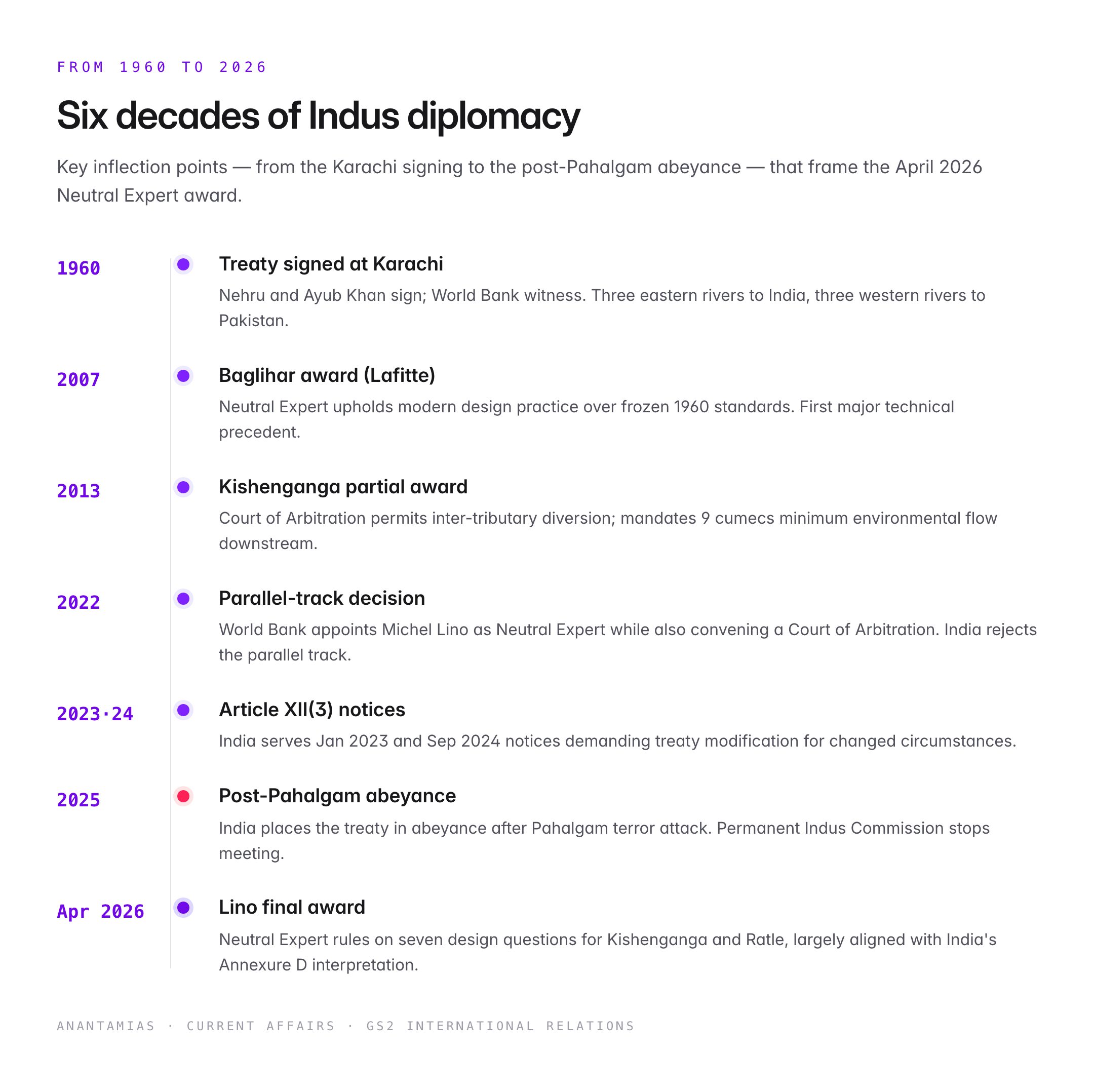
The award lands in an unusually charged political setting. Since India’s post-Pahalgam notice of 24 April 2025 placing the treaty “in abeyance” after the terror attack in Kashmir, the Permanent Indus Commission has not met, data-sharing has been suspended and Islamabad has repeatedly approached international fora alleging treaty violations. India’s January 2023 and September 2024 notices to Pakistan under Article XII(3) of the IWT, demanding formal renegotiation in light of changed circumstances, form the larger backdrop.
For UPSC aspirants, the 2026 award is a textbook case of how a nearly 66-year-old water-sharing compact, signed in Karachi on 19 September 1960 by Prime Minister Jawaharlal Nehru and President Ayub Khan with the World Bank as witness, is being renegotiated in practice through parallel legal tracks, domestic posture and geopolitical signalling.
UPSC Relevance at a Glance
| Dimension | Details |
|---|---|
| GS Paper | GS2 International Relations, GS1 Geography (River Systems), GS3 Environment |
| Prelims | IWT Articles, Annexures D and E, Kishenganga and Ratle projects, Permanent Indus Commission, Court of Arbitration, VCLT 1969 |
| Mains | India-Pakistan relations, treaty renegotiation, transboundary river governance, climate change and water security |
| Syllabus Tags | Bilateral treaties, agreements affecting India’s interests, international institutions |
Background and Context
The Indus Waters Treaty is one of the most durable water-sharing arrangements in the world. Negotiated over nine years under the auspices of the International Bank for Reconstruction and Development (IBRD, now World Bank) and championed by its president Eugene Black, it divided the six rivers of the Indus basin into two baskets. The three eastern rivers, Ravi, Beas and Sutlej, were allocated in full to India with a transition period for Pakistan. The three western rivers, Indus, Jhelum and Chenab, were allocated to Pakistan, with India permitted limited, strictly regulated non-consumptive uses including domestic use, navigation, agriculture up to specified acreages, and run-of-the-river hydroelectric generation subject to detailed design criteria in Annexure D.
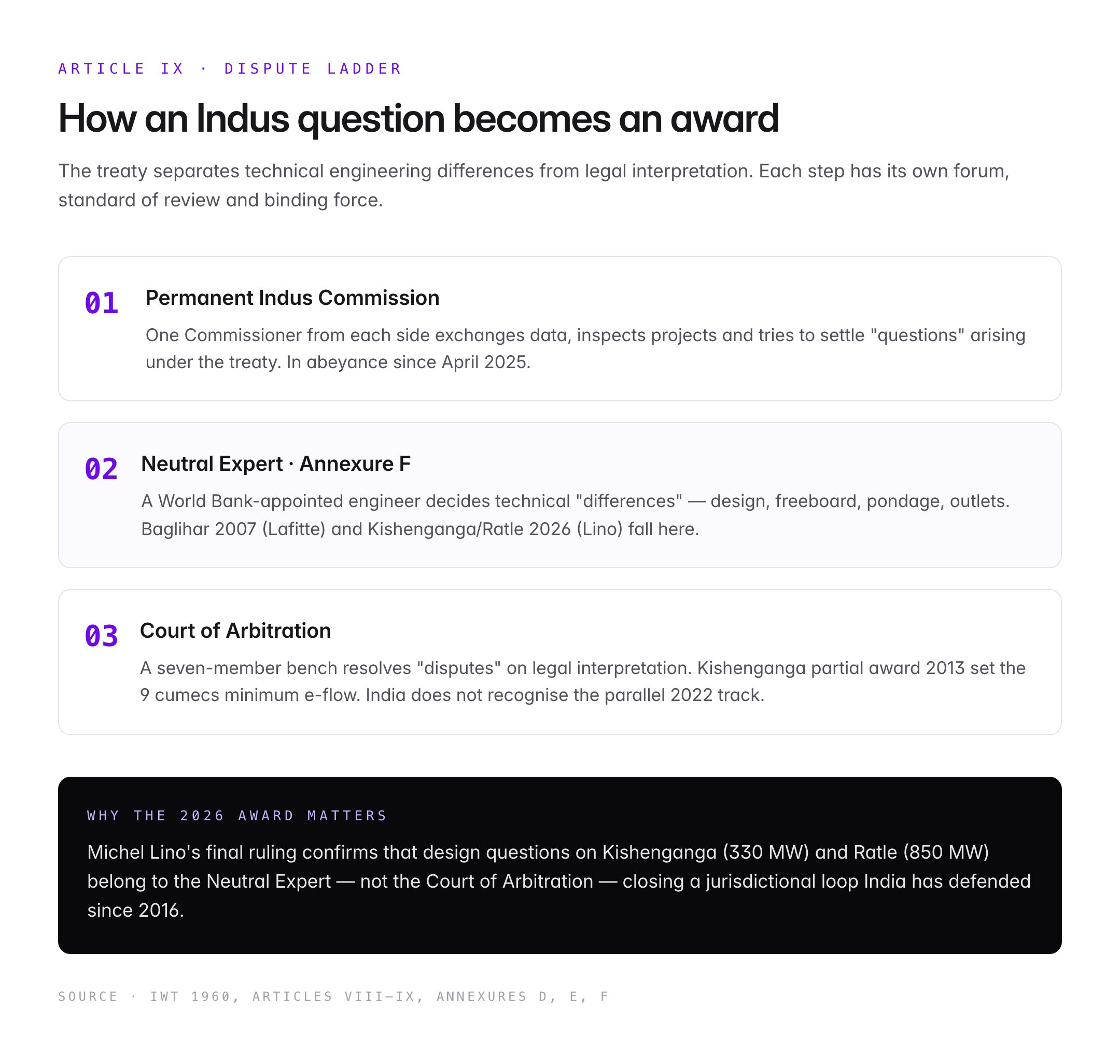
The treaty established the Permanent Indus Commission with a Commissioner from each country tasked with exchanging flow data, inspecting projects and resolving routine questions. When a question cannot be settled at the Commission level, the treaty provides a three-step ladder under Article IX: questions are first discussed at the Commission, then elevated to differences referred to a Neutral Expert for technical determinations, and finally escalated to a Court of Arbitration for legal interpretation issues.
Disputes have punctuated the treaty’s life. The Baglihar award of 2007, authored by Neutral Expert Raymond Lafitte, established that modern dam engineering practices could not be frozen at 1960 technology and largely upheld India’s design. The Kishenganga partial award of 2013 by a Court of Arbitration permitted India’s inter-tributary diversion while mandating a minimum environmental flow of 9 cumecs downstream. Since 2016 Pakistan has pressed for a Court of Arbitration on Kishenganga and Ratle while India has insisted on a Neutral Expert, triggering the World Bank’s controversial decision in 2022 to allow both tracks to proceed in parallel, a step Delhi has consistently refused to recognise.
India’s January 2023 notice, reinforced in September 2024, invoked Article XII(3) to demand modification of the treaty citing fundamentally changed circumstances including demographic shifts, irrigation needs, climate variability and the weaponisation of the dispute resolution architecture. The 2025 abeyance moved this from legal demand to political fact.
Key Features of the 2026 Award
Seven Technical Questions
The Neutral Expert was asked to determine seven specific engineering questions, including whether the design of the Kishenganga and Ratle projects is consistent with the criteria in Annexure D, Paragraph 8 of the treaty. These covered freeboard height above normal operating level, the size and elevation of low-level outlets used for sediment flushing, pondage volumes required for daily peaking power, intake elevation for power generation, and spillway gate configurations.
The Competence Question
A threshold question decided earlier, in the Neutral Expert’s competence award of January 2025, held that the issues fell squarely within his mandate under Annexure F of the treaty, rejecting Pakistan’s argument that they were legal questions requiring a Court of Arbitration. The 2026 final award operationalises this by issuing technical determinations that largely align with modern international best practice for run-of-the-river plants in seismically active Himalayan terrain.
Design Findings
On Kishenganga, the expert accepted that the project’s intake and pondage design are consistent with Annexure D requirements, subject to operational conditions on drawdown flushing. On Ratle, the 850 MW project on the Chenab, the award affirmed India’s freeboard and low-level outlet configuration, noting that sediment management in the high-silt Chenab cannot be achieved with the gated spillway heights Pakistan had proposed.
The Abeyance Question
The award explicitly records, in a procedural note, that the Neutral Expert’s mandate is defined by the treaty and is not legally extinguished by a unilateral notice of abeyance. This is jurisprudentially significant: it reflects the principle that dispute settlement clauses survive broader disputes about treaty status, a principle drawn by analogy from Article 60 of the Vienna Convention on the Law of Treaties (VCLT) 1969 on material breach.
Parallel PCA Proceedings
The Permanent Court of Arbitration at The Hague, seised by Pakistan, issued its own supplemental award in 2025 asserting competence. India does not participate in these proceedings and does not recognise their outcomes. The 2026 Neutral Expert award deepens the legal divergence between the two tracks.
Significance
- The award reinforces India’s position that technical design questions belong to the Neutral Expert track, consolidating a line of reasoning that runs from Baglihar 2007 to Kishenganga 2013 to the 2025 competence ruling.
- It creates operational certainty for the Ratle (850 MW) and Kishenganga (330 MW) projects, unlocking downstream economic and energy benefits for Jammu and Kashmir while respecting Annexure D obligations.
- It provides India diplomatic cover to pursue Article XII(3) renegotiation from a position of legal strength, since the substantive design questions have been resolved on the merits.
- The award illustrates the durability of multilateral institutions under stress, as the World Bank’s fiduciary role as treaty signatory and appointing authority held even through the 2025 abeyance period.
- For basin states globally, the award signals that modern engineering standards, climate adaptation and sediment management can be reconciled with older water treaties without wholesale renegotiation.
- It strengthens India’s bargaining hand on any future modification dialogue, as Pakistan’s argument that Indian projects violate the treaty has been weakened on the technical merits.
Concerns and Challenges
The award does not resolve the underlying political rupture. With the treaty in abeyance and the Permanent Indus Commission not meeting, day-to-day treaty operations, including flood forecasting data, project notifications under Article VII, and tour inspections, remain suspended. The cost of this suspension is borne disproportionately by downstream communities on both sides of the line of control who depend on flow predictability.
The parallel proceedings problem is unresolved. The Court of Arbitration at The Hague continues to claim jurisdiction over the same questions, and any future award from that bench that conflicts with the Neutral Expert’s determination will generate a direct clash of international legal instruments. The World Bank’s 2022 decision to allow both tracks in parallel remains institutionally unsustainable.
Pakistan’s agricultural economy, with over 80 percent of its irrigation drawn from the western rivers of the Indus system and the Indus Basin Irrigation System feeding 90 percent of its food production, means that any operational disruption translates rapidly into food security and political pressure. Islamabad has signalled that continued abeyance will be treated as an act of war, raising escalation risks.
Climate change complicates every parameter. Himalayan glacial retreat, shifting monsoon patterns and rising variability in Jhelum and Chenab flows mean that design criteria negotiated in 1960 and dispute mechanisms tested in 2007 and 2013 must now accommodate hydrological realities that the treaty drafters did not anticipate. The 2026 award nods to this reality but cannot substitute for renegotiation.
Comparative and Historical Perspective
The IWT is often compared with other transboundary water regimes. The contrast with the Nile Basin, where the 1959 Egypt-Sudan agreement is contested by upstream Ethiopia over the Grand Ethiopian Renaissance Dam, shows how upstream-downstream asymmetry plays out without a binding multilateral framework. The Mekong River Commission, established in 1995 among Cambodia, Laos, Thailand and Vietnam, offers a softer cooperative model without China’s participation. The Helsinki Rules 1966 and the Berlin Rules 2004 of the International Law Association represent the doctrinal evolution from equitable utilisation toward ecosystem-based management.
| Treaty or Framework | Year | Parties | Dispute Mechanism | Status 2026 |
|---|---|---|---|---|
| Indus Waters Treaty | 1960 | India, Pakistan, World Bank witness | Commission to Neutral Expert to CoA | In abeyance |
| Ganges Waters Treaty | 1996 | India, Bangladesh | Joint Committee | Up for renewal 2026 |
| Mekong Agreement | 1995 | Four lower riparians | MRC consensus | Operating, China absent |
| Helsinki Rules | 1966 | Soft law (ILA) | None | Superseded in part |
| Berlin Rules | 2004 | Soft law (ILA) | None | Reference framework |
Way Forward
- The Ministry of External Affairs and Ministry of Jal Shakti should use the 2026 award as a platform to re-engage on Article XII(3) renegotiation covering climate, sediment, environmental flows and modernised dispute clauses.
- The Permanent Indus Commission should be revived in a limited technical mode for humanitarian flood data exchange, isolating it from the wider political abeyance.
- The Central Water Commission should complete detailed project reports for all permissible storages on the western rivers to fully utilise India’s 3.6 million acre-feet storage entitlement under Annexure E.
- The World Bank, as fiduciary, should be pressed to resolve the parallel proceedings anomaly and reaffirm the single-track Neutral Expert mechanism.
- NITI Aayog and the Ministry of Power should fast-track Kishenganga and Ratle commissioning with transparent monitoring of minimum environmental flows at 9 cumecs.
- The Ministry of Environment, Forest and Climate Change should align treaty modernisation with national climate adaptation plans for the Jhelum and Chenab basins.
- The Law Ministry should publish a white paper articulating India’s VCLT-based position on fundamental change of circumstances under Article 62 to build domestic and international legal consensus.
Conclusion
The 2026 Neutral Expert award is not a final settlement of the Indus dispute but a reaffirmation of one of its enduring principles: that technical questions of dam design belong to engineers applying treaty criteria, not to political forums invoking grievance. By vindicating India’s interpretation on Kishenganga and Ratle, the award sharpens the asymmetry between the legal and political tracks and gives India a stronger position to pursue the larger renegotiation it has sought since 2023.
For aspirants, the takeaway is that treaties are living instruments. The IWT has survived three wars and countless crises because its design separates technical operation from political conflict. Whether the post-Pahalgam abeyance ends in a modernised treaty or a permanent rupture will depend less on the legal merits of any single award and more on whether both capitals can recover the minimum political trust required to let water flow on its own schedule.
Prelims Pointers
- IWT signed on 19 September 1960 at Karachi by Jawaharlal Nehru and Ayub Khan, with World Bank as a witness party.
- Eastern rivers: Ravi, Beas, Sutlej allocated to India.
- Western rivers: Indus, Jhelum, Chenab allocated to Pakistan with limited Indian non-consumptive use.
- The Permanent Indus Commission comprises one Commissioner from each country.
- Dispute resolution ladder: Commission, then Neutral Expert, then Court of Arbitration.
- Annexure D governs run-of-the-river plants; Annexure E governs storage; Annexure F governs Neutral Expert procedure.
- Baglihar award 2007 was authored by Raymond Lafitte of Switzerland.
- Kishenganga partial award 2013 required India to release 9 cumecs as minimum environmental flow.
- Neutral Expert Michel Lino was appointed in October 2022.
- India issued Article XII(3) notices in January 2023 and September 2024.
- Treaty placed in abeyance in April 2025 after Pahalgam attack.
- VCLT 1969 Article 60 deals with material breach; Article 62 covers fundamental change of circumstances.
Mains Practice Question
Q. The 2026 Neutral Expert award on Kishenganga and Ratle reaffirms the technical architecture of the Indus Waters Treaty even as the political framework stands suspended. Critically examine India’s options for modernising the treaty under Article XII(3) in light of climate change and bilateral trust deficit. (15 marks, 250 words)
- Explain the structure of IWT dispute resolution and the specific findings of the 2026 award.
- Analyse the drivers of India’s 2023 and 2024 notices and the 2025 abeyance decision.
- Suggest a calibrated path combining legal continuity, climate adaptation and political re-engagement.
Frequently Asked Questions
What is the Indus Waters Treaty?
The Indus Waters Treaty is a 1960 water-sharing agreement between India and Pakistan, brokered by the World Bank and signed in Karachi by Jawaharlal Nehru and Ayub Khan. It allocates the three eastern rivers Ravi, Beas and Sutlej to India and the three western rivers Indus, Jhelum and Chenab to Pakistan, while permitting India limited non-consumptive use on the western rivers.
Why is the Indus Waters Treaty in news in April 2026?
Neutral Expert Michel Lino issued his final award in April 2026 on seven technical design questions concerning the Kishenganga and Ratle hydroelectric projects. The award largely upheld India’s interpretation of Annexure D design criteria, even as the treaty itself remains in abeyance following India’s April 2025 notice after the Pahalgam terror attack.
How does this help UPSC preparation?
The topic bridges GS2 International Relations, GS1 Geography and GS3 Environment. It offers concrete material on bilateral treaties, dispute resolution mechanisms, the Vienna Convention on the Law of Treaties, river systems of the Indus basin and climate change impacts on transboundary water governance, all frequently tested in Prelims and Mains..
What is the dispute resolution mechanism under the treaty?
Article IX of the treaty sets a three-step ladder. Questions are first examined by the Permanent Indus Commission. Unresolved differences on technical matters are referred to a Neutral Expert appointed by the World Bank. Legal interpretation issues escalate to a Court of Arbitration. The 2026 award emerged from the Neutral Expert track.
What did India’s Article XII(3) notices of 2023 and 2024 demand?
India’s notices of January 2023 and September 2024 invoked Article XII(3) to demand formal modification of the treaty. They cited fundamentally changed circumstances including demographic pressure, irrigation needs, climate variability and the misuse of dispute mechanisms, seeking bilateral renegotiation rather than unilateral abrogation.
What role does the World Bank play in the treaty?
The World Bank is a signatory in a fiduciary capacity. It brokered the original negotiation, holds the Indus Basin Development Fund, appoints the Neutral Expert when parties disagree and facilitates the Court of Arbitration. Its 2022 decision to allow parallel Neutral Expert and Court of Arbitration tracks remains contested by India.
How does the Kishenganga 2013 award differ from the 2026 award?
The 2013 Court of Arbitration partial award dealt with the legality of inter-tributary diversion, permitting it while imposing a 9 cumecs minimum environmental flow. The 2026 Neutral Expert award, by contrast, resolves technical design questions such as low-level outlets, freeboard and pondage under Annexure D, not legal interpretation issues.
Why is Pakistan especially concerned about western river flows?
Pakistan’s agriculture draws more than 80 percent of its irrigation from the western rivers, with the Indus Basin Irrigation System supporting roughly 90 percent of national food production. Any reduction or uncertainty in flows from the Jhelum, Chenab or Indus translates quickly into food security, livelihood and political pressures inside Pakistan.
Tell Google you want more of this.
Add Anantam IAS as a preferred sourceOne tap, and this site shows up more often in your own Top Stories, AI Overviews and AI Mode. Remove it any time.