Removing a Judge: The Tough Law and Its Loophole
Why in News?
Debates over judicial conduct have again put the spotlight on how India actually removes a tainted judge — a process so demanding that it has never once succeeded. The procedure for the higher judiciary rests on Article 124(4) and Article 124(5) for the Supreme Court, extended to High Courts by Article 217(1)(b), and operationalised by the Judges (Inquiry) Act, 1968.
The headline fact is stark: not a single judge of the higher judiciary has been removed since the Constitution came into force. The closest case, that of Justice V. Ramaswami, collapsed on the floor of the Lok Sabha in 1993 despite an adverse inquiry finding.
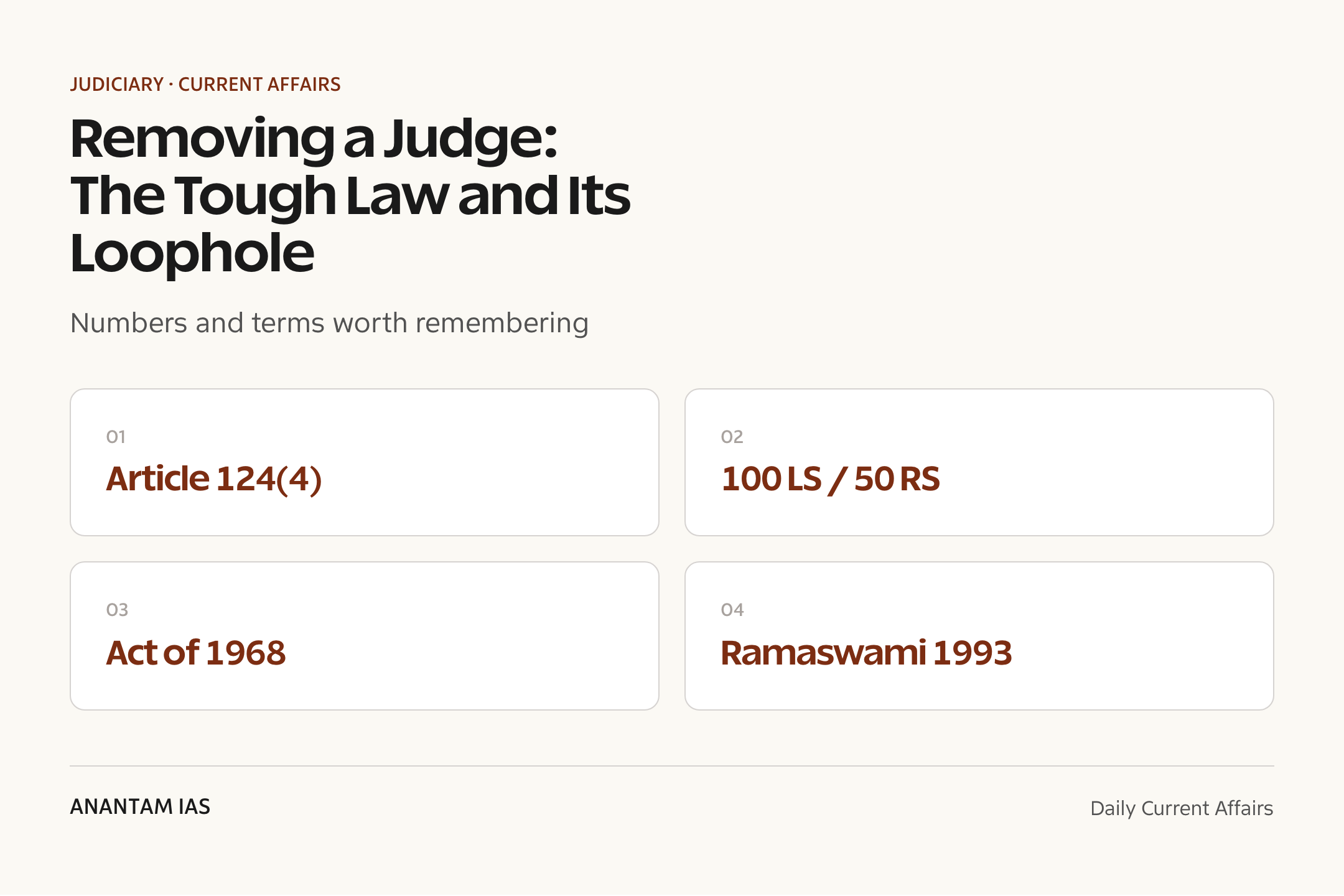
- Removal needs a motion signed by 100 Lok Sabha or 50 Rajya Sabha members before it can even be admitted.
- The only constitutional grounds are “proved misbehaviour or incapacity” — there is no removal for ordinary error or unpopular judgments.
- Each House must pass the motion by a special majority — a majority of total membership and two-thirds of members present and voting.
- The Justice V. Ramaswami motion failed in 1993 when the ruling party abstained, leaving the two-thirds threshold unmet.
- There is no in-between sanction: anything short of removal falls to an informal in-house procedure with no statutory teeth.
The development matters in the context of:
- Matters because it sits at the core of the judicial independence versus accountability balance the Constitution tries to strike.
- Matters because the NJAC verdict (2015) reaffirmed judicial primacy in appointments, sharpening the question of who disciplines judges.
- Matters because a high removal bar protects judges from political reprisal but leaves lesser misconduct effectively unpunished.
UPSC Relevance
Prelims Relevance
- Article 124(4) — grounds and procedure for removal of Supreme Court judges
- Article 124(5) — Parliament’s power to regulate the investigation procedure
- Article 217(1)(b) — removal of High Court judges by the same process
- Judges (Inquiry) Act, 1968 — three-member inquiry committee
- Motion threshold — 100 Lok Sabha / 50 Rajya Sabha members
- Special majority — total-membership majority + two-thirds present and voting
- “Proved misbehaviour or incapacity” — the only constitutional grounds
- Justice V. Ramaswami case (1993) — first and failed removal attempt
- In-house procedure — Supreme Court’s non-statutory mechanism (1999)
- NJAC struck down in 2015 — Article 124A held unconstitutional
Mains Relevance
GS Paper 2
- Examine whether the impeachment process for judges balances independence against accountability.
- Discuss the accountability gap below removal and the case for a graded sanctions framework.
GS Paper 2
- Evaluate the role of the collegium and the in-house procedure in maintaining judicial integrity.
Essay
- “Independence without accountability is a license; accountability without independence is a cage.”
- The unfinished architecture of judicial self-regulation in a constitutional democracy.
Background and Context
The constitutional design
The Constitution deliberately makes removal hard, treating security of tenure as a pillar of judicial independence.
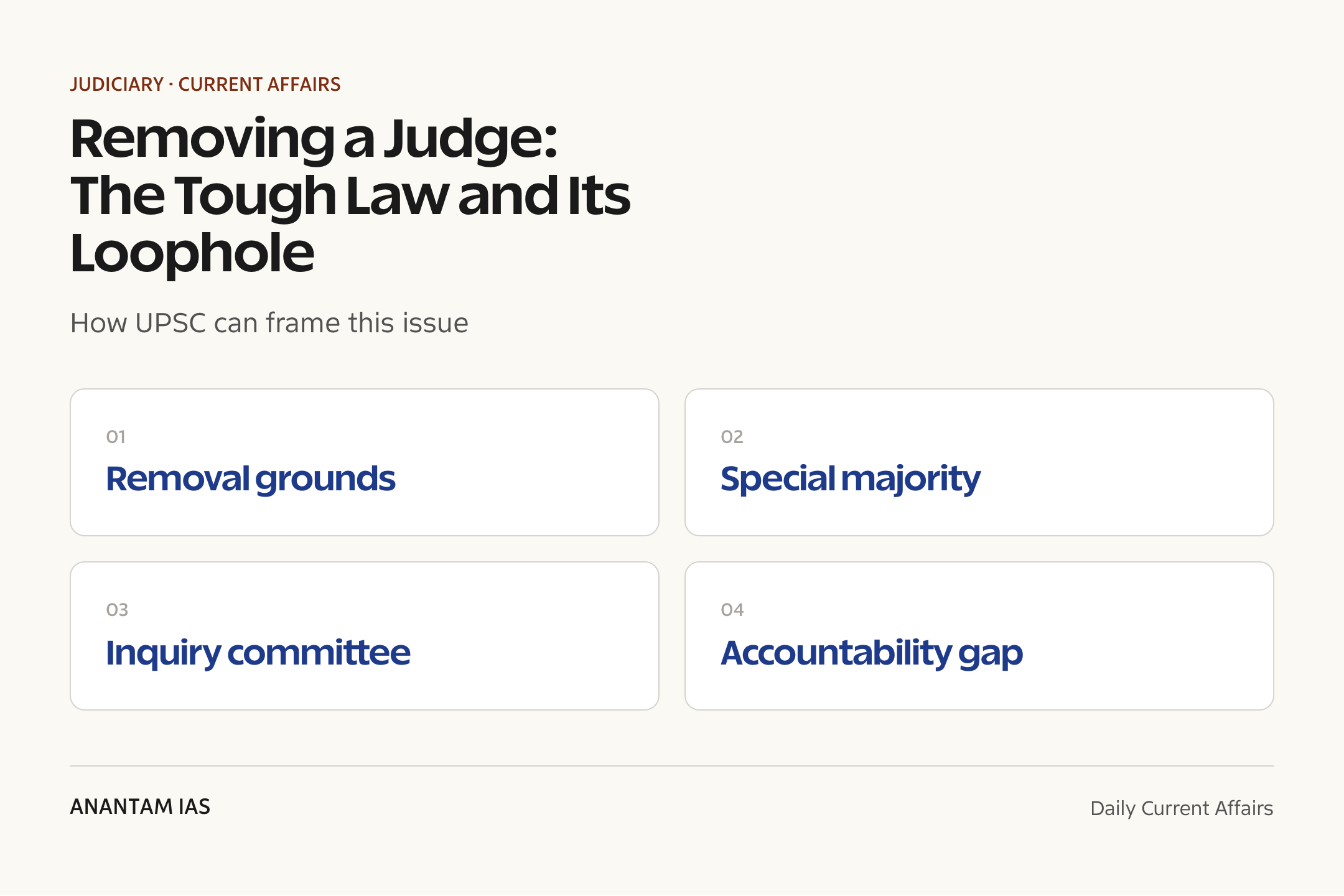
- Article 124(4) says a Supreme Court judge can be removed only by a presidential order passed after an address by each House supported by a special majority, on grounds of “proved misbehaviour or incapacity”.
- Article 124(5) empowers Parliament to regulate by law the procedure for presentation of the address and for the investigation and proof of the misbehaviour or incapacity.
- Article 217(1)(b) applies the identical mechanism to judges of the High Courts — see our explainer on the removal of judges of the High Court and Supreme Court.
- The word “impeachment” is journalistic shorthand; the Constitution speaks of removal by address, distinct from the US-style impeachment of the President under Article 61.
- Security of tenure until 65 years (Supreme Court) and 62 years (High Courts), barring removal, shields judges from executive pressure.
How the machinery actually runs
The Judges (Inquiry) Act, 1968 turns the constitutional grounds into a multi-stage gauntlet.
- A removal motion must be signed by at least 100 members of the Lok Sabha or 50 members of the Rajya Sabha and submitted to the Speaker or Chairman.
- The presiding officer may admit or reject the motion; if admitted, a three-member committee is constituted to investigate.
- The committee comprises a Supreme Court judge, a Chief Justice of a High Court, and a distinguished jurist.
- Only if the committee finds the judge guilty does the motion go to a vote; each House must clear it by a special majority in the same session.
- On both Houses passing the address, the President issues the order of removal — the only formal trigger to end a sitting judge’s tenure.
Why it has never worked: the Ramaswami precedent
The single serious attempt exposed how political arithmetic, not proven facts, decides the outcome.
- Justice V. Ramaswami of the Supreme Court faced charges of financial impropriety from his time as Chief Justice of the Punjab and Haryana High Court.
- An inquiry committee under the 1968 Act found him guilty on several counts, the first such adverse finding against a sitting judge.
- When the motion reached the Lok Sabha in 1993, the ruling party abstained from voting on a legal-political reasoning.
- With abstentions counted against the threshold, the motion fell short of the required two-thirds of those present and voting and failed.
- Later attempts against other judges, including Justice Soumitra Sen (who resigned in 2011 before the Lok Sabha could vote), reinforced that resignation, not removal, ends such episodes.
The loophole: an accountability gap below removal
Because removal is the only constitutional sanction, lesser misconduct escapes any binding penalty.
- There is no mechanism short of removal — no censure, suspension, fine, or reprimand with statutory force — for conduct that is improper but not impeachable.
- The in-house procedure, adopted by the Supreme Court in 1999, lets the Chief Justice order a peer inquiry, but its findings carry no legal sanction and can at most recommend resignation or withdrawal of work.
- The high signature and majority thresholds make removal hostage to party strength and floor management rather than the merits of the charge.
- The lapsed Judicial Standards and Accountability Bill, 2010 sought a complaints mechanism and minor penalties but was never enacted.
- Critics argue this leaves a graded-sanctions vacuum: either the judge stays untouched or faces the near-impossible bar of removal.
Appointments, NJAC and the wider accountability debate
Who selects and who disciplines judges are two halves of the same independence question.
- The collegium system, evolved through the Second and Third Judges cases, gives the judiciary primacy over appointments and transfers; we trace the contest in Collegium vs NJAC.
- The National Judicial Appointments Commission (NJAC) and the 99th Constitutional Amendment were struck down by the Supreme Court in 2015 for breaching the basic-structure doctrine protecting judicial independence.
- With self-appointment entrenched, the absence of a robust removal-and-discipline channel draws sharper criticism of self-regulation without external check.
- The contempt of court power further insulates judges from public criticism, adding to the perception of an accountability deficit.
- Comparators like the UK’s Judicial Conduct Investigations Office and tiered-sanction models abroad are often cited in reform proposals.
Way Forward
Build a graded-sanctions framework
- Enact a statutory mechanism allowing minor penalties — warning, censure, withdrawal of judicial work — for misconduct below the removal threshold.
- Revive the substance of the lapsed Judicial Standards and Accountability Bill with a credible complaints process and timelines.
Strengthen and formalise internal review
- Give the in-house procedure statutory backing and transparency so its findings carry consequence.
- Adopt and publicise a binding code of judicial conduct across the higher judiciary.
Insulate the inquiry stage from political arithmetic by ensuring that an adverse finding under the Judges (Inquiry) Act carries clearer consequence, while protecting genuine independence from executive or legislative reprisal.
Conclusion
The removal process is a deliberate paradox: built to be almost impossible to use, so that a judge fears no reprisal for an unpopular but lawful verdict. That same design becomes a loophole when the only available sanction is the one nobody can realistically deploy.
Closing the gap is not about making removal easy — it is about adding graded, credible sanctions between a clean record and impeachment, so accountability does not collapse into all-or-nothing. The challenge is to discipline misconduct without denting the independence the Constitution guards.
UPSC Practice Questions
Prelims MCQ 1
With reference to the removal of a judge of the Supreme Court of India, consider the following statements:
- The only constitutional grounds are proved misbehaviour or incapacity.
- A removal motion in the Rajya Sabha requires the signatures of at least 50 members.
- Each House must pass the motion by a simple majority of members present and voting.
How many of the above statements are correct?
(a) Only one (b) Only two (c) All three (d) None
Answer: (b) Only two
Explanation:
Statements 1 and 2 are correct. Statement 3 is wrong: passage needs a special majority — a majority of the total membership of the House and at least two-thirds of members present and voting, not a simple majority.
Prelims MCQ 2
Which one of the following correctly describes the inquiry committee under the Judges (Inquiry) Act, 1968?
(a) The President, the Chief Justice of India and the Attorney General (b) A Supreme Court judge, a Chief Justice of a High Court and a distinguished jurist (c) The Speaker, the Chairman of the Rajya Sabha and a retired Chief Justice (d) Three members of the collegium nominated by the Chief Justice of India
Answer: (b) A Supreme Court judge, a Chief Justice of a High Court and a distinguished jurist
Explanation:
Under the 1968 Act, the three-member committee that investigates the charges comprises a sitting Supreme Court judge, a Chief Justice of a High Court and a distinguished jurist.
UPSC Mains Questions
- The Constitution makes the removal of a higher-judiciary judge almost impossible by design. Examine how this protects judicial independence yet creates an accountability gap, and suggest reforms short of diluting security of tenure. (250 words)
- “India’s judiciary appoints itself but cannot effectively discipline itself.” Critically analyse this statement in light of the collegium system, the NJAC verdict and the removal process under Article 124(4). (250 words)
- Discuss the adequacy of the in-house procedure and the Judges (Inquiry) Act, 1968 in addressing judicial misconduct that falls short of the removal threshold. (150 words)
Sources: Constitution of India; Judges (Inquiry) Act, 1968 and Supreme Court of India.
Frequently Asked Questions
What are the grounds to remove a judge?
The Constitution permits removal only on two grounds: proved misbehaviour or incapacity, under Article 124(4) for the Supreme Court and Article 217 for the High Courts. There is no removal for unpopular judgments, ordinary errors of law, or mere allegations. The misconduct must be formally proved through the statutory inquiry before Parliament can even vote on the address.
Has any Indian judge ever been removed?
No. Since the Constitution came into force, no judge of the higher judiciary has been removed. The nearest case was Justice V. Ramaswami in 1993, where an inquiry committee found him guilty but the Lok Sabha motion failed when the ruling party abstained. Others, such as Justice Soumitra Sen, resigned before a final vote, so removal has never actually been completed.
Is impeachment the right word for this process?
Not strictly. “Impeachment” is popular shorthand. The Constitution describes removal by an address of both Houses to the President, not impeachment in the US sense. True impeachment in India applies only to the President under Article 61. For judges, the correct term is removal under Article 124(4) read with the Judges (Inquiry) Act, 1968.
What majority is needed in Parliament?
Each House must pass the removal motion by a special majority in the same session — a majority of the total membership of that House and at least two-thirds of the members present and voting. The motion must also first be admitted, requiring signatures of 100 Lok Sabha or 50 Rajya Sabha members, making the overall threshold extremely demanding to meet.
What is the in-house procedure?
The in-house procedure is a non-statutory mechanism the Supreme Court adopted in 1999. It lets the Chief Justice order a peer inquiry into a judge’s conduct. But its findings carry no legal sanction; at most it can recommend that the judge resign or be denied judicial work. It fills part of the gap below removal, though without binding teeth.
Why is the removal process called a loophole?
Because removal is the only constitutional sanction, there is nothing in between a clean record and impeachment. Misconduct that is improper but not grave enough for removal escapes any binding penalty — no censure, fine, or suspension with statutory force. This all-or-nothing design, combined with high political thresholds, leaves an accountability gap critics call the loophole.