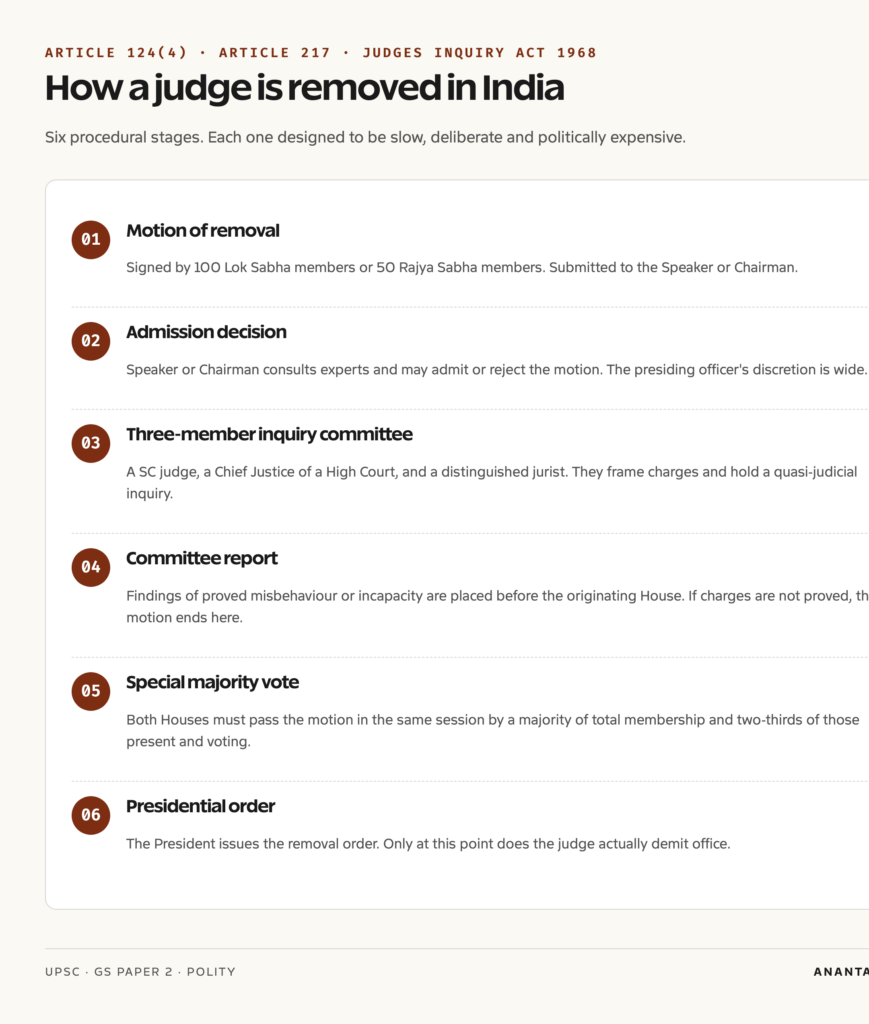
A Supreme Court or High Court judge can be removed only through the constitutional “removal” procedure under Article 124(4) — extended to High Court judges by Articles 217(1)(b) and 218 — and only on two grounds: proved misbehaviour or incapacity. The process needs a motion signed by at least 100 Lok Sabha or 50 Rajya Sabha members, a guilty finding by a three-member inquiry committee under the Judges (Inquiry) Act, 1968, a special-majority vote in both Houses, and finally a removal order by the President. No judge has ever been removed this way in India.
The Indian Constitution treats the removal of a Supreme Court or High Court judge as a constitutional event of the highest gravity. The procedure is deliberately slow, the threshold is deliberately high, and the institutional design assumes that judicial independence cannot survive if removal is easy. In July 2025, more than 145 Lok Sabha members and over 50 Rajya Sabha members submitted motions seeking the removal of Justice Yashwant Varma, a sitting High Court judge. The numbers crossed the constitutional threshold for initiation, and the country was reminded that the impeachment machinery, dormant for years, can still be set in motion.
The legal architecture sits in Article 124(4) of the Constitution, made applicable to High Court judges through Articles 217 and 218, with the procedural details supplied by the Judges (Inquiry) Act, 1968. The grounds are limited to two: proved misbehaviour and incapacity. The route runs through a presiding officer, a three-member inquiry committee, both Houses of Parliament voting by special majority, and finally a presidential order. No judge has ever been successfully removed in India. The history shows two near-misses, Justice V. Ramaswami in 1993 and Justice Soumitra Sen in 2011, and several motions that died at the admission stage.
This guide walks through the constitutional text, the statutory procedure, the special majority requirement, the comparative judicial removal frameworks elsewhere in the democratic world, and the prelims and mains pointers that an aspirant should carry into the examination hall.
Quick Facts on Removal of Judges
A Supreme Court judge can be removed only on the grounds of proved misbehaviour and incapacity, under Article 124(4). The same procedure applies to High Court judges through Articles 217(1)(b) and 218. The motion requires 100 Lok Sabha members or 50 Rajya Sabha members to sign before introduction. The presiding officer of the relevant House decides on admission. A three-member inquiry committee comprising the Chief Justice of India or a Supreme Court judge, a High Court Chief Justice, and a distinguished jurist investigates the charges. If the committee finds the judge guilty, both Houses must pass the motion in the same session by special majority, defined as a majority of total membership and at least two-thirds of members present and voting. The President then issues the removal order. The Constitution uses the word “removal,” not “impeachment,” for judges. Impeachment in the strict constitutional sense is reserved for the President under Article 61. No judge has ever been successfully removed in independent India.
What “Removal” Means in the Indian Context
The Constitution distinguishes between removal of judges and impeachment of the President with deliberate care. Article 61 sets up impeachment for the President as a quasi-judicial process driven entirely by Parliament for “violation of the Constitution,” with both Houses sitting as the deciding body. Article 124(4) sets up removal of Supreme Court judges as a hybrid process, in which the substantive determination of misbehaviour or incapacity is delegated to a three-member inquiry committee, and Parliament’s role is to act on the committee’s finding. The committee makes the factual decision; Parliament makes the political and constitutional decision to act on it.
This design serves judicial independence. Judges are not removed by political majorities applying political tests. They are removed by judicial-style determinations, ratified by political institutions through a high voting threshold. Misbehaviour is generally read to cover wilful and persistent misconduct, corruption, violation of constitutional norms, or moral turpitude that affects judicial functioning. Incapacity covers physical and mental incapacity that prevents the judge from discharging duties. The two grounds are exhaustive. Disagreement with judgments, allegations of poor reasoning, or political opposition to a judge’s rulings are not constitutional grounds for removal.
Background and Historical Context
The removal procedure carries a constitutional inheritance from English law. The 1701 Act of Settlement first established the principle that English judges could be removed only on an address from both Houses of Parliament to the Crown, a structure designed to insulate the judiciary from royal interference. The framers of the Indian Constitution borrowed and modified the English model. They added a structured inquiry process, drew the inquiry committee partly from the higher judiciary itself, and replaced the simple parliamentary address with a special majority vote in both Houses.
The Constituent Assembly debates on Article 124 reveal a clear preference for high thresholds. B.R. Ambedkar argued that removal should be neither too easy nor practically impossible. The compromise produced a procedure that has been initiated several times but has never reached the presidential order stage. The first serious test came with Justice V. Ramaswami of the Supreme Court in 1993. A three-member committee found him guilty of misconduct relating to financial irregularities at the Punjab and Haryana High Court. The motion was placed before the Lok Sabha. The Congress party abstained from the vote. The motion fell short of the special majority and was defeated. Ramaswami served out his term.
The second major test came with Justice Soumitra Sen of the Calcutta High Court in 2011. The Rajya Sabha passed the motion against him by the requisite majority on charges of misappropriating funds in his pre-judicial career. Before the Lok Sabha could vote, Sen resigned. He was the first Indian judge to come within a parliamentary vote of removal. The Yashwant Varma motion of 2025 has revived the procedure once again. For a wider context on judicial reform debates, see our explainers on judicial reforms in India and the role of the Chief Justice of India.
The Constitutional Text
Article 124(4) provides that a Supreme Court judge shall not be removed from office except by an order of the President passed after an address by each House of Parliament supported by a majority of the total membership of that House and by a majority of not less than two-thirds of the members of that House present and voting has been presented to the President in the same session for such removal on the ground of proved misbehaviour or incapacity. Article 124(5) authorises Parliament to regulate the procedure by law for presentation of an address and for investigation and proof of the misbehaviour or incapacity, which Parliament did through the Judges (Inquiry) Act, 1968.
For High Court judges, Article 217(1)(b) provides that a judge of a High Court shall be removed from office in the manner provided in clause (4) of Article 124 for the removal of a Supreme Court judge. Article 218 reinforces the cross-application. The procedure is identical for Supreme Court and High Court judges. There is no separate or lower threshold for High Court removal.
The Procedure under the Judges (Inquiry) Act, 1968
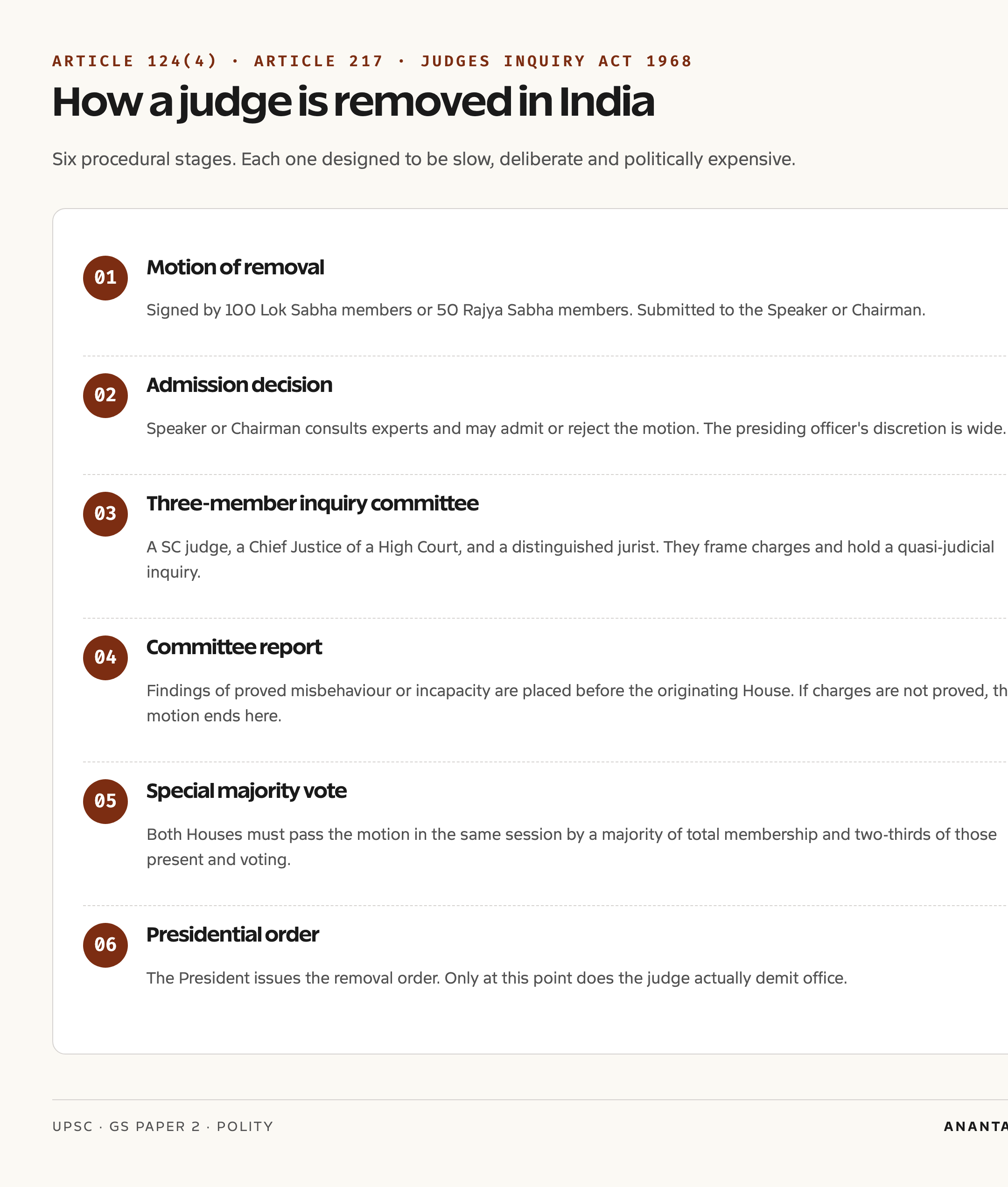
The procedural detail breaks into six stages. The first is initiation. A removal motion must be signed by at least 100 Lok Sabha members if introduced in the Lok Sabha, or at least 50 Rajya Sabha members if introduced in the Rajya Sabha. The signed notice is submitted to the Speaker of the Lok Sabha or the Chairman of the Rajya Sabha.
The second stage is admission. The presiding officer may admit or refuse to admit the motion after consulting individuals as deemed fit and considering the materials placed before them. This is a discretionary step. It is not automatic, and the presiding officer’s refusal is generally not subject to judicial review. The Yashwant Varma motion of 2025 had to clear this stage before the inquiry process could begin.
The third stage is the inquiry committee. If admitted, a three-member committee is constituted under the Judges (Inquiry) Act. The composition is fixed by statute: the Chief Justice of India or a sitting Supreme Court judge as the chairperson, the Chief Justice of a High Court, and a distinguished jurist. The committee frames charges, calls evidence, and proceeds in a quasi-judicial manner. The judge under investigation has the right to a defence, including the right to counsel and to cross-examine witnesses.
The fourth stage is the report. The committee submits its report to the presiding officer of the House where the motion was introduced. If the committee finds the judge not guilty, the process ends. The motion lapses. The House cannot proceed to a vote on a not-guilty finding. This is the most decisive procedural protection in the framework. If the committee finds the judge guilty, the motion proceeds to consideration by the House.
The fifth stage is the special majority vote. The motion must be passed in the same session by both Houses of Parliament. The constitutional threshold is special majority, defined as a majority of the total membership of the House, which is more than half of the sanctioned strength, and at least two-thirds of the members present and voting. Both conditions must be satisfied independently.
The sixth stage is the presidential order. Once both Houses have passed the motion by special majority, the address is presented to the President, who issues an order removing the judge. The presidential order is the formal act that ends the judge’s tenure.
Special Majority Explained
Special majority under Article 124(4) is the high constitutional threshold. The first condition is a majority of the total membership of the House. For the Lok Sabha with a sanctioned strength of 543, that is at least 272 members. For the Rajya Sabha with a sanctioned strength of 245, that is at least 123 members. The second condition is two-thirds of members present and voting. If 400 Lok Sabha members are present and voting, the motion needs at least 267 votes in favour. Both conditions must be met independently in the same session in both Houses.
The threshold is intentionally demanding. It ensures that no government acting on its own legislative majority can remove a judge, because special majority typically requires cross-party support. The same threshold is used for constitutional amendments under Article 368 in respect of provisions affecting the federal structure. Both contexts share the same principle: changes that go to the heart of the constitutional balance require broad legislative consensus.
For more on parliamentary mechanics that anchor this procedure, see our notes on Lok Sabha vs Rajya Sabha and the role of parliamentary committees in India.
Why It Matters
The removal procedure matters for three reasons. First, it operationalises judicial independence. A judiciary that can be dismissed by simple majority cannot stand against an executive determined to override individual rights or federal balance. The high threshold of Article 124(4) is the structural guarantee that judges can decide hard cases without fearing for their tenure.
Second, the procedure also operationalises judicial accountability. Judges are not above the law. Misbehaviour and incapacity are constitutional grounds for removal precisely because no constitutional officer is meant to be irremovable. The 1968 Act builds a fair, structured, and judicial-style process to test those grounds.
Third, the rare invocation of the procedure is itself constitutionally significant. The fact that no judge has been removed in seventy-five years suggests that the in-house mechanisms of self-regulation, peer pressure, and resignation under threat have done much of the heavy lifting. Soumitra Sen resigned before the Lok Sabha vote. Other judges facing motions have stepped down quietly. The shadow of the procedure works even when the procedure itself does not run its full course.
Comparative Look: India, United Kingdom, United States
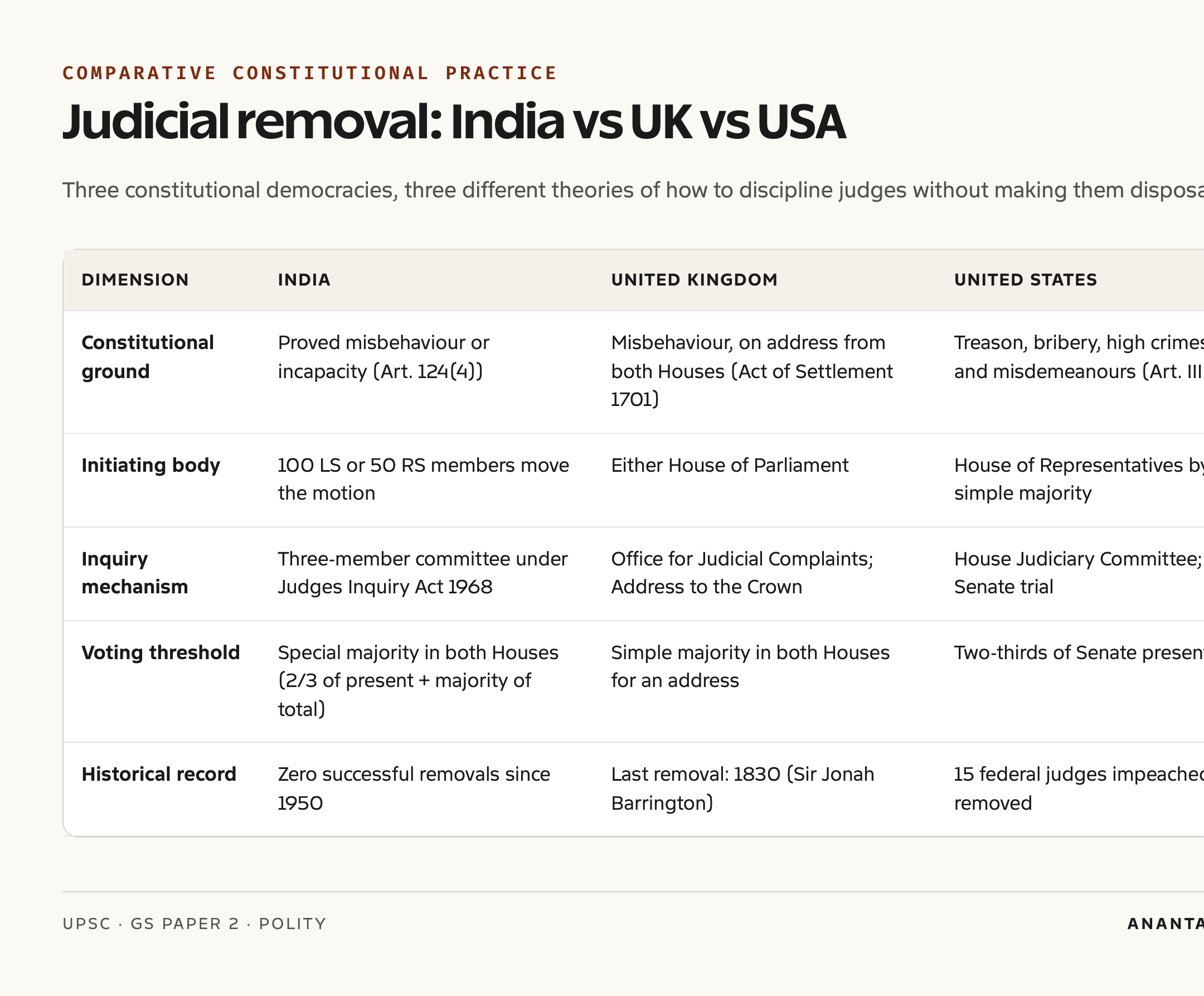
The United Kingdom retains the Act of Settlement model. A senior judge can be removed only by an address presented to the Crown by both Houses of Parliament. The procedure is rarely used and has not led to a removal in modern times. The threshold is a simple majority in both Houses, with the practical safeguard supplied by parliamentary culture and the convention of judicial independence rather than by a high voting bar.
The United States Constitution provides for impeachment of federal judges under Article II, Section 4, and Article III, Section 1. A judge can be impeached by the House of Representatives by simple majority for “treason, bribery, or other high crimes and misdemeanours” and tried by the Senate, where conviction requires a two-thirds majority. Fifteen federal judges have been impeached by the House in American history; eight have been convicted by the Senate and removed. The American practice is more frequent than the Indian or British, partly because the grounds are interpreted broadly.
India sits between the British and American models. The grounds are narrower than the American “high crimes and misdemeanours,” the procedure is more structured than the British address, and the special majority threshold is the highest of the three.
Notable Historical Cases
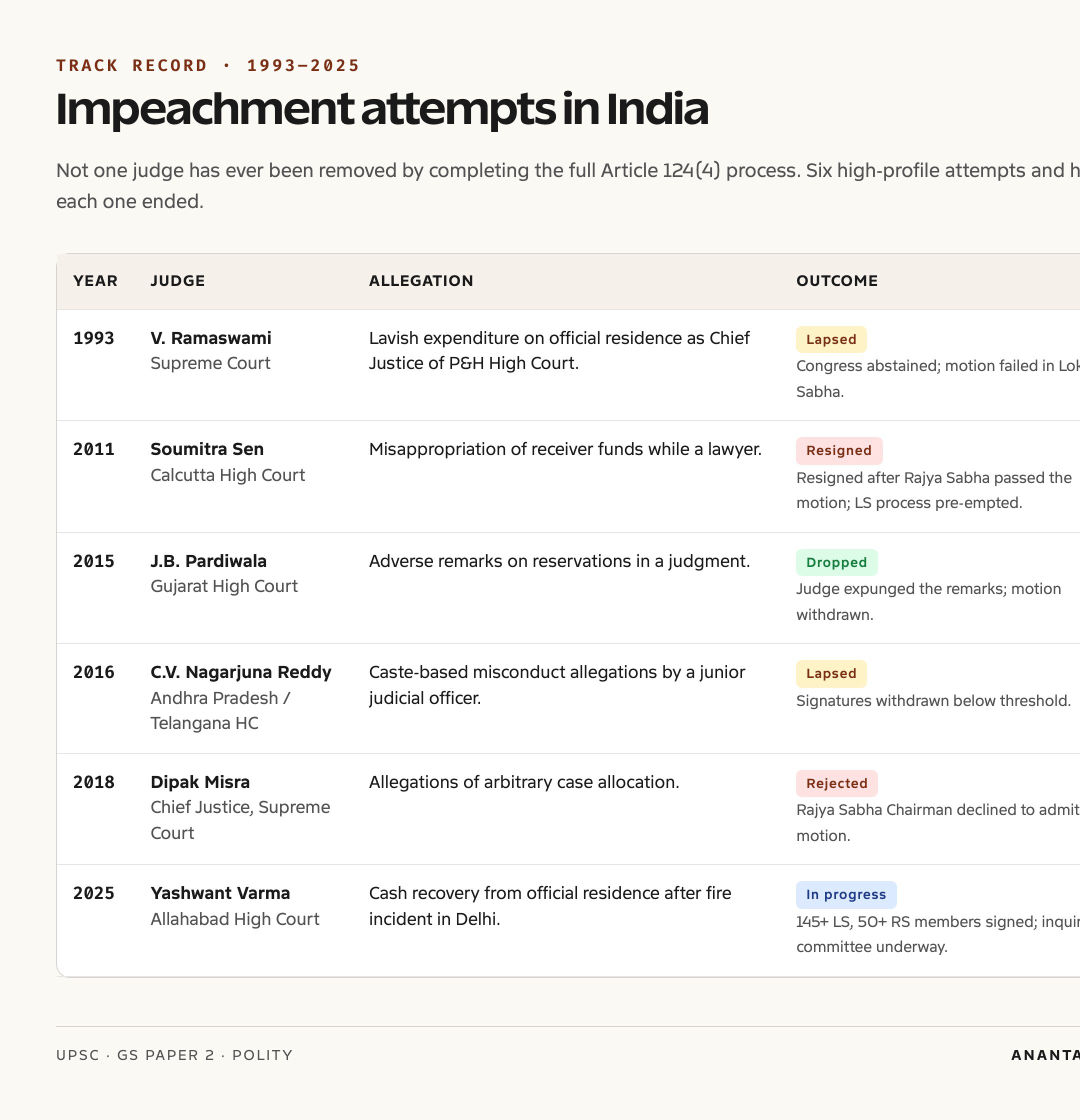
Justice V. Ramaswami of the Supreme Court was the first Indian judge to face a fully constituted inquiry committee under the 1968 Act, in 1993. The committee found him guilty of misconduct. The Lok Sabha motion failed because the Congress party abstained, leaving the special majority threshold unmet. Justice Soumitra Sen of the Calcutta High Court came closest to removal. The Rajya Sabha passed the motion against him by special majority in August 2011. He resigned in September before the Lok Sabha could vote. Other motions, including against Justice J.B. Pardiwala in 2015, Justice C.V. Nagarjuna Reddy in 2016, and Chief Justice Dipak Misra in 2018, did not survive the admission or signature stages.
The Yashwant Varma motion of 2025 has reopened the procedural conversation. The signature thresholds were comfortably crossed. Whether the motion proceeds to inquiry, what the committee finds, and whether Parliament reaches the special majority threshold will write the next chapter in this constitutional history. The procedure remains, in the words of constitutional commentators, “a sword in the scabbard”—one that exists primarily to deter rather than to be drawn.
Prelims Pointers
The grounds for removal are proved misbehaviour and incapacity, and only these two. The signature requirement is 100 Lok Sabha or 50 Rajya Sabha members. The inquiry committee has three members: a Supreme Court judge, a High Court Chief Justice, and a distinguished jurist. A not-guilty committee report ends the process; Parliament cannot override it. The special majority requires both a majority of total membership and two-thirds of members present and voting. The same procedure applies to High Court judges through Articles 217(1)(b) and 218. The Constitution uses “removal” for judges, “impeachment” for the President under Article 61. No judge has been successfully removed. Justice V. Ramaswami’s motion was defeated in the Lok Sabha in 1993. Justice Soumitra Sen resigned in 2011 after the Rajya Sabha passed the motion.
A common trap statement: “The procedure for removal of a High Court judge is different from that of a Supreme Court judge.” This is incorrect. The procedure is identical. Another trap: “If the inquiry committee finds the judge innocent, Parliament can still vote on the motion.” This is incorrect; the process drops on a not-guilty finding.
Mains Practice Questions
- The procedure for removal of a Supreme Court or High Court judge under Article 124(4) reflects a deliberate balance between judicial independence and judicial accountability. Discuss with reference to the constitutional design and the historical record. (GS Paper 2, 250 words)
- Examine the role of the three-member inquiry committee under the Judges (Inquiry) Act, 1968, and assess whether the not-guilty barrier in the procedure adequately safeguards judicial independence. (GS Paper 2, 250 words)
- Compare the judicial removal frameworks in India, the United Kingdom, and the United States and bring out their constitutional and political differences. (GS Paper 2, 150 words)
- Why has no judge been successfully removed in independent India despite multiple impeachment motions? Analyse with reference to the Ramaswami and Soumitra Sen cases. (GS Paper 2, 150 words)
Way Forward
Three reform directions are commonly debated. The first is a Judicial Standards and Accountability framework that supplements removal with lighter sanctions for misconduct that does not meet the misbehaviour threshold. The Judicial Standards and Accountability Bill of 2010 attempted this but lapsed. The second is greater transparency in the in-house mechanism that the Supreme Court has used since the 1990s to handle complaints against sitting judges. The third is procedural clarity at the admission stage, where the presiding officer’s discretion sometimes becomes the chokepoint that stops genuine cases from being heard.
The deeper reform task is institutional. A robust collegium that vets appointments carefully, an in-house mechanism that handles minor misconduct credibly, and a removal procedure reserved for grave cases together produce a sustainable balance. The Constitution sets up the framework. Constitutional culture has to operate it.
Frequently Asked Questions
On what grounds can a Supreme Court or High Court judge be removed in India?
A judge can be removed only on the grounds of proved misbehaviour and incapacity, under Article 124(4) for Supreme Court judges and through Articles 217(1)(b) and 218 for High Court judges. Disagreement with judgments, political opposition, or unpopular rulings are not constitutional grounds for removal. Misbehaviour generally covers wilful and persistent misconduct, corruption, violation of constitutional norms, or moral turpitude. Incapacity covers physical and mental incapacity that prevents the judge from discharging duties.
Is the procedure for removal of a High Court judge different from that of a Supreme Court judge?
No. The procedure is identical. Article 217(1)(b) of the Constitution makes the procedure under Article 124(4) applicable to High Court judges. The signature thresholds, the inquiry committee structure, the special majority requirement, and the presidential order are the same in both cases.
How many signatures are needed to introduce a removal motion?
A motion introduced in the Lok Sabha must be signed by at least 100 members. A motion introduced in the Rajya Sabha must be signed by at least 50 members. The signed notice is submitted to the Speaker or the Chairman, who decides on admission.
What does the three-member inquiry committee do?
The committee, constituted under the Judges (Inquiry) Act, 1968, frames charges and conducts a quasi-judicial inquiry into the allegations against the judge. The committee comprises a Supreme Court judge, a High Court Chief Justice, and a distinguished jurist. The judge under investigation has the right to a defence, including counsel and cross-examination. The committee submits a report finding the judge guilty or not guilty.
What happens if the inquiry committee finds the judge not guilty?
The process ends. Parliament cannot override a not-guilty finding by the committee. The motion lapses, and no further action is taken on it. This is the most important procedural protection in the removal framework, because it places the substantive determination of misbehaviour or incapacity outside the hands of political majorities.
What is the special majority required to pass a removal motion?
The motion must be passed in both Houses by a majority of the total membership of the House and by at least two-thirds of the members present and voting. For the Lok Sabha, that means at least 272 members of the total strength of 543, and at least two-thirds of those present and voting. For the Rajya Sabha, that means at least 123 of 245, and the same two-thirds present-and-voting threshold. Both conditions must be met independently and in the same session.
Has any judge ever been successfully removed in India?
No. No Supreme Court or High Court judge has been removed under the Article 124(4) procedure since the Constitution came into force in 1950. Justice V. Ramaswami’s motion was defeated in the Lok Sabha in 1993 because the Congress party abstained. Justice Soumitra Sen resigned in September 2011 after the Rajya Sabha passed the motion against him in August 2011, before the Lok Sabha could vote.
Why does the Constitution use “removal” instead of “impeachment” for judges?
The Constitution uses “impeachment” only for the President under Article 61. For judges, it uses “removal” under Article 124(4). The terminological distinction reflects a structural difference: the President’s impeachment is conducted entirely by Parliament for “violation of the Constitution,” while the removal of judges depends on a quasi-judicial inquiry committee finding before Parliament can vote. The two procedures share the special majority threshold but differ in their internal mechanics.
Can the Speaker or Chairman refuse to admit a removal motion?
Yes. The presiding officer of the relevant House has discretion to admit or refuse a motion after considering the materials placed before them. The discretion is generally not subject to judicial review on its merits, although procedural impropriety can be challenged. This admission stage has historically been the chokepoint where several motions have died.
What was the significance of the Justice Yashwant Varma motion in 2025?
The motion submitted in July 2025 by over 145 Lok Sabha members and over 50 Rajya Sabha members crossed the constitutional threshold for initiation. It revived the rarely used impeachment machinery and reminded Parliament, the judiciary, and the public that the Article 124(4) procedure remains operational. The motion’s progression through admission, inquiry, and any subsequent voting will write a fresh chapter in India’s judicial accountability record.
Tell Google you want more of this.
Add Anantam IAS as a preferred sourceOne tap, and this site shows up more often in your own Top Stories, AI Overviews and AI Mode. Remove it any time.