The Kashmir Markhor: Conserving a Himalayan Flagship Species
Why in News?
Conservation attention has returned to the Kashmir markhor (Capra falconeri), the world’s largest wild goat, whose Indian range has narrowed to a handful of small, fragmented populations across the western Himalaya of Jammu and Kashmir.
Surveys and protected-area reporting place the surviving Indian markhor in pockets such as Kazinag, Hirpora, Shopian and Boniyar, making it a textbook case of a flagship species clinging on at the edge of its global range.
- The markhor is listed as Near Threatened on the IUCN Red List, an improvement from its earlier Endangered status driven largely by recovery in Pakistan.
- India’s markhor is the Pir Panjal markhor (the western, flare-horned form), found only in Jammu and Kashmir and numbering only a few hundred animals.
- Key Indian sites include Kazinag National Park, the Hirpora Wildlife Sanctuary and the Boniyar–Shopian belt along the Pir Panjal.
- Principal threats are habitat loss, grazing competition from domestic livestock, and poaching for meat and the distinctive spiral horns.
- The species is the national animal of Pakistan, where community-run trophy-hunting conservancies have helped numbers rebound — a model debated for its lessons and limits.
The development matters in the context of:
- The markhor matters as an indicator species: a healthy markhor herd signals an intact, well-protected Himalayan slope ecosystem.
- Its decline mirrors the wider stress on Himalayan biodiversity from livestock pressure, fragmentation and weak landscape-level protection.
UPSC Relevance
Prelims Relevance
- Capra falconeri — the markhor, the world’s largest wild goat; not a deer or an antelope
- Indian range is restricted to Jammu and Kashmir (Pir Panjal and Kazinag belts)
- IUCN Red List status — Near Threatened (down-listed from Endangered)
- National animal of Pakistan; flare-horned and straight-horned forms exist
- Kazinag National Park and Hirpora Wildlife Sanctuary as key Indian markhor habitats
- Difference between a flagship, indicator, keystone and umbrella species
- Protected under the Wild Life (Protection) Act, 1972 in India
- Shares Himalayan habitat with the snow leopard, its principal natural predator
- Listed on CITES Appendix I, restricting international trade
Mains Relevance
GS Paper 3
- Conserving a flagship Himalayan species through protected areas, the Wild Life (Protection) Act and community reserves.
- Human-wildlife conflict and grazing competition as drivers of mountain biodiversity loss.
- Lessons and limits of incentive-based, community-led conservation models drawn from across the border.
GS Paper 2
- Transboundary conservation cooperation for a species split across the India-Pakistan frontier.
Essay
- Can a single charismatic species rescue an entire landscape — the promise and limits of flagship conservation?
Background and Context
What the markhor is
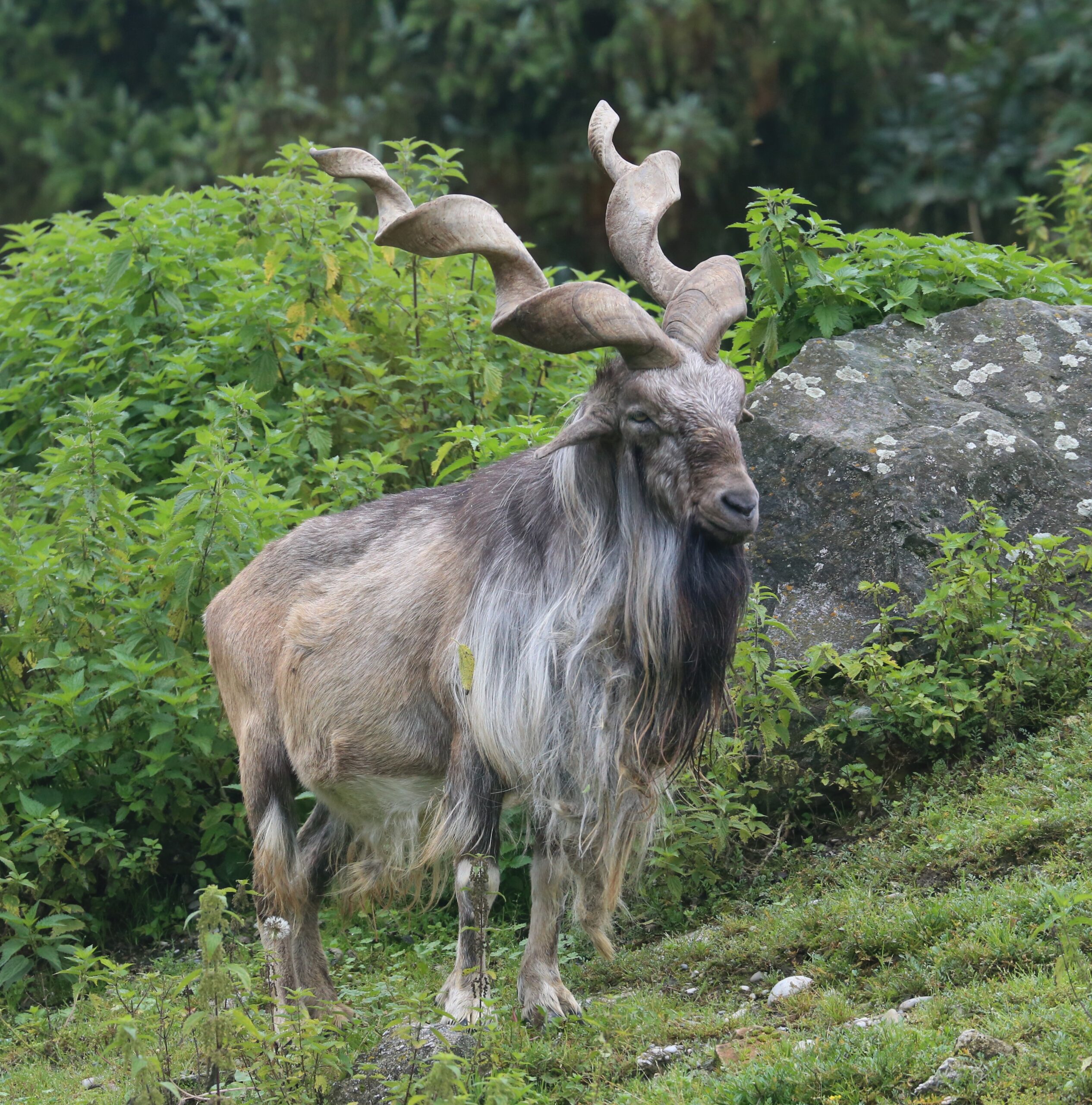
The markhor is a large, spiral-horned wild goat adapted to steep, rugged Himalayan and Central Asian terrain.
- Capra falconeri is the world’s largest wild goat, with males far heavier than females and bearing dramatic corkscrew horns.
- Its global range arcs across the mountains of Pakistan, Afghanistan, Tajikistan, Uzbekistan and the western Himalaya of India.
- Several geographic forms exist — broadly the flare-horned (western) and straight-horned (southern) types.
- India’s animals belong to the Pir Panjal markhor, the flare-horned form at the easternmost edge of the species’ range.
- It grazes and browses on steep grassy and rocky slopes, descending to lower elevations in harsh winter.
Where it survives in India
India holds only a small, fragmented sliver of the global markhor population, confined to Jammu and Kashmir.
- Kazinag National Park, in the lower Jhelum valley, is a core Indian markhor stronghold.
- Hirpora Wildlife Sanctuary along the Pir Panjal protects another key population and a historic migration corridor.
- Animals also persist around Shopian, Boniyar and other pockets of the Pir Panjal range.
- Indian numbers run only to a few hundred, scattered across these isolated patches with limited connectivity.
- Small, broken-up populations are vulnerable to inbreeding, local extinction and chance events.
Why it is threatened
The markhor’s Indian decline is driven by pressure on its mountain habitat rather than any single cause.
- Habitat loss and fragmentation from settlement, infrastructure and degradation of slope pastures.
- Grazing competition with domestic sheep and goats that crowd the same forage and carry disease.
- Poaching for meat and for the prized spiral horns sold as trophies.
- Disturbance along migration routes that severs seasonal movement between summer and winter ranges.
- Disease transmission and predation pressure that small, isolated herds absorb poorly.
Conservation status and legal protection
The markhor sits within an interlocking set of global and Indian protection frameworks.
- IUCN Red List — currently Near Threatened, down-listed from Endangered after recovery elsewhere in its range.
- Listed on CITES Appendix I, banning commercial international trade in the species.
- Protected in India under the Wild Life (Protection) Act, 1972, with its habitats notified as protected areas.
- Conservation rests on the protected-area network plus community reserves that bring local people into stewardship.
- Recovery in Pakistan, where the markhor is the national animal, shows incentive-linked protection can reverse declines.
Flagship and indicator value
The markhor’s worth to conservation goes well beyond its own population numbers.
- As a flagship species, its charisma draws funding, attention and protected-area status that benefit the whole slope ecosystem.
- As an indicator species, a thriving markhor herd signals intact grazing land, low disturbance and a functioning food web.
- It is prey for the snow leopard, so markhor health underpins the survival of a still-rarer Himalayan predator.
- Protecting markhor habitat also shelters co-occurring species across the Himalaya biodiversity hotspot.
- Its plight is a barometer of how well India manages human-wildlife conflict in shared mountain landscapes.
The community-conservation debate
The most-cited markhor success story comes with both a clear model and pointed criticisms.
- Across the border, community conservancies let villages earn from tightly regulated, very limited trophy hunting of old males.
- Channelling that revenue to local communities turned residents into custodians and curbed unregulated poaching.
- Numbers rebounded enough to justify the IUCN down-listing — a headline win for incentive-based conservation.
- Critics question the ethics of hunting for conservation and warn of elite capture of permit revenue.
- India’s path leans instead on the protected-area network, the Wild Life (Protection) Act and non-consumptive community engagement.
Way Forward
Secure and connect the habitat
- Strengthen Kazinag, Hirpora and surrounding reserves and restore corridors so fragmented herds can mix.
- Regulate livestock grazing on key markhor slopes to ease forage and disease pressure.
Build local stewardship
- Develop community reserves and benefit-sharing that give residents a direct stake in markhor survival.
- Curb poaching through patrolling, intelligence and alternative livelihoods rather than enforcement alone.
Monitor and cooperate
- Run regular population surveys and genetic monitoring to track small, isolated herds.
- Explore transboundary cooperation for a species whose range straddles a contested frontier.
Conclusion
The markhor’s Indian story is a reminder that a species can be globally recovering yet locally precarious. The Near Threatened down-listing rides largely on gains across the border, while India’s Pir Panjal animals remain a few hundred individuals scattered across shrinking, disconnected patches of the western Himalaya.
Saving them means protecting habitat, easing grazing competition and stopping poaching — and treating the markhor as a flagship whose fate is tied to the whole mountain ecosystem. Whether through the protected-area network, community reserves or careful borrowing of incentive-based models, the test is the same: keep the slope intact, and the markhor stays.
UPSC Practice Questions
Prelims MCQ 1
With reference to the markhor (Capra falconeri), consider the following statements:
- It is the world’s largest wild goat.
- In India its range is restricted to Jammu and Kashmir.
- It is currently classified as Critically Endangered on the IUCN Red List.
How many of the above statements are correct?
(a) Only one (b) Only two (c) All three (d) None
Answer: (b) Only two
Explanation:
Statements 1 and 2 are correct — the markhor is the largest wild goat and its Indian range is confined to Jammu and Kashmir. Statement 3 is wrong: it is listed as Near Threatened, not Critically Endangered.
Prelims MCQ 2
The markhor is the national animal of which one of the following countries?
(a) Afghanistan (b) Nepal (c) Pakistan (d) Tajikistan
Answer: (c) Pakistan
Explanation:
The markhor is the national animal of Pakistan, where community-run conservancies are credited with helping the species recover.
UPSC Mains Questions
- The markhor is often described as a flagship species of the western Himalaya. Explain what flagship and indicator species mean, and discuss why conserving the markhor matters for the wider Himalayan ecosystem.
- Examine the main threats to the markhor in India and assess how the protected-area network, the Wild Life (Protection) Act, 1972 and community reserves can together secure its small, fragmented populations.
- Incentive-based, community-led conservation has been credited with reviving the markhor across its range. Critically analyse the promise and the limits of such models for Indian wildlife conservation.
Sources: IUCN Red List, Wildlife Institute of India and Jammu & Kashmir Department of Wildlife Protection.
Frequently Asked Questions
What is the markhor?
The markhor (Capra falconeri) is the world’s largest species of wild goat, instantly recognisable by the long, spiralling corkscrew horns of the males. It lives on steep, rugged slopes across the mountains of Pakistan, Afghanistan, Central Asia and the western Himalaya of India, where it grazes and browses on grassy and rocky terrain.
Where is the markhor found in India?
India’s markhor survives only in Jammu and Kashmir, in small, fragmented populations along the Pir Panjal range. Key sites include Kazinag National Park, the Hirpora Wildlife Sanctuary, and pockets around Boniyar and Shopian. The total Indian population runs to only a few hundred animals scattered across these isolated patches.
What is the markhor’s conservation status?
The markhor is listed as Near Threatened on the IUCN Red List, having been down-listed from Endangered after recovery in parts of its range, mainly Pakistan. It is also on CITES Appendix I, which bans commercial international trade, and is protected in India under the Wild Life (Protection) Act, 1972.
Why is the markhor threatened in India?
The main threats are habitat loss and fragmentation, grazing competition with domestic sheep and goats that crowd its forage and spread disease, and poaching for meat and its prized horns. Small, disconnected herds are also vulnerable to inbreeding, disease and chance events that can wipe out a local population.
Which country has the markhor as its national animal?
Pakistan has the markhor as its national animal. There, village-run community conservancies have used tightly regulated, very limited trophy hunting of old males to fund conservation and curb poaching, a model often credited with helping markhor numbers recover, though it remains ethically debated.
Why is the markhor called a flagship species?
As a charismatic, recognisable animal, the markhor attracts attention, funding and protected-area status that benefit its entire mountain habitat. It is also an indicator species — a healthy markhor herd signals an intact slope ecosystem — and it is prey for the snow leopard, so protecting it helps safeguard wider Himalayan biodiversity.