Ken-Betwa Link Project: Engineering Progress and Displacement Costs
Why in News?
The Ken-Betwa Link Project has entered a decisive implementation phase around the Daudhan dam in Madhya Pradesh. The Indian Express reported in July 2026 that excavation, access works and river-diversion preparations were advancing while families in the proposed submergence zone protested over surveys, compensation, eligibility and relocation.
The immediate issue isn’t only an engineering deadline. It is whether India’s first river link under implementation can reconcile Bundelkhand’s water security with enforceable rehabilitation, livelihood restoration and the protection of the Panna Tiger Reserve landscape.
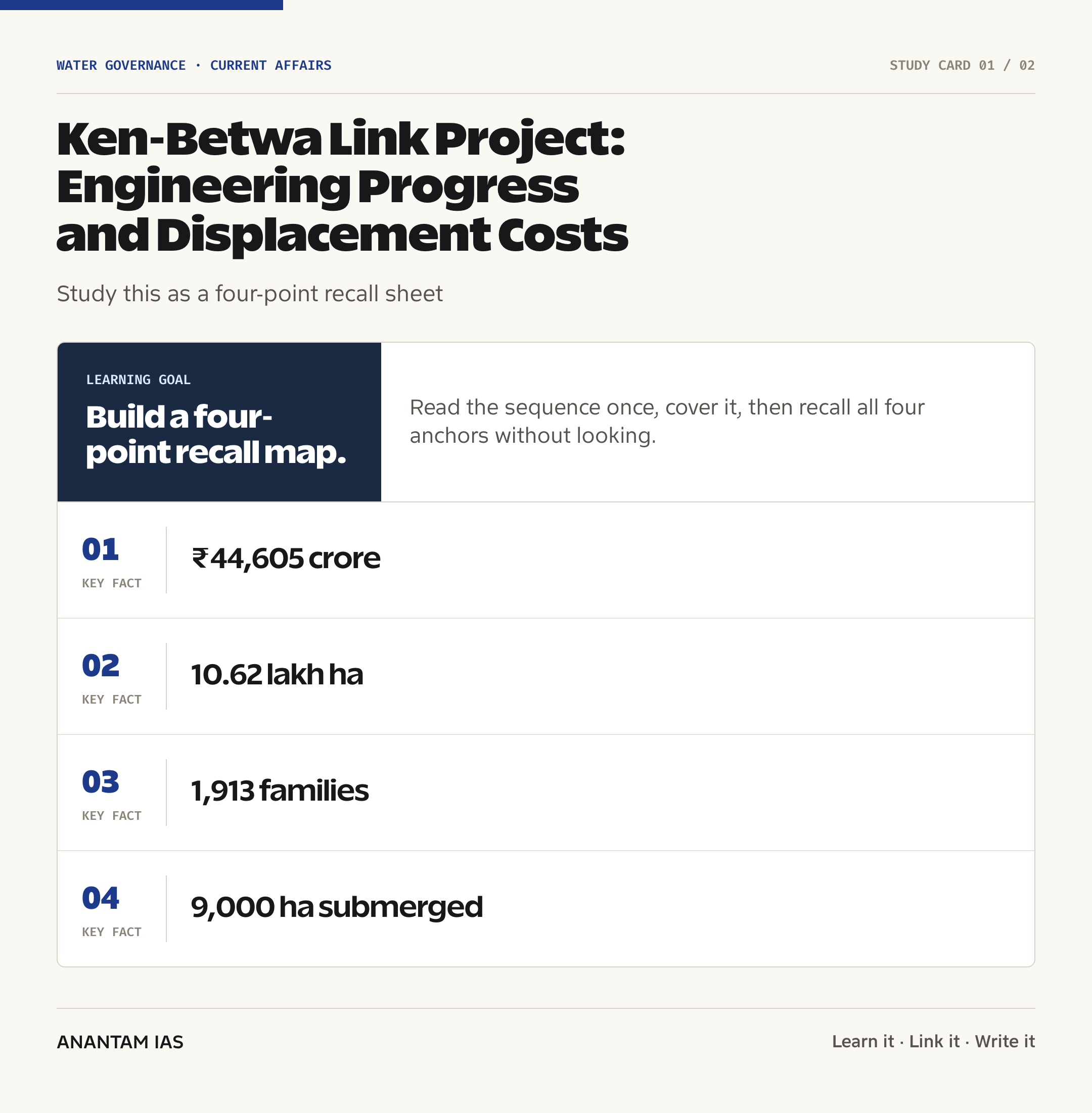
- The Indian Express reported that the rehabilitation plan identifies 1,913 affected families in 10 villages, with an estimated population of 8,339.
- Residents of Daudhan, Palkhua and Sukwaha alleged omissions in household surveys and compensation lists; the district administration said most payments had been made and disputed cases were being reviewed.
- The Ministry of Jal Shakti said in a late-2025 status update that the Daudhan dam contract had been awarded on 28 November 2024 and preliminary work was underway.
- The official completion horizon is March 2030, while rehabilitation and resettlement remain part of the project’s initial implementation focus.
- The controversy makes procedural justice as important as monetary compensation: an omitted name, house or family unit can decide whether a person receives a rehabilitation entitlement.
The development matters in the context of:
- The project tests whether an inter-basin transfer can treat a river labelled surplus as an ecological system with seasonal flows, not merely a volume available for diversion.
- It connects water federalism, forest and wildlife clearance, tribal livelihoods, land acquisition and public accountability in one implementation problem.
- Its outcomes may shape the legitimacy of other links proposed under the National Perspective Plan.
UPSC Relevance
Prelims Relevance
- The Ken and Betwa are both tributaries of the Yamuna and form part of the Ganga river system.
- The Ken-Betwa link is the first project under the National Perspective Plan for interlinking rivers to enter implementation.
- The National Water Development Agency, established in 1982, undertakes water-balance studies and prepares feasibility and detailed project reports for river links.
- The project transfers water from the Ken basin to the Betwa basin through the Daudhan reservoir and a roughly 218.7-km link canal.
- The project area covers Madhya Pradesh and Uttar Pradesh, with major intended benefits in drought-prone Bundelkhand.
- The Cabinet-approved benefit estimate is 10.62 lakh hectares of annual irrigation and drinking-water supply for about 62 lakh people.
- The power component comprises 103 MW hydropower and 27 MW solar power.
- The Daudhan reservoir affects the core and buffer of Panna Tiger Reserve; core-buffer zoning is central to tiger-reserve governance under the Wildlife (Protection) Act, 1972.
- Land acquisition and rehabilitation are governed by the RFCTLARR Act, 2013, alongside project-specific packages and clearance conditions.
Mains Relevance
GS Paper 3
- Assess the trade-off between drought mitigation and irrigation benefits on one side and forest submergence, habitat fragmentation and altered river flows on the other.
- Evaluate cumulative ecological management across the Panna landscape, rather than treating compensatory planting as a complete substitute for mature natural habitat.
- Examine whether basin planning has adequately tested demand management, groundwater recharge and decentralized storage before a large inter-basin transfer.
GS Paper 2
- Analyse cooperative federalism through the 2021 agreement among the Union, Madhya Pradesh and Uttar Pradesh and the role of the Ken-Betwa Link Project Authority.
- Connect rehabilitation disputes with transparent beneficiary lists, Gram Sabha participation, grievance redress and the state’s duty to restore living standards.
GS Paper 1
- Relate the project’s geography to Bundelkhand’s drought vulnerability, hard-rock terrain, variable monsoon and dependence on rain-fed agriculture.
- Study development-induced displacement as a change in settlement, access to commons, forest-based livelihoods and social networks.
Essay
- A project can move water through a canal more easily than it can rebuild a community.
- Development becomes durable when benefits, ecological costs and displacement risks are measured on the same public ledger.
Background and Context
Project Design and Institutional Architecture
The link is a multipurpose basin-transfer system, not a single canal.
- The idea moved from feasibility work in the 1990s to a 2005 agreement for preparing a detailed project report and a tripartite implementation agreement on 22 March 2021.
- The Union Cabinet approved funding and implementation in December 2021; the Cabinet decision placed the estimated cost at ₹44,605 crore at 2020-21 prices.
- A special-purpose vehicle, the Ken-Betwa Link Project Authority, coordinates implementation. Central support approved in 2021 was ₹39,317 crore, including grant and loan components.
- The principal works include the Daudhan dam, a roughly 218.7-km Ken-Betwa Link Canal, two powerhouses, and associated projects such as Lower Orr, Kotha Barrage and Bina Complex.
- Because these components are spread across two states, sequencing matters. Reservoir, canal, command-area and distribution works must become functional together; otherwise completed headworks may not translate into timely water at farms and settlements.
- The authority model concentrates implementation responsibility, but it also creates a need for clear disclosure of contracts, milestones, cost revisions and compliance. Parliamentary oversight and state-level monitoring remain important even when a special-purpose vehicle executes the works.
- For broader context, the river-interlinking project guide explains the National Perspective Plan, proposed links and the arguments for and against basin transfers.
Water and Development Benefits Claimed
The public-purpose case rests on drought relief, irrigation reliability, drinking water and power in Bundelkhand.
- The Ministry projects 10.62 lakh hectares of annual irrigation: 8.11 lakh hectares in Madhya Pradesh and 2.51 lakh hectares in Uttar Pradesh.
- The link is expected to provide 194 million cubic metres of water for en-route domestic and industrial supply to about 62 lakh people.
- The generation plan combines 103 MW of hydropower with 27 MW of solar power, giving a total installed capacity of 130 MW.
- Potential beneficiaries span districts in both states, including Chhatarpur, Panna, Tikamgarh, Sagar, Damoh and Datia in Madhya Pradesh and Banda, Mahoba, Jhansi and Lalitpur in Uttar Pradesh.
- Irrigation benefits include both new coverage and the stabilization of existing command areas. That distinction matters because a headline area doesn’t show how much land gains first-time access, how much receives more reliable supply, or how often water will arrive.
- Drinking-water gains also depend on treatment, storage and village-level pipelines. A bulk allocation of 194 MCM becomes a welfare outcome only when households receive safe and dependable service at an affordable cost.
- These benefits should be assessed through delivered water, reliable last-mile distribution and equitable access, not only the canal’s physical completion.
River Geography and the Surplus-Deficit Question
Interlinking depends on a contested planning assumption: one basin has transferable water while another faces a deficit.
- The Ken River rises in Madhya Pradesh, passes through the Panna landscape and joins the Yamuna near Chilla in Uttar Pradesh.
- The Betwa River also rises in Madhya Pradesh and joins the Yamuna in Uttar Pradesh; the link shifts regulated water within the larger Yamuna-Ganga system.
- A surplus basin is a planning classification based on assessed availability after specified uses. It doesn’t mean that all high-flow-season water is ecologically expendable.
- Environmental-flow releases must preserve downstream channel functions, aquatic habitats and livelihood uses across dry and wet seasons.
- The Ken’s flow is strongly seasonal. A dependable-yield calculation must account for upstream uses, evaporation, reservoir operation and legally required releases rather than treating the entire monsoon pulse as transferable storage.
- Demand-side alternatives aren’t exact substitutes for every project benefit, but comparing them improves appraisal. Micro-irrigation, tank restoration, aquifer recharge and less water-intensive crops may deliver part of the objective with different costs and risks.
- Climate variability can change rainfall timing and runoff, so water-balance assumptions require periodic, transparent review during the project’s long operating life.
Panna Tiger Reserve and Clearance Conditions
The ecological cost is concentrated in a nationally important dry-deciduous forest and riverine landscape.
- A Ministry of Jal Shakti reply estimated total Daudhan reservoir submergence at 9,000 hectares.
- That official estimate includes 4,141 hectares of Panna Tiger Reserve core, 1,314 hectares of buffer and 2,171 hectares of village land across 10 villages.
- Environmental clearance and wildlife clearance were issued in 2017 and 2016, respectively, subject to conditions; statutory approval doesn’t erase the duty to comply with each condition during construction and operation.
- The landscape supports tigers, vultures and gharials. Reservoir formation, roads, construction traffic and habitat change can have effects beyond the land directly submerged.
- Panna’s conservation significance is also historical: its tiger population was rebuilt after local extinction through reintroduction and intensive protection. That recovery makes habitat security and connectivity a long-term public investment, not an incidental project constraint.
- A reservoir converts a river-valley habitat into a different aquatic environment. Impacts may include loss of nesting and denning sites, altered sediment movement, barriers to terrestrial movement and changed conditions for downstream river-dependent species.
- The proposed landscape-management approach connects Panna with adjoining forest divisions and protected areas. The Project Tiger notes explain why core-buffer management and habitat connectivity matter.
- Compensatory afforestation can add tree cover, but it can’t immediately recreate the structure, species mix and ecological relationships of an established natural forest.
Displacement, Enumeration and Entitlements
Rehabilitation begins with accurate recognition of every affected person, asset and livelihood.
- The Indian Express reported that the approved plan covers 1,913 families across 10 villages and that Scheduled Tribes form 33.9% of the affected population.
- Reported disputes concern omitted houses, missing adult family members, disputed land parcels and documentary proof. These aren’t minor clerical gaps because enumeration determines eligibility.
- The Madhya Pradesh special package reported by the newspaper provides ₹12.5 lakh per eligible adult unit, with a married couple treated as one unit, plus house compensation and a resettlement plot.
- Officials cited high overall disbursement rates, while residents described unresolved cases. Both can be true: an aggregate completion percentage can conceal severe hardship for the smaller group left outside the register.
- Eligibility disputes often arise because administrative categories don’t match changing households. Adult children, separated families, widows, migrants and people occupying unrecorded structures may live independently but appear differently in older revenue or family records.
- The principle of free, prior and informed participation requires information in accessible forms, adequate time to object and decisions taken without pressure created by demolition or the withdrawal of basic services.
- A credible process needs publicly accessible beneficiary lists, correction windows, reasoned orders on rejected claims and an independent appeals channel before physical eviction.
Why Cash Alone Cannot Restore Livelihoods
Displacement can sever access to common resources, markets and social networks that a compensation schedule doesn’t fully price.
- Forest-edge households reported dependence on mahua, tendu, amla, honey and fuelwood. These seasonal flows support food, income, credit repayment and cultural life.
- Moving to a colony may improve electricity or road access but can also raise recurring costs for water, transport and food and place fields or forest produce farther away.
- The Indian Express found complaints about water access, school disruption, distance to ration shops and weak local demand for relocated businesses at Kawar Karondiya.
- Resettlement can also redistribute unpaid care work. When water points, schools and ration shops are distant, women and children often absorb the additional time cost, while disrupted schooling can produce losses that no one-time payment repairs.
- Land values near a project can rise before relocation is complete. A cash award that appears substantial may still be insufficient to purchase comparable cultivable land, construct a house and finance the transition to a new livelihood.
- Livelihood restoration should measure household income, land access, school attendance, nutrition and public-service availability for several years after relocation.
- Special safeguards are needed for widows, landless workers, adult dependants, forest-produce collectors and people with weak documentary records, since title-based compensation can miss them.
Legal and Governance Framework
The governing standard is informed participation and improved post-acquisition well-being, not payment followed by removal.
- The RFCTLARR Act, 2013 provides for social-impact assessment, public hearings, an R&R scheme, awards and institutional monitoring.
- Its stated objective is a humane, participative and transparent process with fair compensation and adequate rehabilitation so affected people can become partners in development.
- Where forest-dwelling Scheduled Tribes and other traditional forest dwellers are affected, compliance with the Forest Rights Act, 2006 and meaningful Gram Sabha participation are essential.
- Environmental clearance reportedly requires rehabilitation and resettlement issues to be completed before commissioning. Compliance should be verified through field conditions, not only expenditure statements.
- The idea of completion must be substantive: physical movement and payment aren’t enough if potable water, school access, livelihood support or grievance decisions remain pending at the destination.
- An independent compliance mechanism can reduce conflicts of interest where the same administration faces pressure to meet construction deadlines, certify rehabilitation progress and decide complaints from affected residents.
- The Centre-state-state arrangement also needs transparent water accounting so that promised benefits, ecological releases and interstate allocations can be audited over time.
Way Forward
Complete a Public Enumeration Audit
- Conduct a time-bound, village-wise re-verification of people, houses, land and common-resource users with Gram Sabha participation before coercive clearance of habitation.
- Publish accepted, pending and rejected claims with privacy safeguards, written reasons and a simple independent appeal process.
Make Resettlement Habitable Before Relocation
- Certify reliable piped water, sanitation, electricity, school access, health care, ration delivery and transport at each colony before families move.
- Add land-based or livelihood-based options, skill support and transitional income where cash cannot replace agriculture or forest-linked earnings.
Monitor Outcomes, Not Just Payments
- Create a public dashboard for R&R claims, amenities and livelihood indicators, with social audits by affected communities and periodic third-party review.
- Track household welfare for at least five years and fund corrective measures when income, schooling or access to services deteriorates.
Enforce Landscape-Level Ecological Safeguards
- Implement clearance conditions, environmental flows, wildlife passages, catchment treatment and the Panna landscape-management plan through measurable milestones.
- Publish independent ecological monitoring on habitat quality, river health, vulture nesting, gharial habitat and tiger movement, and adapt operations when thresholds are breached.
Audit the Water-Security Promise
- Disclose updated basin balances, canal losses, command-area readiness and district-wise delivery so claimed benefits can be compared with actual outcomes.
- Integrate the link with watershed restoration, efficient irrigation, groundwater recharge and crop planning to reduce dependence on a single large structure.
Conclusion
The Ken-Betwa Link Project may expand irrigation and drinking-water security in drought-prone Bundelkhand, but engineering progress can’t be the sole measure of success. A canal that reaches farms while affected families lose water, schooling or livelihoods would shift scarcity rather than solve it.
The credible path is conditional implementation: verify every claimant, make resettlement sites functional, restore livelihoods, enforce ecological safeguards and publish evidence of water delivery. That approach treats rehabilitation and conservation as core project works, not obstacles outside the construction schedule.
UPSC Practice Questions
Prelims MCQ 1
With reference to the Ken-Betwa Link Project, consider the following statements:
- Both the Ken and Betwa are tributaries of the Yamuna.
- The project transfers water from the Betwa basin to the Ken basin.
- The project’s power component includes hydropower and solar power.
How many of the above statements are correct?
(a) Only one (b) Only two (c) All three (d) None
Answer: (b) Only two
Explanation:
Statements 1 and 3 are correct. The project is designed to transfer water from the Ken basin to the Betwa basin, so statement 2 reverses the direction.
Prelims MCQ 2
Which institution was established to investigate and prepare proposals for interlinking India’s rivers?
(a) Central Water Commission (b) National Water Development Agency (c) Ken-Betwa Link Project Authority (d) National Tiger Conservation Authority
Answer: (b) National Water Development Agency
Explanation:
The National Water Development Agency was established in 1982 to undertake water-balance studies and develop river-link proposals under the National Perspective Plan.
UPSC Mains Questions
- The Ken-Betwa Link Project presents river interlinking as a response to regional water scarcity, yet its implementation raises ecological and social costs. Critically examine how basin science, environmental flows and landscape conservation should shape the evaluation of such projects.
- Development-induced displacement cannot be addressed through cash compensation alone. Discuss with reference to enumeration errors, common-property resources, livelihood restoration and access to public services in the rehabilitation of families affected by large water projects.
- Large interstate water projects are tests of cooperative federalism as well as administrative capacity. Evaluate the institutional mechanisms needed to ensure transparent water accounting, enforceable rehabilitation, independent monitoring and accountable Centre-state coordination.
Sources: Ministry of Jal Shakti, Government of India and The Indian Express.
Frequently Asked Questions
What is the Ken-Betwa Link Project?
It is India’s first river-link project under the National Perspective Plan to enter implementation. It will regulate water through the Daudhan reservoir and carry it from the Ken basin toward the Betwa basin through a roughly 218.7-km canal, with irrigation, drinking-water and power components.
Why is the project important for Bundelkhand?
Bundelkhand faces recurrent drought, variable rainfall and high dependence on rain-fed farming. The government expects the project to provide annual irrigation to 10.62 lakh hectares and drinking water to about 62 lakh people across beneficiary areas in Madhya Pradesh and Uttar Pradesh.
How does the project affect Panna Tiger Reserve?
The government estimates that the Daudhan reservoir will submerge 9,000 hectares, including 4,141 hectares of Panna Tiger Reserve core and 1,314 hectares of its buffer. Construction and reservoir formation can also affect connectivity, river ecology and species beyond the directly submerged area.
How many families are affected?
Official government material identifies about 1,913 affected families across 10 villages. The Indian Express reported an estimated affected population of 8,339 and disputes over omitted residents, houses and family units, showing why transparent enumeration and appeals are central to fair rehabilitation.
Which law governs rehabilitation and resettlement?
The RFCTLARR Act, 2013 provides the central framework for social-impact assessment, public consultation, compensation, rehabilitation schemes and R&R awards. Forest-dwelling communities may also have relevant rights under the Forest Rights Act, 2006, while project-specific packages and clearance conditions add further obligations.
When is Ken-Betwa expected to be completed?
Recent official replies place the planned completion in March 2030. The schedule doesn’t reduce the need to resolve pending claims, establish working amenities at resettlement sites and comply with environmental, forest and wildlife safeguards before commissioning and during long-term operation.