LNG Rail Traction: A Fuel Switch With Lifecycle Conditions
Why in News?
An LNG-powered train was flagged off at Sabarmati Railway Station in Ahmedabad on 27 September 2026, bringing LNG rail traction into focus.
- PIB confirmed the flag-off and presented the fuel switch as an environmental initiative.
- The release separately reported a WAG-12 maintenance shed; that announcement does not identify the LNG train’s engine design.
- The announcement provides no measured emissions savings, LNG substitution ratio or detailed engine configuration.
- A fuel’s combustion emissions and its total climate impact answer different questions.
- Rail fuel choices require comparison of operating performance, supply infrastructure and emissions across the complete energy chain.
UPSC Relevance
Prelims Relevance
- LNG: natural gas cooled into liquid form for storage and transport.
- Methane: the main constituent of natural gas and a greenhouse gas.
- Regasification: conversion of liquid natural gas back into gaseous form.
- Lifecycle assessment: accounting beyond emissions released directly during vehicle operation.
Mains Relevance
GS Paper 3
- Assess alternative transport fuels through lifecycle emissions and infrastructure needs.
- Compare incremental fuel switching with electrification under real operating conditions.
Essay
- Environmental progress depends on what a measurement includes.
Background and Context
What LNG changes in fuel storage
LNG makes natural gas easier to store in a compact volume, while introducing demanding temperature-control requirements.
- Liquefaction cools natural gas into a liquid. This changes its physical state for transport and storage; it does not remove carbon from the fuel or make it renewable.
- Cryogenic storage uses insulated tanks to keep the fuel very cold. Heat entering the tank can vaporise some liquid, so pressure and gas handling require deliberate engineering controls.
- Regasification returns the liquid to gas before gaseous fuel delivery in relevant systems. This is the general technology sequence; the announcement does not disclose the train’s particular arrangement.
- CNG stores natural gas as compressed gas, whereas LNG uses cooling to store it as liquid. The fuel family overlaps, but tanks and handling requirements differ.
- Fuel infrastructure includes supply, storage and safe refuelling. A railway operator must assess the complete delivery chain, because suitable rolling stock alone cannot establish a reliable fuel service.
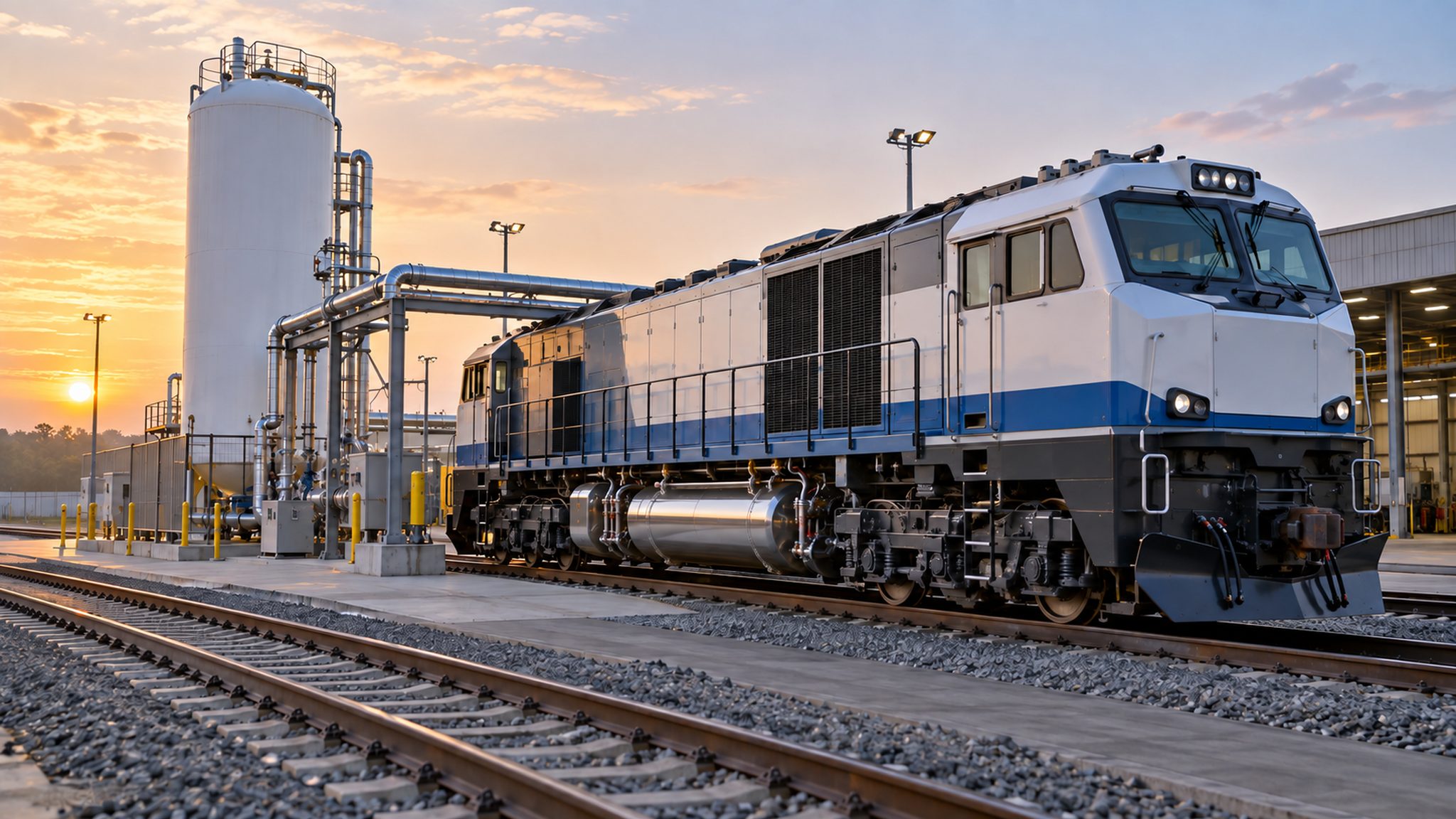
Why cleaner combustion is only part of the calculation
Climate performance depends on emissions before the fuel reaches the train as well as those released when it is used.
- Natural-gas combustion generally emits less carbon dioxide per unit of fuel energy than petroleum fuels. That comparison alone does not establish emissions per passenger or tonne of freight moved.
- Methane leakage during production, processing, transport or storage adds warming outside the engine. Measuring only carbon dioxide at the exhaust would leave those losses outside the accounting boundary.
- Liquefaction energy also carries an emissions cost, depending on how that energy is supplied. Transporting the LNG adds further stages that belong inside a complete fuel-chain assessment.
- Engine efficiency, operating load and any unburned methane affect the result during use. Without verified operating measurements, assigning this train a percentage climate saving would be speculative.
- Air quality and climate are distinct outcomes. Lower emissions of some local pollutants can be useful, but they cannot substitute for accounting for greenhouse gases across the supply chain.
How to compare LNG with electric traction
A useful comparison holds the transport service constant and then examines where each option uses energy and releases emissions.
- Electric traction uses electricity to drive the train rather than burning its traction fuel onboard. Its wider emissions depend on electricity generation and the infrastructure supplying that power.
- LNG traction retains a combustible carbon-containing fuel. It can diversify fuel options, but the word alternative does not establish either zero emissions or superiority over electric traction.
- Comparable service means similar loads, route conditions and duty cycles. Compare fuel-chain emissions per useful transport output, alongside reliability, maintenance and the infrastructure needed to sustain operations.
- Fuel origin also matters: ordinary fossil LNG differs from e-methanol produced using renewable inputs. A new fuel name cannot replace scrutiny of production pathways.
- Traction concerns movement and energy supply; interlocking and Kavach concern signalling and train protection. Improvements in one do not demonstrate environmental or safety performance in the other.
Way Forward
Measure the fuel chain before scaling claims
- Publish verified fuel consumption, operating conditions and exhaust measurements, with a clearly defined comparison service.
- Include methane losses and liquefaction energy in climate accounting; disclose uncertain estimates instead of presenting them as measured savings.
- Assess refuelling safety, supply reliability and maintenance costs alongside electric alternatives before expanding a particular fuel pathway.
Conclusion
- LNG rail traction is a fuel-switching option whose environmental value depends on the complete supply and operating chain. The flag-off establishes deployment, not a verified lifecycle emissions advantage.
- In a transport-decarbonisation answer, separate storage technology, local pollution and climate performance. Judge each option against a comparable transport service and state clearly what evidence remains unavailable.
UPSC Practice Questions
Prelims MCQ 1
With reference to LNG, consider the following statements:
- Liquefaction changes natural gas into liquid form for storage and transport.
- Methane leakage before combustion can affect the lifecycle climate impact of LNG.
- Using LNG eliminates carbon dioxide emissions from fuel combustion.
How many of the above statements are correct?
(a) Only one (b) Only two (c) All three (d) None
Answer: (b) Only two
Explanation:
The first two statements are correct. LNG remains a carbon-containing fuel; its combustion produces carbon dioxide.
Prelims MCQ 2
Which comparison best evaluates the climate performance of two rail traction options?
(a) Fuel-chain emissions for a comparable transport service (b) The colour of visible exhaust alone (c) Fuel-storage capacity alone (d) The number of locomotives inaugurated
Answer: (a) Fuel-chain emissions for a comparable transport service
Explanation:
A fair comparison includes upstream and operating emissions while holding the useful transport service and relevant operating conditions comparable.
UPSC Mains Questions
- Explain why a switch to LNG does not automatically establish a lifecycle climate advantage in rail transport. (150 words)
- Discuss the evidence needed to compare LNG and electric traction for sustainable railway operations. (150 words)
Sources: PIB, Ministry of Home Affairs and US Energy Information Administration: LNG and environmental effects.
Frequently Asked Questions
What is LNG rail traction?
It is the use of liquefied natural gas as a fuel for railway traction. LNG permits compact fuel storage, but the engine configuration and actual fuel use must be established for each deployment.
Is LNG a zero-emission fuel?
No. LNG contains carbon, and combustion produces carbon dioxide. Methane leakage and energy used in liquefaction and transport also affect its total climate impact before the fuel reaches the train.
How is LNG different from CNG?
LNG stores natural gas in liquid form through cooling, while CNG stores it as compressed gas. Their storage and handling systems differ even though both belong to the natural-gas fuel family.
Does the flag-off establish a measured climate benefit?
The PIB announcement confirms the LNG train’s flag-off but does not provide measured emissions savings or detailed engine specifications. Assessing climate benefits requires verified operating data and a complete fuel-chain comparison.