Why in News?
The foundation stone for a proposed e-methanol plant at Deendayal Port, Kandla, was laid on 26 September 2026, linking renewable energy inputs with future marine-fuel production.
- The 150-tonne-per-day planned capacity is a joint initiative of Deendayal Port Authority and Assam Petro-Chemicals Ltd.
- The announced inputs are renewable power, water and biogenic carbon dioxide; the fuel is intended for ships on the Asia-Europe trade corridor.
- The project is planned in phased modules. The announcement establishes a foundation-stone event, not commissioned production or verified fuel deliveries.
- Marine-fuel transition requires production, port storage and compatible vessels to develop together; a fuel plant alone cannot establish a functioning shipping corridor.
- The central policy question is whether clean inputs and credible emissions accounting survive the entire chain from electricity generation to ship propulsion.
UPSC Relevance
Prelims Relevance
- E-methanol: methanol synthesised using electrolytic hydrogen and a carbon source.
- Electrolysis: electricity splits water to produce hydrogen and oxygen.
- Biogenic carbon dioxide: carbon dioxide originating from biological material or processes.
- Well-to-tank: emissions associated with making and delivering fuel.
- Tank-to-wake: emissions associated with fuel use aboard a ship.
Mains Relevance
GS Paper 3
- Connecting renewable-energy supply with industrial decarbonisation and port infrastructure.
- Evaluating alternative marine fuels through lifecycle emissions and commercial readiness.
Essay
- A transition is credible when its supply chain matches its environmental promise.
Background and Context
How renewable electricity becomes a liquid fuel
E-methanol stores energy in a manufactured molecule, allowing electricity to serve uses that cannot easily connect directly to the grid.
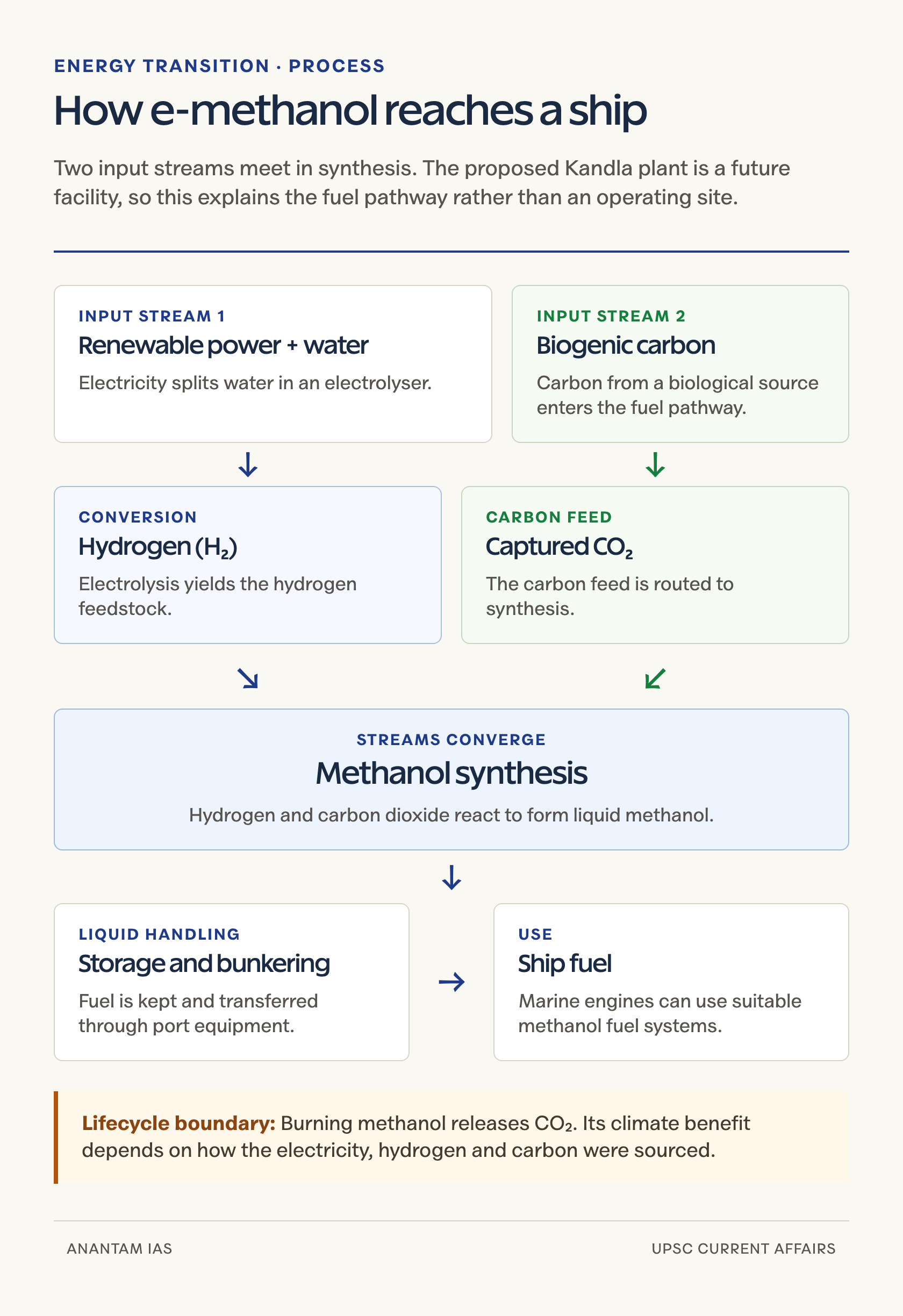
- Renewable electricity powers electrolysis, which splits water into hydrogen and oxygen. Hydrogen becomes a chemical feedstock; electricity is not poured directly into a ship’s fuel tank.
- The hydrogen is combined with captured carbon dioxide through methanol synthesis. Carbon dioxide supplies the carbon atom, while hydrogen supplies another essential building block of the resulting fuel.
- The product is methanol, a liquid that can be stored and delivered through appropriately designed facilities. Turning electricity into fuel adds conversion steps and energy requirements.
- In the Kandla proposal, the carbon input is biogenic CO2. The official release names this category but does not identify the specific supplier or document its full chain of custody.
- IRENA identifies renewable hydrogen and sustainable carbon sourcing as central to renewable methanol. The same chemical product can carry different environmental footprints depending on how its inputs are obtained.
Why the carbon source matters
Biogenic carbon belongs to a biological carbon cycle; its presence does not automatically certify the complete fuel as sustainable.
- Biogenic CO2 can arise from biological processing, such as fermentation. Its origin differs from carbon released by extracting and burning fossil fuels that were stored underground.
- Carbon capture for fuel reuses carbon in a product that will later be consumed. It is different from keeping captured carbon in durable geological storage.
- Burning methanol releases carbon dioxide. A claim of reduced lifecycle emissions must account for the carbon’s origin and processing; it cannot mean that the exhaust contains no carbon.
- The renewable-electricity claim also needs evidence. Electricity used for hydrogen production is part of the fuel pathway, so emissions can arise upstream even when they are invisible at the port.
- A credible assessment tracks input provenance alongside quantities produced. The planned plant’s green-fuel description cannot substitute for measured operating data once production and deliveries actually begin.
Read shipping fuels through the whole lifecycle
IMO’s lifecycle approach joins upstream fuel production with onboard use, preventing emissions from disappearing merely because they occur elsewhere.
- Well-to-tank covers the supply chain before onboard consumption, including feedstock sourcing, fuel manufacture and delivery. Moving emissions outside the vessel does not remove them from this boundary.
- Tank-to-wake covers fuel use on the vessel. Evaluating only this segment can miss electricity-related emissions and the carbon burden created earlier in the production process.
- Well-to-wake combines both segments. This boundary helps compare alternative fuels on a common basis rather than judging them solely through labels such as green or conventional.
- Lifecycle evidence is needed before assigning a project-specific emissions saving. The foundation-stone release does not supply a verified operating lifecycle assessment for the proposed Kandla plant.
Why a port location helps, and what remains unproven
Port integration can connect manufacturing with customers, but construction, fuel availability and vessel adoption remain separate milestones.
- Port-based production can place fuel supply near ships that need bunkering, meaning refuelling. Storage, transfer equipment and operating procedures must still be designed for the actual fuel.
- Demand coordination matters: producers need buyers, while ship operators need dependable supplies. A planned production capacity is not evidence of purchase contracts or routine bunkering services.
- Compatible machinery and handling remain essential. Methanol’s industrial usefulness does not erase its hazards, as the separate note on methanol safety and regulation explains.
- Operational readiness requires evidence beyond an announced project. The distinction between demonstration and dependable service also appears in the technology-readiness explainer; commissioning must be verified independently.
Way Forward
Make the supply chain auditable
- Require traceable electricity and carbon inputs, with a clear accounting boundary and independent verification of lifecycle emissions.
- Track commissioning and actual deliveries separately from announced capacity, projected costs and ceremonial milestones.
- Coordinate fuel producers, port operators and shipowners on storage, handling, compatible equipment and dependable purchase arrangements.
Conclusion
- Kandla’s e-methanol proposal illustrates how renewable electricity can reach shipping through hydrogen and a manufactured liquid fuel, with carbon sourcing determining an essential part of its environmental case.
- For an answer on clean shipping, connect the production mechanism with lifecycle accounting and port readiness; distinguish planned capacity from an operating, verified low-emissions supply chain.
UPSC Practice Questions
Prelims MCQ 1
With reference to e-methanol as a marine fuel, consider the following statements:
- Renewable hydrogen can be combined with carbon dioxide to produce methanol.
- Methanol combustion releases no carbon dioxide because its hydrogen is renewable.
- Well-to-wake assessment includes fuel production and onboard use.
How many of the above statements are correct?
(a) Only one (b) Only two (c) All three (d) None
Answer: (b) Only two
Explanation:
Statements 1 and 3 are correct. Methanol contains carbon and releases carbon dioxide on combustion; renewable inputs do not make the exhaust carbon-free.
Prelims MCQ 2
Which distinction is most important when assessing the environmental claim of a proposed e-methanol plant?
(a) Port ownership versus ship ownership (b) Fuel colour versus storage-tank colour (c) Announced green-fuel capacity versus verified lifecycle performance (d) Domestic cargo versus imported cargo alone
Answer: (c) Announced green-fuel capacity versus verified lifecycle performance
Explanation:
An announcement establishes an intention and planned capacity. Environmental performance needs evidence about electricity, carbon inputs, production and fuel use.
UPSC Mains Questions
- Explain the production pathway of renewable e-methanol and assess why lifecycle accounting is essential to its use in shipping.
- How can port-based fuel production support maritime decarbonisation? Discuss the coordination and verification requirements beyond construction of a fuel plant.
Sources: PIB, Ministry of Ports, Shipping and Waterways and IMO, Lifecycle GHG intensity of marine fuels.
Frequently Asked Questions
What is e-methanol?
E-methanol is methanol produced using electrolytic hydrogen and a carbon source. A renewable pathway depends on renewable electricity and suitable carbon sourcing; the final molecule alone does not establish its emissions footprint.
Is the Kandla e-methanol plant already operating?
The 26 September announcement concerns a foundation stone and a proposed phased plant. It does not establish commissioned production, actual fuel deliveries or verified operating emissions performance.
Does e-methanol produce zero emissions when burned?
No. Methanol contains carbon, and combustion releases carbon dioxide. Its potential climate benefit must be assessed across the complete production and use pathway, including electricity supply and the carbon source.
Why does well-to-wake accounting matter?
Well-to-wake accounting combines emissions from producing and delivering fuel with emissions from using it aboard a vessel. It helps prevent an apparent onboard improvement from hiding emissions shifted upstream.
Tell Google you want more of this.
Add Anantam IAS as a preferred sourceOne tap, and this site shows up more often in your own Top Stories, AI Overviews and AI Mode. Remove it any time.