Mangrol: Matching Anti-Submarine Craft to Shallow Waters
Why in News?
On 9 October 2026, the Defence Ministry announced that Mangrol, an indigenous anti-submarine warfare shallow-water craft, was scheduled for commissioning on 12 October at Mumbai.
- Cochin Shipyard Limited built Mangrol for detecting and countering underwater threats in coastal and shallow waters.
- The announced equipment includes Abhay sonar, lightweight torpedoes, an anti-submarine rocket launcher and Maareech torpedo decoys.
- Waterjet propulsion supports manoeuvrability; the craft can also undertake underwater surveillance and mine warfare-related tasks.
- Ports and coastal approaches need underwater protection alongside surface surveillance; a visible patrol presence alone does not identify submerged threats.
- Specialised craft supplement the fleet by matching equipment and movement to the operating environment rather than treating warship size as the measure of capability.
UPSC Relevance
Prelims Relevance
- Anti-Submarine Warfare Shallow Water Craft (ASW-SWC)
- Abhay: compact hull-mounted sonar
- Active and passive sonar
- Maareech: torpedo defence through decoys
- Waterjet propulsion and coastal manoeuvrability
Mains Relevance
GS Paper 3
- Matching defence capability to coastal operating conditions.
- Integrating indigenous sensors, weapons and propulsion into a useful naval platform.
Essay
- Specialisation and cooperation as complementary sources of institutional capability.
Background and Context
Why Shallow Waters Need Specialised Craft
A coastal anti-submarine craft is designed around its operating environment, where movement and underwater surveillance must work together near valuable maritime infrastructure.
- Mission fit: The Defence Ministry identifies coastal waters as an area where larger warships face operational limitations. Mangrol addresses that specific requirement rather than replacing every role performed by a larger naval vessel.
- Protected approaches: Ports, harbours and their approaches concentrate movements of naval and commercial vessels. Detecting underwater threats nearby supports access to these facilities, making local surveillance part of wider maritime security.
- Waterjet propulsion: Mangrol’s diesel engines power waterjets, which the announcement links to high manoeuvrability in shallow water. Propulsion supports positioning and movement; it is not a substitute for the sonar that detects threats.
- Capability boundaries: The release also lists low-intensity maritime operations and mine warfare-related tasks. That wording does not establish a complete minesweeping capability or justify treating every specialised underwater mission as interchangeable.
- Operational status: As of this edition, commissioning remains scheduled. The announcement describes intended roles and installed equipment; it should not be presented as evidence that Mangrol has already completed an operational deployment.
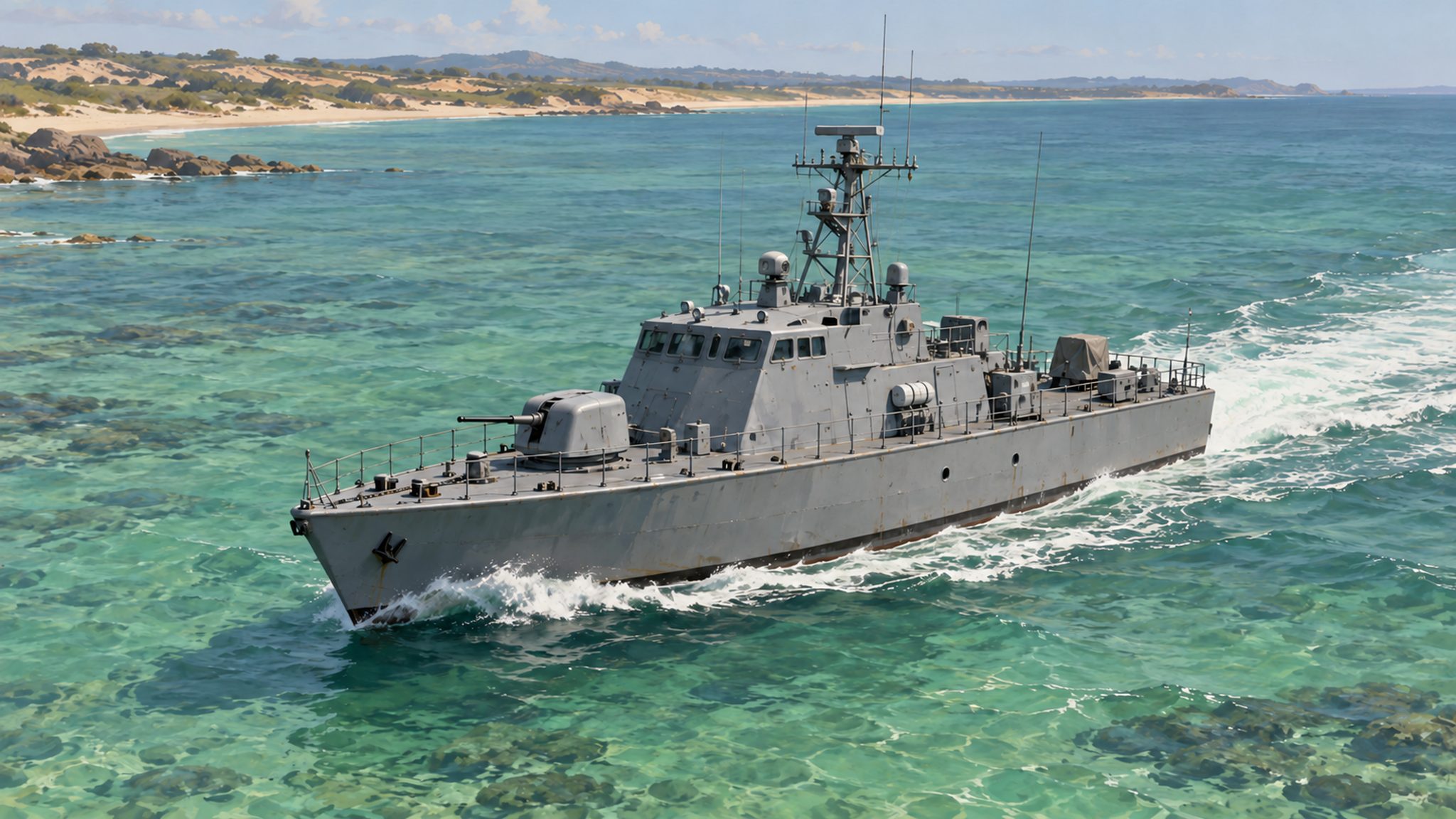
Sonar Detects; Weapons and Decoys Have Different Jobs
The equipment list becomes useful when separated into sensing, countering a submarine threat and defending the surface ship against an incoming torpedo.
- Sound underwater: NOAA explains sonar as sound-based detection and ranging. Sound travels farther underwater than light or radar waves, making acoustic sensing important for locating objects that cannot be seen directly.
- Active sonar emits sound and listens for returning echoes; passive sonar listens without transmitting its own signal. These describe sensing methods, not two different kinds of weapon or a guarantee of finding every target.
- Abhay is the announced hull-mounted sonar. The Defence Ministry describes active and passive sensing for smaller platforms, bringing underwater surveillance to vessels designed for coastal patrol and shallow-water operations.
- Lightweight torpedoes and the anti-submarine rocket launcher are weapons for countering underwater threats. Their presence does not remove the need to detect, identify and track a contact before deciding what response is appropriate.
- Maareech has a defensive role: official descriptions identify torpedo detection and countermeasures, including decoying. A decoy seeks to mislead the threat; it is not the same function as attacking a submarine.
Cooperation Makes a Specialised Platform More Useful
A craft contributes to a wider naval system when observations and responses can be coordinated across ships and aircraft, with clear capability limits.
- Complementary platforms: The announcement says Mangrol can operate alongside maritime patrol aircraft, helicopters and other warships. The teaching point is cooperation between different platforms, not a claim that one craft can secure an entire coastline.
- Interoperability requires crews to share usable information and coordinate action. The earlier SLINEX note explains why practising together matters; equipment compatibility alone cannot demonstrate effective cooperation during an operation.
- System integration: Indigenous construction becomes militarily useful when sensors, weapons and propulsion work together reliably. Listing domestic components establishes neither their operational availability nor their performance under every condition encountered at sea.
- Evidence of capability must come from appropriate trials, maintenance experience and crew proficiency. The defence test-ranges note provides the related distinction between developing equipment and generating evidence about its performance.
- Limits of public evidence: The announcement supplies no verified detection range or claim of acoustic invisibility. An answer should explain the functions actually disclosed instead of converting a commissioning announcement into unproven technical specifications.
Way Forward
Assess Readiness Through Functions
- Exercise the whole chain: Test whether crews can interpret contacts and coordinate responses with other platforms, rather than judging readiness from a list of installed systems.
- Maintain sensor availability: Connect training, spares and maintenance to the craft’s surveillance mission so that indigenisation translates into usable equipment at sea.
- Keep roles distinct: Assess anti-submarine capability, torpedo defence and mine-related tasks against their own requirements instead of assuming success in one proves competence in all.
Conclusion
- Mangrol illustrates mission-specific design: suitable movement, underwater sensing and differentiated weapons or decoys must operate as a coordinated system to protect coastal approaches.
- For an examination answer, connect specialised platforms with cooperation and evidence of readiness; retain the distinction between a scheduled commissioning and demonstrated operational performance.
UPSC Practice Questions
Prelims MCQ 1
With reference to underwater naval systems, consider the following statements:
- Active sonar transmits sound and receives echoes.
- Passive sonar necessarily transmits its own signal to locate a target.
- Torpedo decoys and anti-submarine weapons perform different functions.
How many of the above statements are correct?
(a) Only one (b) Only two (c) All three (d) None
Answer: (b) Only two
Explanation:
Statements 1 and 3 are correct. Passive sonar listens without emitting its own signal. A decoy misleads a threat, whereas an anti-submarine weapon is used to counter a submarine.
Prelims MCQ 2
Which pairing correctly matches an announced Mangrol system with its principal role?
(a) Abhay : hull-mounted underwater sensing (b) Maareech : waterjet propulsion (c) Waterjets : acoustic target identification (d) Lightweight torpedoes : passive surveillance
Answer: (a) Abhay : hull-mounted underwater sensing
Explanation:
Abhay is a hull-mounted sonar. Maareech is a torpedo-defence system, waterjets provide propulsion, and lightweight torpedoes are weapons.
UPSC Mains Questions
- Explain why specialised shallow-water anti-submarine craft complement larger naval platforms in protecting coastal approaches. (150 words)
- Distinguish underwater sensing, anti-submarine weapons and torpedo decoys. Why does integrating them require both technical compatibility and trained crews? (150 words)
Sources: PIB, Ministry of Defence and NOAA Ocean Exploration.
Frequently Asked Questions
Has Mangrol been commissioned?
The Defence Ministry’s announcement of 9 October scheduled commissioning for 12 October 2026. As of this 10 October edition, the event remains upcoming and should not be described as completed.
What is Abhay sonar?
Abhay is a compact hull-mounted sonar developed for smaller naval platforms. The Defence Ministry describes active and passive sensing, helping distinguish its surveillance role from that of weapons carried by the ship.
How does Maareech differ from an anti-submarine weapon?
Maareech is intended to defend a surface ship against torpedoes through detection and acoustic decoying. Anti-submarine weapons counter submarine threats; a decoy instead seeks to mislead an incoming threat.
Does a shallow-water craft replace a minesweeper?
Not on the evidence in this announcement. The Ministry lists mine warfare-related tasks, which is narrower than establishing the full capabilities needed for specialised mine clearance or every minesweeping operation.