How a Tiny Memory Chip Is Driving Up India’s Inflation
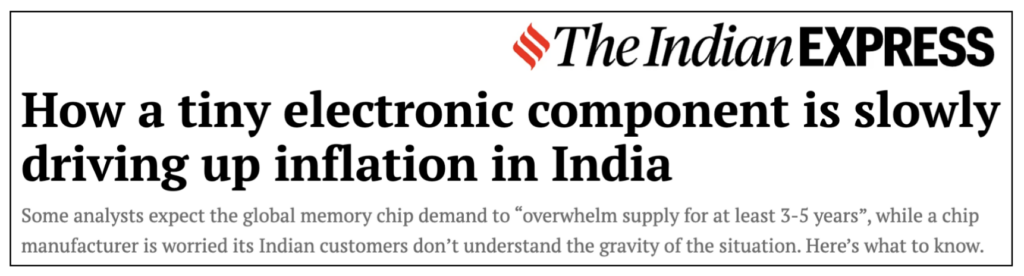
Why in News?
A The worldwide shortage of memory chips is filtering into the prices of phones, laptops, home appliances and cars. Because India imports most of its semiconductors, the squeeze shows up as imported inflation in consumer-electronics and durable-goods prices.
The trigger is the chip-makers’ pivot toward high-bandwidth memory (HBM) for artificial-intelligence servers. As Samsung, SK Hynix and Micron shift fabrication capacity to feed AI data-centres, the supply of ordinary DRAM and NAND memory has tightened and prices have climbed across global markets.
- Memory chips come in two main types — DRAM (working memory) and NAND flash (storage); both are now in short supply.
- AI data-centres consume large volumes of high-bandwidth memory, so producers have diverted wafer capacity away from commodity memory.
- India imports the overwhelming share of its semiconductors, so global price rises pass through to local device prices almost directly.
- The cost of memory feeds into smartphones, laptops, televisions, appliances and cars, which sit inside India’s consumer-price and wholesale-price baskets.
The development matters in the context of:
- Why it matters for prices: Durable goods and electronics carry real weight in the household budget, so a memory squeeze can nudge core inflation.
- Why it matters for policy: it underscores why the India Semiconductor Mission targets domestic fabrication and assembly to cut import dependence.
- Why it matters strategically: memory supply is concentrated in a few firms and geographies, exposing India to the global ‘chip war’.
UPSC Relevance
Prelims Relevance
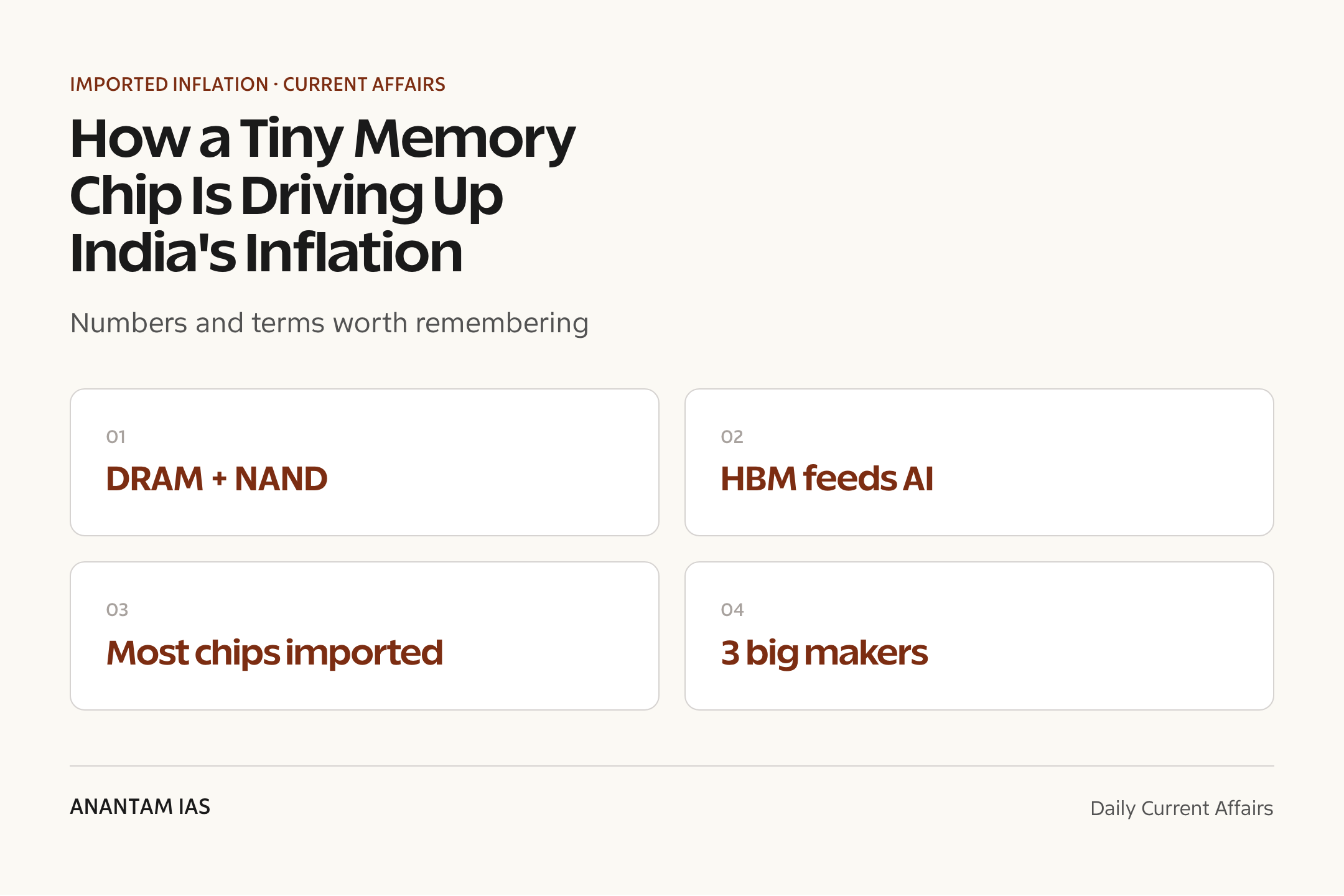
- Difference between DRAM (volatile working memory) and NAND flash (non-volatile storage)
- High-bandwidth memory (HBM) and its link to AI/GPU servers
- Leading memory producers: Samsung, SK Hynix, Micron
- India Semiconductor Mission (ISM) under MeitY
- Meaning of imported inflation and pass-through to domestic prices
- Difference between a fab (fabrication) and OSAT/ATMP (assembly, test, packaging)
- CPI and WPI baskets, and where electronics/durables sit
- Design-Linked Incentive (DLI) and the semiconductor-package incentives
Mains Relevance
GS Paper 3
- How global semiconductor supply chains transmit price shocks into India’s inflation
- Role of the India Semiconductor Mission in building self-reliance in critical electronics
GS Paper 3
- AI-driven demand for compute as a new source of resource and supply-chain stress
GS Paper 2
- Technology supply chains, the ‘chip war’ and India’s strategic-autonomy choices
Essay
- Technology, trade and the price of self-reliance in a connected world
- When the smallest components decide the largest outcomes
Background and Context
What a memory chip is — DRAM vs NAND
Memory chips store the data a device works with, and they fall into two families.
- DRAM (Dynamic Random-Access Memory) is fast, volatile working memory — it holds the data a phone or laptop is actively using and clears when power is off.
- NAND flash is non-volatile storage — it keeps photos, apps and files even when the device is switched off; it is what an SSD or phone storage is built from.
- Almost every modern electronic product — smartphones, laptops, servers, cars, TVs, washing machines — carries both DRAM and NAND.
- Memory is a commodity good: largely interchangeable across brands, so its price swings with the global supply-demand balance, not with branding.
Why prices are rising — the AI compute boom
The shortage is a demand-and-allocation story, not a factory shutdown.
- Training and running large AI models need vast data-centres packed with accelerators that pair with high-bandwidth memory (HBM). For the policy backdrop, see artificial intelligence in India.
- HBM is far more profitable per wafer than commodity memory, so producers shift fabrication capacity toward it.
- That diversion tightens the supply of ordinary DRAM and NAND, pushing their prices up across global markets.
- A handful of firms — Samsung, SK Hynix and Micron — dominate memory, so their capacity choices move the whole market.
- Memory pricing is famously cyclical (boom-and-bust); the current up-cycle is amplified by the AI surge.
How a global chip price becomes Indian inflation
The pass-through runs through India’s heavy reliance on imported electronics.
- India imports the bulk of its semiconductors; very little memory is made domestically, so global prices land here with little buffer.
- Costlier memory raises the bill of materials for phones, laptops, appliances and cars, which manufacturers eventually pass to buyers.
- These durable and electronic goods sit inside the Consumer Price Index (CPI) and Wholesale Price Index (WPI) baskets.
- Because the cost rise originates abroad, economists call this imported inflation — a price shock transmitted through trade rather than domestic demand. See our note on types and measurement of inflation.
- A weaker rupee would magnify the effect, since imports are dollar-priced.
India’s self-reliance push — the Semiconductor Mission
Policy aims to cut this exposure by building chips at home.
- The India Semiconductor Mission (ISM), under the Ministry of Electronics and IT (MeitY), anchors incentives for fabs, display fabs and assembly.
- Schemes support fabrication (fabs) and OSAT/ATMP — outsourced assembly, test, marking and packaging units that finish chips.
- A Design-Linked Incentive (DLI) scheme backs domestic chip-design start-ups and IP.
- Early OSAT/ATMP plants are quicker to set up than leading-edge fabs and reduce the import bill on packaging.
- The strategic logic ties to the wider goals of Atmanirbhar Bharat and resilient critical supply chains. See the India Semiconductor Mission guide.
The strategic backdrop — the ‘chip war’
Semiconductors are now a front line of geopolitics, not just commerce.
- Advanced chip and memory output is concentrated in a few firms and geographies, chiefly in East Asia.
- Export controls and friend-shoring among major economies have made supply a question of strategy and security.
- Concentration means any disruption — capacity shift, geopolitical shock or natural event — ripples worldwide.
- For India, this raises the value of diversified sourcing and a credible domestic electronics value chain.
Why it matters for the wider economy
A small component carries outsized macro and welfare weight.
- Electronics and durables are aspirational purchases for India’s expanding middle class, so price rises bite into consumption.
- Higher input costs squeeze margins for domestic assemblers operating under thin-margin incentive schemes.
- Persistent imported price pressure complicates the RBI‘s inflation-management mandate.
- It strengthens the case for moving up the electronics value chain from assembly toward components and design.
Way Forward
Deepen the value chain
- Move beyond final assembly toward components, packaging and design so more value is captured at home.
- Scale OSAT/ATMP capacity first, since it is faster to build than leading-edge fabs.
Diversify and de-risk supply
- Pursue trusted-partner sourcing and trade pacts so India is not hostage to a single geography.
- Build buffer resilience for critical memory inputs used by domestic manufacturers.
Build skills and design IP
- Expand chip-design talent and back start-ups through the Design-Linked Incentive route.
- Tie incentives to genuine technology transfer, not just box-assembly.
Macro-policy should treat episodes like this as a reminder that supply-side, import-linked shocks need structural answers — domestic capability and diversification — rather than demand management alone.
Conclusion
A memory chip the size of a fingernail is showing how tightly India’s prices are stitched into global technology supply chains. When AI data-centres soak up the world’s high-bandwidth memory, the spillover reaches Indian shop shelves as costlier phones, laptops, appliances and cars.
The episode is a textbook case of imported inflation and a strong argument for the India Semiconductor Mission. Reducing import dependence in critical electronics is not only an industrial-policy goal — it is, increasingly, a question of price stability and strategic autonomy.
UPSC Practice Questions
Prelims MCQ 1
With reference to semiconductor memory, consider the following statements:
- DRAM is volatile working memory, while NAND flash is non-volatile storage.
- High-bandwidth memory is used mainly to feed AI and data-centre servers.
- India currently manufactures the bulk of the memory chips it consumes.
How many of the above statements are correct?
(a) Only one (b) Only two (c) All three (d) None
Answer: (b) Only two
Explanation:
Statements 1 and 2 are correct: DRAM is volatile, NAND is non-volatile, and HBM serves AI/data-centre demand. Statement 3 is wrong — India imports most of its memory chips, which is exactly why global prices pass through as imported inflation.
Prelims MCQ 2
The India Semiconductor Mission (ISM) is implemented under which ministry?
(a) Ministry of Commerce and Industry
(b) Ministry of Electronics and Information Technology (MeitY)
(c) Ministry of Heavy Industries
(d) Ministry of Science and Technology
Answer: (b) Ministry of Electronics and Information Technology (MeitY)
Explanation:
ISM operates under MeitY, anchoring incentives for fabs, display fabs, OSAT/ATMP units and the Design-Linked Incentive (DLI) scheme to build domestic semiconductor capability.
UPSC Mains Questions
- Explain how a shortage in global semiconductor memory can transmit into domestic inflation in India. What does this reveal about the limits of demand-side monetary policy in tackling supply-driven price shocks? (250 words)
- The India Semiconductor Mission seeks to reduce import dependence in critical electronics. Evaluate the strategy of prioritising assembly and packaging over leading-edge fabrication, and discuss its implications for price stability and strategic autonomy. (250 words)
- Discuss how the surge in artificial-intelligence compute demand is reshaping global supply chains for memory chips, and assess its consequences for a major importer like India. (150 words)
Sources: The Indian Express (Explained) and India Semiconductor Mission, MeitY.
Frequently Asked Questions
What is a memory chip?
A memory chip stores the data an electronic device works with. There are two main kinds: DRAM, the fast working memory a device uses while running, and NAND flash, the non-volatile storage that keeps files, apps and photos even after the device is switched off. Almost every phone, laptop, car and appliance contains both.
Why are memory chip prices rising?
Makers like Samsung, SK Hynix and Micron are shifting fabrication capacity toward high-bandwidth memory for AI data-centres, which is more profitable per wafer. That diverts capacity away from ordinary DRAM and NAND, tightening their supply. With demand strong and supply squeezed, prices climb across global markets.
How does this raise inflation in India?
India imports most of its semiconductors, so when global memory prices rise the cost lands here with little buffer. Costlier memory raises the price of phones, laptops, appliances and cars, which sit inside India’s consumer and wholesale price baskets. Because the shock comes from abroad through trade, economists call it imported inflation.
What is high-bandwidth memory (HBM)?
HBM is a high-performance type of memory that stacks chips to move data very fast, making it ideal for the accelerators in AI and data-centre servers. Because it earns more per wafer than commodity memory, producers prioritise it, which is the core reason ordinary memory has gone into shortage.
What is the India Semiconductor Mission?
The India Semiconductor Mission, run under the Ministry of Electronics and IT, offers incentives to build chip fabrication units, display fabs and assembly-and-packaging (OSAT/ATMP) plants in India, alongside a Design-Linked Incentive scheme for chip design. Its goal is to cut import dependence in critical electronics and strengthen supply-chain resilience.
What is imported inflation?
Imported inflation is a rise in domestic prices caused by costlier imports rather than by domestic demand. When a good India relies on buying from abroad becomes more expensive globally — or when the rupee weakens against the dollar — that higher cost passes through into local prices, as is happening now with memory chips.