Monsoon Withdrawal: Why Retreat Can Coexist With Heavy Rain
Why in News?
The India Meteorological Department’s September 20 bulletin recorded southwest monsoon withdrawal from parts of western Rajasthan on September 19 while warning of heavy rainfall associated with a Bay of Bengal low-pressure system.
- Observed withdrawal: Retreat had begun in western Rajasthan; further withdrawal from adjoining areas was described as favourable, not already completed.
- Observed system: A low-pressure area lay over the eastcentral Bay of Bengal and adjoining north Andaman Sea on September 20.
- Forecast intensification: The bulletin expected a depression on September 21 and a deep depression on September 22; these remained forecasts in that release.
- Rainfall warning: Isolated extremely heavy rainfall was possible over south Odisha and north coastal Andhra Pradesh on September 23–24.
- Regional transition: Withdrawal from a dry northwestern sector does not end moisture-bearing circulation over the rest of the country.
- Risk communication: A seasonal retreat announcement must not override district rainfall warnings or the separate marine advisory for fishing operations.
UPSC Relevance
Prelims Relevance
- IMD criteria for southwest monsoon withdrawal
- Lower-tropospheric anticyclone and moisture reduction
- Bay of Bengal low-pressure systems
- Difference between observed weather and forecast development
- Spatial continuity of monsoon withdrawal
Mains Relevance
GS Paper 1
- Spatial differences during the retreat of the southwest monsoon.
GS Paper 3
- Translating rainfall and marine forecasts into local disaster preparedness.
Essay
- Public communication must distinguish a broad seasonal pattern from the immediate risks faced by individual communities.
Background and Context
Withdrawal is a circulation diagnosis
IMD identifies withdrawal through a combination of persistent weather conditions, rather than treating one rainless day as the end of the monsoon.
- For the first retreat from western northwest India, IMD’s criteria include five continuous days without rainfall. A brief dry spell alone does not establish that the seasonal circulation has withdrawn.
- A lower-tropospheric anticyclone must also become established. This circulation feature matters because a change in the atmospheric setting, rather than only a decline in recorded rainfall, helps distinguish retreat from temporary inactivity.
- Reduced atmospheric moisture provides another check, using satellite water-vapour imagery and atmospheric profiles. Together, these observations help establish whether the environment supporting widespread monsoon rain has weakened over the region being assessed.
- As withdrawal advances, IMD considers spatial continuity, dry weather and moisture reduction. The withdrawal line follows a regional transition; it cannot be reconstructed simply by picking isolated districts reporting little rain.
- The official withdrawal criteria also require a changed wind regime before retreat is declared complete across the country. An announcement covering western Rajasthan should never be read as a nationwide declaration that monsoon rainfall has ended.
Why a Bay system can still produce heavy rain
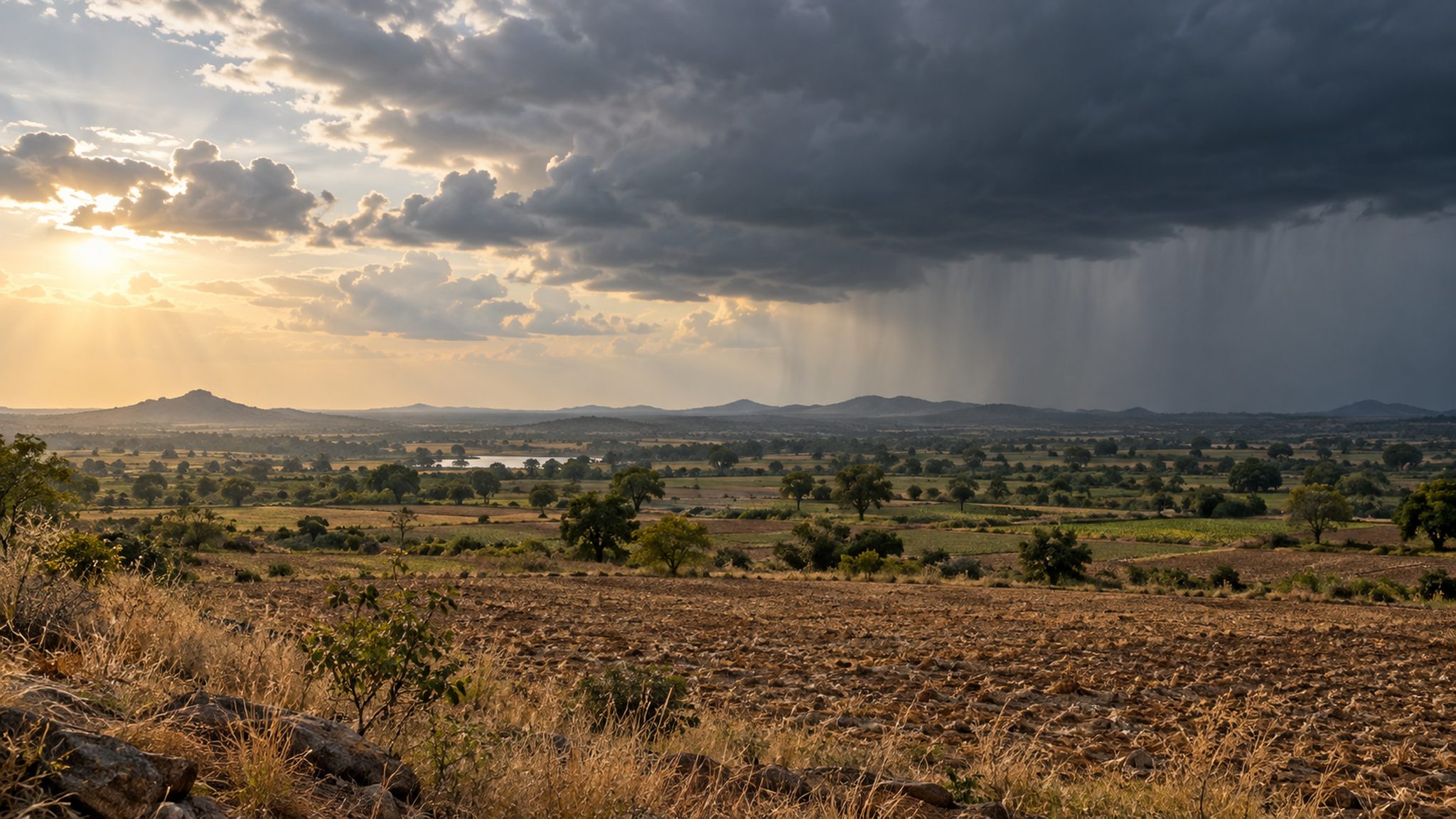
Northwestern drying and an active Bay of Bengal disturbance describe different atmospheric conditions operating across a large country at the same time.
- The Bay of Bengal low-pressure area was an observed system in the September 20 release. Associated circulations and troughs provided the weather setting for rainfall warnings across eastern, central and peninsular regions.
- Near a low-pressure system, converging moist air can rise, cool and form rain-bearing clouds. This regional mechanism can remain active while drier circulation establishes itself far away over parts of northwest India.
- The bulletin anticipated west-northwestward movement towards the north Andhra Pradesh–south Odisha coastal sector. Its forecast path helps explain the area of concern, but is not evidence that the projected movement had already occurred.
- Warnings also extended inland, including Chhattisgarh and Telangana. A Bay-origin disturbance is not exclusively a coastal hazard: rainfall associated with its circulation can affect inland catchments and communities as the system evolves.
- The useful comparison is northwestern withdrawal versus regional rainfall risk, not an all-India dry-versus-wet label. Different circulation regimes can coexist, so local forecasts remain necessary even after the first withdrawal announcement.
Read observations, forecasts and impacts separately
The date of an observed development and the time window of a forecast answer different questions and should remain separate in an exam answer.
- Withdrawal on September 19 was reported as an established development. The September 20 publication date identifies the bulletin, not a new date for the start of withdrawal; conflating them changes the factual timeline.
- Depression and deep-depression development were predicted stages in this bulletin. Do not convert them into an observed cyclone, name a storm, or claim landfall without a later authoritative update confirming the relevant development.
- Isolated extremely heavy rainfall describes a forecast intensity and distribution. It does not mean every location in a named state will receive that intensity, or that severe rain must persist throughout the forecast period.
- Flood consequences depend on where rain falls and the condition of the receiving landscape. Saturated catchments, blocked drainage and exposed settlements can turn a rainfall event into a more damaging local emergency.
- Marine and land warnings serve different decisions. A community may need preparations for heavy rain while fishing vessels must follow sea-condition restrictions; a general statement about monsoon retreat cannot safely substitute for either advisory.
Way Forward
Use the latest local warning for operational decisions
- District administrations: Match the latest rainfall window to vulnerable drainage routes and settlements, and prepare access restrictions where inundation would isolate people. Read local weather observations alongside these bulletins.
- Farmers: Use local agrometeorological advice to time harvesting, secure harvested produce and clear field drainage instead of assuming withdrawal means an uninterrupted dry spell.
- Fishing communities: Follow updated IMD marine warnings for the named sea areas and valid periods; check revisions before departure.
- Public communication: Label each statement as observed, forecast or recommended action, and retain its location and validity period when sharing alerts.
Conclusion
- Monsoon withdrawal is regional and progressive. It describes a changing circulation over a specified area, while active weather systems elsewhere can continue generating substantial rainfall and requiring local preparedness.
- Keep weather status separate from weather risk. In an answer, connect the withdrawal criteria to northwestern drying, explain the independent Bay-system mechanism, and preserve the distinction between observations and forecasts.
UPSC Practice Questions
Prelims MCQ 1
With reference to southwest monsoon withdrawal, consider the following statements:
- IMD considers persistent cessation of rainfall along with circulation and moisture conditions.
- Withdrawal from western Rajasthan automatically marks withdrawal from the entire country.
- Further withdrawal is assessed while maintaining spatial continuity.
How many of the above statements are correct?
(a) Only one (b) Only two (c) All three (d) None
Answer: (b) Only two
Explanation:
Statements 1 and 3 are correct. Withdrawal is regional and progressive; retreat from western Rajasthan does not establish complete withdrawal across India.
Prelims MCQ 2
Which best explains how monsoon withdrawal in northwest India can coexist with heavy rain farther east?
(a) Withdrawal immediately reverses winds uniformly across India. (b) Every monsoon low-pressure area ends when withdrawal begins. (c) A regional Bay of Bengal disturbance can sustain rainfall away from the withdrawn sector. (d) Withdrawal is declared solely from an all-India rainfall average.
Answer: (c) A regional Bay of Bengal disturbance can sustain rainfall away from the withdrawn sector.
Explanation:
Withdrawal concerns circulation and moisture over a specific region. A separate low-pressure system can sustain moist convergence and rainfall elsewhere.
UPSC Mains Questions
- Explain why the initial withdrawal of the southwest monsoon does not imply an immediate end to rainfall hazards across India.
- How should disaster-management authorities distinguish observed weather, forecast development and local impacts when communicating monsoon-transition risks?
Sources: IMD, September20 bulletin and IMD withdrawal criteria.
Frequently Asked Questions
What is monsoon withdrawal?
It is the progressive retreat of the southwest monsoon circulation from a region. IMD assesses persistent dry weather, circulation changes and reduced moisture rather than declaring withdrawal after a single rainless day.
Can heavy rain occur while the monsoon is withdrawing?
Yes. Withdrawal from one region can coexist with active weather systems elsewhere. A Bay of Bengal low-pressure disturbance may sustain rainfall over eastern or central India while northwestern areas become drier.
Did the September 20 bulletin confirm a cyclone?
No. It described an observed low-pressure area and forecast its intensification into a depression and deep depression. Predicted stages must not be presented as observed developments or as a confirmed cyclone.
Why does a local warning matter after withdrawal starts?
An initial withdrawal announcement covers a specified region. District rainfall warnings and marine advisories address immediate hazards in their own areas and valid periods, so they remain essential for operational decisions.