NAMASTE Scheme: Centre set to expand Mechanised Sanitation Scheme to Rural India
Why in News?
The Centre plans to expand the National Action for Mechanised Sanitation Ecosystem (NAMASTE) from urban to rural India, covering a wider range of sanitation workers and strengthening efforts to eliminate hazardous manual cleaning.
| UPSC Relevance: GS-2 Social Justice: Vulnerable sections, Government schemes Prelims: NAMASTE Scheme |
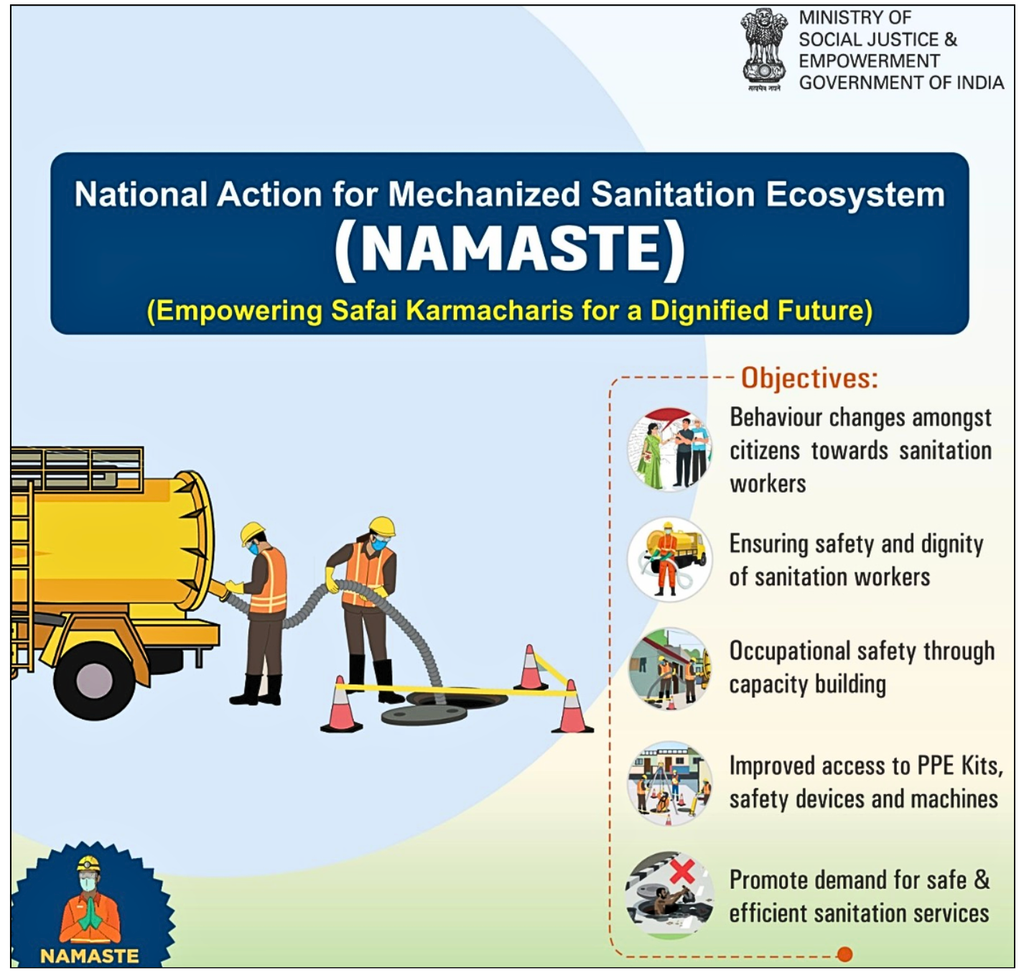
NAMASTE Scheme- Key Features:
- Launched in 2023-24, NAMASTE aims to eliminate deaths and injuries from hazardous sewer and septic-tank cleaning and promote mechanised sanitation.
- Initially covered Sewer and Septic Tank Workers (SSWs) and was subsequently expanded to include waste pickers.
- The proposed rural expansion would cover:
- Drain cleaners;
- Workers in Sewage Treatment Plants (STPs); and
- Workers in Faecal Sludge Treatment Plants (FSTPs).
- Proposed additional outlay: around ₹498.73 crore for 2026-27 to 2030-31.
- 90,915 SSWs and 1.3 lakh waste pickers have been profiled so far.
- Benefits include:
- Capital subsidy up to 50% of project cost for sanitation-related enterprises
- Support for Emergency Response Sanitation Units
- Skill and safety training; and
- Personal Protective Equipment (PPE).
Significance:
- Promotes dignity of labour and occupational safety.
- Advances the goal of eliminating manual scavenging and hazardous sanitation work.
- Mechanisation can reduce worker exposure to toxic gases, pathogens and confined-space hazards.
- Extending the scheme to rural areas addresses the urban-rural gap in sanitation safety.
- Supports social justice, livelihood diversification and rehabilitation of vulnerable sanitation workers.
The Persistent Challenge:
Despite the scheme’s objectives, implementation remains weak:
- Government data recorded 498 deaths during hazardous sewer and septic-tank cleaning between January 2019 and June 2026.
- The National Commission for Scheduled Castes (NCSC) has repeatedly raised concerns about high rejection rates under the self-employment and capital-subsidy components. Of 810 SSWs approved for capital subsidies, only 147 had received funds by March 2026.
- Credit-linked subsidies may remain inaccessible to workers lacking collateral, documentation or the capacity to finance the remaining project cost.
- Outsourcing often obscures the accountability of local bodies and principal employers.
- Rural sanitation depends heavily on septic tanks and informal workers, but institutional capacity for mechanised cleaning remains limited.
Way Forward:
- Improve transparency and simplify application and subsidy approval procedures.
- Strengthen local bodies’ capacity for mechanised sewer and septic-tank cleaning.
- Ensure timely provision of PPE, training and insurance/social-security support.
- Establish stronger monitoring and accountability for sanitation-related deaths.
- Promote locally appropriate mechanised technologies, particularly for rural and smaller settlements.
NAMASTE’s rural expansion can transform sanitation from hazardous caste-linked labour into formal and mechanised employment, but success will depend on implementation, finance and enforceable accountability.