

Why in News?
The Centre plans to expand the National Action for Mechanised Sanitation Ecosystem (NAMASTE) from urban to rural India, covering a wider range of sanitation workers and strengthening efforts to eliminate hazardous manual cleaning.
| UPSC Relevance: GS-2 Social Justice: Vulnerable sections, Government schemes Prelims: NAMASTE Scheme |
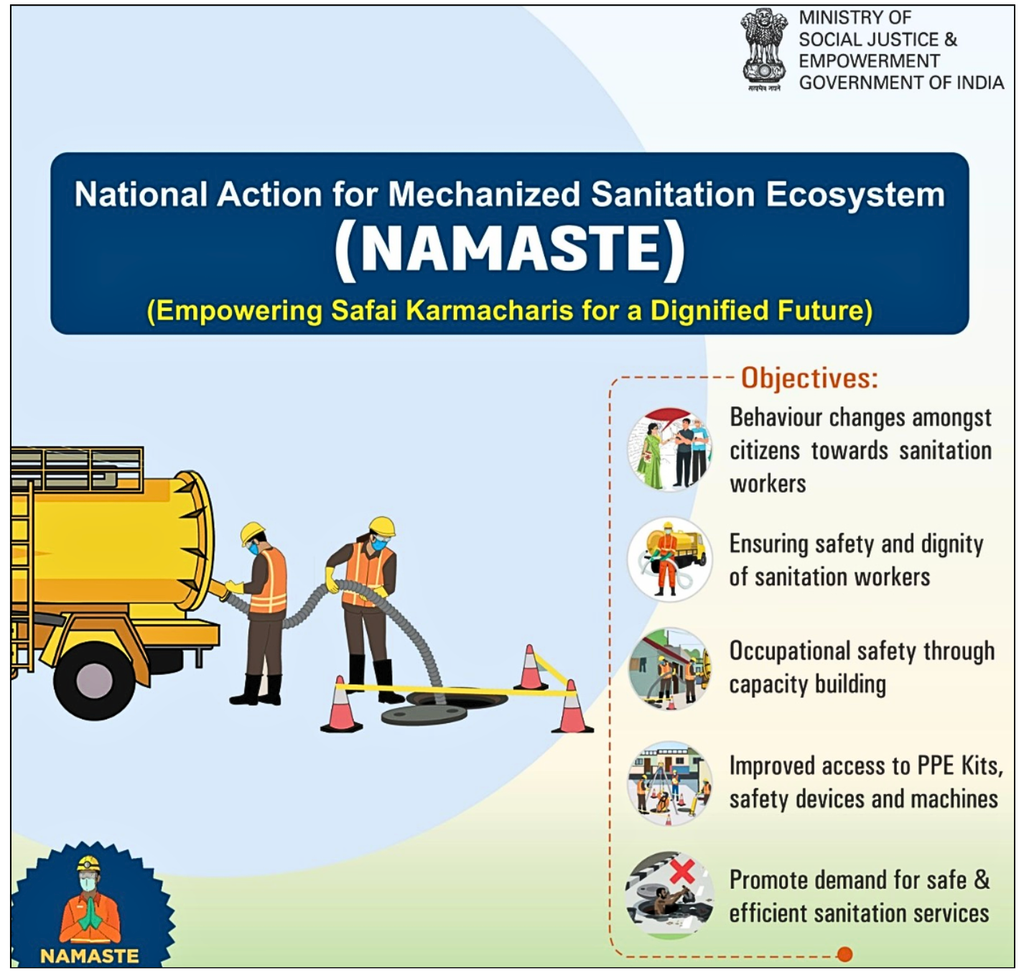
NAMASTE Scheme- Key Features:
- Launched in 2023-24, NAMASTE aims to eliminate deaths and injuries from hazardous sewer and septic-tank cleaning and promote mechanised sanitation.
- Initially covered Sewer and Septic Tank Workers (SSWs) and was subsequently expanded to include waste pickers.
- The proposed rural expansion would cover:
- Drain cleaners;
- Workers in Sewage Treatment Plants (STPs); and
- Workers in Faecal Sludge Treatment Plants (FSTPs).
- Proposed additional outlay: around ₹498.73 crore for 2026-27 to 2030-31.
- 90,915 SSWs and 1.3 lakh waste pickers have been profiled so far.
- Benefits include:
- Capital subsidy up to 50% of project cost for sanitation-related enterprises
- Support for Emergency Response Sanitation Units
- Skill and safety training; and
- Personal Protective Equipment (PPE).
Significance:
- Promotes dignity of labour and occupational safety.
- Advances the goal of eliminating manual scavenging and hazardous sanitation work.
- Mechanisation can reduce worker exposure to toxic gases, pathogens and confined-space hazards.
- Extending the scheme to rural areas addresses the urban-rural gap in sanitation safety.
- Supports social justice, livelihood diversification and rehabilitation of vulnerable sanitation workers.
The Persistent Challenge:
Despite the scheme’s objectives, implementation remains weak:
- Government data recorded 498 deaths during hazardous sewer and septic-tank cleaning between January 2019 and June 2026.
- The National Commission for Scheduled Castes (NCSC) has repeatedly raised concerns about high rejection rates under the self-employment and capital-subsidy components. Of 810 SSWs approved for capital subsidies, only 147 had received funds by March 2026.
- Credit-linked subsidies may remain inaccessible to workers lacking collateral, documentation or the capacity to finance the remaining project cost.
- Outsourcing often obscures the accountability of local bodies and principal employers.
- Rural sanitation depends heavily on septic tanks and informal workers, but institutional capacity for mechanised cleaning remains limited.
Way Forward:
- Improve transparency and simplify application and subsidy approval procedures.
- Strengthen local bodies’ capacity for mechanised sewer and septic-tank cleaning.
- Ensure timely provision of PPE, training and insurance/social-security support.
- Establish stronger monitoring and accountability for sanitation-related deaths.
- Promote locally appropriate mechanised technologies, particularly for rural and smaller settlements.
NAMASTE’s rural expansion can transform sanitation from hazardous caste-linked labour into formal and mechanised employment, but success will depend on implementation, finance and enforceable accountability.
Tell Google you want more of this.
Add Anantam IAS as a preferred sourceOne tap, and this site shows up more often in your own Top Stories, AI Overviews and AI Mode. Remove it any time.





