Natural Gas Curbs Lifted: What freer allocation means for India’s energy market
Why in News?
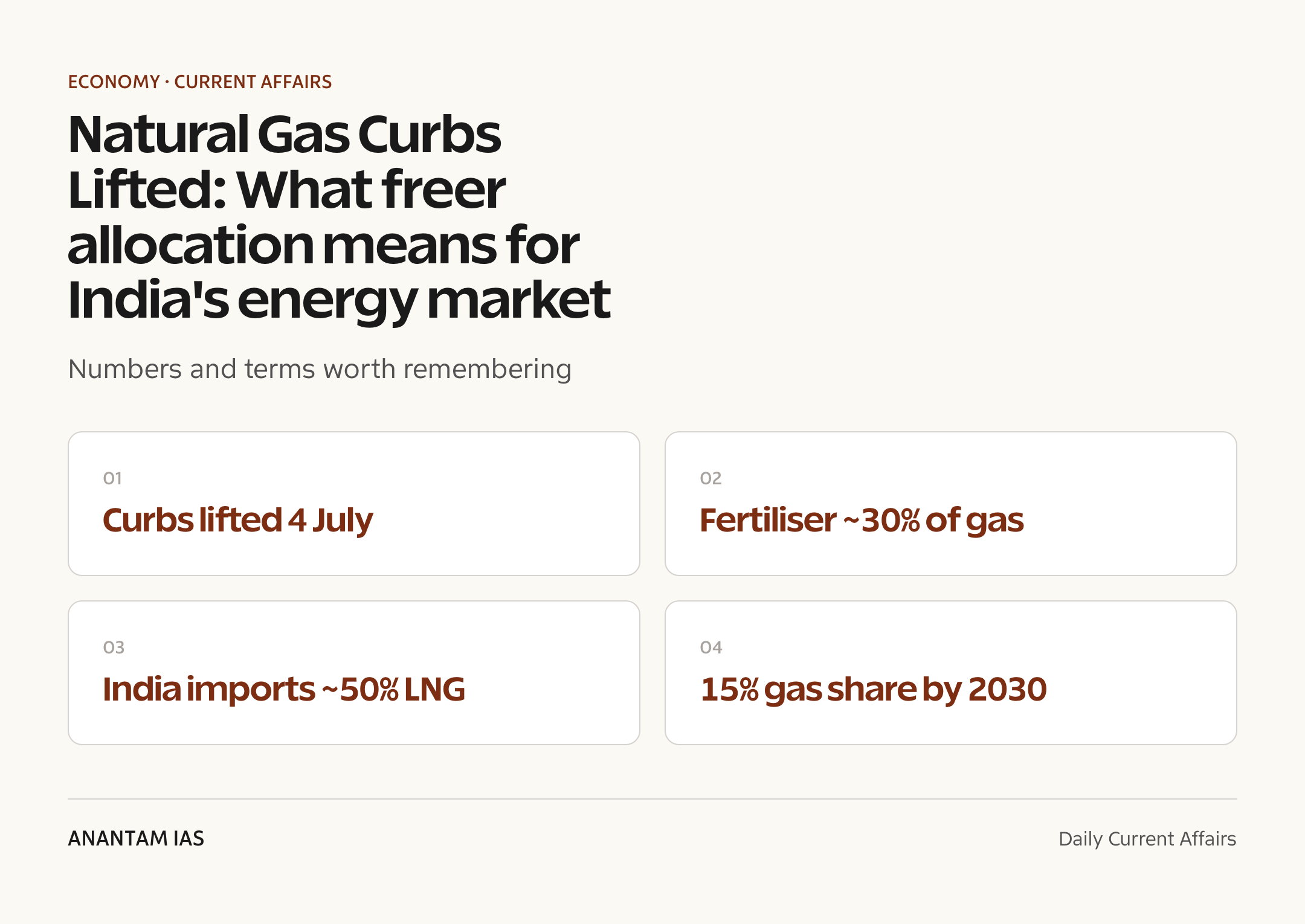
On 4 July 2026, the Union government lifted the emergency curbs it had imposed on the supply of natural gas in March 2026 during the West Asia crisis. The Hindu reported that the Ministry of Petroleum and Natural Gas issued a notification amending the Natural Gas (Supply Regulation) Order, 2026, omitting the provisions that had forced all domestically produced natural gas and imported Liquefied Natural Gas (LNG) to be sold strictly as per a government priority list.
The ministry cited the ceasefire and negotiations in West Asia and the resumption of sea traffic through the Strait of Hormuz as the reasons for restoring normal supplies to fertiliser plants, refineries, city gas distributors and industrial users.
- The curbs dated to the US–Israel war on Iran: LNG shipments through the Strait of Hormuz were disrupted, and supplies from Qatar — India’s main long-term LNG supplier — dwindled to a trickle after its gas fields were attacked.
- Under the March priority sequence announced in Parliament by Petroleum Minister Hardeep Singh Puri: domestic piped gas (PNG) to homes and CNG for vehicles got 100% supply, industrial consumers up to 80% of their six-month average, and fertiliser plants up to 70%.
- This is the second easing step: on 25 June 2026 the government had already restored industrial and commercial LPG supplies to pre-crisis levels by removing all sectoral restrictions on non-domestic packed LPG.
- The rollback chiefly benefits fertiliser plants, refineries, city gas distribution (CGD) entities and gas-intensive industries such as the Morbi ceramic cluster in Gujarat.
- During the crisis India replaced lost Qatari cargoes with LNG from the US (26%), Oman (24%), Nigeria (22%) and Angola (16%), according to a Businessline report cited by The Hindu.
The development matters in the context of:
- India imports about half of its natural gas and around 60% of its LPG — any Hormuz disruption directly hits fertiliser output, cooking gas and city transport fuel.
- The episode is a live case study for the gas-based economy goal: raising natural gas from about 6.3% of the energy mix to 15% by 2030, a target the government has reiterated through PIB.
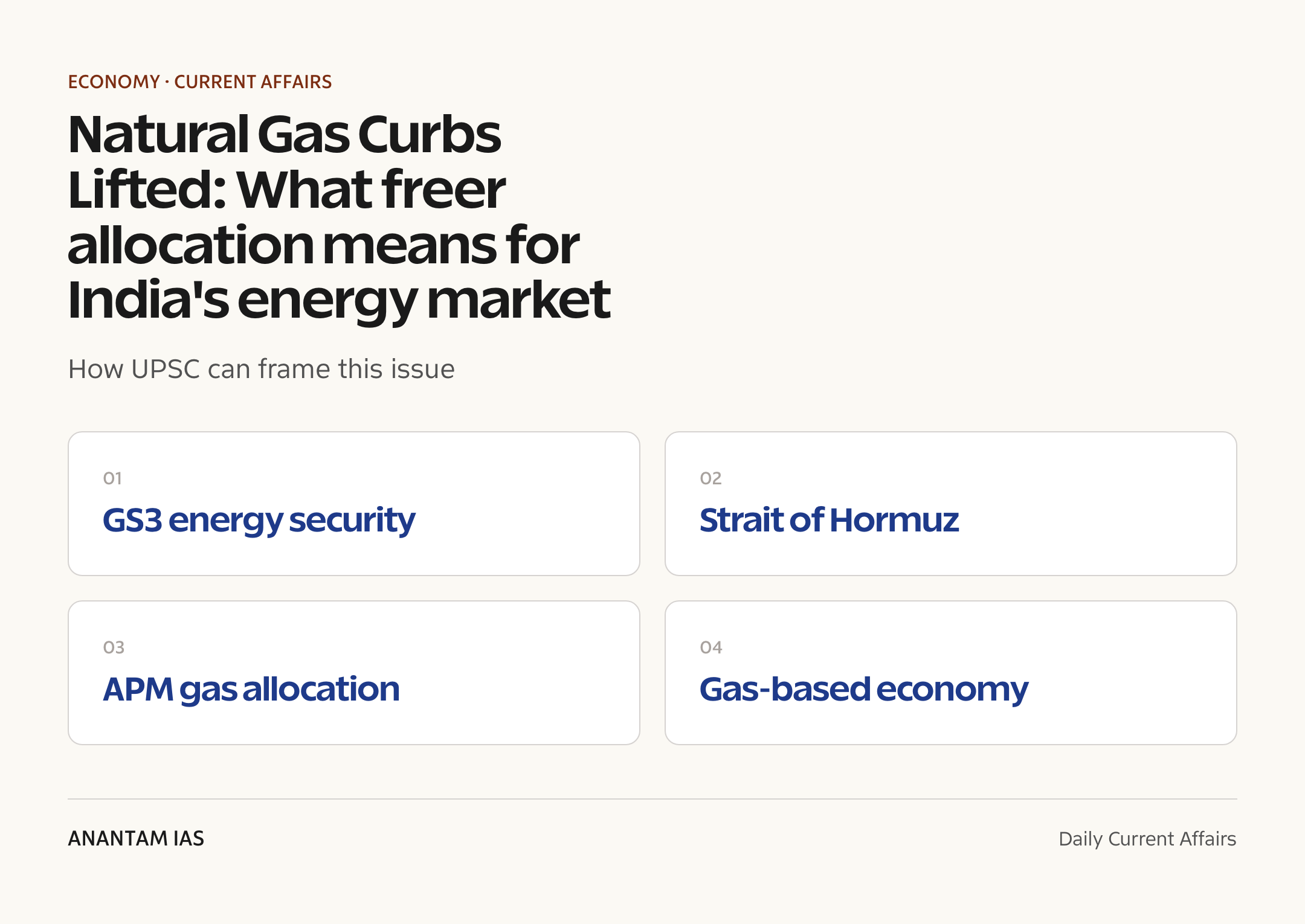
- It also tests the normal peacetime allocation architecture — APM gas, priority to CNG/domestic PNG, and market pricing — that the emergency order had temporarily overridden.
UPSC Relevance
Prelims Relevance
- Natural Gas (Supply Regulation) Order, 2026 — emergency supply-prioritisation order of March 2026; operative provisions omitted by notification in July 2026.
- LNG is mostly methane cooled to about −160°C into liquid form, shipped in cryogenic tankers and re-gasified in vaporisers at port terminals.
- LPG is a mix of propane and butane stored as liquid under pressure; India imports about 60% of its LPG.
- Sectoral gas use (ICRA estimates): fertilisers just under 30%, city gas distribution 21%, power plants 13%.
- Urea (about 46% nitrogen) is made by converting natural gas (methane) into ammonia, then combining it with carbon dioxide — the reason fertiliser plants dominate LNG demand.
- Strait of Hormuz — chokepoint between the Persian Gulf and Gulf of Oman; the transit route for Qatari LNG to India.
- Gas-based economy target: 15% share of natural gas in the primary energy mix by 2030, from about 6.3% now.
- APM (Administered Price Mechanism) gas — domestically produced gas from legacy ONGC/OIL fields, priced since April 2023 at 10% of the Indian crude basket price with a floor and ceiling, on the Kirit Parikh Committee’s recommendation.
- PNGRB (Petroleum and Natural Gas Regulatory Board, 2006) regulates downstream gas; the Indian Gas Exchange (IGX), launched 2020, is India’s gas trading platform.
- India’s crude import basket has widened from 27 to 41 countries, and LNG import terminal capacity has roughly doubled over a decade.
Mains Relevance
GS Paper 3
- Energy security as economic security: how import dependence (about 50% for gas, 60% for LPG, nearly 88% for crude) transmits geopolitical shocks into fertiliser, transport and industrial costs.
- Emergency allocation vs market allocation: when should the state override price signals with priority lists, and what are the costs of prolonged rationing for industry?
- Progress and hurdles of the gas-based economy: CGD expansion, national gas grid, LNG terminals, pricing reform (Kirit Parikh formula) against the 15%-by-2030 target.
- Vulnerability of the fertiliser–food security chain to imported LNG, and de-risking options (nano urea, ammonia imports, renewables-based green ammonia).
GS Paper 2
- West Asia instability and Indian interests: the Strait of Hormuz chokepoint, diaspora, and energy diplomacy with Qatar, the US, Oman and African suppliers.
- Institutional response to crises: use of statutory supply-regulation orders, parliamentary accountability, and the calibrated exit from emergency controls.
Essay
- Energy is the new currency of geopolitics: resilience is built in decades, tested in days.
- Markets allocate efficiently; states allocate in emergencies — the art lies in knowing when to switch.
Background and Context
What the curbs were: the March 2026 priority order
The emergency regime replaced normal contracts with a state-drawn queue for every molecule of gas.
- In March 2026, as the West Asia crisis peaked, the government invoked emergency powers through the Natural Gas (Supply Regulation) Order, 2026, requiring all domestic gas and imported LNG to be sold according to a government priority list.
- Minister Hardeep Singh Puri told Parliament on 12 March the sequence: households (domestic PNG) and CNG for vehicles — 100% supply, no cuts; industrial and manufacturing consumers — up to 80% of their previous six-month average; fertiliser plants — up to 70%, protecting the agricultural input chain ahead of the sowing season.
- Refineries and petrochemical units absorbed a managed reduction, with the freed gas redirected to higher-priority sectors.
- The design logic: shield household cooking, urban transport and food security first, and let sectors with fuel-switching options carry the burden.
Why they were imposed: Hormuz, Qatar and the supply shock
One chokepoint closure rearranged India’s entire gas import map.
- The US–Israel war on Iran halted commercial shipping through the Strait of Hormuz, the exit route for Persian Gulf LNG; India’s dominant supplier Qatar saw its gas fields attacked, and its long-term cargoes to India dried up.
- India imports about half of its LNG; with Qatar cut off, the supply mix flipped to the US (26%), Oman (24%), Nigeria (22%) and Angola (16%).
- LPG was hit in parallel — India imports around 60% of it, mostly from the Gulf — forcing emergency procurement from the US Gulf coast.
- The pre-built buffers mattered: a crude basket widened from 27 to 41 countries, doubled import terminals, and pipelines and reserves created over a decade kept supplies moving, a point Mr Puri underlined in a recent blog post.
- For the geography of this chokepoint, see the explainer on Strait of Hormuz geopolitics.
Know the fuels: LNG vs LPG, and who consumes India's gas
The two look-alike acronyms behave very differently in trade and use.
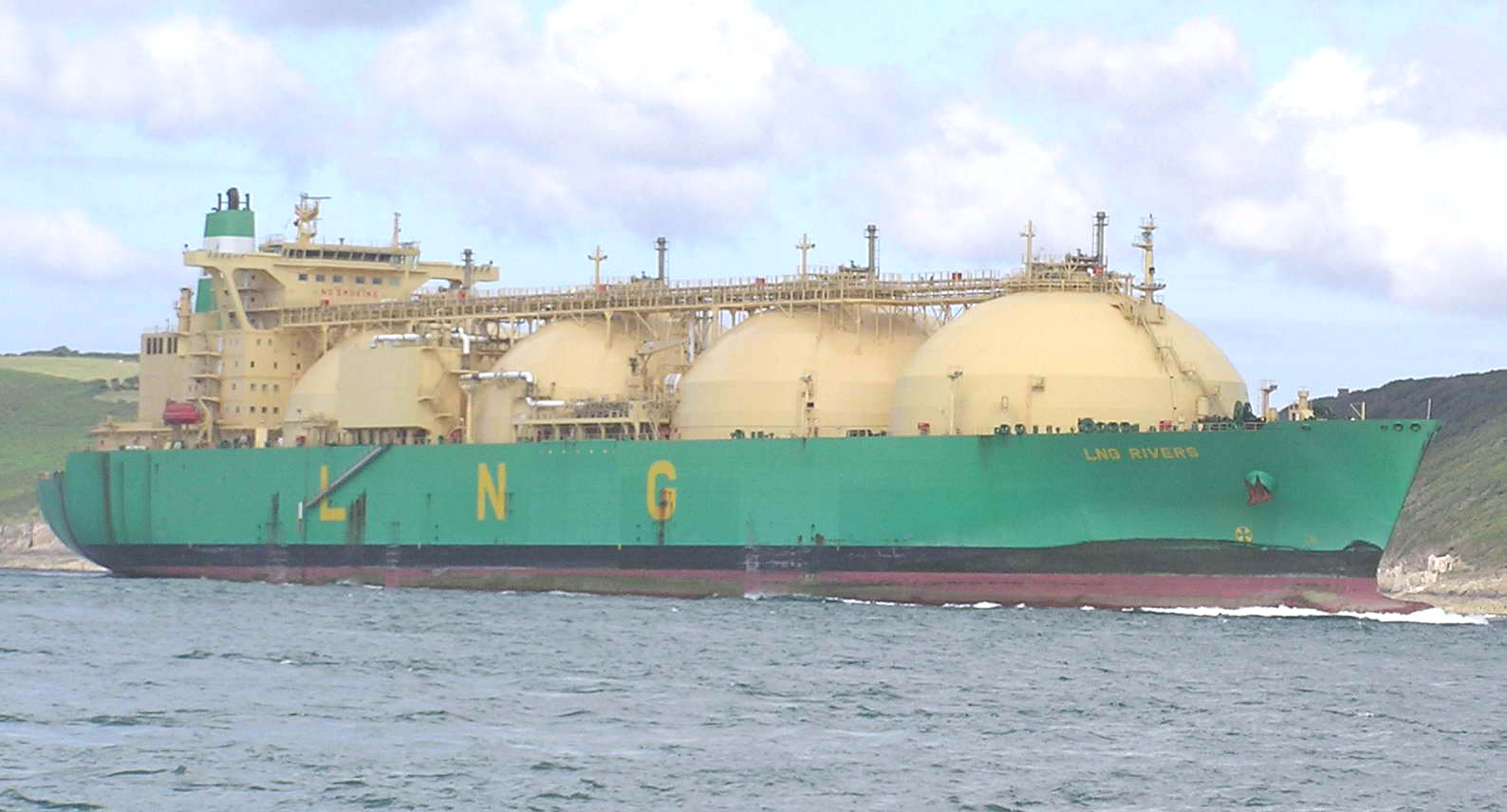
- LNG is natural gas — mostly methane — cooled to about −160°C so it can travel in specialised cryogenic tankers; it is re-gasified in vaporisers (heat exchangers) at port terminals and piped onward.
- LPG is propane plus butane, stored as liquid under modest pressure — the familiar cooking cylinder fuel.
- Sectoral shares of gas use (ICRA’s Prashant Vasisht, quoted by The Hindu): fertilisers just under 30%, city gas distribution 21%, power 13%.
- The fertiliser sector has accounted for almost all of India’s LNG demand growth since FY2016, per the Institute for Energy Economics and Financial Analysis (IEEFA).
- Urea, with about 46% nitrogen, is produced by converting methane into ammonia and combining it with carbon dioxide — an energy-intensive route that makes LNG a core input for food security. Alternatives like nano urea and nano DAP aim to cut this bulk-urea dependence.
- The ceramic cluster at Morbi, Gujarat, showed the industrial stakes: reports indicated about 600 factories and 4 lakh workers were hit by the wartime shortage of propane and natural gas.
How gas is normally allocated and priced
The emergency order sat on top of an allocation-and-pricing architecture that now resumes full effect.
- APM gas — output from legacy fields of ONGC and Oil India — is allocated with first priority to CNG (transport) and domestic PNG segments of city gas distribution.
- On the Kirit Parikh Committee’s recommendation, APM gas has been priced since April 2023 at 10% of the Indian crude basket price, within a floor-and-ceiling band, replacing the old formula linked to foreign gas hubs.
- Gas from difficult fields (deepwater, high-pressure high-temperature) earns a higher ceiling price to incentivise domestic exploration.
- The Petroleum and Natural Gas Regulatory Board (PNGRB) regulates pipelines, CGD authorisation rounds and access; the Indian Gas Exchange (IGX) provides market-based spot and forward trading.
- Lifting the supply order restores contract-based and market-based allocation — buyers and sellers, not a ministry priority list, again decide who gets gas beyond the protected CGD segments.
The gas-based economy push: the 15% target
The crisis interrupted, but did not change, India’s structural bet on gas as a transition fuel.
- The government targets raising natural gas from about 6.3% of the primary energy mix to 15% by 2030 (PIB).
- Instruments: expanding the National Gas Grid to roughly 33,500 km, successive CGD bidding rounds covering most districts, and new LNG import terminals.
- CGD entities authorised up to the 11A round are committed to about 12.33 crore PNG connections and 17,700 CNG stations by 2030.
- Gas is pitched as the bridge fuel — halving CO2 versus coal in power and displacing dirtier industrial fuels — while renewables and storage scale up.
- The Hormuz episode exposes the target’s soft underbelly: a 15% gas share built on imported LNG imports geopolitical risk along with the molecules — the systems-over-austerity argument made in this site’s essay on energy security.
What the lifting means now
Restored flows change costs, output and price signals across four sectors at once.
- Fertilisers: plants move back from 70% rationing to full feedstock, stabilising urea output and easing the subsidy arithmetic before the kharif peak.
- City gas: CGD entities regain assured volumes for expansion, supporting CNG and PNG growth beyond the protected core.
- Industry: Morbi-type gas-intensive clusters (ceramics, glass, steel re-rolling) get predictable supply at market terms instead of quota allocations.
- Refineries and petrochemicals: the managed reduction ends, normalising product output.
- The larger signal: emergency economic controls were time-bound and reversible — imposed with a stated priority logic, reported to Parliament, and withdrawn once the trigger (Hormuz closure) passed.
Way Forward
Build resilience before the next chokepoint crisis
- Create strategic gas storage — depleted fields, salt caverns and expanded LNG tankage — mirroring the crude oil strategic reserves.
- Deepen supplier diversification with term contracts beyond Qatar (US, Oman, African producers) and destination-flexible clauses.
- Accelerate domestic exploration under HELP/OALP and difficult-field pricing incentives to lift the domestic share of consumption.
- De-risk fertilisers via green ammonia, nano-fertilisers and efficiency in urea use, so food security is less hostage to shipping lanes.
- Complete the National Gas Grid and CGD build-out so restored supply reaches consumers, and let IGX-based market pricing deepen now that controls are gone.
Conclusion
The lifting of the gas curbs closes a four-month experiment in wartime energy rationing. The priority architecture — households and transport first, fertilisers protected, industry curtailed — worked as designed, and the decade-long investment in diversified suppliers, doubled terminals and pipelines gave the government room to manage the shock without blackouts or a cooking-gas crisis.
But the episode is a warning wrapped in a success story. A country that imports half its gas and 60% of its LPG cannot treat the Strait of Hormuz as a given. If natural gas is to reach 15% of the energy mix by 2030, storage, domestic production and supplier diversity must grow as fast as demand — or the next emergency order will be back sooner than expected.
UPSC Practice Questions
Prelims MCQ 1
With reference to the natural gas supply curbs lifted by the Government of India in July 2026, consider the following statements:
- The curbs had been imposed through the Natural Gas (Supply Regulation) Order, 2026 during the West Asia crisis.
- Under the emergency priority sequence, fertiliser plants received 100% of their supplies while household piped gas faced cuts.
- The government cited the resumption of sea traffic through the Strait of Hormuz while withdrawing the curbs.
How many of the above statements are correct?
(a) Only one (b) Only two (c) All three (d) None
Answer: (b) Only two
Explanation:
Statements 1 and 3 are correct. Statement 2 inverts the priority: domestic PNG to homes and CNG for vehicles got 100% supply with no cuts, while fertiliser plants received up to 70% of their previous six-month average.
Prelims MCQ 2
Which one of the following correctly distinguishes Liquefied Natural Gas (LNG) from Liquefied Petroleum Gas (LPG)?
(a) LNG is mainly propane and butane, while LPG is mainly methane (b) LNG is mainly methane cooled to about −160°C, while LPG is propane and butane stored as liquid under pressure (c) Both are mainly methane, but LPG is transported only by pipeline (d) LNG is used only for cooking, while LPG is used only in power plants
Answer: (b) LNG is mainly methane cooled to about −160°C, while LPG is propane and butane stored as liquid under pressure
Explanation:
LNG is natural gas (mostly methane) liquefied at cryogenic temperature (about −160°C) for shipping and re-gasified at port terminals. LPG is a propane-butane mix liquefiable under modest pressure, used chiefly as cylinder cooking gas; India imports around 60% of its LPG.
UPSC Mains Questions
- India’s emergency natural gas allocation during the 2026 West Asia crisis prioritised households and fertilisers over industry. Examine the rationale of such administrative allocation, its economic costs, and the conditions under which a return to market-based allocation is justified.
- “A gas-based economy built on imported LNG imports geopolitical risk along with the fuel.” In the light of the Strait of Hormuz disruption, critically evaluate India’s 15%-by-2030 natural gas target and suggest measures to strengthen gas security.
- Energy resilience is created in peacetime, not during a crisis. Discuss with reference to India’s diversification of crude and LNG sources, import infrastructure, and strategic reserves.
Sources: Ministry of Petroleum and Natural Gas and The Hindu Explained.
Frequently Asked Questions
Why were the natural gas curbs imposed?
The March 2026 West Asia crisis shut sea traffic through the Strait of Hormuz and crippled LNG supplies from Qatar, India’s main supplier. The government invoked the Natural Gas (Supply Regulation) Order, 2026 to ration available gas by priority — households and CNG first, then industry and fertilisers.
What changed on 4 July 2026?
The Petroleum Ministry amended the Natural Gas (Supply Regulation) Order, 2026 and omitted the priority-list provisions. Domestic gas and imported LNG can again be sold on normal contractual and market terms, citing the ceasefire and the reopening of the Strait of Hormuz.
Who benefits from the lifting of curbs?
Fertiliser plants (which use just under 30% of India’s gas), refineries and petrochemical units, city gas distributors supplying CNG and PNG, and gas-intensive industries such as the Morbi ceramic cluster in Gujarat, where about 600 factories were hit during the shortage.
Why do fertiliser plants need so much LNG?
Urea, the most common nitrogen fertiliser with about 46% nitrogen, is made by converting methane into ammonia and combining it with carbon dioxide. The process is energy-intensive, and IEEFA notes the fertiliser sector drove almost all of India’s LNG demand growth since FY2016.
What is the gas-based economy target?
The government aims to raise natural gas from about 6.3% of India’s primary energy mix to 15% by 2030, through the National Gas Grid, city gas distribution rounds, and new LNG terminals. Heavy import dependence remains the target’s biggest vulnerability.
How did India replace Qatari LNG during the crisis?
With Qatar’s cargoes disrupted, India sourced LNG mainly from the US (26%), Oman (24%), Nigeria (22%) and Angola (16%), and bought LPG from the US Gulf coast. A crude basket widened to 41 countries and doubled import terminals helped absorb the shock.