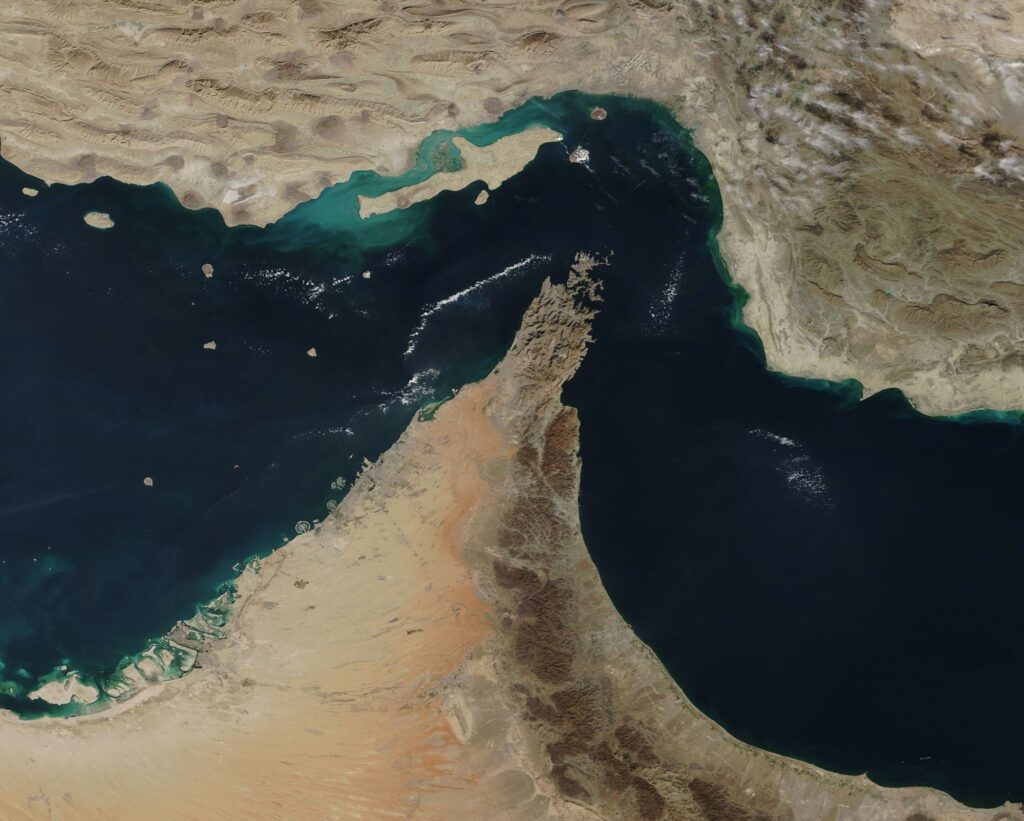
The Strait of Hormuz geography and geopolitics together produce what is probably the single most consequential maritime chokepoint on the planet. The strait separates Iran’s southern coast from the Musandam peninsula of Oman and is, at its narrowest, only about 33 kilometres wide. Through that gap moves roughly 21 per cent of the world’s total petroleum liquids traded by sea, according to the US Energy Information Administration. Crude oil and condensate from Saudi Arabia, Iraq, Kuwait, Qatar, the United Arab Emirates and Iran, along with the world’s largest LNG flows from Qatar, must transit the Strait of Hormuz to reach customers in Asia, Europe and North America. Any disruption — from threatened closure to attacks on shipping — sends an immediate shock through global oil markets, including India’s import bill.
For UPSC, the Strait of Hormuz geography and geopolitics is a recurring topic across , international relations, and current affairs. It also tests political-geography questions about which Persian Gulf states must cross Hormuz to reach the Indian Ocean and which can reach the open sea by alternative routes.
Where the Strait Is
The Strait of Hormuz lies between the Persian Gulf to its northwest and the Gulf of Oman to its southeast. To the north sits the Iranian coast, including the Bandar Abbas port and the strategically placed islands of Qeshm, Hormuz, Hengam, the Tunbs, and Abu Musa. To the south lies the Omani enclave of Musandam, an exclave of Oman cut off from the rest of the country by a strip of UAE territory. The shipping lanes within the strait are narrow — only about three kilometres wide each in the inbound and outbound lanes, with a two-kilometre buffer — which is what creates the chokepoint character of the geography.
Why it is a chokepoint
Three features combine.
- Narrow width: 33 kilometres at the narrowest.
- Single corridor: the only sea route between the Persian Gulf and the open ocean.
- High traffic concentration: thousands of tanker, container, LNG and general cargo vessels each year.
A chokepoint, in maritime parlance, is a strategic narrow channel that concentrates traffic and creates leverage for any actor who can disrupt it. The Strait of Hormuz is the textbook example.
The 21 Per Cent of World Oil
The US EIA, in its periodic chokepoint analyses, has put the Hormuz transit at around 17 million barrels of petroleum liquids per day, equivalent to roughly 21 per cent of total global petroleum liquids consumption and around a quarter of seaborne oil trade. The figure varies year-on-year with Saudi and Iranian export levels and with the share of oil shipped by pipeline, but it has consistently been the largest single-chokepoint share in the world. The Strait of Malacca handles a higher volume of total cargo but carries a smaller share of oil specifically.
In addition, Hormuz carries roughly 20 per cent of global liquefied natural gas trade, primarily from Qatar’s North Field.
Which Persian Gulf States Must Use Hormuz
A common political-geography question concerns which oil-producing states must use the Strait of Hormuz to reach the Indian Ocean and the global market.
Must use Hormuz (no alternative seaboard)
- Bahrain — entirely inside the Persian Gulf, with no Indian Ocean coast.
- Qatar — also entirely inside the Persian Gulf.
- Kuwait — sits at the northwestern head of the Persian Gulf.
- Iraq — Iraq’s only Persian Gulf access is the very short Umm Qasr-Faw stretch; the rest of the country is landlocked-equivalent. Its seaborne exports must transit Hormuz.
Partial pipeline workarounds
- Saudi Arabia has a partial workaround through the East-West (Petroline) pipeline to Yanbu on the Red Sea, allowing some of its oil to bypass Hormuz.
- UAE has the Habshan-Fujairah pipeline that exits at Fujairah on the Gulf of Oman, bypassing Hormuz altogether.
- Iran sits on both sides — it has access to the Gulf of Oman through Jask and is building the Goreh-Jask pipeline.
Outside the Persian Gulf
- Syria does not border the Persian Gulf and does not use Hormuz at all. Its coastline faces the eastern Mediterranean.
- Egypt also does not border the Persian Gulf; its main maritime arteries are the Suez Canal between the Mediterranean and the Red Sea.
A multi-statement prelims question therefore tests these correctly: Bahrain and Qatar must cross Hormuz to reach the Indian Ocean. Syria and Egypt do not — they have other maritime arteries entirely.
Strait of Hormuz Geopolitics
The Strait of Hormuz geography and geopolitics is contested by the major regional and global powers.
Iran’s leverage
Because the northern shore of the strait is Iranian, Tehran’s military doctrine — small fast-attack boats, anti-ship missiles, sea mines, drones — is designed to threaten or briefly close the strait in a crisis. Iran has periodically warned that it could shut Hormuz if its own oil exports are blocked. The threat has never been carried out for an extended period, but it conditions every oil-market crisis in the region.
US and Allied presence
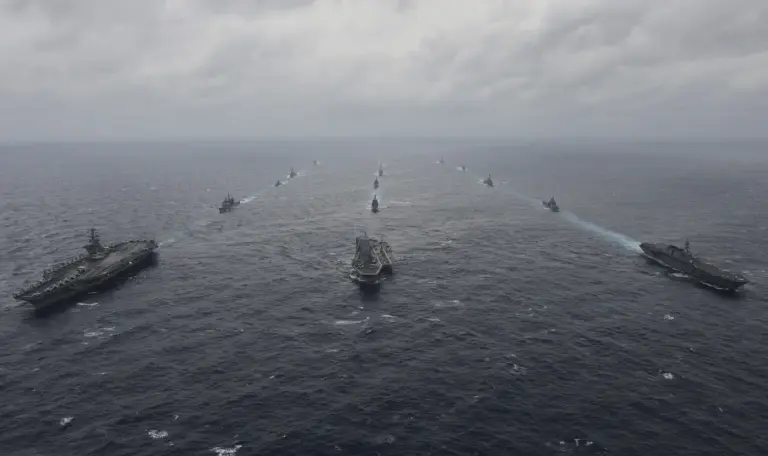
The US Fifth Fleet is headquartered at the Naval Support Activity Bahrain, with the Combined Maritime Forces coordinating naval operations across multiple task forces. UK, French and Australian vessels participate in escort and presence missions. The International Maritime Security Construct (IMSC) was created in 2019 to provide escort to merchant shipping after the tanker incidents that year.
India’s stake
India imports roughly 80 per cent of its crude oil and a large share comes through Hormuz from Saudi Arabia, Iraq, Kuwait and the UAE. A serious Hormuz disruption would push global crude prices sharply higher and add to India’s current-account deficit. India therefore engages in maritime security cooperation through Operation Sankalp, Indian Navy patrols in the Gulf of Oman and the Persian Gulf, and bilateral defence agreements with Oman (Duqm port access) and the UAE.
Recent incidents
The 2019 attacks on tankers in the Gulf of Oman, the 2019 seizure of the British tanker Stena Impero by Iran, the 2024 series of incidents around the Red Sea (Houthi attacks) and Hormuz, and continuing tensions over the Joint Comprehensive Plan of Action have kept the strait in the news.
Energy Pipelines that Bypass Hormuz
There are only two pipelines of consequence that allow Persian Gulf oil to reach an Indian Ocean or Red Sea port without using the strait.
- East-West Petroline in Saudi Arabia carries crude from Abqaiq to Yanbu on the Red Sea, with a nameplate capacity around 5 million barrels per day.
- Habshan-Fujairah pipeline in the UAE carries crude from the inland Habshan field to Fujairah on the Gulf of Oman, with capacity around 1.5 million barrels per day.
Together these can substitute only a fraction of normal Hormuz throughput. The strait therefore remains structurally indispensable.
Frequently Asked Questions
Where exactly is the Strait of Hormuz?
Between the southern coast of Iran and the Musandam peninsula of Oman, connecting the Persian Gulf to the Gulf of Oman and the wider Indian Ocean. At its narrowest it is about 33 kilometres wide.
How much of the world’s oil passes through the Strait of Hormuz?
About 21 per cent of total global petroleum liquids consumption — roughly 17 million barrels per day — and about a quarter of seaborne oil trade, according to the US Energy Information Administration.
Which countries must use Hormuz to reach the Indian Ocean?
Bahrain, Qatar, Kuwait and Iraq must use the Strait of Hormuz because they have no other sea outlet to the Indian Ocean. Saudi Arabia and the UAE have partial pipeline workarounds to the Red Sea and the Gulf of Oman respectively.
Do Syria and Egypt have to cross Hormuz?
No. Syria’s coastline is on the eastern Mediterranean, and Egypt’s main maritime artery is the Suez Canal between the Mediterranean and the Red Sea. Neither uses the Strait of Hormuz.
What is a chokepoint?
A strategic narrow channel that concentrates global maritime traffic. Closure or disruption produces an outsized impact on world trade, prices and security. Hormuz, Malacca, Bab-el-Mandeb, Suez and the Bosporus are the most famous examples.
Why is Hormuz so important to India?
Because India imports about 80 per cent of its crude oil and a substantial share comes through Hormuz from Saudi Arabia, Iraq, Kuwait and the UAE. A serious disruption would raise India’s import bill and trigger inflation.
Has Iran ever closed the Strait of Hormuz?
No, never for an extended period, though it has repeatedly threatened closure and has briefly disrupted shipping through tanker seizures, mining and attacks during periods of high tension.
What pipelines bypass Hormuz?
The East-West Petroline in Saudi Arabia (to Yanbu on the Red Sea) and the Habshan-Fujairah pipeline in the UAE (to Fujairah on the Gulf of Oman) are the two main bypass pipelines, with limited combined capacity.
Tell Google you want more of this.
Add Anantam IAS as a preferred sourceOne tap, and this site shows up more often in your own Top Stories, AI Overviews and AI Mode. Remove it any time.