Nepal Power Approval: Supply Windows, Circuits and Review Conditions
Why in News?
On 14 September 2026, the Ministry of Power announced approval for electricity exports to Nepal Electricity Authority through specified transmission lines, with a daily supply window and review conditions.
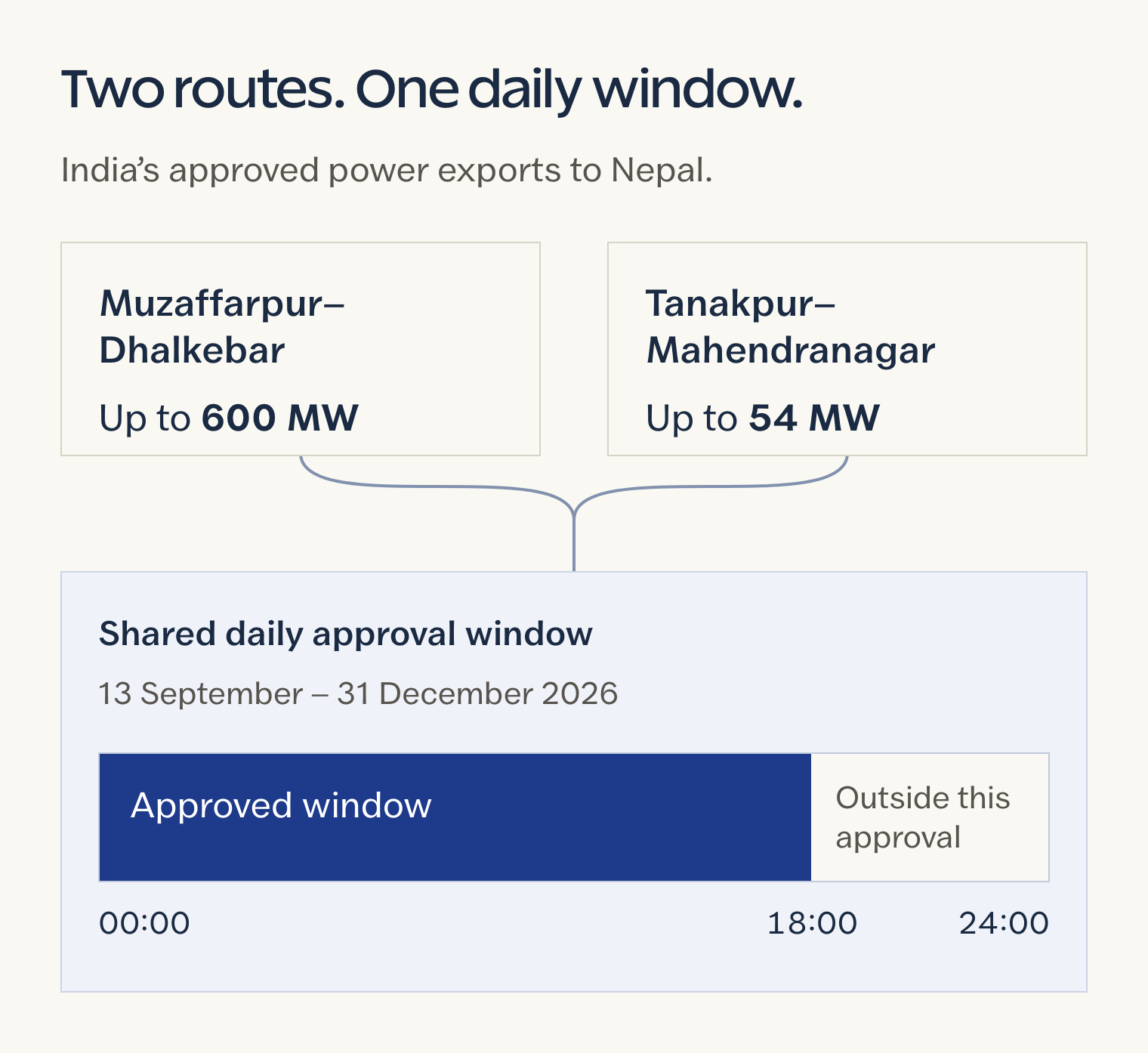
- Approval permits up to 600 MW through Muzaffarpur-Dhalkebar and up to 54 MW through Tanakpur-Mahendranagar.
- The approved daily window is 00:00 to 18:00, during the period from 13 September to 31 December 2026.
- The export quantum from January 2027 will be reviewed in December 2026.
- Flood damage reduced Nepal’s hydropower generation capacity. The new announcement grants approval; it does not report metered deliveries or guarantee continuous supply.
- The earlier India-Nepal power-trade note described a pending request. The material advance is granted approval with named routes, ceilings, a daily window and an end date.
- The practical question is how to read an authorisation: permitted power, actual scheduled flows and electricity ultimately delivered are related but different quantities.
UPSC Relevance
Prelims Relevance
- MW: a unit of power, describing the rate of electricity transfer.
- MWh: a unit of energy, recording power supplied over time.
- Muzaffarpur-Dhalkebar: the higher-ceiling route named in the approval.
- Tanakpur-Mahendranagar: the second route, with its own export ceiling.
- Daily window and validity period: separate limits on an approved cross-border transaction.
Mains Relevance
GS Paper 2
- India-Nepal cooperation through specific, time-bound operational decisions.
GS Paper 3
- Infrastructure authorisation, supply scheduling and measurable delivery.
- Review clauses in temporary disaster-support arrangements.
Background and Context
A Route Ceiling Is Not a Delivery Report
The approval specifies how much power may be exported through each named route, rather than recording how much electricity has already crossed the border.
- The Muzaffarpur-Dhalkebar line carries the larger approved export ceiling; Tanakpur-Mahendranagar has a separate smaller ceiling. The route names matter because permission is tied to identified infrastructure rather than an unrestricted pool of cross-border capacity.
- The words up to establish maximum authorised power, not an obligation to deliver that amount continuously. A report about the approval should preserve this qualification instead of turning a ceiling into an assured supply claim.
- Route-specific limits must be read separately. Adding the ceilings does not demonstrate that both routes operated at their maxima simultaneously, and does not establish permission to move one route’s unused allowance onto the other.
- Approval, scheduling and delivery describe different stages: authority permits a transaction, operators arrange the intended flow, and metering records actual energy. The Ministry’s release establishes the first stage without providing records for the later stages.
- The announcement identifies the Nepal Electricity Authority as the recipient of the approved exports. It does not specify retail distribution, individual household service hours or a guaranteed end-user supply outcome across Nepal’s electricity network.
Read the Clock Together with the Calendar
A shipment of electricity must fit both the recurring daily window and the overall period covered by this particular approval.
- The daily window runs from 00:00 to 18:00. This is permission for a defined portion of each day, not an announcement that the two routes will supply power around the clock without interruption.
- The validity period runs from 13 September through 31 December 2026. These calendar dates limit the temporary arrangement, while the daily clock determines which part of each covered day falls within the stated approval.
- The release was published after the stated starting date. Keep the publication date and approval period distinct: the earlier start in the announcement does not independently prove that exports actually began on that date.
- Outside the stated window, this announcement supplies no permission for the described exports. That does not prove all electricity trade between the countries stops then; other arrangements cannot be inferred either way from this release.
- An operator interpreting the notice must combine route, ceiling, daily window and calendar period. Satisfying only a capacity ceiling is insufficient to show that a proposed transaction fits every condition in the announced arrangement.
Measure Energy and Review the Next Period
To assess delivered support, follow energy records over time; to assess future permission, follow the review decision rather than extrapolating the present approval.
- Megawatts measure power, the rate at which electricity is transferred. Megawatt-hours measure energy, the amount transferred over a duration. Confusing these units turns an approved transfer rate into an unsupported claim about total supply.
- If power remains constant, energy equals power multiplied by time. When flow changes, energy must be added across the relevant intervals; a maximum permitted rate alone cannot establish the total electricity delivered during the day.
- The planned December review concerns the quantum to be exported from January 2027. It is a future decision point, not a promise that the present ceilings will continue, increase or end when the review occurs.
- A useful review would compare remaining supply needs with restored availability and feasible scheduled imports. These are policy considerations for assessing support, not criteria that the Ministry announcement explicitly lists or a forecast of its decision.
- Metered energy and utilisation would help assess the arrangement’s practical contribution. A low realised flow could reflect several constraints or lower demand; the approval notice alone cannot identify its cause or establish successful delivery.
Way Forward
Keep Permission and Performance Visible
- Publish clear operational instructions for the approved routes and window so scheduling follows the same conditions on both sides.
- Report scheduled and metered energy separately from sanctioned MW ceilings when assessing the support provided.
- Prepare the December review using updated needs and operational evidence, then communicate the next applicable arrangement before the current period ends.
Conclusion
- The new India-Nepal decision converts a pending request into conditional export approval. Its meaning depends on named routes, separate power ceilings, the daily window and the covered calendar period.
- Assess relief using actual energy delivered, and assess January arrangements through the December review outcome. Neither continuous delivery nor automatic extension follows from the present approval notice.
UPSC Practice Questions
Prelims MCQ 1
With reference to the announced power-export approval for Nepal, consider the following statements:
- It specifies separate ceilings for two named transmission routes.
- Its stated daily window provides round-the-clock approval.
- The quantum for January 2027 is to be reviewed in December 2026.
How many of the above statements are correct?
(a) Only one (b) Only two (c) All three (d) None
Answer: (b) Only two
Explanation:
Statements 1 and 3 are correct. The announced daily window is 00:00 to 18:00, not round-the-clock approval.
Prelims MCQ 2
Why can an approved MW ceiling not be treated as electricity already delivered?
(a) MW measures power, while delivered energy depends on actual flow over time. (b) MW measures energy accumulated over a calendar year. (c) Approval proves constant operation at the ceiling. (d) Every transmission line delivers its maximum power continuously.
Answer: (a) MW measures power, while delivered energy depends on actual flow over time.
Explanation:
Power is a transfer rate; energy incorporates duration and actual flow. Permission sets a ceiling, whereas delivery requires operational and metering evidence.
UPSC Mains Questions
- Time-bound electricity-export approvals require careful distinction between permitted capacity and delivered support. Discuss using the latest India-Nepal arrangement.
- Explain how route limits, daily supply windows and review clauses make temporary cross-border infrastructure cooperation accountable.
Source: PIB, Ministry of Power.
Frequently Asked Questions
What has India approved for Nepal?
India approved exports to Nepal Electricity Authority through two named transmission lines, with separate power ceilings. The arrangement has a specified daily window and calendar period, rather than unconditional or permanent supply authorisation.
What is the approved daily supply window?
The release states 00:00 to 18:00 each day for the period from 13 September to 31 December 2026. This defines the approved window; it does not confirm actual uninterrupted delivery within it.
Are the announced MW figures actual electricity delivered?
No. They are maximum approved power levels for the named routes. Actual energy delivered depends on realised flows over time and is measured in energy units such as MWh, supported by metering records.
Will the present export ceilings automatically continue in January?
The release says the quantum from January 2027 will be reviewed in December 2026. It does not announce an automatic extension, a predetermined increase or an assured continuation of the present arrangement.