Why in News?
On 30 August 2026, Nepal was reported to have requested earlier approval to import electricity from India after floods reduced its hydropower availability.
- Nepal normally seeks Indian electricity around October, when falling river flows begin reducing dry-season hydropower output; this request sought imports from September.
- Indian authorities were reported to be processing the request under the existing cross-border framework. A pending request isn’t an approved supply arrangement or a confirmed delivery schedule.
- Preliminary assessments cited by officials suggested about 550 MW of generation loss and export flows roughly 400 MW below earlier peak levels; these aren’t audited final figures.
- India was reported to have enough reserve capacity to replace the lower Nepalese inflow without exceptional procurement, supply disruption or loss of domestic grid stability.
- The episode turns a bilateral transmission link into a resilience instrument: scheduled power can move toward the system facing a temporary shortage instead of remaining locked behind a border.
- It also exposes concentration risk. When one generation source dominates, a common shock can reduce several plants together, shrink firm supply and abruptly reverse a country’s trade position.
- For India, the test is not merely imported energy volume but whether dispatchable reserves can cover the shortfall while operators keep frequency, voltage and domestic supply stable.
UPSC Relevance
Prelims Relevance
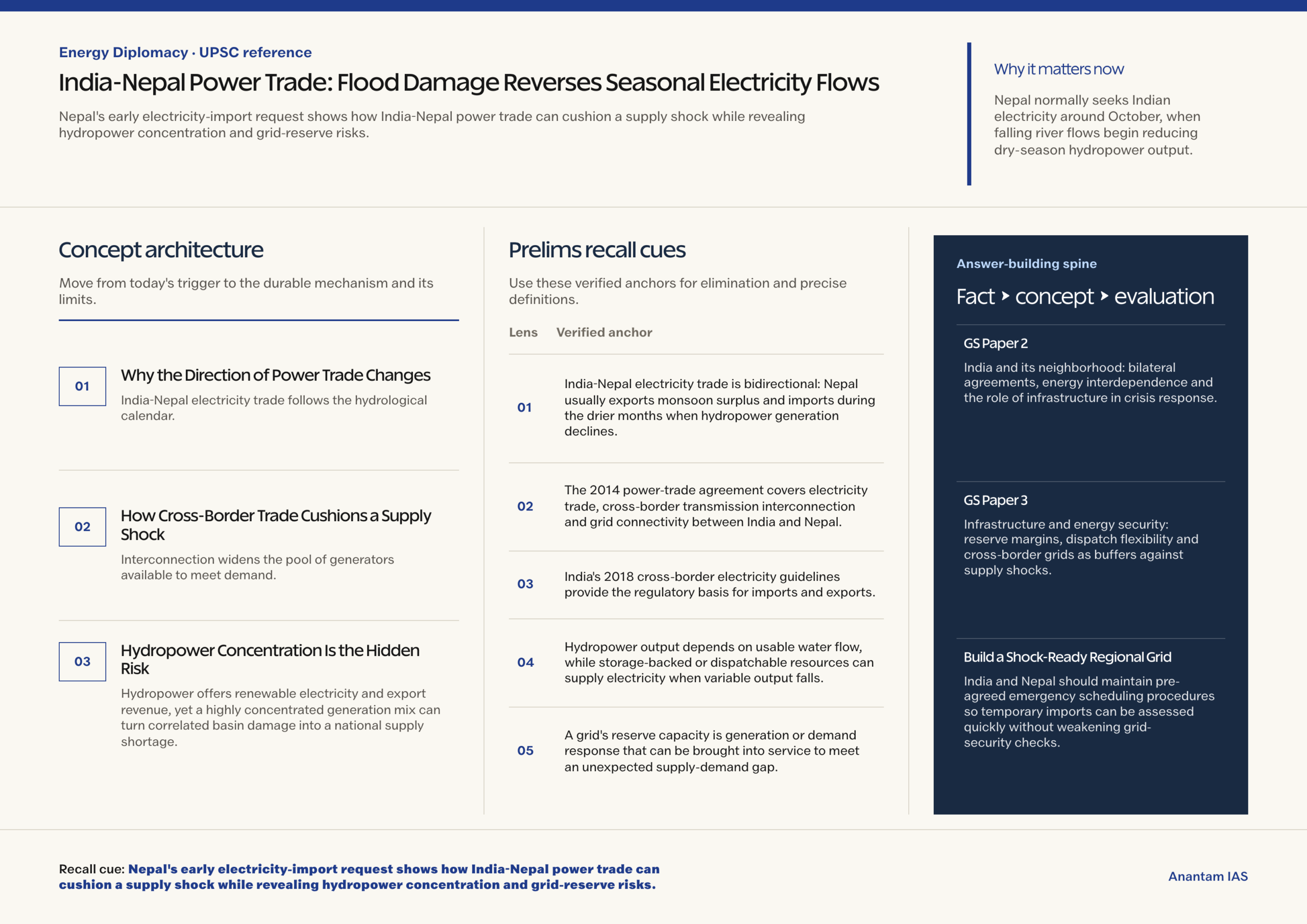
- India-Nepal electricity trade is bidirectional: Nepal usually exports monsoon surplus and imports during the drier months when hydropower generation declines.
- The 2014 power-trade agreement covers electricity trade, cross-border transmission interconnection and grid connectivity between India and Nepal.
- India’s 2018 cross-border electricity guidelines provide the regulatory basis for imports and exports; transactions require the prescribed approval and facilitation process.
- Hydropower output depends on usable water flow, while storage-backed or dispatchable resources can supply electricity when variable output falls.
- A grid’s reserve capacity is generation or demand response that can be brought into service to meet an unexpected supply-demand gap.
Mains Relevance
GS Paper 2
- India and its neighborhood: bilateral agreements, energy interdependence and the role of infrastructure in crisis response.
- Regional cooperation through rules-based electricity markets, coordinated system operation and mutually beneficial transmission connectivity.
GS Paper 3
- Infrastructure and energy security: reserve margins, dispatch flexibility and cross-border grids as buffers against supply shocks.
- Disaster management: reducing correlated infrastructure risk where several generating assets share the same river basin or hazard exposure.
Essay
- Interdependence becomes strategic resilience when institutions allow shared infrastructure to reverse direction during a crisis.
Background and Context
Why the Direction of Power Trade Changes
India-Nepal electricity trade follows the hydrological calendar, so the same transmission corridor can carry seasonal surplus outward and later bring support inward.
- During the monsoon, stronger river flows raise Nepal’s hydropower output. Electricity beyond domestic demand can then enter the Indian market and earn export revenue.
- During the dry season, weaker flows reduce output from run-of-river plants. Nepal then imports electricity to bridge its domestic supply-demand gap as firm availability falls.
- Flood damage advanced this normal reversal. The important change was timing, not a new trade channel, because the corridor already supported movement in both directions.
- A bidirectional line works like a shared reserve corridor: it carries power toward the system facing scarcity, subject to available capacity and secure operating schedules.
- Commercial schedules still depend on available transmission capacity, approved transactions and secure grid operation at each interconnection; physical connectivity alone doesn’t guarantee electricity delivery.
How Cross-Border Trade Cushions a Supply Shock
Interconnection widens the pool of generators available to meet demand, but system operators must still balance supply and consumption continuously across both grids.
- When Nepalese output falls, approved imports can substitute electricity from the Indian grid without waiting for damaged generating units and their evacuation lines to return.
- India simultaneously receives less imported hydropower. Its own reserve capacity must replace that energy while keeping generation and demand matched in real time.
- Reserves matter because electricity systems cannot store every unit at grid scale; operators must activate flexible generation or demand response when scheduled supply disappears.
- A cross-border grid spreads risk only when the connected system has spare generation, operating flexibility, approval to schedule supply and transmission headroom at the required time.
- Nepal’s request and India’s reported reserve position are linked: one system seeks support while the other assesses safe supply, domestic adequacy and network constraints.
Hydropower Concentration Is the Hidden Risk
Hydropower offers renewable electricity and export revenue, yet a highly concentrated generation mix can turn correlated basin damage into a national supply shortage.
- Several plants can share the same river system, access roads, substations and transmission corridors. One regional shock may impair both generation and power-evacuation infrastructure together.
- Installed capacity isn’t the same as firm capacity, meaning power reliably available during stressed conditions. Seasonal water, outages and damaged transmission change what operators can dispatch.
- Run-of-river projects have less ability than large storage plants to shift water and generation across time, increasing exposure to seasonal variation.
- Diversification doesn’t mean abandoning hydropower. It means combining it with storage, solar, stronger transmission and import contracts that preserve firm supply during low-output or repair periods.
- The exam trap is to treat cross-border trade as permanent dependence. Properly designed, it is a reciprocal balancing arrangement whose direction changes with supply conditions.
Way Forward
Build a Shock-Ready Regional Grid
- India and Nepal should maintain pre-agreed emergency scheduling procedures so temporary imports can be assessed quickly without weakening grid-security checks.
- Joint planning should map common-mode failures, where generation, substations, roads and transmission lines can be disabled by the same event.
- Nepal should diversify firm supply through storage, complementary renewables and flexible contracts while repairing hydropower assets to higher resilience standards.
- System operators should share real-time availability, outage and river-flow information so reserve deployment and cross-border schedules rest on the same operating picture.
Conclusion
- India-Nepal power trade shows that regional connectivity is most valuable when electricity can reverse direction as seasonal surplus becomes temporary scarcity.
- A strong Mains answer should connect energy diplomacy with reserve capacity, diversified generation and approval-based grid operation, rather than treating transmission links as sufficient resilience.
UPSC Practice Questions
Prelims MCQ 1
With reference to India-Nepal electricity trade, consider the following statements:
- Nepal generally exports surplus electricity during the monsoon and imports electricity during the drier months.
- A request for cross-border electricity imports automatically becomes an approved transaction once submitted.
- Reserve capacity can help a connected grid replace an unexpected reduction in imported electricity.
How many of the above statements are correct?
(a) Only one (b) Only two (c) All three (d) None
Answer: (b) Only two
Explanation:
Statements 1 and 3 are correct. Cross-border transactions follow an approval and facilitation framework; submitting a request doesn’t itself amount to approval.
Prelims MCQ 2
Which one of the following best explains hydropower concentration risk in an electricity system?
(a) Hydropower plants cannot connect to regional electricity markets (b) A common river-basin shock can reduce output from several plants at the same time (c) Hydropower always produces more electricity in the dry season (d) Cross-border transmission permits electricity to flow in only one direction
Answer: (b) A common river-basin shock can reduce output from several plants at the same time
Explanation:
Generation concentrated in hydropower assets with shared geographic exposure can suffer correlated outages, creating a larger system-wide shortfall.
UPSC Mains Questions
- Cross-border electricity trade can convert regional interdependence into a buffer against climate-related supply shocks. Discuss with reference to India-Nepal power cooperation.
- Hydropower-led energy transitions require both regional grids and domestic generation diversification. Critically examine.
Sources: The Indian Express and Central Electricity Authority.
Frequently Asked Questions
Why does Nepal both export electricity to and import electricity from India?
Nepal’s hydropower output rises with monsoon river flows, creating exportable surplus, but declines in drier months. The same cross-border network can then carry Indian electricity into Nepal.
Did India approve Nepal’s request for earlier electricity imports?
No approval was reported in the source. Nepal requested earlier approval, and Indian authorities were reported to be processing that request under the existing cross-border electricity framework.
What is reserve capacity in a power grid?
Reserve capacity is generation or demand response that can be activated when scheduled supply falls or demand rises unexpectedly, helping operators maintain the continuous balance required for grid stability.
Why is dependence on hydropower a concentration risk?
Hydropower assets may share river basins, roads and transmission corridors. Seasonal low flows or one regional shock can reduce several plants together, cutting firm electricity availability.
How can cross-border electricity trade improve disaster resilience?
It gives an affected country access to generators outside the damaged area. The benefit depends on spare generation, transmission headroom, approvals and coordination between system operators.
Tell Google you want more of this.
Add Anantam IAS as a preferred sourceOne tap, and this site shows up more often in your own Top Stories, AI Overviews and AI Mode. Remove it any time.