New EPF Scheme 2026: What changes for provident fund subscribers
Why in News?
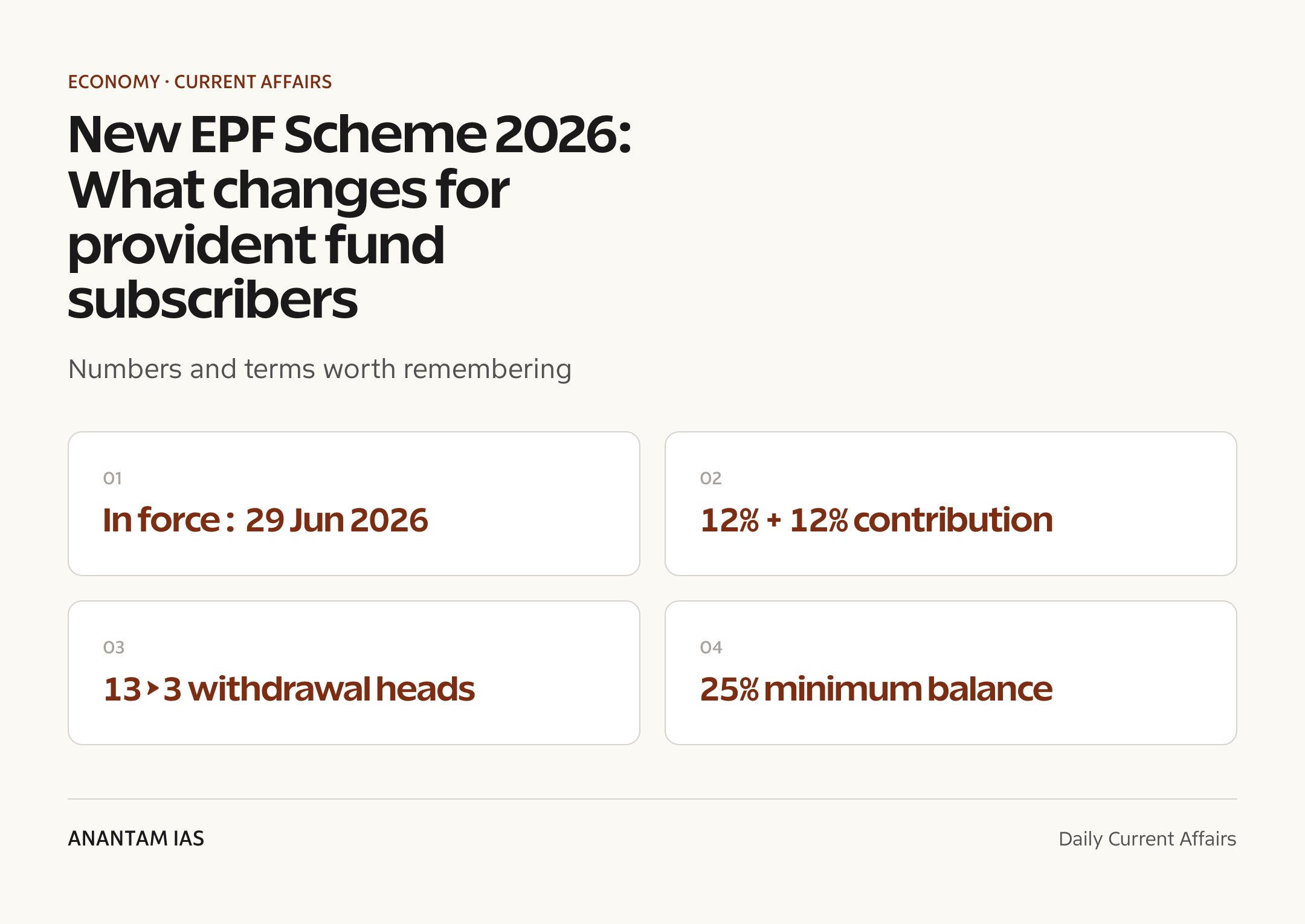
The Centre has notified the Employees’ Provident Funds Scheme, 2026, replacing the Employees’ Provident Funds Scheme, 1952 — the rulebook that has governed India’s largest retirement fund for over seven decades. The Ministry of Labour and Employment’s move is part of implementing the Code on Social Security, 2020, and the new scheme came into effect from June 29, 2026 with its publication in the Gazette, as The Indian Express reported.
The consolidated scheme folds in the withdrawal reforms the EPFO approved in October 2025 — three simplified withdrawal categories and a 25% minimum balance — while keeping the contribution rate unchanged at 12%. It also introduces, for the first time, the concept of a principal employer who carries ultimate responsibility for the provident fund dues of contract workers.
- EPF Scheme, 2026 notified under the Code on Social Security, 2020; effective from June 29, 2026.
- It supersedes the EPF Scheme, 1952; the Employees’ Pension Scheme, 2026 and EDLI Scheme, 2026 were notified alongside.
- Withdrawal categories streamlined from 13 to 3 — essential needs, housing needs and special circumstances — with a 25% minimum balance requirement.
- Contribution rate stays at 12% of wages each from employer and employee (10% for certain notified establishments).
- Employers must deposit both contributions plus administrative charges within 15 days of the close of every month.
- For contract workers, the principal employer carries ultimate responsibility for contributions even when a contractor makes the payment.
The development matters in the context of:
- The notification operationalises the social-security pillar of the four labour codes, which PIB confirmed were brought into force from November 21, 2025, rationalising 29 central labour laws.
- The EPF corpus is the default retirement vehicle for India’s organised workforce — news reports put active subscribers at nearly 8 crore — so any change to contribution and withdrawal rules has economy-wide savings implications.
- The scheme is a live test case of how the Code on Social Security, 2020 translates statute into subordinate legislation — a recurring GS2/GS3 theme.
UPSC Relevance
Prelims Relevance
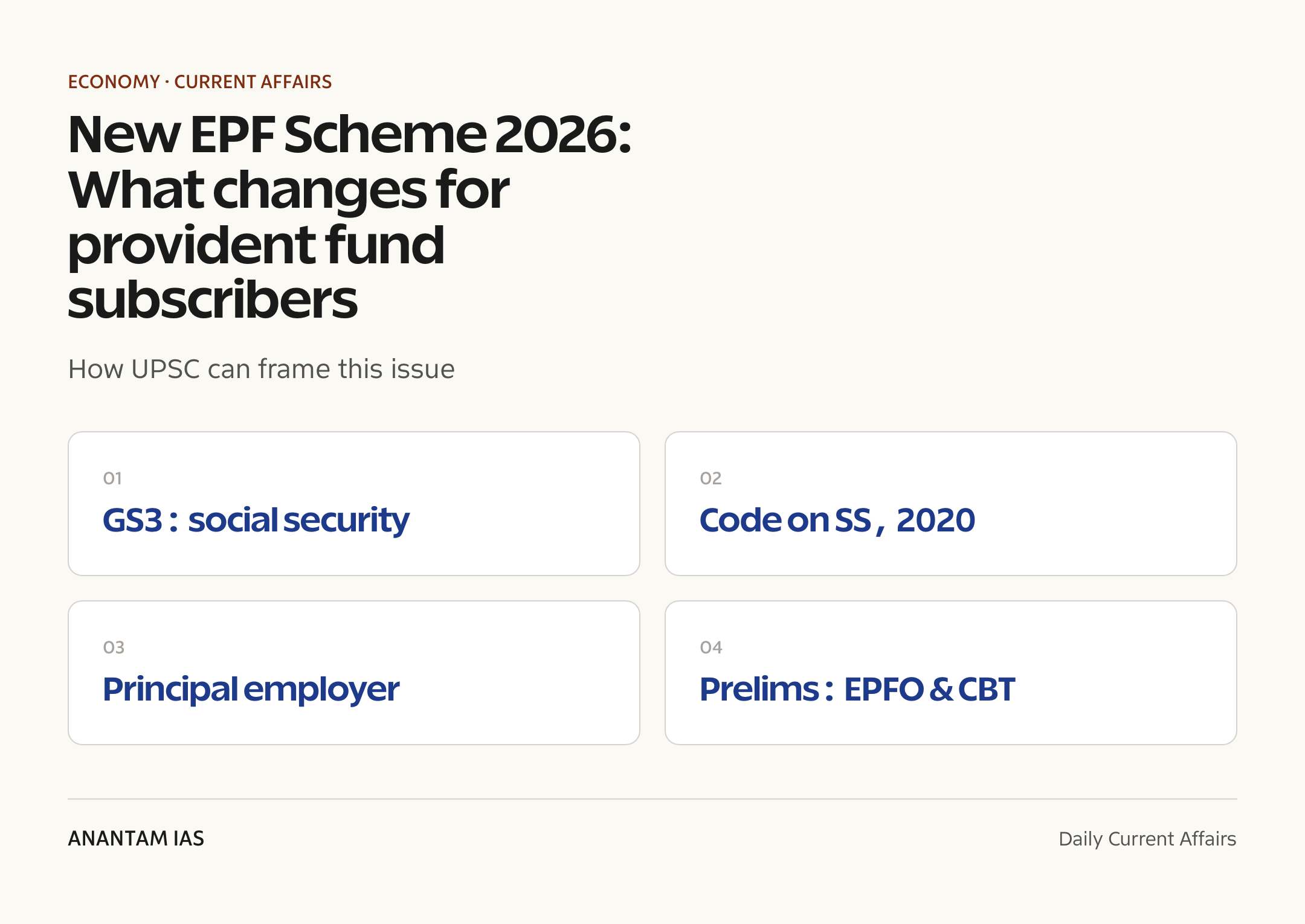
- EPF Scheme, 2026 — notified under the Code on Social Security, 2020; effective June 29, 2026; replaces the EPF Scheme, 1952.
- Three withdrawal categories — essential needs (illness, education, marriage), housing needs, special circumstances; earlier there were 13.
- 25% minimum balance — mandatory floor that must stay in the fund; the withdrawable ‘100% of eligible balance’ means up to 75% of total funds.
- Contribution rate — 12% of wages each from employer and employee; 10% for certain notified establishments; mandatory only up to the statutory wage ceiling of ₹15,000 per month.
- Principal employer — introduced in the EPF scheme for the first time; ultimately responsible for contract workers’ PF contributions.
- EPFO — statutory body under the Ministry of Labour and Employment; administered by the tripartite Central Board of Trustees (CBT).
- Four labour codes — Code on Wages 2019, Industrial Relations Code 2020, Code on Social Security 2020, OSH Code 2020; effective November 21, 2025.
- International workers — mandatory EPF coverage continues; withdrawal generally only on retirement after 58 years, except under Social Security Agreements (SSAs).
- Vishwas Scheme — EPFO’s 2025 amnesty-style rationalisation of penal damages on delayed PF remittances under Section 14B.
Mains Relevance
GS Paper 3
- Social security architecture and household savings: how simplified withdrawals and voluntary contributions above the wage ceiling reshape retirement savings behaviour and take-home pay.
- Labour reforms and formalisation: the EPF Scheme, 2026 as subordinate legislation under the Code on Social Security, 2020 — continuity, codification of CBT decisions, and ease of compliance.
- Inclusion of contract labour: the principal-employer liability as a tool against PF evasion in outsourced employment.
GS Paper 2
- Governance and welfare delivery: consolidating 70-year-old subordinate rules into a single scheme; balancing liquidity for members against the pension adequacy objective.
- Statutory bodies: role of the EPFO and the tripartite Central Board of Trustees in social-security policymaking.
Essay
- Social security is the bridge between economic growth and economic dignity.
- Reforms succeed when they simplify the citizen’s interface with the State.
Background and Context
From the 1952 Scheme to the Code on Social Security
The new scheme is the subordinate-legislation leg of India’s biggest labour-law consolidation in decades.
- The Employees’ Provident Funds and Miscellaneous Provisions Act, 1952 and the schemes under it (EPF 1952, EPS 1995, EDLI 1976) governed provident fund, pension and insurance for organised-sector workers for over 70 years.
- Parliament subsumed the 1952 Act into the Code on Social Security, 2020 — one of the four labour codes that replaced 29 central labour laws.
- PIB confirmed the four codes took effect from November 21, 2025; the EPF Scheme, 2026 is the machinery that makes the Code’s provident-fund chapter operational.
- Alongside it, the government notified the Employees’ Pension Scheme, 2026 and the Employees’ Deposit Linked Insurance Scheme, 2026, completing the trio of EPFO-run schemes.
- The 2026 scheme largely codifies continuity: it absorbs decisions already taken by the EPFO’s Central Board of Trustees, rather than inventing new rules from scratch.
Simplified Withdrawals: Three Categories, One Minimum Balance
The scheme writes into law the withdrawal overhaul the EPFO board cleared in October 2025.
- In October 2025, the EPFO’s 238th CBT meeting collapsed 13 partial-withdrawal categories into 3: essential needs (illness, education, marriage), housing needs, and special circumstances.
- A 25% minimum balance of aggregate contributions must always remain in the fund — it keeps earning interest and protects the retirement corpus.
- Illness (self or family): withdraw up to 100% of the eligible member balance after 12 months of membership. Since 25% is locked, that effectively means up to 75% of total funds.
- Education (self or family): allowed after 12 months of membership; capped at 10 withdrawals over the membership.
- Marriage (self or family): up to 100% of eligible balance; capped at 5 withdrawals.
- Housing: purchase of a house or flat, a construction site, construction, home-loan repayment, or renovation — limited to 75% of total funds after 12 months, with a 5-withdrawal cap.
- The full 100% of the corpus can be withdrawn only after remaining unemployed for one year — a tightening aimed at preserving retirement savings.
Contributions: What Stays Mandatory, What Turns Voluntary
Rates don’t change; the scheme instead spells out the voluntary layer above the wage ceiling.
- The contribution rate stays at 12% of wages each from employer and employee, with 10% for certain establishments notified by the central government.
- Mandatory contributions apply only up to the statutory wage ceiling of ₹15,000 per month — so the compulsory employee contribution is capped at ₹1,800 a month regardless of actual salary.
- The scheme now explicitly states that employees may voluntarily contribute on wages above the ceiling, or at a rate higher than 12%; employers may make matching contributions but aren’t obliged to.
- Both sides can later reduce or discontinue voluntary contributions — flexibility that, as EY India’s Puneet Gupta noted in The Indian Express, lets workers restructure savings and raise take-home pay.
- An official quoted by the paper stressed that nothing new has been made mandatory — the provision codifies existing practice on voluntary contributions.
- The employer pays additional administrative charges on wages on which voluntary contributions are made.
Contract Workers and the Principal Employer
The most novel provision fixes PF accountability in outsourced employment chains.
- The concept of a principal employer enters the EPF scheme for the first time, in line with the labour codes.
- For workers employed directly or through an unregistered contractor, the employer must pay both the employer’s and the employee’s contribution, plus administrative charges, within 15 days of the close of each month.
- Where a registered contractor remits the PF, the ultimate responsibility for the contributions still rests with the principal employer.
- This targets a chronic evasion gap: contract and outsourced workers — a growing share of organised employment — often fell through the cracks when contractors defaulted.
- It complements the Code’s wider push to extend cover to gig, platform and informal workers, who historically sat outside the EPF net.
International Workers and Continuity Provisions
Cross-border employees stay inside the fund, on the same restrictive exit terms.
- Mandatory EPF coverage of international workers in covered establishments is retained.
- Existing international workers who were members under the EPF Scheme, 1952 automatically continue as members under the 2026 scheme.
- Their withdrawals are generally allowed only on retirement after 58 years of age — except where a bilateral Social Security Agreement (SSA) permits earlier repatriation of contributions.
- SSAs matter for Indian professionals abroad too: they prevent double social-security contributions and totalise service periods across countries.
EPFO: The Institution Behind the Fund
The scheme is administered by one of the world’s largest social-security organisations.
- The Employees’ Provident Fund Organisation (EPFO) functions under the Ministry of Labour and Employment and administers the EPF, pension and insurance schemes.
- Policy is set by the tripartite Central Board of Trustees (CBT) — government, employer and employee representatives — chaired by the Union Labour Minister.
- News reports place EPFO’s active subscriber base at nearly 8 crore, making the fund a systemic pool of household savings channelled into government securities and, partly, equity ETFs.
- Recent EPFO reforms sit alongside the scheme: the Vishwas Scheme rationalising penal damages on delayed remittances, digital life certificates for pensioners, and faster auto-settlement of claims.
- The EPF’s assured, tax-favoured return keeps it central to India’s retirement debate — contrast it with the NPS-linked questions in the OPS vs NPS vs UPS discussion.
Significance and the Watch-Points
Codification brings clarity, but the fine print carries trade-offs worth flagging.
- Ease of compliance: one consolidated scheme replaces seven decades of accreted amendments — simpler for employers, clearer for members.
- Liquidity vs adequacy: easier partial withdrawals help households handle illness or education shocks, but every rupee withdrawn early compounds into a smaller retirement corpus; the 25% floor is the counterweight.
- Formalisation dividend: principal-employer liability should push PF coverage deeper into contract-heavy sectors like construction, security and facility management.
- Voluntary-contribution clarity could nudge higher earners to treat EPF as a top-up savings vehicle — or, conversely, let employers restructure pay to trim PF outgo to the ₹15,000 ceiling.
- Implementation risk: state rules under the labour codes are still being aligned, and the wage definition under the codes (basic pay at least 50% of total remuneration) will decide the real contribution base.
Way Forward
Protect the retirement corpus
- Pair liberal withdrawals with default nudges — auto-restoration plans and clear projections of the retirement cost of each early withdrawal.
- Review the ₹15,000 wage ceiling, unchanged since 2014, so mandatory cover keeps pace with wage growth.
Make principal-employer liability work
- Build a real-time contractor-compliance dashboard so principal employers can verify remittances before releasing contractor payments.
- Extend awareness drives to contract workers on checking UAN-linked passbooks, so evasion is caught by the worker, not just the inspector.
Deepen coverage
- Use the Code on Social Security’s enabling provisions to fold gig and platform workers into contributory social security with aggregator-funded contributions.
- Speed up Social Security Agreements with major destination countries so Indian workers abroad don’t pay twice.
Conclusion
The EPF Scheme, 2026 is less a revolution than a consolidation — it retires a 1952 rulebook, absorbs the withdrawal reforms already approved by the EPFO board, and gives statutory shape to practices like voluntary contributions above the wage ceiling. For nearly 8 crore subscribers, the day-to-day experience changes most visibly at the point of withdrawal: three clean categories, a 25% locked floor, and clearer caps.
The provision to watch is principal-employer liability. If enforced well, it could close the oldest leak in India’s social-security pipe — the contract worker whose PF nobody owned. That, more than any rate or ceiling, will decide whether the new scheme widens the safety net or merely tidies its rulebook.
UPSC Practice Questions
Prelims MCQ 1
With reference to the Employees’ Provident Funds Scheme, 2026, consider the following statements:
- It has been notified under the Code on Social Security, 2020 and replaces the Employees’ Provident Funds Scheme, 1952.
- It reduces the mandatory provident fund contribution rate from 12% to 10% of wages for all establishments.
- It consolidates partial-withdrawal grounds into three categories, subject to a minimum balance of 25% of total contributions.
How many of the above statements are correct?
(a) Only one (b) Only two (c) All three (d) None
Answer: (b) Only two
Explanation:
Statements 1 and 3 are correct. Statement 2 is wrong — the contribution rate is unchanged at 12% (10% applies only to certain establishments notified by the central government, as before).
Prelims MCQ 2
Under the EPF Scheme, 2026, when the provident fund contribution of a contract worker is remitted by a registered contractor, the ultimate responsibility for the contribution rests with:
(a) The contractor alone (b) The principal employer (c) The EPFO regional office (d) The worker, through voluntary deposits
Answer: (b) The principal employer
Explanation:
The 2026 scheme introduces the labour-code concept of the principal employer into EPF rules for the first time: even where the contractor pays, ultimate liability for contract workers’ contributions stays with the principal employer.
UPSC Mains Questions
- The Employees’ Provident Funds Scheme, 2026 consolidates rather than transforms India’s provident fund architecture. Examine the key changes it introduces and evaluate how far they balance members’ liquidity needs against the goal of retirement-income adequacy.
- The introduction of principal-employer liability in the EPF Scheme, 2026 addresses a structural gap in social-security coverage of contract workers. Discuss its significance and the implementation challenges in contract-labour-intensive sectors.
- Subordinate legislation determines whether labour codes deliver on their promise. With reference to the schemes notified under the Code on Social Security, 2020, analyse the challenges of translating consolidated labour statutes into effective social-security delivery.
Sources: Ministry of Labour and Employment (Akashvani News) and Indian Express Explained.
Frequently Asked Questions
What is the EPF Scheme, 2026?
It is the new consolidated provident fund scheme notified by the Ministry of Labour and Employment under the Code on Social Security, 2020. Effective June 29, 2026, it replaces the Employees’ Provident Funds Scheme, 1952 and was notified alongside new pension (EPS 2026) and insurance (EDLI 2026) schemes.
Has the EPF contribution rate changed?
No. The rate stays at 12% of wages each from employer and employee, with 10% for certain notified establishments. Mandatory contributions apply only up to the ₹15,000 monthly wage ceiling; contributions above the ceiling or above 12% are voluntary, with optional employer matching.
What are the new withdrawal categories?
Thirteen partial-withdrawal grounds have been merged into three: essential needs (illness, education, marriage), housing needs, and special circumstances. Members must always keep a minimum balance of 25% of total contributions in the fund, so the withdrawable ‘eligible balance’ is effectively up to 75%.
When can the full PF corpus be withdrawn?
The complete 100% of the corpus can be withdrawn after remaining unemployed for one year, or on retirement. Partial withdrawals for illness, education, marriage and housing are allowed after 12 months of membership, subject to category-wise caps of 5 or 10 withdrawals.
What is the principal employer provision?
For the first time, the EPF scheme makes the principal employer ultimately responsible for contract workers’ provident fund contributions, even when a contractor remits them. Contributions and administrative charges must be deposited within 15 days of the close of each month.
How does the scheme treat international workers?
Mandatory EPF coverage of international workers continues, and 1952-scheme members carry over automatically. They can generally withdraw only on retirement after age 58, unless a bilateral Social Security Agreement between India and their home country allows earlier withdrawal.