National Food Security Act Amendment: What Changes for Antyodaya Entitlements
Why in News?
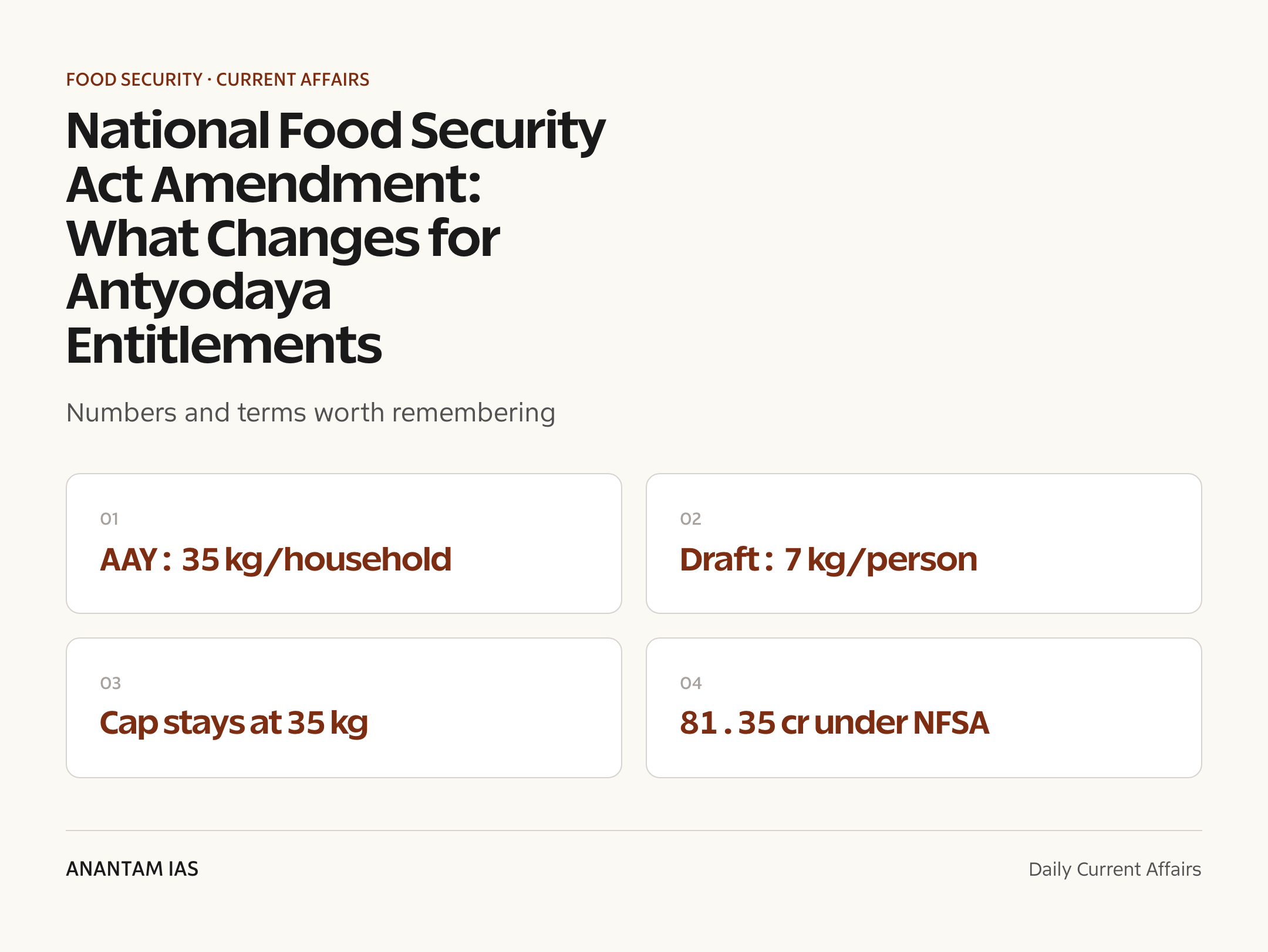
The Department of Food and Public Distribution has circulated the draft National Food Security (Amendment) Bill, 2026, proposing to replace the flat 35 kg monthly foodgrain quota of Antyodaya Anna Yojana (AAY) households with a per-person entitlement of 7 kg, subject to a ceiling of 35 kg per household. Public comments on the draft are open till 13 July 2026.
The Hindu reported that Tamil Nadu Chief Minister C. Joseph Vijay wrote to the Prime Minister on 6 July 2026 urging the Centre to retain the household-based norm, warning that the change would shrink the rations of nearly 70 lakh of the state’s most vulnerable citizens. The letter has turned a technical proviso into a national debate on how India designs food entitlements for its poorest.
- The draft amends the first proviso to Section 3(1) of the National Food Security Act, 2013 — the clause that guarantees every AAY household 35 kg of foodgrains per month irrespective of family size.
- Proposed formula: 7 kg per person per month, capped at 35 kg per household; the Department of Food and Public Distribution has invited stakeholder comments till 13 July 2026.
- The Centre’s stated aim is to remove intra-category inequities: small AAY households now draw far more grain per head than large ones, whose per-capita share can fall below the 5 kg that priority households receive.
- Tamil Nadu has 18,64,600 AAY ration cards covering 69,26,983 beneficiaries; with an average family size of 3.54, a typical AAY household in the state would draw about 25 kg instead of 35 kg.
- The Chief Minister’s letter argues that a per-capita formula with a household ceiling penalises states with smaller families — the very states that delivered on family planning goals.
The development matters in the context of:
- The proposal tests whether a rights-based food law can be re-engineered in the name of equity without diluting its last-resort protection for the poorest.
- The southern states’ objection mirrors the delimitation debate: demographic success translating into a smaller share of national resources.
- It lands at a moment when NFSA coverage is still frozen at Census 2011 numbers and foodgrains are free for all beneficiaries under PMGKAY till December 2028.
UPSC Relevance
Prelims Relevance
- NFSA, 2013: legal entitlement to subsidised foodgrains for up to 75% of the rural and 50% of the urban population — about two-thirds of India, roughly 81.35 crore people.
- Two beneficiary categories: Antyodaya Anna Yojana (AAY) households and Priority Households (PHH); PHH members get 5 kg per person per month.
- The AAY quota flows from the first proviso to Section 3(1): 35 kg per household per month, regardless of family size.
- AAY was launched on 25 December 2000 for the poorest of the poor; the quota rose from 25 kg to 35 kg in 2002; about 2.37 crore households hold AAY cards today.
- Draft National Food Security (Amendment) Bill, 2026: 7 kg per person with a 35 kg household ceiling; floated by the Department of Food and Public Distribution.
- NFSA issue prices — ₹3/₹2/₹1 per kg for rice, wheat and coarse grains — stand suspended: grain is free under PMGKAY since 1 January 2023, extended till 31 December 2028.
- The 7-kg figure tracks the revised ICMR guideline of 250 g of cereals per adult per day, about 7.5 kg a month.
- Other NFSA features: the eldest woman (18+) as head of household, a ₹6,000 maternity benefit, a food security allowance, and State Food Commissions for grievance redressal.
- One Nation One Ration Card (ONORC) makes NFSA entitlements portable across all 36 states and UTs; food supply and distribution sit in Entry 33 of the Concurrent List.
Mains Relevance
GS Paper 2
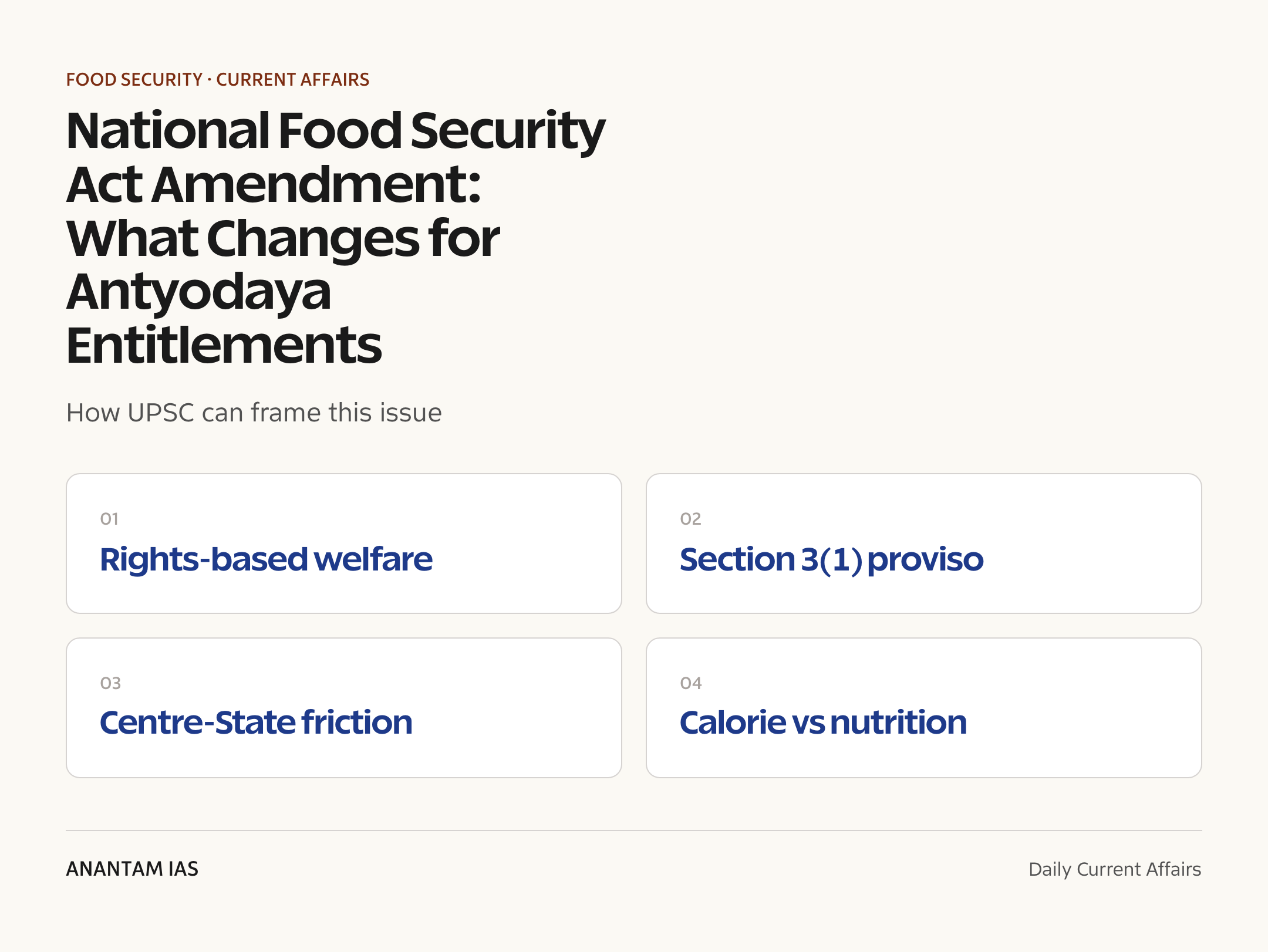
- Welfare design for vulnerable sections: household-based vs per-capita entitlements, and the equity trade-offs built into each.
- Federalism in welfare: a central law implemented by states, amended without formal state concurrence — the consultation gap in shared-responsibility schemes.
- Rights-based governance: NFSA as the statutory face of the right to food read into Article 21 since PUCL v. Union of India (2001).
GS Paper 3
- Food security economics: FCI operations, buffer stocks and the fiscal arithmetic of a free-grain regime under PMGKAY.
- Calorie security vs nutrition security: a cereal-centric PDS and the absent pulses-and-oils basket.
Essay
- Welfare design as moral choice: what a society owes its poorest when arithmetic and empathy collide.
- Demographic success and its penalties: the paradox of states punished for performing.
Background and Context
NFSA 2013: The Rights-Based Architecture
The 2013 Act converted food from a discretionary welfare handout into an enforceable legal right.
- The National Food Security Act, 2013 entitles up to 75% of the rural and 50% of the urban population to subsidised foodgrains through the Targeted Public Distribution System (TPDS).
- That works out to about 81.35 crore people — two-thirds of the population as counted in Census 2011.
- Beneficiaries fall into two buckets: AAY (the poorest of the poor) and Priority Households; states identify eligible families while the Centre allocates grain through the Food Corporation of India (FCI).
- The legal core is Section 3(1): 5 kg per person per month for priority households; its first proviso protects the AAY quota of 35 kg per household.
- The Act codified what the Supreme Court had been building since PUCL v. Union of India (2001) — a right to food derived from Article 21.
- Beyond grain: a ₹6,000 maternity entitlement, meals for children up to 14 years, the eldest woman as head of household, and grievance redressal through State Food Commissions.
- Since 1 January 2023 the grain has been free under PMGKAY, a regime extended to December 2028.
Antyodaya Anna Yojana: Who the 35 kg Protects
AAY is the deepest layer of India’s food safety net — deliberately simple, unconditional and household-based.
- Launched on 25 December 2000 to reach the poorest of the poor; the initial 25 kg household quota was raised to 35 kg from 2002.
- Eligibility targets acute distress: households headed by widows or the terminally ill, persons with disabilities, elderly persons without assured income, vulnerable tribal groups, landless labourers and daily-wage earners.
- About 2.37 crore AAY households — nearly 8.9 crore people — hold these cards nationwide.
- The design logic, as the Tamil Nadu letter puts it, was last-resort protection: an assured, unconditional quantum so that no family, whatever its size, faces hidden hunger.
- For most AAY families the PDS ration is not a supplement but the staple for all three meals; open-market substitution is unaffordable.
What the Draft Amendment Actually Changes
One proviso, one formula change — and a very different distribution of grain across household sizes.
- The draft rewrites the first proviso to Section 3(1): every person in an AAY household gets 7 kg per month, with the household capped at 35 kg.
- A single-person household drops from 35 kg to 7 kg; a two-member household to 14 kg; a four-member household to 28 kg.
- Households of five or more members stay at 35 kg — the cap means a six-member family entitled to 42 kg on the per-person formula still draws 35 kg, under 6 kg per head, barely above the priority-household norm.
- Tamil Nadu’s average family size of 3.54 means the typical AAY household there would draw about 25 kg — a cut of nearly 30%.
- The government anchors the 7-kg figure in the revised ICMR norm of 250 g of cereals per adult per day; the earlier norm was 400 g.
- Down To Earth reported that the draft justifies the change as removing intra-category inequities, since smaller AAY households currently receive far more grain per head than larger ones.
The Equity Argument — and Its Critics
Both sides claim fairness; they disagree on what the baseline for fairness should be.
- The Centre’s case: a household norm gives a one-member family 35 kg and a seven-member family 5 kg per head — per-capita rationalisation treats equals equally.
- Critics answer that the 35 kg cap contradicts the per-capita logic itself: if the entitlement is individual, larger households should not be truncated.
- The amendment covers cereals only — no pulses, no edible oil — while the ICMR’s lower cereal norm assumes a diversified diet the poorest cannot buy.
- Food-rights researchers told Down To Earth that actual cereal consumption among poor households runs to 400–500 g a day, making 250 g an unrealistic policy baseline.
- Development economists concede one point: many single-member AAY households genuinely do not need 35 kg a month — the anomaly is real even if the fix is contested.
- A lower aggregate entitlement also trims the food subsidy bill at a time when grain is free under PMGKAY — a fiscal gain that critics read as the quiet driver of the reform.
The Federal Fault Line
A single central formula meets very different state demographies — and the smaller-family states lose most.
- Tamil Nadu’s letter, reported by The Hindu, says the change would shrink rations for nearly 70 lakh people across 18.65 lakh AAY cards in the state.
- Southern states average 3–4 members per family against 4–5 in the north; a per-capita formula with a cap cuts deepest where family planning succeeded.
- The grievance rhymes with the delimitation debate: performance on population policy translating into smaller shares of central resources.
- Under the NFSA, states identify beneficiaries and run fair price shops while the Centre sets entitlements and allocates grain — food is a shared enterprise under Entry 33 of the Concurrent List.
- Tamil Nadu runs a universal PDS that predates the NFSA and tops up central norms; a shrunken central quota shifts the fiscal burden of protection onto state budgets.
- The letter’s core ask is procedural as much as substantive: consult states before amending a law they must implement.
The Wider PDS Reform Canvas
The AAY debate sits inside a larger set of unresolved food-security questions.
- NFSA coverage is still pegged to Census 2011; researchers Reetika Khera, Jean Drèze and Meghana Mungikar estimated in 2021 that over 10 crore people are excluded because the quotas were never updated.
- Down To Earth has reported how e-KYC and biometric authentication drives lock out the elderly, manual labourers and people without stable addresses — exclusion by technology rather than by design.
- ONORC has made rations portable across all 36 states and UTs, a real gain for migrant workers.
- The Shanta Kumar Committee (2015) had recommended trimming NFSA coverage to around 40% and restructuring the FCI — the opposite direction from the expansion that food-rights groups demand.
- Nutrition outcomes remain the weak link: a cereal-heavy PDS coexists with stubborn child stunting and anaemia.
- Poverty measurement has moved to multidimensional metrics — see the Multidimensional Poverty Index — while PDS targeting still leans on decade-old beneficiary lists.
Way Forward
Fix the anomaly without lowering the floor
- Adopt the per-capita principle but remove or raise the 35 kg cap, so larger households gain rather than merely not losing.
- Add a no-loss grandfathering clause: no existing AAY household should draw less than its current entitlement.
- Publish a state-wise impact assessment of the formula before finalisation, not after.
Move from calorie security to nutrition security
- Pair any cereal rationalisation with pulses, millets and edible oil in the AAY basket, as food-rights experts have long demanded.
- Align PDS design with POSHAN 2.0 and the ICMR’s dietary-diversity logic — if the cereal quantum falls, non-cereal support must rise.
Repair the process and the data
- Institutionalise Centre-State consultation — a standing mechanism or pre-legislative reference before amendments to shared welfare laws.
- Re-base NFSA coverage on Census 2027 data as soon as it is available, ending the Census-2011 freeze.
- Audit and fix e-KYC exclusions: an authentication failure should trigger assisted delivery, not denial of grain.
Conclusion
The draft amendment is not a trivial tidying-up. The 35-kg household quota was the NFSA’s bluntest and most protective instrument — blunt because it ignored family size, protective for the same reason. Replacing it with a capped per-capita formula redistributes grain away from small households — often headed by widows or the elderly — that the Antyodaya Anna Yojana was invented to shield.
The way through is not to freeze the status quo but to fix the anomaly generously: per-capita entitlements without a regressive cap, a nutrition basket that goes beyond cereals, and a federal process that treats states as co-authors of food security rather than as implementing agencies. How the Centre responds after the consultation closes on 13 July will show which version of equity it has in mind.
UPSC Practice Questions
Prelims MCQ 1
With reference to the National Food Security Act (NFSA), 2013, consider the following statements:
- The Act legally entitles up to 75 per cent of the rural population and 50 per cent of the urban population to subsidised foodgrains.
- Under the Act, Antyodaya Anna Yojana households receive 35 kg of foodgrains per household per month, while priority households receive 5 kg per person per month.
- The Antyodaya Anna Yojana was created by the National Food Security Act, 2013.
How many of the above statements are correct?
(a) Only one (b) Only two (c) All three (d) None
Answer: (b) Only two
Explanation:
Statements 1 and 2 are correct — they state the NFSA’s coverage ratios and the two entitlement categories. Statement 3 is incorrect: AAY was launched on 25 December 2000 as a scheme for the poorest of the poor; the NFSA, 2013 later absorbed and protected its 35-kg household entitlement through the first proviso to Section 3(1).
Prelims MCQ 2
The draft National Food Security (Amendment) Bill, 2026 proposes which of the following changes for Antyodaya Anna Yojana households?
(a) Replacing foodgrain entitlements with direct cash transfers (b) Raising the household entitlement from 35 kg to 42 kg per month (c) A per-person entitlement of 7 kg per month, capped at 35 kg per household (d) Merging AAY households into the priority category at 5 kg per person
Answer: (c) A per-person entitlement of 7 kg per month, capped at 35 kg per household
Explanation:
The draft amends the first proviso to Section 3(1) of the NFSA to give every member of an AAY household 7 kg of foodgrains a month, subject to an overall ceiling of 35 kg per household. Households of five or more members keep 35 kg; all smaller households would draw less than they do now.
UPSC Mains Questions
- The proposed shift from a household-based to a per-capita foodgrain entitlement under the National Food Security Act pits horizontal equity against last-resort protection. Examine the trade-offs in the draft amendment and suggest a design that reconciles the two objectives. (250 words)
- Centrally legislated but state-implemented welfare makes food security a shared federal enterprise. In the light of states’ objections to the draft NFSA amendment, discuss the case for institutionalised Centre-State consultation in the design of welfare entitlements. (250 words)
- India’s food security challenge has moved from grain availability to entitlement design and nutritional adequacy. Discuss with reference to the Antyodaya Anna Yojana, PMGKAY and the revised ICMR dietary norms. (250 words)
Sources: Department of Food and Public Distribution and The Hindu.
Frequently Asked Questions
What is the Antyodaya Anna Yojana?
AAY, launched on 25 December 2000, is the deepest layer of the Public Distribution System, covering the poorest of the poor — about 2.37 crore households headed by widows, elderly persons, persons with disabilities, landless labourers and vulnerable tribal groups. Each household gets 35 kg of foodgrains a month, currently free under PMGKAY.
What does the draft NFSA amendment propose?
The draft National Food Security (Amendment) Bill, 2026 rewrites the first proviso to Section 3(1) of the NFSA. Instead of a flat 35 kg per AAY household, every member would get 7 kg a month, with the household capped at 35 kg. The Department of Food and Public Distribution invited public comments till 13 July 2026.
Who loses grain under the proposed formula?
Households with fewer than five members. A single-person household falls from 35 kg to 7 kg, a two-member household to 14 kg and a four-member household to 28 kg. Families of five or more keep 35 kg, though the cap denies larger families the full per-person amount.
Why is Tamil Nadu opposing the change?
The Hindu reported that the Chief Minister’s letter warns nearly 70 lakh beneficiaries across 18.65 lakh AAY cards would lose grain, because the state’s average family size is only 3.54. He argues the formula penalises states that succeeded at family planning, in a state where PDS rice is the staple food.
What do priority households get under the NFSA?
Priority households — the larger of the Act’s two categories — receive 5 kg of foodgrains per person per month. Together with AAY, the Act covers about 81.35 crore people: up to 75 per cent of the rural and 50 per cent of the urban population, based on Census 2011.
Are NFSA foodgrains free at present?
Yes. The original issue prices of ₹3, ₹2 and ₹1 per kg for rice, wheat and coarse grains were suspended from 1 January 2023, when the Centre made NFSA grain free under PMGKAY. The free-grain regime has been extended for five years, till 31 December 2028.