NHAI Plantation Rules: Linking Completion and Payments to Survival
Why in News?
On 9 September 2026, NHAI announced plantation compliance guidelines linking provisional highway completion and subsequent maintenance payments to verified planting coverage and sapling survival.
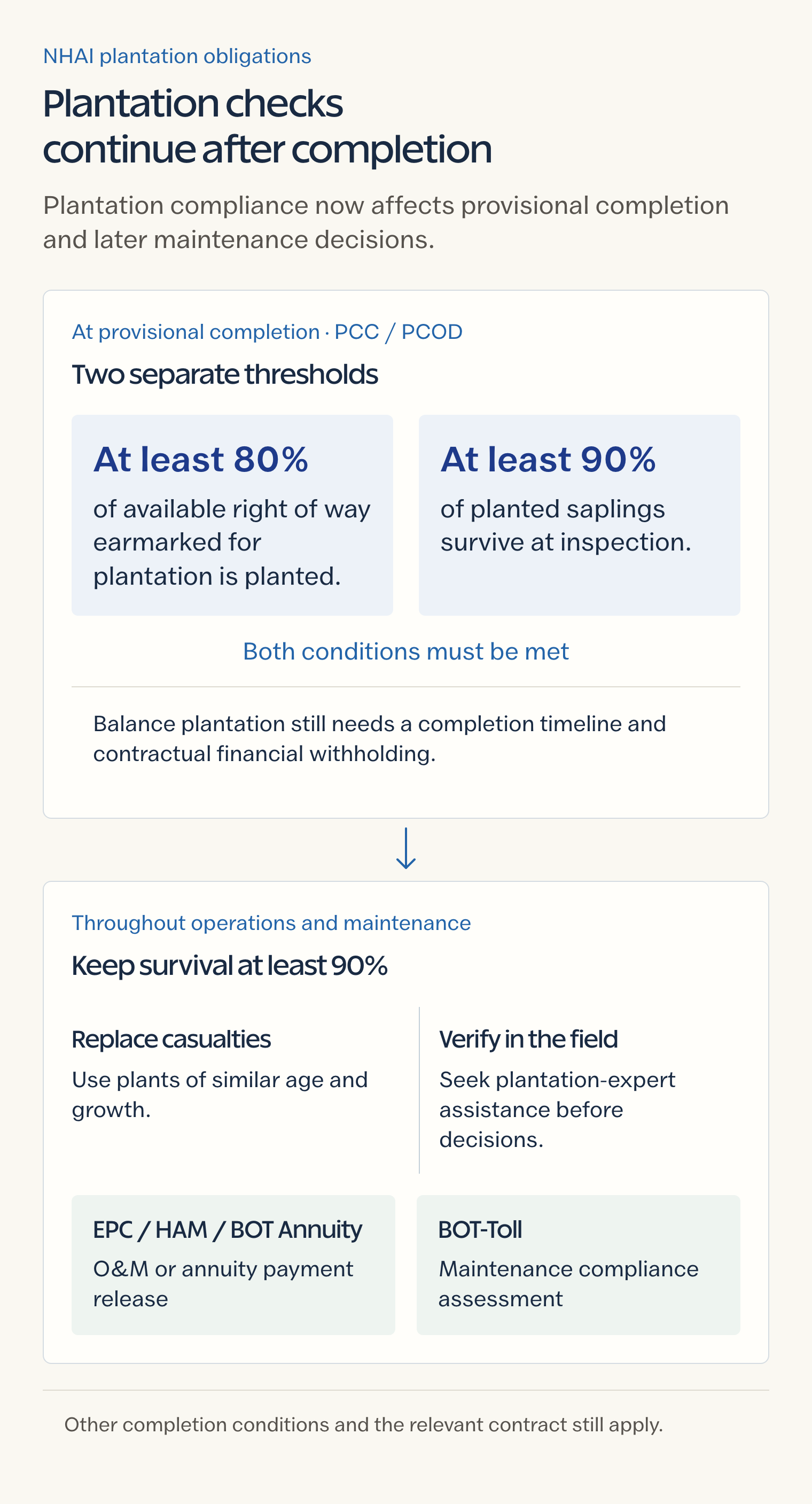
- Provisional completion requires plantation on at least 80% of available Right of Way earmarked for plantation.
- Sapling survival must reach at least 90% at inspection; this is a separate condition from the land-coverage threshold.
- Maintenance compliance carries the survival requirement into the operating period, with payment consequences under the applicable project arrangement.
- Dead plants must be replaced promptly with plants of similar age and growth.
- NHAI’s identified problem: plantation was already contractual, but received insufficient attention when provisional completion was certified.
- Policy significance: environmental obligations now face checks at project completion and during maintenance, rather than relying only on initial planting.
UPSC Relevance
Prelims Relevance
- Right of Way earmarked for plantation
- Provisional Certificate of Completion and Provisional Commercial Operation Date
- Plantation coverage versus sapling survival
- Operations and Maintenance obligations
- EPC, HAM, BOT-Annuity and BOT-Toll distinctions
Mains Relevance
GS Paper 3
- Environmental conditions in infrastructure contracts
- Performance-linked maintenance and durable public assets
GS Paper 2
- Field verification and accountability in contract implementation
Essay
- Public investment succeeds when assets remain useful after construction.
Background and Context
What the plantation thresholds actually measure
Coverage and survival answer different questions: where planting has happened, and whether planted saplings remain alive when officials inspect the work.
- Coverage concerns the available Right of Way specifically earmarked for plantation. It does not mean that trees must occupy the same share of every carriageway, shoulder or other land within a highway corridor.
- Survival concerns the planted saplings, rather than the proportion of highway land planted. A project can cover enough eligible land yet fail the separate survival test because too many of those saplings died.
- Median and avenue planting must follow the relevant contract or concession agreement and prescribed guidelines. The announcement treats landscaping and plantation as components of highway development, rather than optional additions after engineering works finish.
- Green Highways Policy, 2015 is an identified policy reference. The new directions strengthen compliance with planting obligations; they do not establish that every corridor already satisfies those obligations or has achieved lasting ecological benefits.
- Trees outside forests provide a wider conceptual link: roadside planting belongs in discussions beyond notified forests. Read the forest-inventory note separately; counting trees and enforcing their contractual maintenance address different governance problems.

How provisional completion becomes an enforcement point
The completion check joins two conditions, while financial withholding keeps the unfinished plantation obligation alive after that initial threshold is crossed.
- PCC means Provisional Certificate of Completion; PCOD means Provisional Commercial Operation Date. The plantation test applies at these provisional milestones, making environmental compliance relevant when officials assess whether the project can pass this stage.
- Both conditions must hold: plantation must cover at least 80% of the eligible available area, and saplings must show at least 90% survival at inspection. Neither condition can substitute for the other one.
- Remaining plantation must be identified with specific completion timelines. Crossing the provisional threshold does not cancel the balance of the prescribed planting target or convert that remaining obligation into work the contractor may ignore.
- Financial withholdings follow the relevant contract or concession agreement and continue until the balance plantation is completed and the prescribed target achieved. The release does not announce one uniform monetary deduction for every project.
- Field inspection makes the distinction operational: officials need evidence of eligible planted area and living saplings. Treating a planting invoice or a total sapling purchase count as proof would miss the survival condition.
Why survival remains linked to maintenance payments
The maintenance stage tests continuity, so a satisfactory inspection at provisional completion cannot settle the plantation obligation for the rest of the operating period.
- Ongoing survival must meet the minimum standard throughout Operations and Maintenance. This shifts the contractor’s incentive toward keeping plants alive after planting, instead of treating the completion inspection as the final environmental checkpoint.
- EPC, HAM and BOT-Annuity projects face the condition when O&M or annuity payments are released. In BOT-Toll projects it governs maintenance-compliance assessment; the release distinguishes these routes rather than describing identical payments everywhere.
- Replacement plants must have similar age and growth to casualties. Simply inserting very small saplings where established plants died would not satisfy the stated objective of maintaining plantation density, uniformity and corridor continuity.
- Environment and plantation expertise must support field-level verification before payment processing or maintenance certification. This adds a technical check to the administrative decision, rather than leaving compliance to unsupported claims about work performed.
- Payment design links obligations to an enforceable decision point. The railway hybrid-annuity note explains a separate financing application; it should not be used to assume these highway plantation directions automatically govern railway contracts.
Way Forward
Make each compliance decision auditable
- Record denominators: distinguish eligible available planting area, area actually planted and saplings inspected so coverage cannot conceal poor survival.
- Track the remaining obligation: connect shortfalls, completion timelines and contractual withholdings in the same inspection record.
- Verify continuity: document casualties and comparable replacements before processing maintenance payments or certification, rather than relying on completion-stage photographs.
Conclusion
- The central distinction is coverage versus survival: one measures planting across eligible land, while the other checks living saplings. The guidelines combine these measures at provisional completion and retain survival as an operating obligation.
- For a governance answer, trace the enforcement chain: define the obligation, inspect the result, identify unfinished work and connect compliance to certification or money. The announcement establishes this mechanism; successful implementation still requires credible field evidence.
UPSC Practice Questions
Prelims MCQ 1
With reference to NHAI’s new plantation compliance guidelines, consider the following statements:
- Coverage is calculated against available Right of Way earmarked for plantation.
- Meeting the provisional coverage threshold extinguishes the remaining plantation obligation.
- The prescribed survival standard continues throughout the Operations and Maintenance period.
How many of the above statements are correct?
(a) Only one (b) Only two (c) All three (d) None
Answer: (b) Only two
Explanation:
Statements 1 and 3 are correct. The remaining plantation must have completion timelines, with financial withholdings under the relevant agreement until the prescribed target is achieved.
Prelims MCQ 2
Which statement correctly describes the guidelines’ treatment of BOT-Toll projects?
(a) Plantation survival is irrelevant after provisional completion. (b) All toll revenue must be transferred to a plantation fund. (c) Survival compliance forms part of maintenance-compliance assessment. (d) Only the number of saplings purchased is inspected.
Answer: (c) Survival compliance forms part of maintenance-compliance assessment.
Explanation:
The release links BOT-Toll projects to assessment of maintenance compliance, while separately describing release of O&M or annuity payments in EPC, HAM and BOT-Annuity projects.
UPSC Mains Questions
- Explain how linking plantation compliance to provisional completion and maintenance payments can strengthen environmental accountability in highway development.
- Why should infrastructure contracts distinguish work completion from continuing asset performance? Discuss using NHAI’s plantation coverage and survival requirements.
Source: PIB, Ministry of Road Transport & Highways.
Frequently Asked Questions
What is the coverage requirement for provisional completion?
Plantation must cover at least 80% of the available Right of Way earmarked for planting. This denominator is the eligible planting area, not the entire land area of the highway corridor.
How is the survival requirement different?
A minimum 90% of planted saplings must survive at inspection. Coverage measures where planting occurred; survival measures whether the planted saplings are alive. Both conditions are needed for provisional plantation compliance.
Does provisional completion remove the remaining planting obligation?
No. Remaining plantation must be identified with completion timelines. Financial withholdings under the relevant contract or concession agreement apply until the balance plantation is completed and the prescribed target is achieved.
How do maintenance payments enter the mechanism?
O&M or annuity payments in EPC, HAM and BOT-Annuity projects depend on maintaining the survival standard. BOT-Toll projects face maintenance-compliance assessment, supported by expert verification of field conditions before certification.
What does NHAI require when plants die?
Casualties must be replaced promptly with plants of similar age and growth. The requirement aims to preserve plantation density, uniformity and continuity along the highway rather than allowing repeated loss of established planting.