Why in News?
The Indian Express reported that the PPPAC recommended six proposed freight railway lines for development under the Hybrid Annuity Model, a first for Indian Railways.
- The six proposals cover about 647 km: four lines in Odisha, one in Telangana and one in Jharkhand.
- Indian Railways would provide 40% of the bid project cost during construction, while the concessionaire would finance the remaining 60%.
- After commissioning, the authority would make annuity and indexed maintenance payments; passenger and freight earnings would accrue to Indian Railways.
- The PPPAC recommendation is not Cabinet approval, project award or construction commencement; the proposals still require competent-authority approval and subsequent procurement steps.
- The shift followed market feedback on an earlier DBFOT structure, indicating that freight-demand exposure had weakened private appetite.
- The design seeks private capital and delivery capacity without making the builder depend on uncertain freight loading or tariff decisions for repayment.
- For public policy, the key test is whether better risk allocation produces timely assets without creating poorly monitored long-term fiscal commitments.
UPSC Relevance
Prelims Relevance
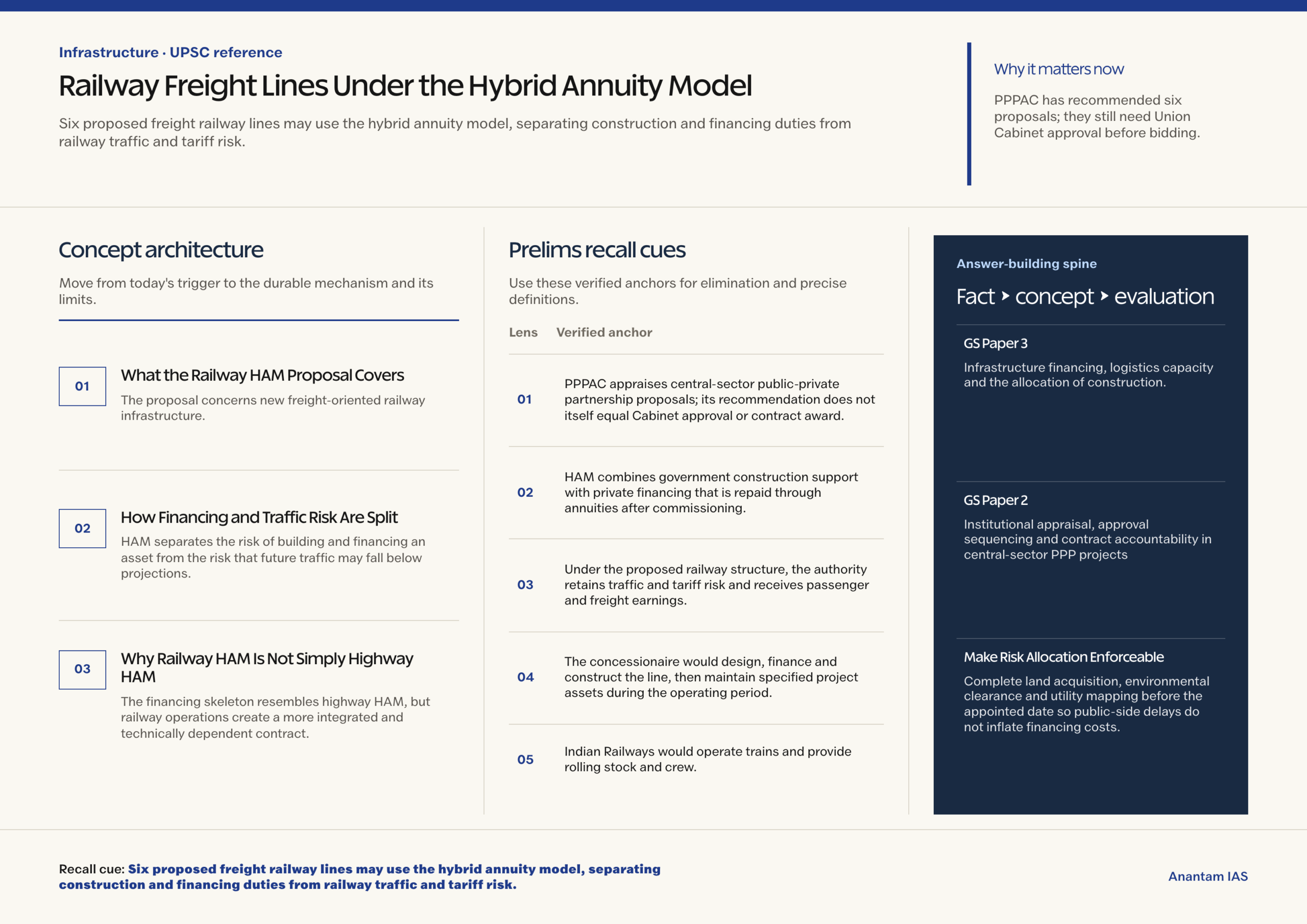
- PPPAC appraises central-sector public-private partnership proposals; its recommendation does not itself equal Cabinet approval or contract award.
- HAM combines government construction support with private financing that is repaid through annuities after commissioning.
- Under the proposed railway structure, the authority retains traffic and tariff risk and receives passenger and freight earnings.
- The concessionaire would design, finance and construct the line, then maintain specified project assets during the operating period.
- Indian Railways would operate trains and provide rolling stock and crew, unlike a concession in which the private party runs the transport service.
Mains Relevance
GS Paper 3
- Infrastructure financing, logistics capacity and the allocation of construction, financing and demand risks in railway PPPs
- Fiscal implications of converting private upfront finance into long-term annuity and maintenance obligations
GS Paper 2
- Institutional appraisal, approval sequencing and contract accountability in central-sector PPP projects
Essay
- Public-private partnership succeeds when each risk is assigned to the party best able to manage it, not when risk merely disappears from the headline budget.
Background and Context
What the Railway HAM Proposal Covers
The proposal concerns new freight-oriented railway infrastructure, not the privatisation of train operations or freight tariff setting.
- The corridors connect coal, mineral, port and industrial areas, where freight demand can vary with production, trade and commodity cycles, making forecasts sensitive to anchor-user demand.
- The concessionaire would undertake design, financing and construction, placing delivery obligations and construction performance with the private project company.
- The authority would handle land acquisition and statutory approvals, risks that depend heavily on public powers and inter-agency coordination. A clean site is essential before the appointed date.
- During operations, Indian Railways would run trains, supply rolling stock and crew, and collect passenger and freight earnings from the completed lines.
- The private party would maintain project assets and stations and replace specified assets at the end of their prescribed life, while rails are excluded from that replacement duty.
How Financing and Traffic Risk Are Split
HAM separates the risk of building and financing an asset from the risk that future traffic may fall below projections.
- Indian Railways would pay 40% during construction against milestones, reducing the private capital that must remain exposed before the line earns public revenue.
- The concessionaire would arrange the balance 60% through debt and equity, so financial closure and construction-period funding remain private responsibilities shaped by project risk and payment certainty.
- After commercial operation, the authority would repay this financed portion through annuities with interest and make separate price-indexed payments for operation and maintenance duties.
- Indian Railways would bear traffic and tariff risk; lower-than-expected freight loading or revenue would not directly reduce the concessionaire’s agreed annuity stream.
- This can attract long-term investors through predictable payments, but it also creates a multi-year public liability requiring transparent budgeting and performance verification across the concession period.
Why Railway HAM Is Not Simply Highway HAM
The financing skeleton resembles highway HAM, but railway operations create a more integrated and technically dependent contract.
- In both models, the authority provides construction support, the concessionaire finances the balance, and user-demand revenue risk remains with the public authority.
- On a highway, the authority collects toll revenue; here, Indian Railways would control train paths, rolling stock, crew, tariffs and freight receipts.
- Railway track, signalling, electrification and safety certification function as one system, so delays or failures can involve both authority-controlled operations and concessionaire-maintained assets, complicating attribution of liability.
- The PPPAC asked for clearer provisions on future line augmentation, equipment inspection, commercial-operation certification, utility shifting and contractor substitution before procurement documents are finalised.
- Most importantly, the PPPAC action is an appraisal-stage recommendation. Cabinet or competent-authority approval, bidding, award, financial closure and construction are separate later stages.
Way Forward
Make Risk Allocation Enforceable
A sound concession must match control with accountability across construction, railway operations and long-term public payments.
- Complete land acquisition, environmental clearance and utility mapping before the appointed date so public-side delays do not inflate financing costs.
- Define measurable construction, safety, availability and maintenance standards, with independent certification and payments linked to verified performance.
- Disclose the full annuity, interest and indexed maintenance commitments in medium-term budgets rather than assessing affordability only through upfront support.
- Provide contractual rules for traffic blocks, future doubling, asset replacement and disputes where railway operations and concessionaire maintenance responsibilities overlap.
Conclusion
- Railway HAM can mobilise private finance by shielding the builder from freight-demand and tariff risk while retaining private responsibility for designing, financing, constructing and maintaining the asset.
- In a Mains answer, assess the model through risk-control alignment, lifecycle fiscal cost and contract governance, while keeping PPPAC recommendation distinct from final approval and execution.
UPSC Practice Questions
Prelims MCQ 1
With reference to the proposed Hybrid Annuity Model for railway freight lines, consider the following statements:
- A PPPAC recommendation itself constitutes final Cabinet approval and project award.
- Indian Railways would bear traffic and tariff risks under the proposed structure.
- The private concessionaire would operate trains and collect all freight revenue.
How many of the above statements are correct?
(a) Only one (b) Only two (c) All three (d) None
Answer: (a) Only one
Explanation:
Only statement 2 is correct. PPPAC recommended the proposals for competent-authority consideration. Indian Railways would operate trains and receive freight earnings; recommendation, award and construction are distinct stages.
Prelims MCQ 2
Which option best describes the financing arrangement proposed for these railway lines?
(a) The concessionaire bears the entire cost and recovers it only from freight charges (b) The authority pays 40% during construction, while the concessionaire finances 60% that is repaid through annuities (c) Indian Railways funds the full construction cost and privately leases train paths (d) The concessionaire receives a one-time viability-gap grant and bears all traffic risk
Answer: (b) The authority pays 40% during construction, while the concessionaire finances 60% that is repaid through annuities
Explanation:
The proposed HAM uses public construction support for 40% of bid project cost. The concessionaire finances the remaining 60%, followed by authority annuity, interest and maintenance payments.
UPSC Mains Questions
- Explain how the proposed Hybrid Annuity Model allocates construction, financing, traffic and operational risks in railway freight-line projects. Why does this allocation matter?
- Railway HAM borrows a financing structure from highways but operates within a more integrated technical system. Discuss the governance and fiscal safeguards required.
Sources: The Indian Express and Public Private Partnership Appraisal Committee, Department of Economic Affairs.
Frequently Asked Questions
What is the Hybrid Annuity Model?
HAM combines public construction support with private financing. The authority later repays the privately financed portion through annuities, while contractually allocating construction, maintenance and demand risks.
Who bears freight traffic risk in the proposed railway HAM?
Indian Railways would bear traffic and tariff risk, operate trains and receive freight earnings. The concessionaire’s return would come mainly from annuity and maintenance payments.
Does PPPAC approval mean the railway projects have Cabinet approval?
No. PPPAC recommended the proposals for consideration by the competent authority. This is not Cabinet approval, bid award, financial closure or commencement of construction.
How does railway HAM differ from highway HAM?
Both use public support plus private finance and keep demand risk with the authority. Railways also retain control over trains, crew, rolling stock, tariffs and network operations.
What is the main fiscal concern with HAM?
Lower upfront public spending creates later annuity, interest and indexed maintenance commitments. Governments must disclose, budget and monitor these lifecycle obligations alongside asset-performance standards.
Tell Google you want more of this.
Add Anantam IAS as a preferred sourceOne tap, and this site shows up more often in your own Top Stories, AI Overviews and AI Mode. Remove it any time.