Nicobarese Wildlife Sanctuaries: Tribal Council Opposes Three New Protected Areas in A&N Islands
A short notification by the Andaman and Nicobar administration to declare three new wildlife sanctuaries in the Nicobar group has reopened one of India’s oldest constitutional debates: how to reconcile statutory conservation with the customary rights of indigenous communities. In May 2026, the Tribal Council of the Nicobars wrote formally to the Lieutenant Governor and the Ministry of Tribal Affairs requesting withdrawal of the proposal, citing inadequate consultation under the Forest Rights Act and the special protection enjoyed by the Shompen as a Particularly Vulnerable Tribal Group.
The Nicobarese wildlife sanctuaries controversy is not just about three forest patches. It tests whether the Forest Rights Act 2006, which has been notified for the Andaman and Nicobar Islands since 2009, can deliver on its promise of protecting habitat rights of PVTGs and recognising community forest resources before any change in land use. The episode also reopens questions about the Great Nicobar transhipment terminal, the Galathea Bay project, and the broader pattern of development pressure on India’s only fully tribal Union Territory.
This article walks through what the administration has proposed, why the Nicobarese are opposed, and how UPSC aspirants should locate the Nicobarese wildlife sanctuaries issue within the polity, environment and tribal rights syllabi.
Quick Facts
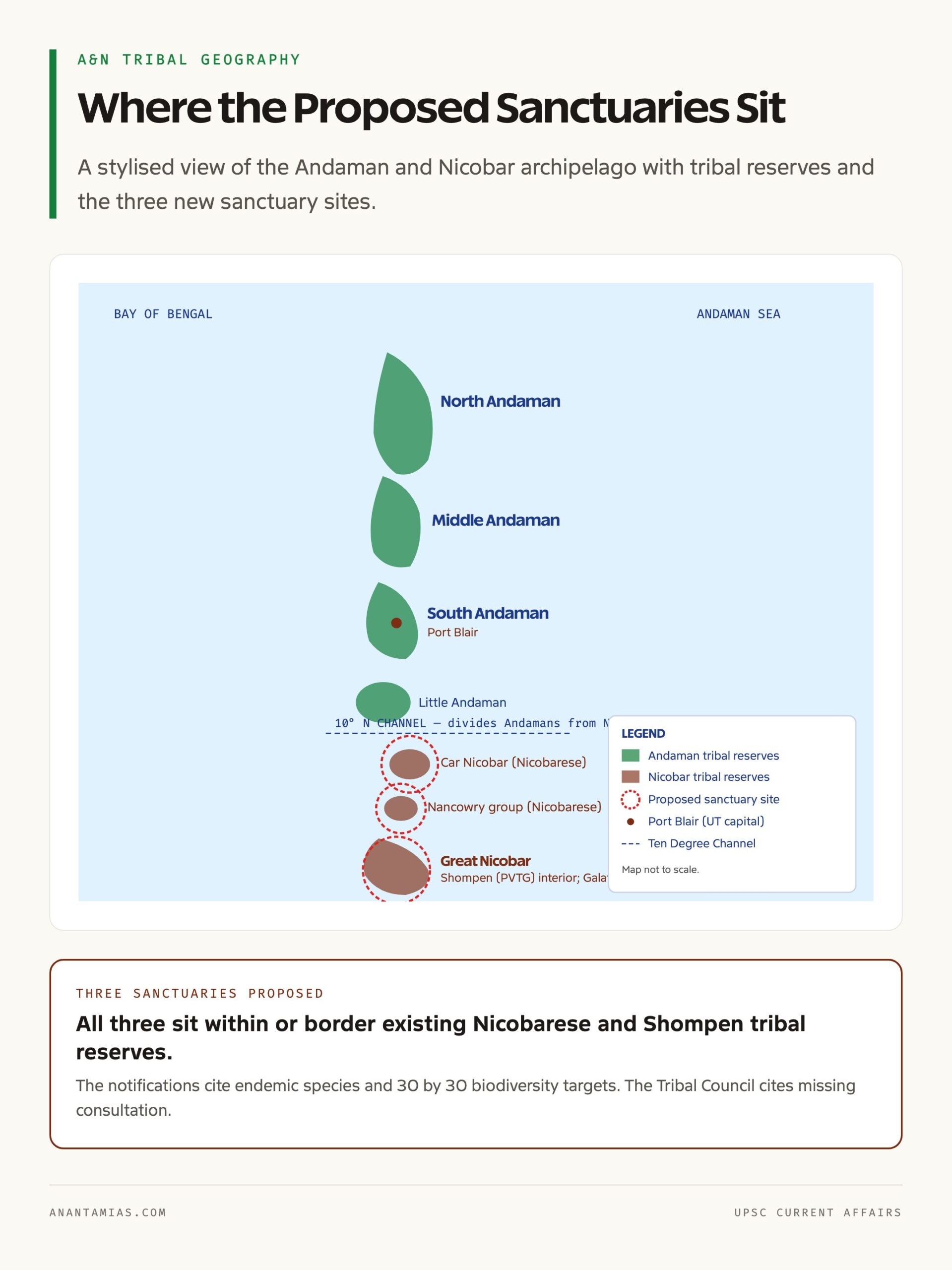
- Proposed sanctuaries: Three new wildlife sanctuaries notified for public consultation in the Nicobar group of islands in early May 2026.
- Opposing community: The Nicobarese Tribal Council, supported by Shompen elders and civil society groups.
- Legal basis cited: Forest Rights Act 2006, particularly Section 3(1)(e) on habitat rights of PVTGs, and the Andaman and Nicobar Islands (Protection of Aboriginal Tribes) Regulation 1956.
- PVTGs in the Nicobar group: The Shompen, classified as one of India’s most isolated PVTGs.
- Existing protection: Several Nicobar islands are already designated as tribal reserves under the 1956 Regulation.
- Land area in question: Sanctuaries would overlap or border ancestral foraging zones, coastal hamlets, and Shompen rainforest habitat.
What Just Happened
The Andaman and Nicobar administration issued draft notifications in early May 2026 proposing three wildlife sanctuaries in the Nicobar group. The stated objective is the protection of endemic species, the Nicobar megapode and the Nicobar long tailed macaque among them, together with mangrove and coral ecosystems damaged in the 2004 tsunami. The notifications also reference international commitments under the Convention on Biological Diversity and the Kunming Montreal Global Biodiversity Framework target of 30 percent protected area coverage by 2030.
The Nicobarese Tribal Council met within days and issued a unanimous resolution opposing the proposal. The Council’s letter argues that no proper Gram Sabha equivalent consultation was held with the Nicobarese village councils, that habitat rights for the Shompen have not been mapped before the sanctuary boundaries were drawn, and that the cumulative impact of the proposed sanctuaries together with the Great Nicobar transhipment terminal threatens the cultural integrity of both communities.
The Nicobarese wildlife sanctuaries proposal has also drawn opposition from former officials of the Anthropological Survey of India, from Shompen welfare societies, and from environmental groups that argue conservation must be co-designed with the resident communities rather than imposed through top down notifications. The Ministry of Tribal Affairs has asked the administration to share the consultation record.
Background and Historical Context
The Nicobar group is geographically and culturally distinct from the Andaman group. It sits at the southern end of the Andaman and Nicobar archipelago, closer to Sumatra than to mainland India. The Nicobarese are an Austroasiatic speaking community spread across most of the inhabited islands, while the Shompen are a smaller and more isolated PVTG that lives in the rainforest interior of Great Nicobar.
The Layered Legal Framework
The Nicobarese and Shompen have lived under a triple-layered protective framework for decades. The first layer is the Andaman and Nicobar Islands (Protection of Aboriginal Tribes) Regulation 1956, which designates tribal reserves and limits entry by outsiders. The second layer is the Scheduled Areas framework under the Fifth and Sixth Schedules of the Constitution, although the Andaman and Nicobar Islands have not been brought under the Sixth Schedule despite long standing demand. The third layer is the Forest Rights Act 2006, which became applicable to the Union Territory after a 2009 notification.
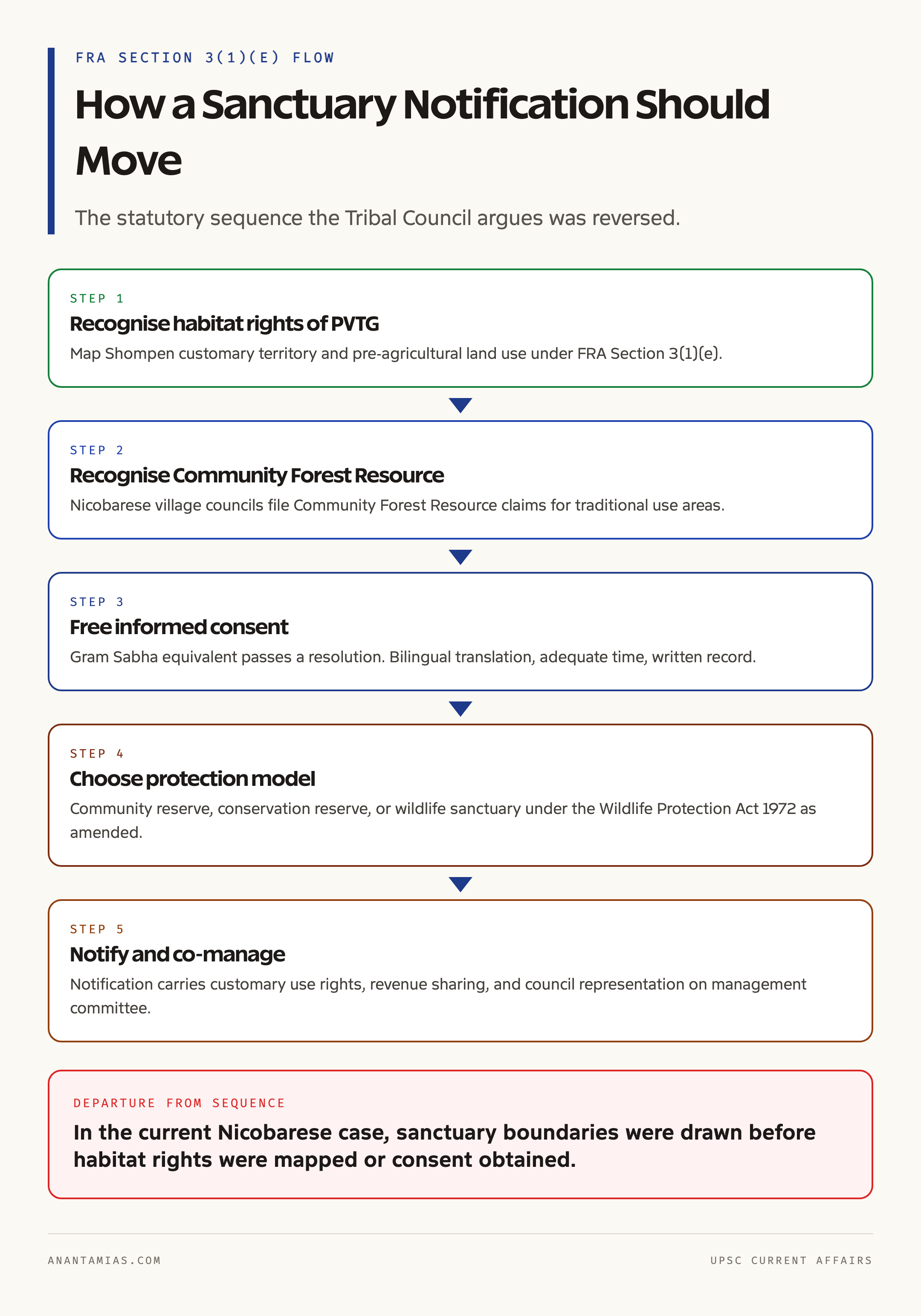
The Forest Rights Act includes a provision specifically designed for communities like the Shompen. Section 3(1)(e) recognises rights including community tenures of habitat and habitation for primitive tribal groups and pre-agricultural communities. Habitat is defined broadly to include the entire customary territory used for foraging, hunting, fishing, swidden cultivation and ritual movement. Once habitat rights are recognised through a process that begins at the Gram Sabha or its equivalent, the area becomes a Community Forest Resource and any change in land use, including the declaration of a wildlife sanctuary, requires the free and informed consent of the rights holders.
Key Concerns Raised by the Nicobarese
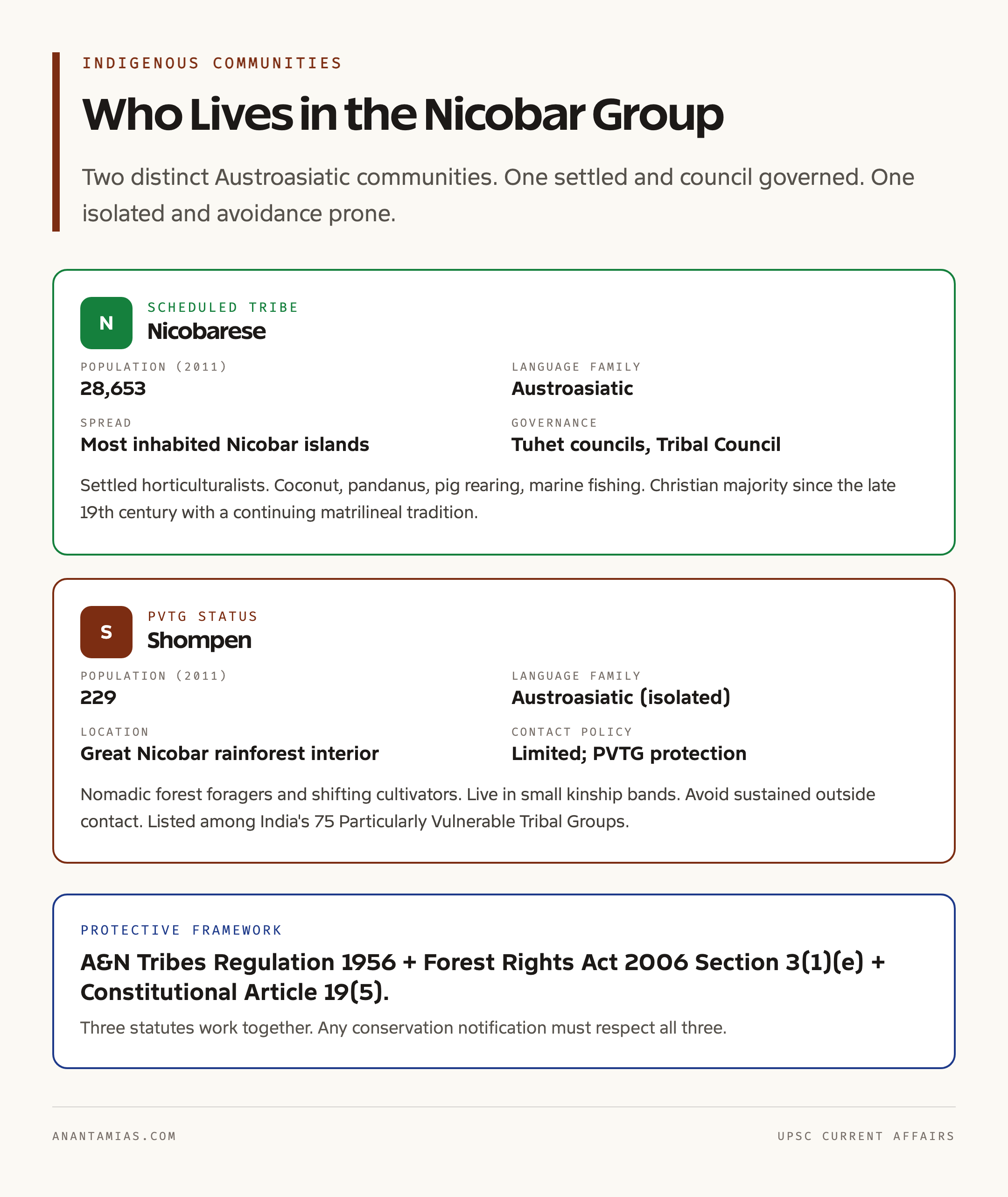
The Tribal Council’s letter and supporting petitions raise five specific concerns that map cleanly onto the FRA framework and the 1956 Regulation.
- Consent and consultation: The Council argues that village councils were not consulted in writing, that the public notice period was inadequate for an isolated archipelago, and that consent forms were not bilingually translated.
- Habitat rights mapping: Section 3(1)(e) habitat rights for the Shompen have not been delimited or recognised. Drawing sanctuary boundaries before habitat is mapped reverses the statutory sequence.
- Cumulative impact: Three sanctuaries together with the Great Nicobar transhipment project, the international airport and the township proposal will sharply reduce the customary commons.
- Restriction on customary use: Wildlife sanctuary status restricts hunting, fishing, swidden cultivation and gathering. These are central to Nicobarese and Shompen economic life.
- Erosion of self-government: The 1956 Regulation gives tribal councils a quasi-administrative role over their reserves. Imposing sanctuary boundaries without their concurrence dilutes that authority.
Why It Matters
The Nicobarese wildlife sanctuaries issue matters for three reasons. First, it tests whether the Forest Rights Act applies in spirit to one of India’s most isolated regions. The Act has been criticised for poor implementation in the Northeast and in tribal majority districts of central India. If habitat rights cannot be operationalised in the Nicobar group, the credibility of the Act as a tool for PVTG protection will be weakened.
Second, the issue reframes the conservation debate in India. The dominant conservation model in India has been exclusionary, modelled on the colonial era forest reserves and post-independence national parks. The Wildlife Protection Act 1972 allowed for the displacement of communities living inside sanctuaries. The Forest Rights Act 2006 created space for a different model: protected areas managed jointly with resident communities. The Nicobarese wildlife sanctuaries case is a high profile test of which model prevails. India’s wildlife protection regime has yet to find a settled answer.
Third, the case interacts directly with the Great Nicobar development project, including the proposed transhipment terminal at Galathea Bay. Galathea is the most important nesting site for the Giant Leatherback turtle in the northern Indian Ocean. The interaction of conservation with development on the same island has produced an unusual coalition of environmentalists, tribal councils and academic anthropologists who all argue for a more deliberate consent process.
Detailed Analysis
The Nicobarese have a long history of structured self-government. Village councils, called Tuhet, operate at the level of joint family clusters. Above them sit island councils. At the top sits the Tribal Council of the Nicobars, recognised by the administration since the colonial era. This is one of the few examples in India of a chain of traditional governance institutions that survived through colonial rule and post-independence consolidation. Any sanctuary process that ignores this structure is procedurally weak.
The Shompen are a different story. They are nomadic forest dwellers who avoid contact, do not have settled village councils, and live in small kinship bands within the rainforest of Great Nicobar. The Anthropological Survey of India classifies them as a PVTG. The 2011 Census recorded their population at 229. The Forest Rights Act explicitly mentions communities like the Shompen in Section 3(1)(e), but operationalising habitat rights for a community that does not assemble in fixed villages requires careful anthropological work. That work has not been done in the present case.
The Wildlife Protection Act 1972, as amended in 2022, allows for the declaration of community reserves and conservation reserves with the consent of local communities. The Nicobarese case raises the question of why the administration has chosen to declare full wildlife sanctuaries rather than community reserves or conservation reserves, which would be procedurally lighter and more compatible with FRA recognition. A conservation reserve managed by the Tribal Council, with revenue sharing and customary use protection, would have produced fewer objections.
The international dimension is also worth flagging. India’s Kunming Montreal target of 30 percent protected area coverage by 2030 is being read by some forest departments as a license to add new sanctuaries quickly. The CBD framework, however, also requires recognition of indigenous and local community contribution to conservation. The Nicobarese position is consistent with the international consensus that 30 by 30 must be achieved through inclusive rather than exclusive protected areas.
Comparative Perspective
The Nicobarese wildlife sanctuaries dispute echoes earlier confrontations in mainland India. In the Niyamgiri hills of Odisha, the Dongria Kondh exercised their FRA right to veto a bauxite mining project after the Supreme Court in 2013 directed that Gram Sabhas decide. In the Mendha Lekha village in Maharashtra, Community Forest Resource recognition transformed local governance and forest economy. In the Northeast, the Sixth Schedule and customary law operate alongside the FRA, producing a more pluralistic system.
The Nicobar group needs a hybrid that draws from these examples. Tribal councils already exist. Habitat rights are statutorily recognisable. The political question is whether the administration will invest the time in a proper consultation or use the public consultation window as a procedural formality.
Challenges Ahead
Implementation challenges in the Nicobarese wildlife sanctuaries case are significant. Mapping Shompen habitat is technically difficult because the community is avoidance prone. Translating consent processes into Nicobarese and Shompen languages requires bilingual facilitators who are not easy to find. Holding public hearings on islands without regular ferry connections multiplies logistical cost.
Politically, the administration faces competing pressures. The Ministry of Environment wants visible additions to the protected area network ahead of CBD reporting. The Ministry of Tribal Affairs wants procedural compliance with FRA. The Ministry of Ports, Shipping and Waterways wants the Galathea project to move ahead. Reconciling these is hard.
There is also a long term capacity question. Sanctuary management requires staff, infrastructure and ongoing community engagement. The Andaman and Nicobar forest department is small relative to the area it manages. Adding three more sanctuaries without budget and staff augmentation could degrade rather than improve protection on the ground.
Prelims Pointers
- PVTG: Particularly Vulnerable Tribal Group, an administrative category for the most isolated tribal communities. There are 75 PVTGs in India.
- Shompen: PVTG of Great Nicobar, Austroasiatic language family, population recorded as 229 in 2011 Census.
- Nicobarese: Austroasiatic speaking community spread across the inhabited Nicobar Islands.
- Forest Rights Act Section 3(1)(e): Recognises habitat rights of PVTGs and pre-agricultural communities.
- A&N Tribes Regulation 1956: Designates tribal reserves and limits outsider entry.
- Wildlife Protection Act 1972: Provides for national parks, sanctuaries, community reserves and conservation reserves.
- Galathea Bay: Important Leatherback turtle nesting site on Great Nicobar.
Mains Practice Questions
- GS Paper 1: Discuss the cultural and economic significance of the Nicobarese and Shompen communities and the policy challenges in protecting their customary rights.
- GS Paper 2: Examine the procedural requirements under the Forest Rights Act 2006 for declaring a wildlife sanctuary in a Scheduled or tribal area.
- GS Paper 3: Evaluate the tension between India’s biodiversity targets under the Kunming Montreal Framework and the rights of forest dwelling communities under the FRA.
- GS Paper 2: Critically examine the institutional architecture for tribal self-governance in the Andaman and Nicobar Islands.
Way Forward
A workable path forward is visible. First, the administration can pause the Nicobarese wildlife sanctuaries notifications and convene a structured consultation with the Tribal Council, Shompen welfare society representatives, and the Ministry of Tribal Affairs. Second, the habitat rights of the Shompen should be mapped under FRA Section 3(1)(e) before any sanctuary boundary is finalised. Third, the administration should consider community reserves and conservation reserves under the amended Wildlife Protection Act as alternatives to full sanctuary status. Fourth, the cumulative impact of the Great Nicobar projects should be assessed jointly with the sanctuary proposal.
The Nicobarese wildlife sanctuaries case can become a model for inclusive conservation if procedural shortcuts are avoided. It can also become a cautionary tale if the administration treats consultation as a formality. The next six months will tell us which way the case turns.
Frequently Asked Questions
What are the proposed Nicobarese wildlife sanctuaries?
The Andaman and Nicobar administration has notified three new wildlife sanctuaries in the Nicobar group of islands for public consultation. The notifications cite protection of endemic species, mangroves and coral systems and align with India’s 30 by 30 biodiversity target.
Why are the Nicobarese opposed to these sanctuaries?
The Tribal Council argues that village councils were not properly consulted, that the Shompen habitat rights under Section 3(1)(e) of the Forest Rights Act have not been mapped, and that the sanctuaries will restrict customary hunting, fishing, swidden cultivation and gathering essential to their economy.
Who are the Shompen?
The Shompen are a Particularly Vulnerable Tribal Group resident in the rainforest interior of Great Nicobar. They are nomadic, avoidance prone and speak an Austroasiatic language. The 2011 Census recorded their population at 229.
What does Section 3(1)(e) of the Forest Rights Act say?
Section 3(1)(e) recognises rights including community tenures of habitat and habitation for primitive tribal groups and pre-agricultural communities. It is specifically designed to protect PVTGs like the Shompen.
How is the 1956 Regulation different from the FRA?
The Andaman and Nicobar Islands (Protection of Aboriginal Tribes) Regulation 1956 protects tribal reserves and limits entry by outsiders. The Forest Rights Act 2006 recognises individual and community rights of forest dwellers over their customary land and resources. Both operate in parallel.
Why has the administration chosen sanctuary status rather than community reserves?
The administration has not publicly explained the choice. Critics argue that community reserves under the amended Wildlife Protection Act 1972 would be more compatible with FRA recognition and tribal council governance.
How does this issue connect with the Great Nicobar project?
Great Nicobar is the site of a proposed transhipment terminal at Galathea Bay and an integrated township and airport project. The sanctuary proposals overlap with land and coastal areas linked to both the project and Shompen habitat, raising concerns about cumulative impact.
What is the role of the Tribal Council?
The Tribal Council of the Nicobars is the apex representative body for the Nicobarese community. It coordinates village level Tuhet councils and acts as the principal interlocutor with the administration. It has issued a formal resolution opposing the sanctuary proposal.
What protected areas already exist in the Nicobar group?
The Nicobar group hosts the Galathea National Park, the Campbell Bay National Park, and several smaller sanctuaries. Tribal reserves under the 1956 Regulation cover much of the inhabited area.
How does this case fit India’s 30 by 30 commitment under the CBD?
India has committed to bringing 30 percent of its land and sea area under protected area or other effective area based conservation by 2030. The Nicobarese case illustrates that meeting the target requires inclusive protected area expansion that recognises customary rights rather than top down notification.