The Forest Rights Act of 2006 sits at the intersection of conservation, social justice, and federalism. Officially titled the Scheduled Tribes and Other Traditional Forest Dwellers (Recognition of Forest Rights) Act, the law tries to repair what its preamble calls a “historical injustice” against communities whose ties to the forest predate every modern statute that displaced them.
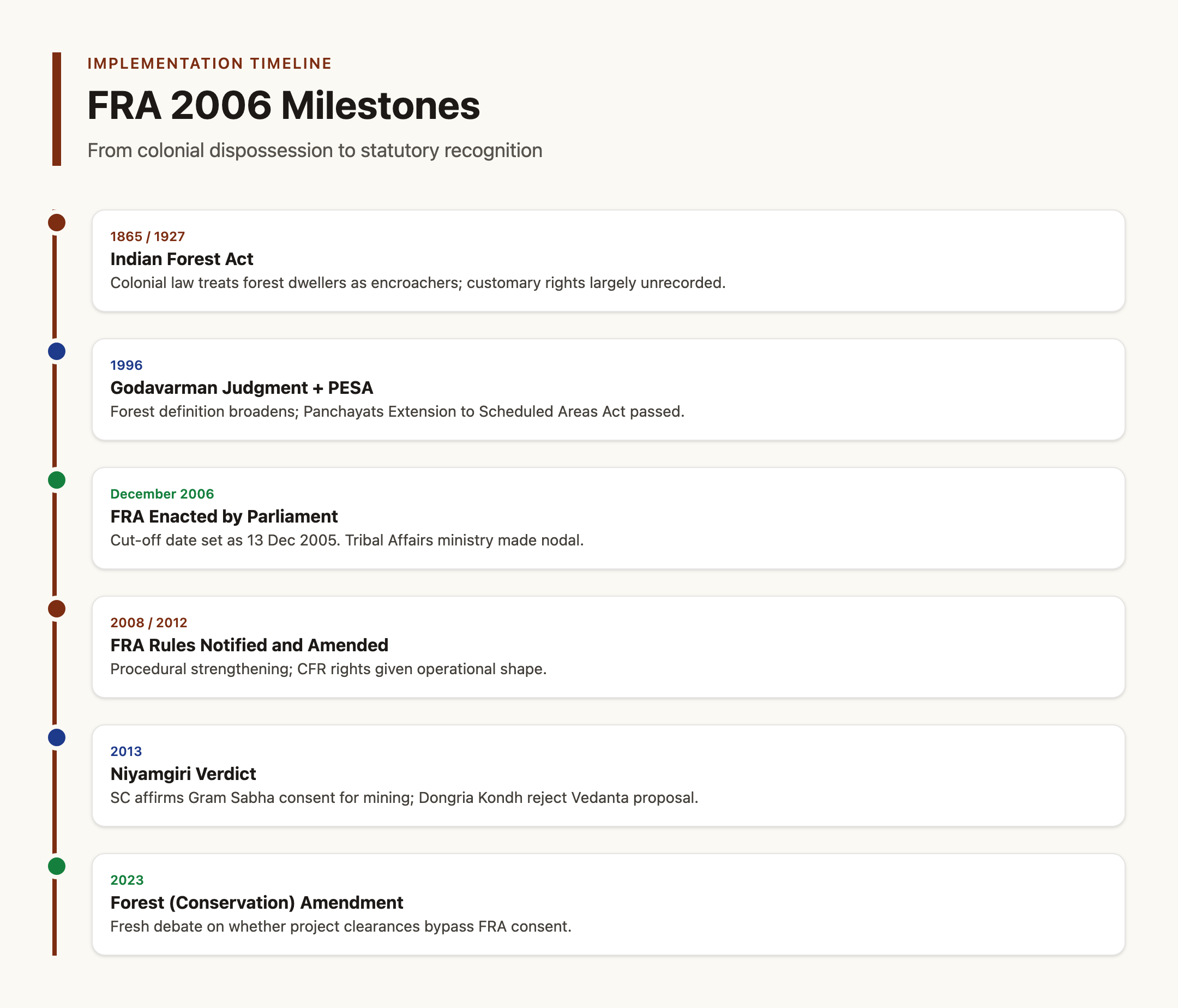
For decades, forest dwellers in India lived inside reserved areas without paperwork. The colonial Indian Forest Act of 1865, and later 1927, treated their homes as state property and their daily uses as encroachment. Independent India inherited that template, and even progressive conservation laws of the 1970s and 1980s left tenure questions unanswered. The FRA finally reversed the burden of proof and put the Gram Sabha at the center of who decides.
This guide unpacks the Act for UPSC aspirants the way examiners actually test it: which rights are recognized, who is eligible, how the three-tier claim process works, and where the law collides with conservation laws like the Wildlife (Protection) Act, 1972.
Quick Facts: Forest Rights Act 2006
- Long title: The Scheduled Tribes and Other Traditional Forest Dwellers (Recognition of Forest Rights) Act, 2006
- Year of enactment: 2006, came into force on 31 December 2007 with Rules notified in 2008 and amended in 2012
- Nodal ministry: Ministry of Tribal Affairs, not Ministry of Environment, Forest and Climate Change
- Eligible beneficiaries: Members of Scheduled Tribes residing in forest areas, plus Other Traditional Forest Dwellers (OTFDs) with at least three generations or 75 years of forest dependence
- Maximum land grant per family: 4 hectares of land already under cultivation as on 13 December 2005
- Decision authority: Gram Sabha initiates, the District Level Committee chaired by the Collector finalizes
- Categories of rights recognized: Individual forest rights, community rights, community forest resource rights, and habitat rights
- Key safeguard: Free, prior and informed consent of the Gram Sabha is required for diversion, displacement, or settlement of rights inside Critical Wildlife Habitats
What the Forest Rights Act Actually Does
The FRA is a recognition statute, not a redistribution statute. It does not give new land. It simply records rights that were always supposed to exist but never made it into the revenue or forest record. That distinction matters in mains answers because it explains why the Act is administered by the Tribal Affairs ministry, not the environment ministry. The framing is one of justice and tenure, not conservation and resource management.
Concretely, the Act lets eligible families and communities apply for legal recognition of how they already use the forest. They can secure title to the patch they cultivate, the right to collect bamboo or tendu leaves, the right to graze livestock, and crucially the right to manage and protect a community forest resource. Once a claim is verified and approved, the rights become heritable and inalienable. They cannot be sold, transferred to an outsider, or mortgaged, but they can pass to the next generation.
Background and Historical Context
To grasp why Parliament felt compelled to legislate in 2006, look at what came before. The British Indian Forest Act of 1865 carved out reserved and protected forests, and the 1927 successor consolidated state ownership. Colonial settlement officers were supposed to record customary rights, but in practice they ignored shifting cultivators, hunter-gatherers, and seasonal users. Millions of forest dwellers were turned, on paper, into encroachers.
Independent India did little to fix this. The National Forest Policy of 1952 prioritized timber and revenue. The Wildlife (Protection) Act, 1972, and the Forest (Conservation) Act, 1980, added new layers of restriction without first recording who lived inside the forest. As tiger reserves, sanctuaries, and national parks expanded, many tribal families faced eviction without compensation or rehabilitation. The Supreme Court’s Godavarman case from 1996 widened the definition of forest, which only deepened the tenure crisis.
Civil society, tribal movements, and academic studies through the 1990s and early 2000s built the political case for a rights-based law. The UPA government tabled the bill in 2005, and Parliament passed it in December 2006. The Rules followed in 2008 and were strengthened in 2012 after early implementation showed how often local administrations were rejecting valid claims.
Eligibility Criteria Under FRA
Two categories of people qualify, and both must satisfy a forest dependence test.
Scheduled Tribes who primarily reside in and depend on forests or forest land for bona fide livelihood needs are the first group. The 2005 cut-off requires that the forest land be in their occupation as of 13 December 2005. They do not need to prove a 75-year continuous dependence.
Other Traditional Forest Dwellers, or OTFDs, are the second group. The Act sets a higher bar for them. An OTFD family must have primarily resided in and depended on forest land for at least three generations prior to 13 December 2005, and the law defines a generation as 25 years. That is the famous 75-year test that has been the single biggest source of dispute in implementation.
Types of Rights Recognized
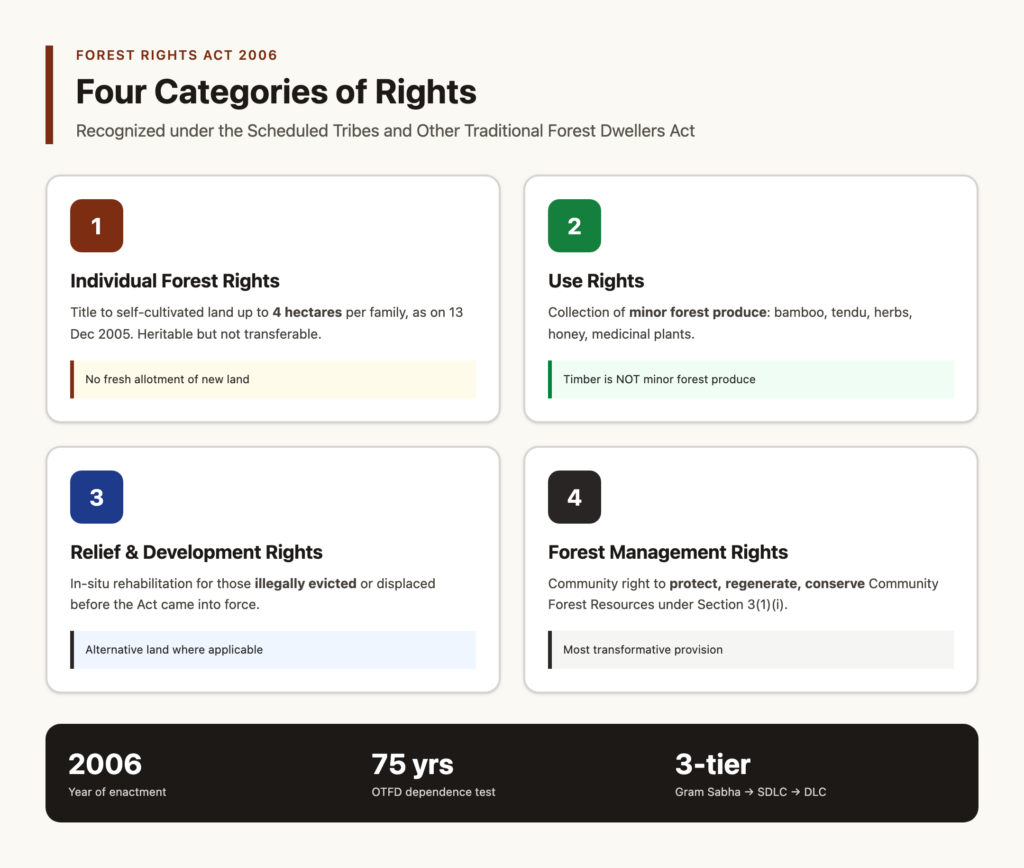
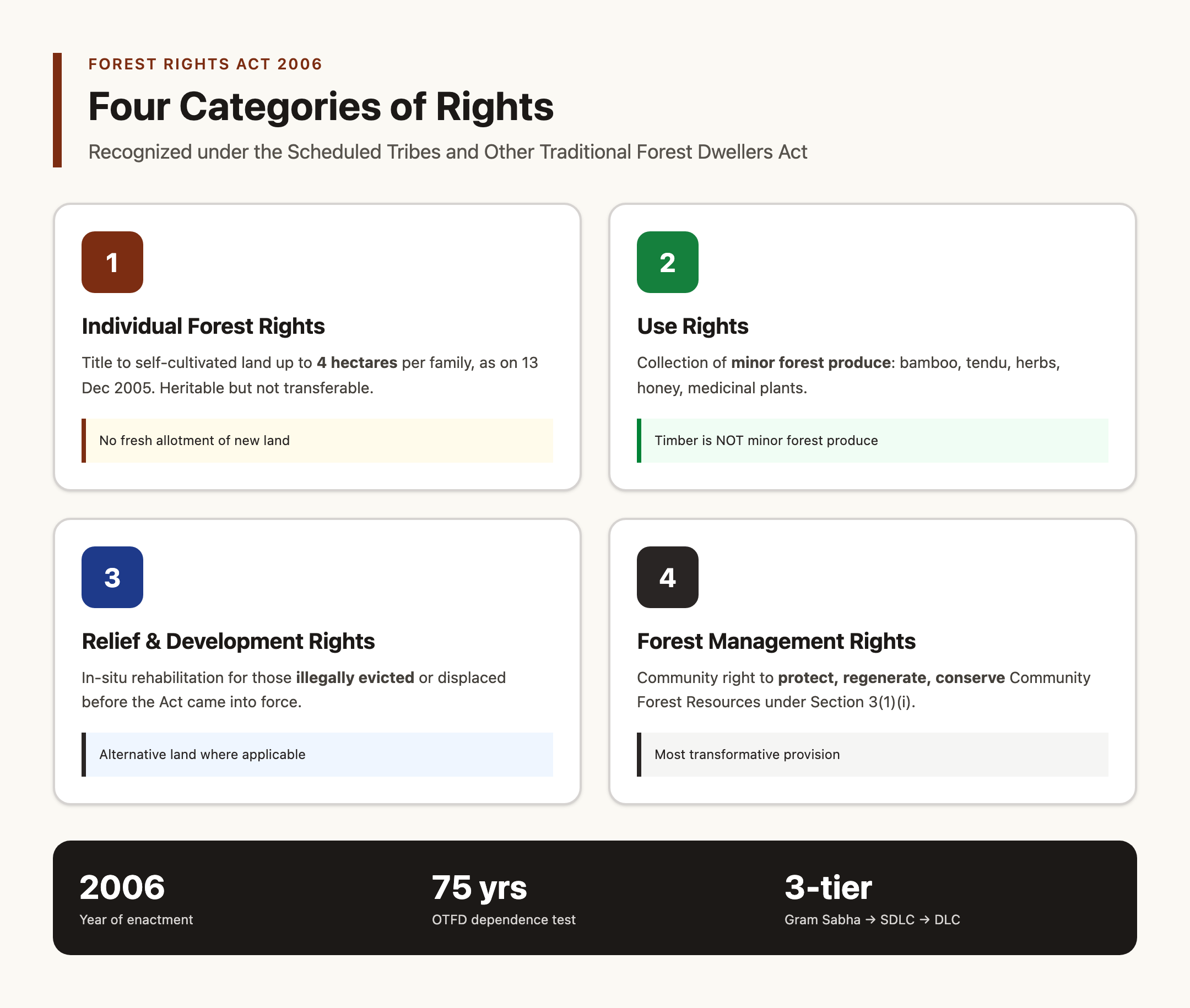
The Act recognizes thirteen specific rights, which scholars usually cluster into four families.
- Individual forest rights, also called land rights, allow ownership of self-cultivated forest land up to a ceiling of 4 hectares per family. The plot must already be under cultivation as on the 2005 cut-off, and no fresh allotment is permitted. Title is heritable but cannot be sold or transferred outside the community except by inheritance.
- Use rights cover the collection, use, and disposal of minor forest produce traditionally gathered by the community. This includes bamboo, tendu leaves, herbs, medicinal plants, lac, honey, gums, resins, fibers, and mahua. Timber is explicitly excluded from minor forest produce, which is one of the most heavily tested distinctions in prelims.
- Relief and development rights provide for in-situ rehabilitation, including alternative land, in cases of illegal eviction or forced displacement carried out before the Act came into force without proper rehabilitation.
- Forest management and conservation rights include the community right to protect, regenerate, conserve, or manage any community forest resource that the community has been traditionally protecting and conserving for sustainable use. This is the famous Community Forest Resource (CFR) right under Section 3(1)(i) and is widely seen as the most transformative provision because it transfers governance, not just tenure.
Why the Forest Rights Act Matters for UPSC and Policy
The FRA is the rare law that bridges environment, tribal welfare, federalism, and constitutional rights, which is exactly why it appears across GS-II and GS-III. It operationalizes the Fifth and Sixth Schedule promises. It gives statutory teeth to the Panchayats (Extension to Scheduled Areas) Act, 1996. It is the legal foundation for the Niyamgiri verdict, where the Supreme Court in 2013 told Vedanta that bauxite mining could only proceed if the Dongria Kondh Gram Sabhas consented, and they refused.
Aspirants should also note the Act’s intersection with the Compensatory Afforestation Fund Act, 2016, the Forest (Conservation) Amendment Act, 2023, and project clearance procedures under the EIA notification. Diversion of forest land for non-forest use cannot be approved unless the rights of forest dwellers under FRA have first been recognized and the Gram Sabhas have given written consent.
Detailed Analysis of the Three-Tier Claim Process
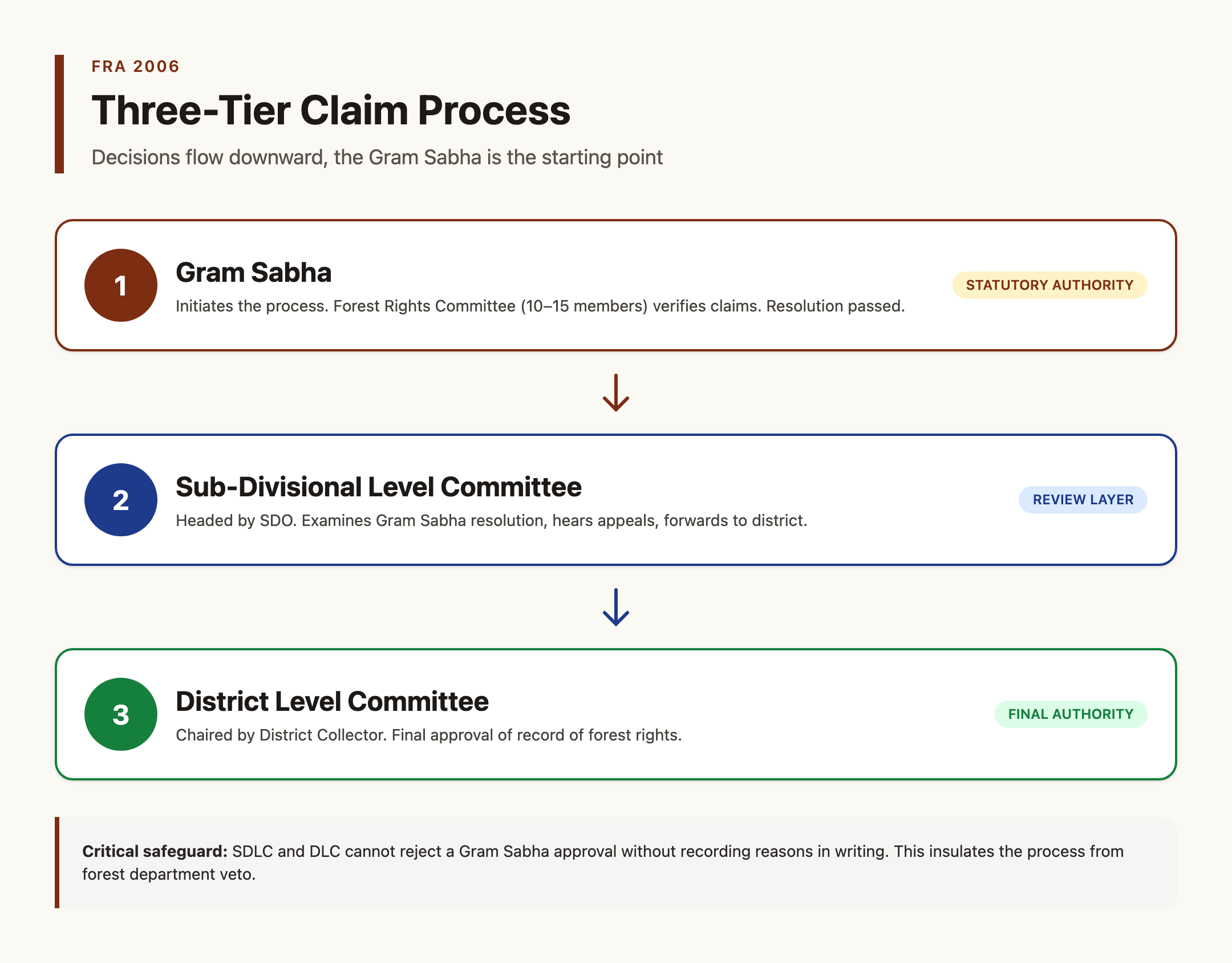
The architecture of the FRA pushes decisions downward, not upward, which is unusual for an Indian law of this scale. The Gram Sabha is not a consultative body here. It is the statutory authority of first instance.
- Gram Sabha. The process begins at the Gram Sabha, which is convened with a quorum specifically for FRA business. The Gram Sabha forms a Forest Rights Committee of 10 to 15 members, with at least one-third women and at least one-third Scheduled Tribe members where applicable. The committee receives claims, conducts field verification, and the Gram Sabha then passes a resolution recommending which claims should be approved.
- Sub-Divisional Level Committee (SDLC). The SDLC, headed by the Sub-Divisional Officer, examines the Gram Sabha resolution, hears appeals from rejected claimants, and forwards recommendations to the district level. It cannot reject a claim that the Gram Sabha has approved without giving reasons in writing.
- District Level Committee (DLC). The DLC is chaired by the District Collector and is the final authority for approving the record of forest rights. Its decisions are deemed final and binding. There is no judicial appeal except through writ jurisdiction.
This design tries to insulate the process from forest department veto. In practice, the bureaucracy has often pushed back, and many states have used the SDLC and DLC stages to dilute Gram Sabha resolutions, which is the most cited implementation gap.
Critical Wildlife Habitats and the Conservation Trade-off
The Act anticipates that some forest areas, particularly core tiger habitats and breeding zones for endangered species, may not be compatible with continued human settlement. Section 4(2) creates the category of Critical Wildlife Habitat (CWH), which can be notified inside national parks and sanctuaries.
Rights inside a CWH may be modified or rights-holders may be resettled only if four conditions are simultaneously met. First, scientific and objective criteria must establish that coexistence is impossible. Second, the State must demonstrate that activities of rights-holders cause irreversible damage. Third, no other reasonable conservation option exists. Fourth, the affected Gram Sabha must give free and informed consent in writing to the resettlement package. The package itself must satisfy the Land Acquisition law as it stood on the date of relocation.
This procedure runs parallel to the Critical Tiger Habitat (CTH) provisions added to the Wildlife (Protection) Act in 2006 for tiger reserves. The two regimes overlap on the ground, and harmonizing them is a recurring theme in the National Tiger Conservation Authority’s directions and in Supreme Court orders.
Comparative Perspective: FRA, PESA, and Wildlife Protection Act
| Feature | Forest Rights Act, 2006 | PESA, 1996 | Wildlife (Protection) Act, 1972 |
|---|---|---|---|
| Primary objective | Recognize forest rights of STs and OTFDs | Empower Gram Sabhas in Fifth Schedule areas | Conserve wild fauna and flora |
| Nodal ministry | Tribal Affairs | Panchayati Raj | Environment, Forest and Climate Change |
| Geographic scope | All forest land in India | Fifth Schedule areas only | All India, with state amendments |
| Decision authority | Gram Sabha to DLC | Gram Sabha for local resources | Forest department, state board, NTCA |
| Treatment of communities | Rights-holders | Self-governing | Subjects of regulation |
Challenges and Implementation Gaps
Despite the law’s transformative design, the gap between paper and practice has been wide. As per latest available data, individual claims have moved faster than community claims, and Community Forest Resource rights remain especially under-recognized in most states. Common problems include rejection of OTFD claims for failure to produce written 75-year evidence, rejection without giving reasons or hearing the claimant, weak revenue surveys that block plot demarcation, and forest department resistance to handing over CFR governance.
Conflicts with conservation imperatives, particularly inside tiger reserves, have produced repeated litigation. Capacity at the Gram Sabha level is uneven, with many tribal hamlets lacking the documentation, mapping support, and legal aid that a successful claim demands. The Forest (Conservation) Amendment Act, 2023, has triggered fresh debate about whether projects in untitled forest areas can bypass FRA consent, which the Tribal Affairs ministry insists they cannot.
Prelims Pointers on FRA 2006
- Nodal ministry is Ministry of Tribal Affairs, not Environment.
- Land grant ceiling under FRA is 4 hectares per family for self-cultivated land as on 13 December 2005.
- Bamboo is classified as a minor forest produce under the Act, even though the Indian Forest Act, 1927, traditionally treated it as timber.
- Timber is not minor forest produce.
- OTFD eligibility requires at least three generations of dependence, where one generation is defined as 25 years.
- The District Level Committee, chaired by the Collector, is the final authority.
- Free and informed written consent of the Gram Sabha is mandatory before resettlement from a Critical Wildlife Habitat.
- Rights recognized under FRA are heritable but inalienable.
Mains Practice Questions
- (GS-II) The Forest Rights Act, 2006, attempts to balance tribal rights with conservation imperatives. Critically examine the institutional design that the Act adopts to mediate this balance.
- (GS-III) Discuss how the recognition of Community Forest Resource rights under the FRA can transform forest governance in India. Illustrate with examples.
- (GS-II) Compare and contrast the Forest Rights Act, 2006, with the Provisions of the Panchayats (Extension to Scheduled Areas) Act, 1996, in empowering forest-dwelling communities.
- (GS-III) Examine the implementation challenges of the Forest Rights Act, 2006, with particular reference to the Other Traditional Forest Dwellers category and Critical Wildlife Habitats.
Way Forward
A credible reform agenda for the FRA begins with completing the recognition of Community Forest Resource rights, which most reviews identify as the single biggest unfinished task. This needs systematic state-level mapping with community participation, supported by satellite imagery and revenue records. Capacity building of Gram Sabhas, including legal aid clinics and trained Forest Rights Committees, would reduce wrongful rejection of claims. State Level Monitoring Committees should publish quarterly dashboards. Convergence with the Mahatma Gandhi National Rural Employment Guarantee Act and with district mineral foundation funds can finance CFR management plans. On the conservation side, harmonizing the CWH process under FRA with the CTH process under WPA would reduce litigation and let coexistence models be tested seriously before any village is moved.
Frequently Asked Questions
Which ministry implements the Forest Rights Act, 2006?
The Ministry of Tribal Affairs is the nodal ministry for the FRA, not the Ministry of Environment, Forest and Climate Change. This reflects the Act’s primary framing as a justice and tenure law rather than a conservation law.
Who is eligible to claim rights under the FRA?
Two categories qualify. Members of Scheduled Tribes who reside in and depend on forest land are eligible without a generational test. Other Traditional Forest Dwellers must show at least three generations, or 75 years, of forest dependence prior to 13 December 2005.
What is the maximum land that a family can get under FRA?
A family can get title to a maximum of 4 hectares of forest land, and only for land already under self-cultivation as on the cut-off date of 13 December 2005. The Act does not allow allotment of fresh land.
Is bamboo a minor forest produce under the FRA?
Yes. The FRA explicitly classifies bamboo as a minor forest produce. This was a major change from the Indian Forest Act, 1927, which historically treated bamboo as timber and routed it through the forest department.
What are Critical Wildlife Habitats?
Critical Wildlife Habitats are areas inside national parks and sanctuaries that the State notifies as off-limits to most human activity because coexistence is scientifically established to be impossible. Rights can be modified or people can be resettled from CWHs only with the free and informed written consent of the Gram Sabha and a proper rehabilitation package.
What is the role of the Gram Sabha under the FRA?
The Gram Sabha is the statutory authority of first instance. It receives claims, sets up a Forest Rights Committee, conducts verification, and passes a resolution recommending approval or rejection. Higher committees cannot overturn a Gram Sabha decision without recording reasons in writing.
Can FRA rights be sold or transferred?
No. Rights recognized under the FRA are heritable, which means they can pass to the next generation, but they are inalienable. They cannot be sold, leased, or transferred to anyone outside the community.
What is a Community Forest Resource right?
A Community Forest Resource right under Section 3(1)(i) gives a community the legal authority to protect, regenerate, conserve, and manage a forest area it has traditionally protected. This is widely considered the most transformative provision of the Act because it shifts governance, not only ownership.
How does the FRA interact with the Wildlife Protection Act?
The two laws operate in parallel. The Wildlife Protection Act creates Critical Tiger Habitats inside tiger reserves, while the FRA creates Critical Wildlife Habitats. Both regimes require careful procedural compliance before any rights-holder can be relocated, and the Gram Sabha’s free informed consent is a binding requirement under FRA.
Why has FRA implementation been criticized?
Critics point to high rates of claim rejection, especially for OTFDs, weak recognition of Community Forest Resource rights, forest department resistance to transferring management functions, and inadequate documentation support at the Gram Sabha level. The 2023 amendment to the Forest (Conservation) Act has also raised concerns about whether project clearances are bypassing FRA consent requirements.
Tell Google you want more of this.
Add Anantam IAS as a preferred sourceOne tap, and this site shows up more often in your own Top Stories, AI Overviews and AI Mode. Remove it any time.