Ayurveda Global: NITI Aayog’s strategic roadmap report
Why in News?
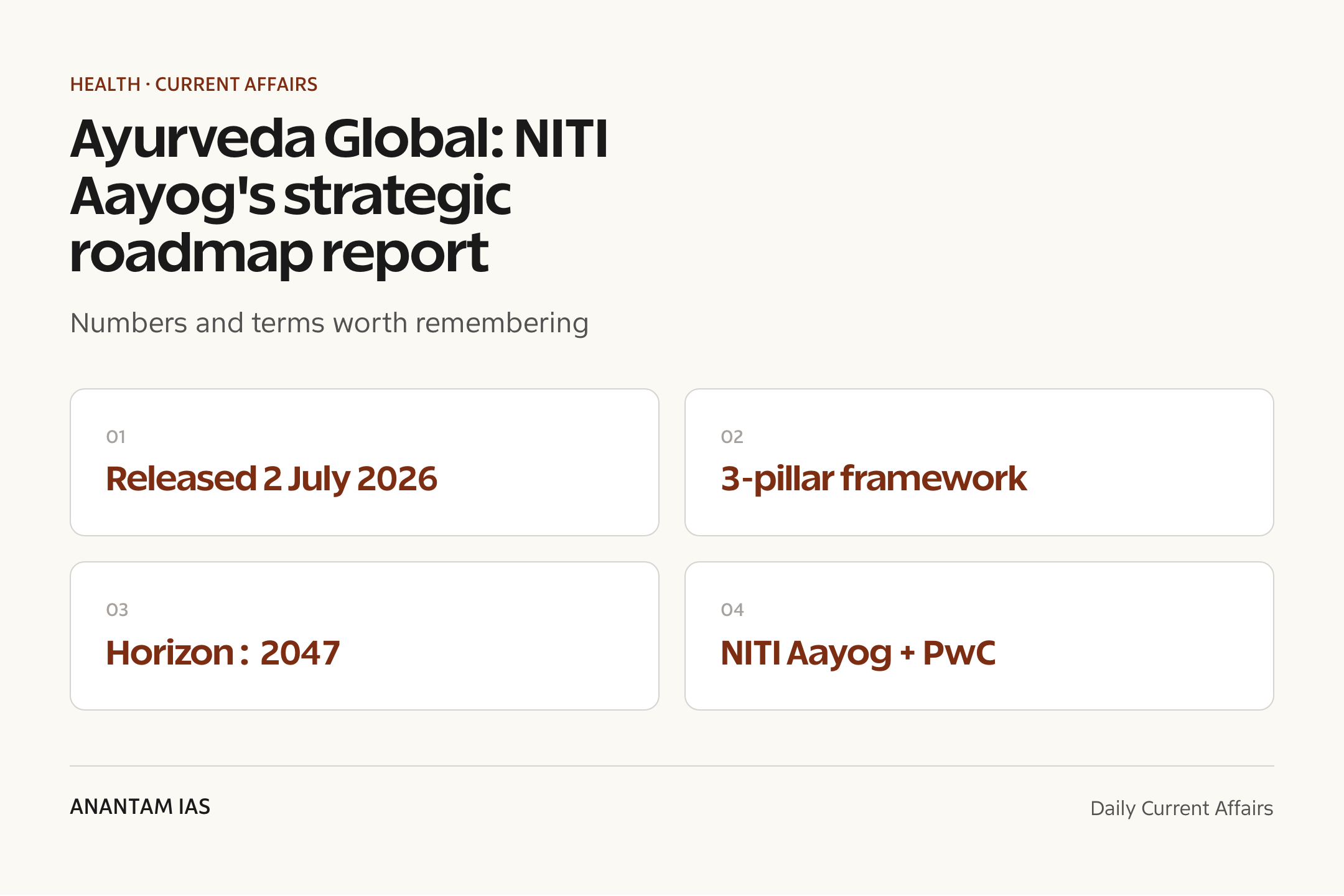
On 2 July 2026, NITI Aayog released a report titled “Strategic Roadmap for Making Ayurveda Global” in New Delhi. PIB confirmed that the report presents a comprehensive assessment of Ayurveda’s global footprint and lays out a phased roadmap for taking the system worldwide.
The report was launched by Dr Ashok Kumar Lahiri, Vice Chairman of NITI Aayog, in the presence of NITI Aayog Member Prof (Dr) M. Srinivas and Vaidya Rajesh Kotecha, Secretary, Ministry of Ayush, alongside officials from the Ministry of External Affairs, research bodies and industry associations.
- The study was prepared by the Health Division of NITI Aayog in collaboration with PricewaterhouseCoopers (PwC), drawing on stakeholder consultations and international benchmarking.
- It adopts a three-pillar framework — Availability, Acceptability and Propagation — covering practice, exports, research, education, regulation, insurance and brand positioning.
- The roadmap proposes a phased strategy up to 2047, aligned with the Viksit Bharat@2047 vision.
- The Vice Chairman called for a whole-of-government approach for coordinated, time-bound implementation.
- The report anchors itself in India’s commitment to the “One Earth, One Health” vision articulated during India’s G20 presidency era.
The development matters in the context of:
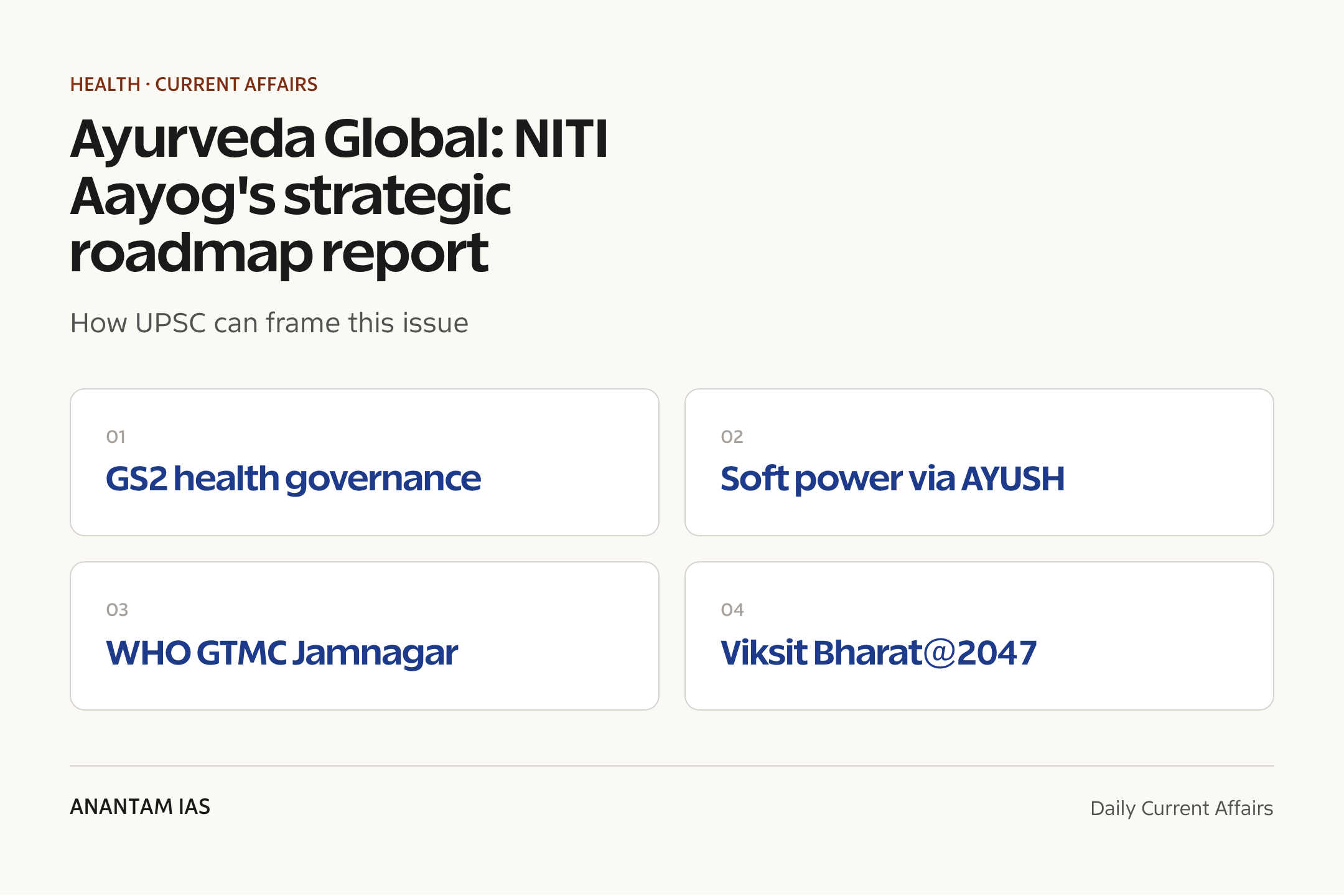
- The release matters because traditional medicine sits at the junction of GS2 health governance and India’s soft-power toolkit — a NITI Aayog roadmap signals apex-level policy ownership beyond the Ministry of Ayush.
- It lands amid a supportive global moment: the WHO Traditional Medicine Strategy 2025–2034 and the WHO Global Traditional Medicine Centre at Jamnagar have put evidence-based traditional systems on the multilateral agenda.
UPSC Relevance
Prelims Relevance
- Strategic Roadmap for Making Ayurveda Global — released by NITI Aayog on 2 July 2026, prepared with PwC.
- Three pillars of the report: Availability, Acceptability, Propagation; phased strategy up to 2047.
- Ministry of AYUSH — full ministry since November 2014 (upgraded from the Department of AYUSH); AYUSH covers Ayurveda, Yoga & Naturopathy, Unani, Siddha, Sowa-Rigpa and Homoeopathy.
- WHO Global Traditional Medicine Centre (GTMC) — the WHO’s first global centre for traditional medicine, at Jamnagar, Gujarat (agreement 2022), India-supported.
- National AYUSH Mission (NAM) — centrally sponsored scheme (2014) for AYUSH services, education and drug quality in states.
- ICD-11 Traditional Medicine Module 2 — WHO’s disease-classification update coding Ayurveda, Siddha and Unani morbidity, enabling global data and insurance billing.
- National Commission for Indian System of Medicine (NCISM) Act, 2020 — regulator for Ayurveda education and practice, replacing the Central Council of Indian Medicine.
- Pharmacopoeia Commission for Indian Medicine and Homoeopathy (PCIM&H), Ghaziabad — sets quality standards for ASU&H drugs.
- Ayush visa (introduced 2023) — special visa category for foreigners seeking treatment under Indian systems of medicine.
- Global Traditional Medicine Summit, Gandhinagar (August 2023) — co-hosted by WHO and India; outcome: the Gujarat Declaration.
Mains Relevance
GS Paper 2
- Health governance: mainstreaming traditional medicine into public health — issues of evidence, regulation and quality standards.
- Government policies and interventions: role of NITI Aayog as a think tank shaping sectoral roadmaps and whole-of-government coordination.
- International relations: medical diplomacy and India’s engagement with the WHO on traditional medicine as an instrument of soft power.
GS Paper 3
- Economy: AYUSH sector exports, manufacturing, herbal supply chains and employment potential.
- Science and technology: the research-validation gap — clinical trials, pharmacovigilance and standardisation of traditional formulations.
Essay
- Tradition and modernity in Indian healthcare — can ancient knowledge systems pass modern scientific tests?
- Soft power in the 21st century: yoga, Ayurveda and the export of Indian civilisational goods.
Background and Context
What the report actually says
PIB’s release sets out the architecture of the roadmap, which organises the globalisation task into three mutually reinforcing pillars.
- Availability — building a globalised practice and workforce, expanding global exports and manufacturing, deepening international research and development, and standardising Ayurveda education worldwide.
- Acceptability — ensuring compliance with foreign regulations and guidelines, forging academic and industrial collaborations, securing insurance coverage for Ayurveda treatments, and adapting offerings to local cultures.
- Propagation — strategic brand positioning, global visibility campaigns, medical value travel, and presence in global standard-setting bodies.
- The strategy is phased up to 2047, deliberately synchronised with the Viksit Bharat@2047 national vision.
- NITI Aayog frames the goal as more than commerce: Member Prof M. Srinivas stressed the aim of giving people worldwide additional evidence-based options for better health outcomes.
- The full report is hosted on the NITI Aayog website, and the study’s method combined stakeholder consultations with international benchmarking.
The institutional architecture behind Ayurveda
The roadmap builds on a two-decade institutionalisation of traditional medicine within the Union government.
- The Ministry of AYUSH became a full ministry in November 2014, upgraded from a department, giving Ayurveda, Yoga and Naturopathy, Unani, Siddha, Sowa-Rigpa and Homoeopathy a dedicated administrative home.
- The National AYUSH Mission (2014), a centrally sponsored scheme, funds AYUSH dispensaries, co-located facilities in primary health centres, drug quality infrastructure and educational institutions in states.
- Education and practice are regulated under the NCISM Act, 2020, which replaced the old Central Council of Indian Medicine with a National Commission modelled on the NMC for modern medicine.
- Research flows through the Central Council for Research in Ayurvedic Sciences (CCRAS), while apex institutions such as the All India Institute of Ayurveda, New Delhi, and the Institute of Teaching and Research in Ayurveda (ITRA), Jamnagar — an Institution of National Importance — anchor tertiary care and academics.
- Drug standards are set by the Pharmacopoeia Commission for Indian Medicine and Homoeopathy (PCIM&H); Ayurvedic, Siddha and Unani drugs are licensed under the Drugs and Cosmetics Act, 1940, with GMP norms under its Schedule T.
- An AYUSH Export Promotion Council was set up with the Commerce Ministry to push AYUSH products and services abroad. For the parent institution’s role, see the explainer on NITI Aayog’s structure and functions.
Ayurveda's global footprint so far
The roadmap does not start from zero — India has spent a decade wiring traditional medicine into the multilateral system.
- The WHO Global Traditional Medicine Centre at Jamnagar, Gujarat — the WHO’s first and only global outposted centre for traditional medicine — was agreed in 2022 with Indian financial support, focusing on evidence, data, sustainability and innovation.
- The first WHO Global Traditional Medicine Summit was co-hosted by India at Gandhinagar in August 2023, producing the Gujarat Declaration on evidence-based traditional medicine.
- The WHO Traditional Medicine Strategy 2025–2034, adopted by the World Health Assembly, gives member states a fresh mandate to integrate validated traditional systems into national health policies.
- The WHO’s ICD-11 Traditional Medicine Module 2 now codes disorders as described in Ayurveda, Siddha and Unani, a technical step that enables global morbidity data, research comparability and insurance claims.
- India has signed a series of bilateral MoUs on traditional medicine and supports AYUSH academic chairs at foreign universities; the Ayush visa (2023) channels inbound patients for treatment.
- PIB noted the Ministry of External Affairs’ role: Acquino Vimal, Additional Secretary, highlighted how international engagements and partnerships have advanced the globalisation agenda.
The evidence and standards problem
The hardest barrier to globalisation is not marketing but proof — Ayurveda must clear the scientific and regulatory thresholds that foreign systems demand.
- Most importing jurisdictions classify Ayurvedic products as food supplements, not medicines, because few formulations have cleared randomised controlled trials to modern regulatory standards.
- Episodes of heavy-metal contamination in some exported herbo-mineral (rasashastra) products have triggered import alerts abroad, making pharmacovigilance and batch-level quality assurance a credibility issue.
- Standardisation is intrinsically hard: classical formulations vary by raw-material source, season and preparation method, complicating pharmacopoeial standards and stability testing.
- Practitioner mobility is limited because most countries do not recognise BAMS degrees; the report’s push for standardised global education and WHO benchmark-aligned training targets exactly this gap.
- Insurance coverage — a pillar-two priority — depends on coded diagnoses and costed protocols, which is why the ICD-11 TM2 module and treatment-standardisation work matter commercially, not just academically.
- The sector also needs stronger sustainable sourcing of medicinal plants, since export scale-up without cultivation planning risks depleting wild herb stocks.
Economy and soft power: why the government cares
The Vice Chairman’s launch remarks framed globalisation of Ayurveda as an economic and civilisational project simultaneously.
- PIB quoted Dr Ashok Kumar Lahiri saying the effort can unlock substantial economic value, create employment, strengthen exports and reinforce India’s cultural and knowledge-based soft power.
- The AYUSH industry spans classical medicines, nutraceuticals, cosmetics and wellness services, feeding a fast-growing global wellness economy; exports run through both products and medical value travel.
- Ayurveda complements Yoga — already globalised via the International Day of Yoga — as a twin instrument of India’s cultural diplomacy.
- A credible traditional-medicine offer also supports domestic goals of universal health coverage by widening the primary-care and preventive toolkit; see the note on universal health coverage in India.
- For NITI Aayog, the report extends its established role of producing sectoral strategy documents, reviewed in 10 years of NITI Aayog.
- Secretary Vaidya Rajesh Kotecha said the recommendations would complement the Ministry of Ayush’s decade of groundwork and add momentum to global recognition.
Criticisms and caveats to note
A balanced Mains answer should acknowledge the friction points around state-backed promotion of traditional medicine.
- Public-health scholars caution against promoting systems ahead of evidence generation; the report’s own emphasis on international R&D implicitly concedes the validation deficit.
- There are recurring turf tensions over integrative medicine — including debates on cross-system practice rights — which regulators must settle without diluting patient safety.
- Global branding can collide with intellectual property concerns; India’s Traditional Knowledge Digital Library (TKDL) exists precisely to block wrongful patenting of classical formulations abroad.
- Export ambitions must not outpace domestic quality enforcement, since a single adverse event abroad damages the collective brand more than years of promotion can build.
- Coordination risk is real: the roadmap spans the Ayush, Commerce, External Affairs, Education and Health ministries — precisely why NITI Aayog urges a whole-of-government approach.
Way Forward
Build the evidence base first
- Scale up multi-centre clinical trials and real-world evidence studies through CCRAS and partnerships with foreign universities, prioritising a shortlist of high-potential formulations.
- Institutionalise pharmacovigilance for ASU drugs with public adverse-event reporting, and enforce GMP uniformly across export and domestic batches.
Fix standards, education and recognition
- Align pharmacopoeial monographs with international norms and pursue mutual recognition agreements so Ayurvedic products can be registered as therapeutics, not just supplements.
- Roll out WHO benchmark-aligned curricula and international bridge courses so Ayurveda practitioners can qualify to practise in foreign jurisdictions.
Sequence the market push
- Use the Ayush Export Promotion Council and missions abroad to target receptive markets first, pairing product exports with medical value travel under the Ayush visa.
- Secure insurance codification of standardised treatment protocols using ICD-11 TM2, and protect classical knowledge through TKDL while building a positive global brand.
Conclusion
The Strategic Roadmap for Making Ayurveda Global marks a shift in ambition — from promoting Ayurveda as heritage to engineering its acceptance as a regulated, evidence-based system of healthcare in foreign markets. By assigning the task a three-pillar structure and a 2047 horizon, NITI Aayog has converted a cultural aspiration into an implementable policy programme.
Its success will turn on the least glamorous parts of the plan: clinical validation, quality enforcement and regulatory diplomacy. If those foundations hold, Ayurveda can become to Indian soft power what evidence-based integration is to global health — a case where civilisational knowledge and modern science reinforce, rather than contradict, each other.
UPSC Practice Questions
Prelims MCQ 1
With reference to the report “Strategic Roadmap for Making Ayurveda Global” (2026), consider the following statements:
- The report was released by NITI Aayog.
- It adopts a three-pillar framework of Availability, Acceptability and Propagation.
- It proposes a phased strategy extending up to the year 2035.
How many of the above statements are correct?
(a) Only one (b) Only two (c) All three (d) None
Answer: (b) Only two
Explanation:
Statements 1 and 2 are correct: NITI Aayog’s Health Division, with PwC, prepared the report around the Availability–Acceptability–Propagation framework. Statement 3 is wrong — the phased strategy extends up to 2047, aligned with Viksit Bharat@2047.
Prelims MCQ 2
The WHO Global Traditional Medicine Centre, the World Health Organization’s first global centre dedicated to traditional medicine, is located at:
(a) Gandhinagar, Gujarat (b) New Delhi (c) Jamnagar, Gujarat (d) Pune, Maharashtra
Answer: (c) Jamnagar, Gujarat
Explanation:
The WHO Global Traditional Medicine Centre is being established at Jamnagar, Gujarat, with Indian support under a 2022 agreement. Gandhinagar hosted the first WHO Global Traditional Medicine Summit in August 2023.
UPSC Mains Questions
- NITI Aayog’s Strategic Roadmap for Making Ayurveda Global frames traditional medicine as both a public-health asset and an instrument of soft power. Examine the principal barriers to the global acceptance of Ayurveda and evaluate how the roadmap’s three-pillar framework addresses them.
- “The globalisation of a traditional medicine system depends less on promotion and more on proof.” Discuss with reference to evidence generation, pharmacopoeial standards and regulatory recognition challenges facing Ayurveda’s international expansion.
- Discuss the role of NITI Aayog as a policy think tank in driving whole-of-government sectoral strategies, using the 2026 Ayurveda globalisation roadmap as a case study.
Source: PIB, NITI Aayog.
Frequently Asked Questions
What is the Strategic Roadmap for Making Ayurveda Global?
It is a report released by NITI Aayog on 2 July 2026, prepared by its Health Division with PwC. It assesses Ayurveda’s global footprint and lays out a phased strategy, extending up to 2047, for making Ayurveda a globally accepted system of healthcare.
What are the three pillars of the report?
Availability (global practice, workforce, exports, manufacturing, R&D and standardised education), Acceptability (regulatory compliance, international collaborations, insurance coverage and cultural adaptation) and Propagation (brand positioning, global visibility, medical value travel and presence in global bodies).
Why is the roadmap linked to 2047?
The phased strategy is deliberately aligned with the Viksit Bharat@2047 vision, the national goal of becoming a developed country by the centenary of independence. Ayurveda’s globalisation is framed as part of that economic and soft-power ambition.
Where is the WHO Global Traditional Medicine Centre located?
At Jamnagar, Gujarat. It is the WHO’s first global centre dedicated to traditional medicine, established with Indian support under a 2022 agreement, and focuses on evidence, data, sustainability and innovation in traditional systems.
What is ICD-11 Traditional Medicine Module 2?
It is a module of the WHO’s International Classification of Diseases (ICD-11) that codes disorders as described in Ayurveda, Siddha and Unani. Coding enables global morbidity data collection, research comparability and insurance billing for traditional medicine treatments.
Which body regulates Ayurveda education in India?
The National Commission for Indian System of Medicine, created by the NCISM Act, 2020, regulates Ayurveda, Unani, Siddha and Sowa-Rigpa education and practice. It replaced the earlier Central Council of Indian Medicine, mirroring the NMC reform in modern medicine.